
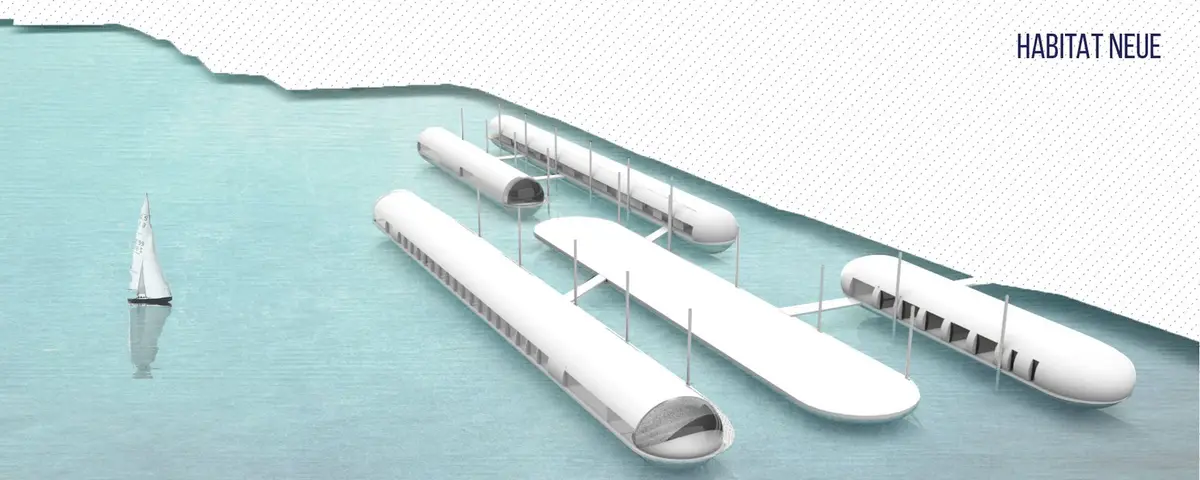
Habitat Neue: A Floating School That Rises with the Floodwaters of Serbia
Pontoon-supported modules, submarine engineering logic, and computational design converge in a climate-adaptive school for flood-prone Obrenovac.


What if a school could float? Not as metaphor, but as structural fact: pontoon-supported modules that lift and settle with the water level, keeping classrooms, galleries, and courtyards operational while the river does what rivers in Obrenovac, Serbia, have always done. Habitat Neue takes the logic of submarine engineering and transplants it into an educational facility, producing a building that treats flooding not as catastrophe but as a baseline design parameter.
Designed by Anja Ljubičić and shortlisted in the Bauhaus Neue competition, the project reimagines architectural education itself alongside the building that houses it. The proposal packages three interconnected courses into a pedagogical framework that spans climate-responsive design, regenerative material science, and AI-driven computational simulation. The school is both curriculum and case study: students learn to design for environmental resilience inside a structure that performs it.
Three Piers Reaching into the Water
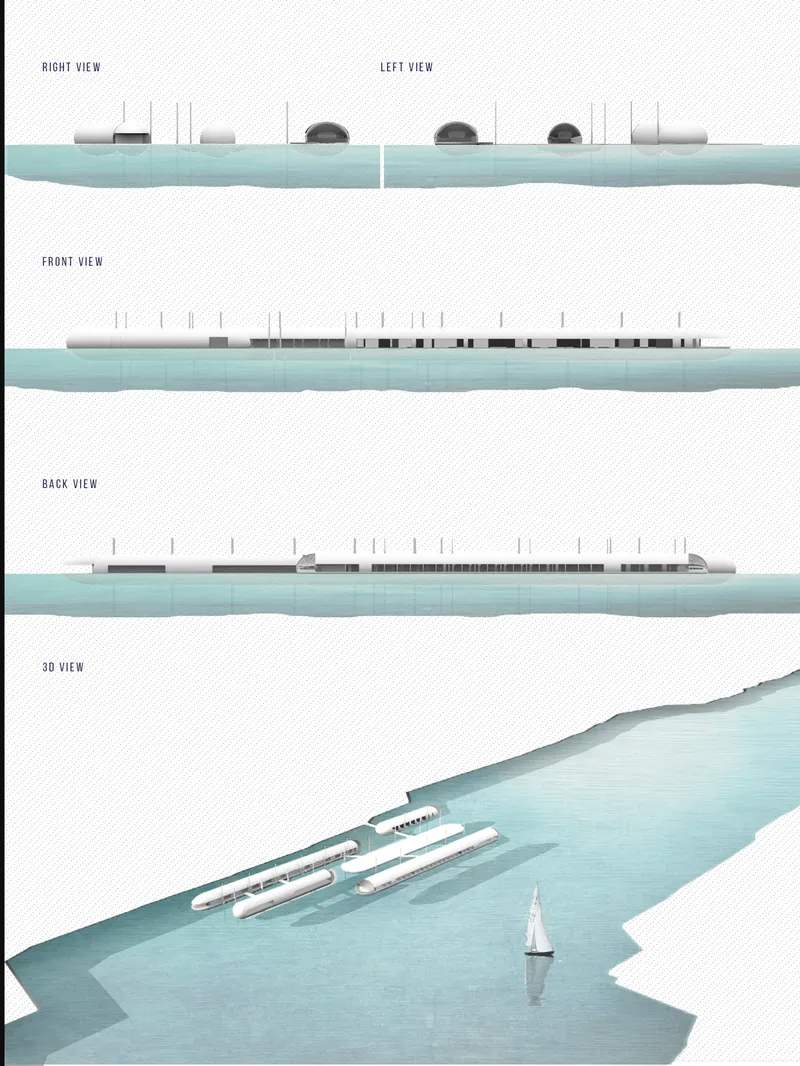
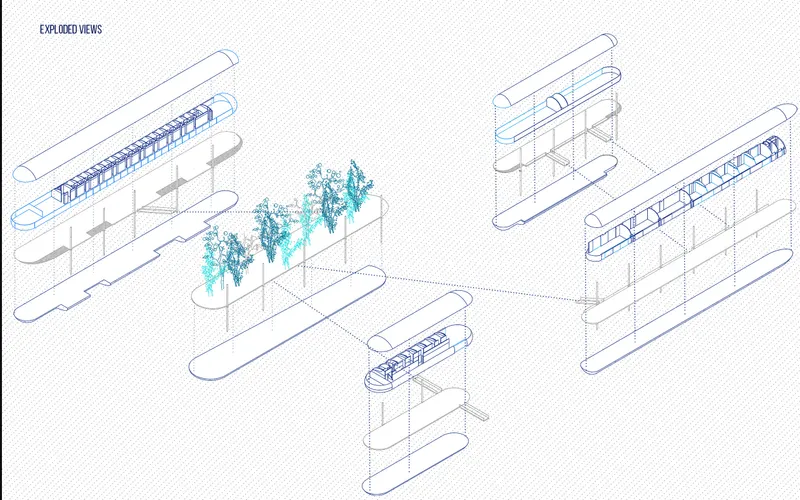
The elevation drawings and axonometric views reveal the project's primary spatial move: three parallel linear structures extending directly into the water, each carried by truss systems and pontoon supports. The forms are not rigid boxes planted on pilings but curved, almost biological pier structures that accommodate multilevel platforms, planted terraces, and open-air gathering spaces. A sailboat drifts calmly beside them in the elevation, quietly underscoring the scale and the aquatic reality of the site.
The axonometric drawing makes the structural ambition clearer. Trees grow on elevated decks. Truss frameworks give the modules their long-span capability without relying on heavy foundations sunk into unstable floodplain soil. The architecture reads as infrastructure first, building second, which is exactly the right priority for a site where the ground is not guaranteed.
Designing Against the Wave

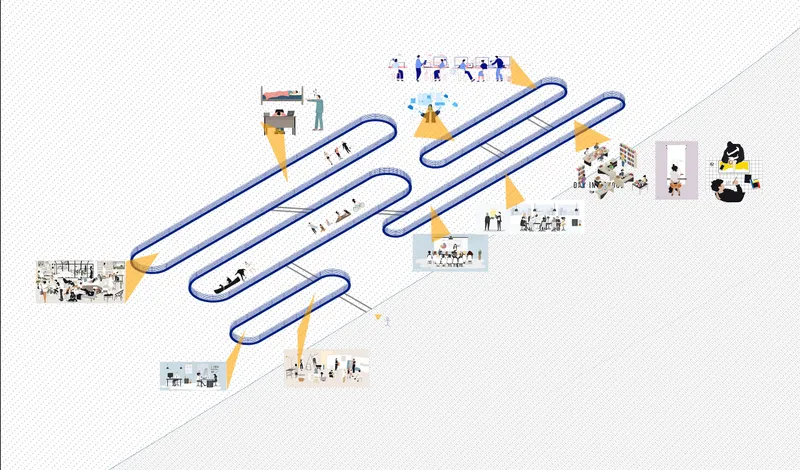
A striking circular illustration places high-rise towers behind a massive stylized wave, compressing the project's entire argument into a single graphic: conventional urban development stands exposed and passive before climate forces. Habitat Neue's response is the serpentine plan visible in the isometric diagram alongside it. Three sinuous corridors weave through the site, connected at yellow nodes that function as programmatic hubs. Human figures occupy these spaces at various scales, inhabiting classrooms, workshops, and social zones distributed along the winding paths.
The serpentine geometry is not decorative. It increases the linear footage of waterfront engagement, distributes structural loads more evenly across pontoon systems, and creates sheltered microclimates between the curves. Each corridor becomes a distinct programmatic zone while the connection points maintain porosity, allowing students and faculty to circulate freely across the three-course pedagogical framework that organizes the school.
Waterside Atmospheres and Interior Thresholds
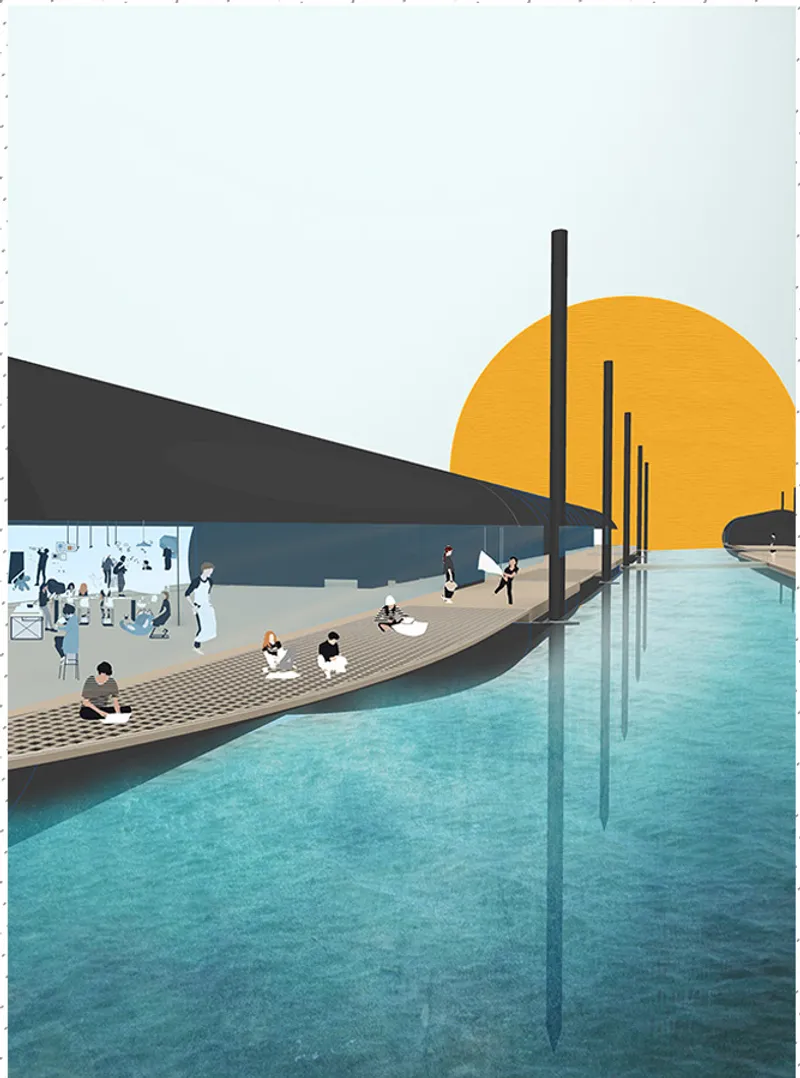
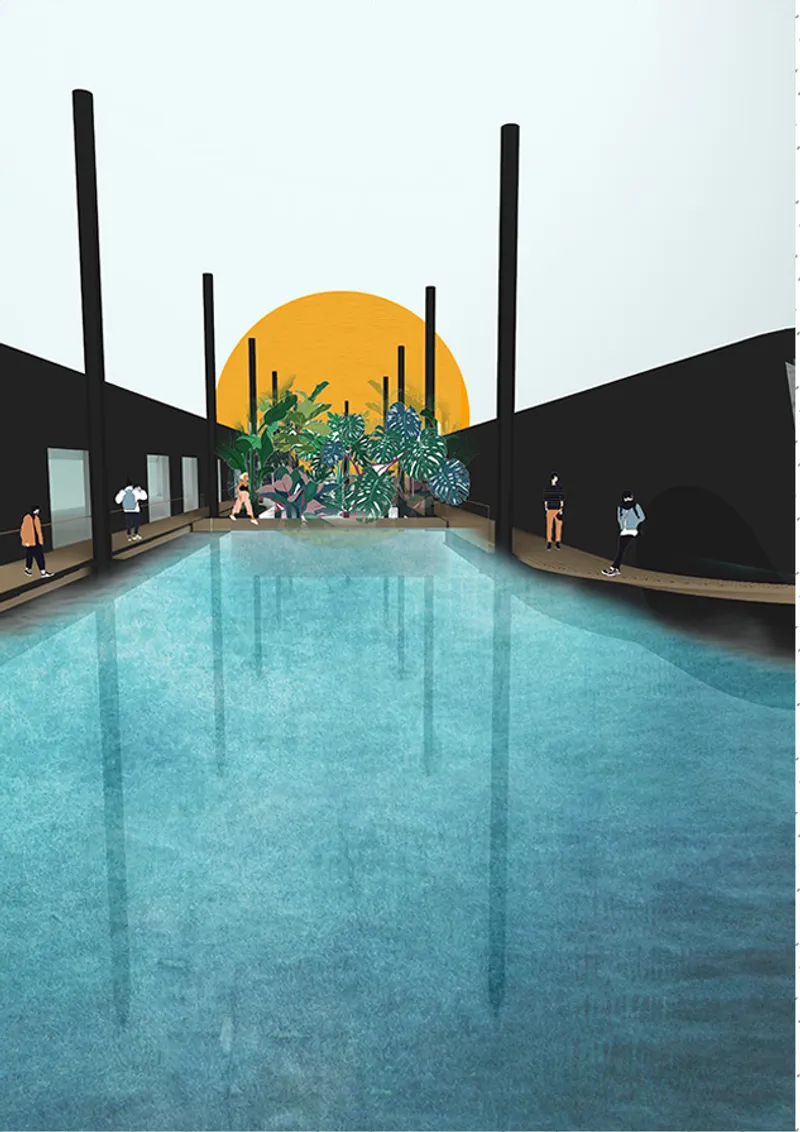
The rendered boardwalk scene captures the experiential payoff of all that structural engineering. Vertical black posts rhythm the walkway while figures lounge beside a reflecting pool at sunset, the water surface doubling the warm light. It is a civic space that happens to be afloat. The material palette is restrained: dark structural elements, timber decking, and water doing most of the atmospheric work.
The interior pool view pushes the water relationship further inward. Tall columns rise between black walls, framing a planted courtyard beneath an orange sun. Water is not just around the building; it occupies its center, collapsing the boundary between landscape and architecture. The effect is meditative, but it also serves a pedagogical function: students studying regenerative design and ecological systems are literally immersed in their subject matter.
Framing the Edge: Section and Site
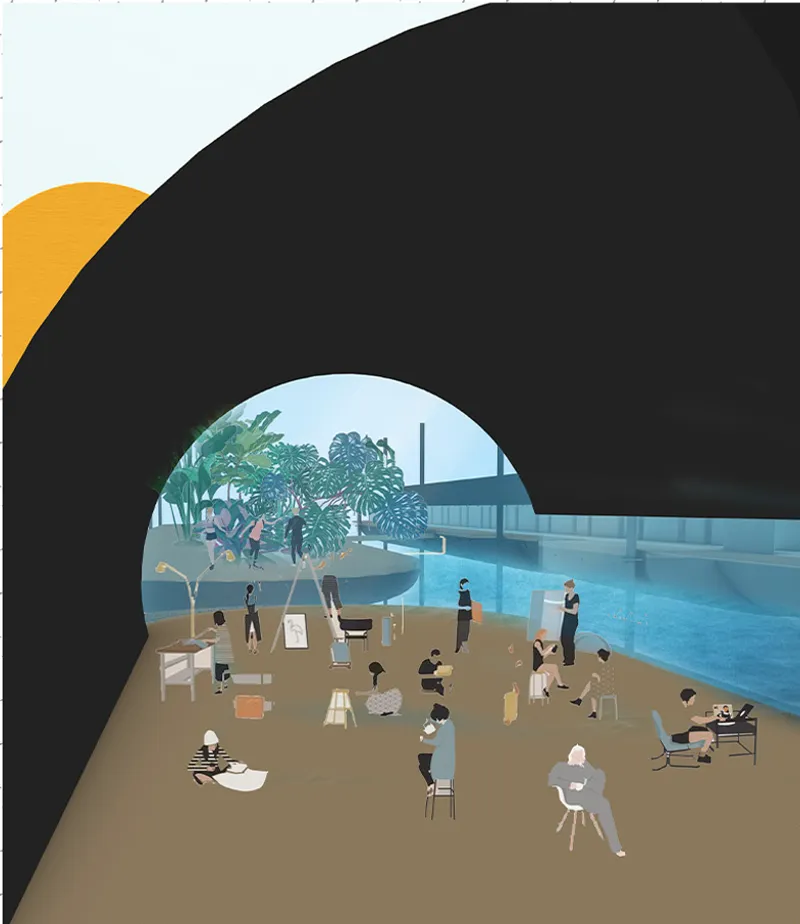
The section drawing reveals a curved portal that frames a gallery space at the water's edge, with visitors moving between planted areas and exhibition zones. The architecture operates as a series of thresholds: land to water, interior to exterior, education to public engagement. The curve of the portal echoes the serpentine plan geometry, maintaining formal coherence across scales.
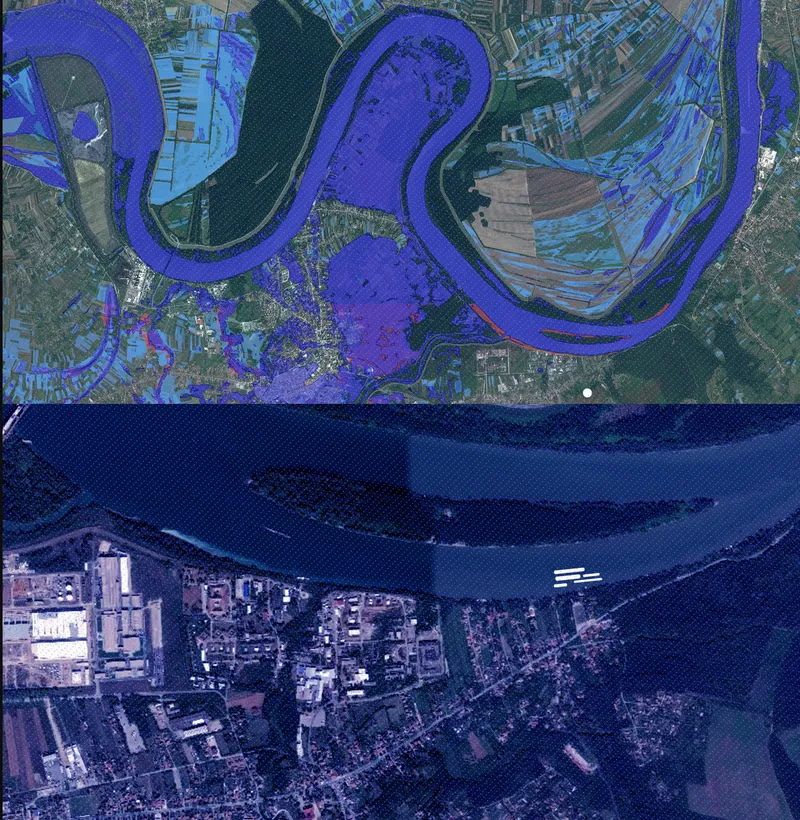
The aerial site plan situates the project within Obrenovac's broader waterfront, overlaying a three-lobed diagram that maps development zones. The diagram communicates scalability: while Habitat Neue is designed for one flood-prone Serbian town, its modular, pontoon-based logic could be deployed along vulnerable waterfronts worldwide. The site plan is as much a policy argument as it is a drawing.
Why This Project Matters
Habitat Neue refuses the usual split between speculative thesis project and buildable proposal. The floating infrastructure is grounded in real engineering precedent, the site is a real place with a documented flood history, and the pedagogical program addresses real gaps in how architecture schools teach climate adaptation. By housing the curriculum inside the case study, Ljubičić creates a feedback loop: the building teaches, and teaching improves the building.
At a moment when resilience is invoked constantly but delivered rarely, this project offers something concrete. Pontoons, trusses, serpentine corridors, and computational simulation tools are not futuristic fantasies; they are available technologies waiting for architectural imagination to assemble them. Habitat Neue provides that assembly, and in doing so, it argues that the most radical thing a school can do is take its own site conditions seriously.
View the Full Project
About the Designers
Designer: Anja Ljubičić
Enter a Design Competition on uni.xyz
uni.xyz runs architecture and design competitions year-round that reward proposals with spatial conviction and real site intelligence.
Project credits: Habitat Neue by Anja Ljubičić Bauhaus Neue (uni.xyz).


Popular Articles
Popular articles from the community


Little Red Riding Hood: Architectural Design as a Journey Through Fear, Light, and Storytelling
Little Red Riding Hood reimagines the fairy tale through architectural design shaped by fear, light, scale, memory, uncertainty, and choice.

Hill & Cross Opera: Sculptural Opera House Architecture Shaped by Tallinn’s Landscape and Identity
Hill & Cross Opera reimagines opera house architecture in Tallinn through its sculptural hill, civic plaza, glass wave and a luminous cross.

Co-Life: Senior Housing Design That Reconnects Older Adults With the City
Co-Life reimagines senior housing design through healing gardens, shared streets, workshops, and a sustainable community across generations.

Co-life: Sustainable Architecture for Age-Friendly Community Living
Co-life reimagines sustainable architecture for seniors through courtyards, rammed earth, shared gardens, and spaces designed for belonging.

Similar Reads
You might also enjoy these articles

Day and Night Park: A Time-Based Urban Newsstand in Beijing
A temporary urban newsstand in Beijing blending travel, light, and reading through poetic colors, compact form, and community-focused design.

Modernist Patio Renovation in El Masnou, Barcelona by Oliver Segura Arquitectura + Cebrià Arquitectura
Modernist patio renovation blending tradition and innovation with a movable pool, leveled floors, and Catalan materials in El Masnou.

Alto Residencial Coop: Cooperative Housing Development in Santiago de Compostela by Carbajo Barrios Arquitectos
A linear cooperative housing complex blending white volumes and perforated metal façades, enhancing community living, natural light, privacy, and urban integration.
Vil Genis School by BPA ARCHITECTURE – Massy, France
Vil Genis School in Massy, France, features sustainable design, south-facing classrooms, community integration, accessible spaces, and modern educational architecture.

Explore Sustainable Urbanism Competitions
Discover active competitions in this discipline

Challenge to design public laboratory

Challenge to reimagine the Iron Throne

Photograph architecture without architects

Illustrate the lost glory of Angkor Wat - Render Challenge
Comments (0)
Please login or sign up to add comments
No comments yet. Be the first to comment!