

SPNG Architects and NTA-Architecture Float a Triangular Coffee Pavilion Over Koi Ponds in Vietnam
La Do Coffee in Bao Loc channels the spatial rhythms of Hue's royal palaces through water, stone, and steel on a highland hillside.


On the outskirts of Bao Loc City in Vietnam's Central Highlands, a coffee shop doubles as a threshold between a public street and a private resort. La Do Coffee, designed by SPNG Architects and NTA-Architecture, occupies a 2,300 square meter plot facing Spung Mountain, the most prominent peak in the region. The project is part of the larger La Do Homestay complex, which includes six bungalow units tucked into the slope behind it. Rather than treating the café as a simple amenity, the architects elevated it into the spatial and symbolic anchor of the entire compound.
What makes La Do Coffee worth studying is the precision of its central idea: a single equilateral triangle, rendered in I-beams and glass, hovering over a network of reflecting ponds stocked with koi. The geometry is formal and deliberate, yet the experience is anything but rigid. Drawing on the alternating sequence of open and enclosed spaces found in the ancient royal palaces of Hue, the design orchestrates a journey from street to garden that keeps shifting between exposure and shelter, solid and void, built mass and living water.
A Triangle That Earns Its Shape
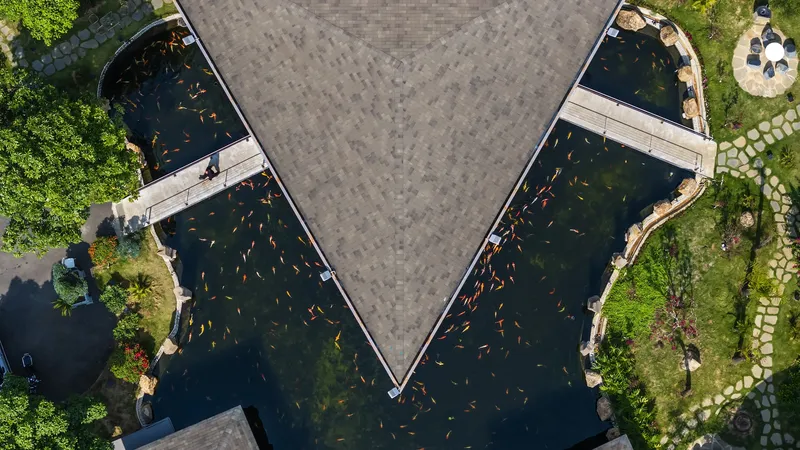
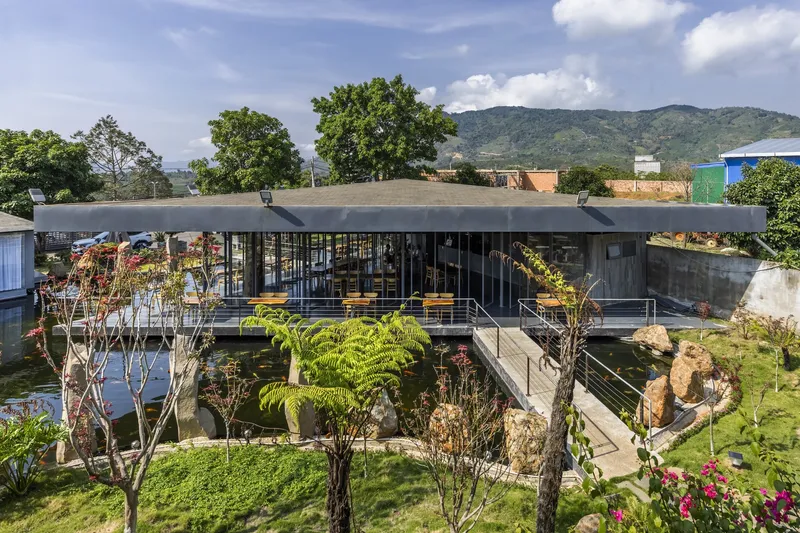
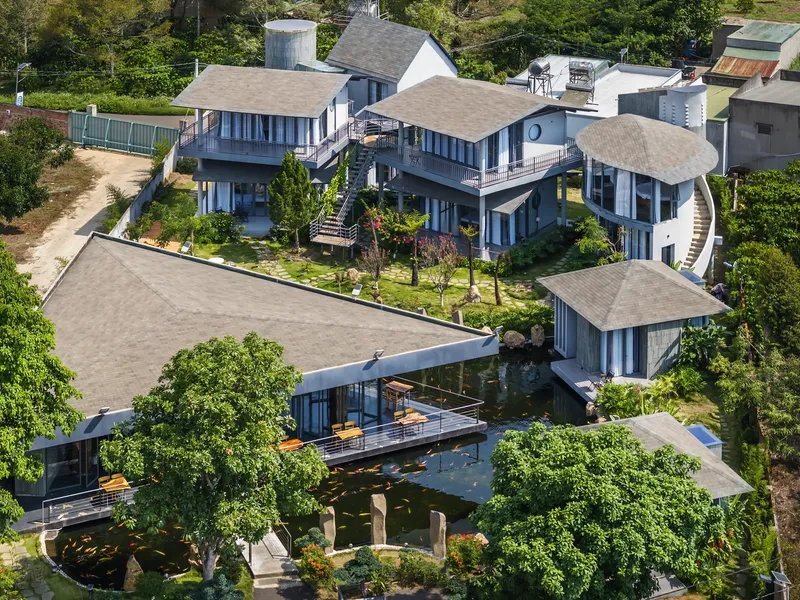
Equilateral triangles show up in architecture often enough, but they rarely justify themselves beyond formal novelty. Here the shape does real work. The triangular floor plan allows the pavilion to address three conditions simultaneously: the street frontage, the pond at its base, and the bungalows behind. Each vertex points toward something specific, and each edge mediates between inside and outside with floor-to-ceiling glazing that dissolves the wall plane entirely.
Seen from above, the geometry reads clearly against the organic planting and the sinuous edges of the surrounding water. The contrast is the point. Where the pond curves and softens, the building insists on a classical rigidity that gives the whole composition its tension. The flat concrete roof, supported by three massive stone columns arranged as a sculptural tripod, keeps the profile low enough to avoid competing with the mountain view beyond.
Water as Infrastructure
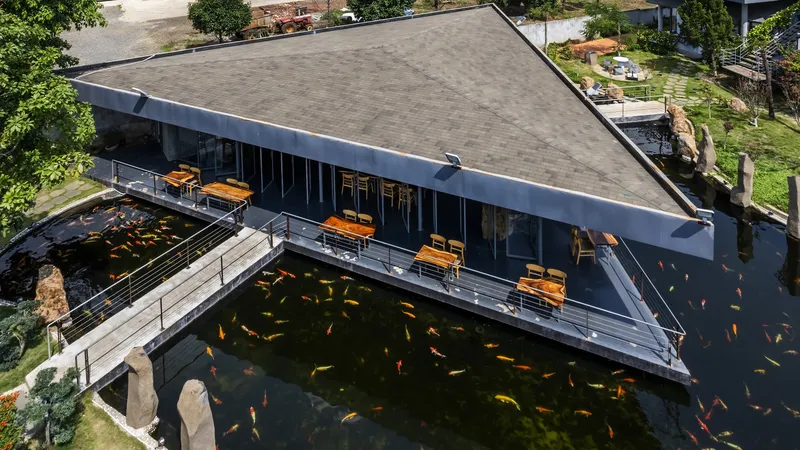
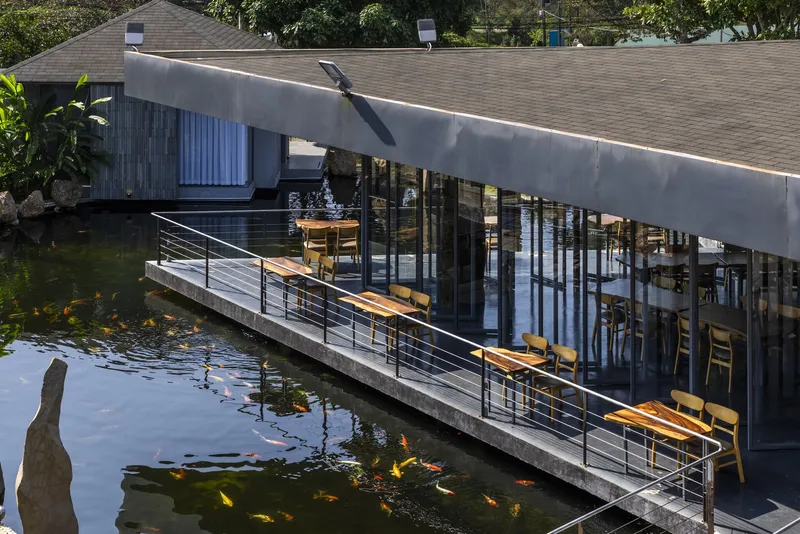
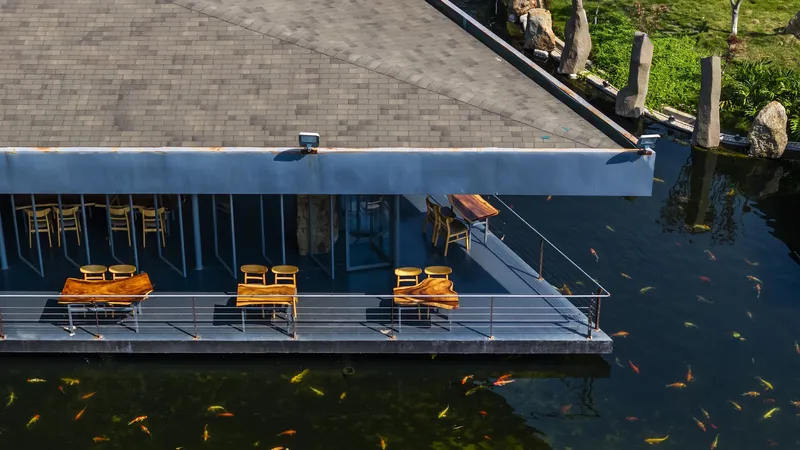
The central pond is not decorative. It regulates humidity and temperature across the site, functioning as a passive cooling device that improves the microclimate for the glass-walled pavilion it surrounds. The koi swimming beneath cantilevered terraces add biological life to what is essentially a piece of environmental engineering. Stepping stones thread through and around the water, forcing visitors to slow their pace and engage with the surface underfoot.
Reflections are integral to the spatial experience. At dusk, the illuminated pavilion doubles itself in the still water, and the coffered ceiling grid appears to extend infinitely downward. The architects clearly understood that in a highland climate with mild temperatures and soft light, water becomes a mirror before it becomes anything else, and they designed for that condition.
Structure as Expression
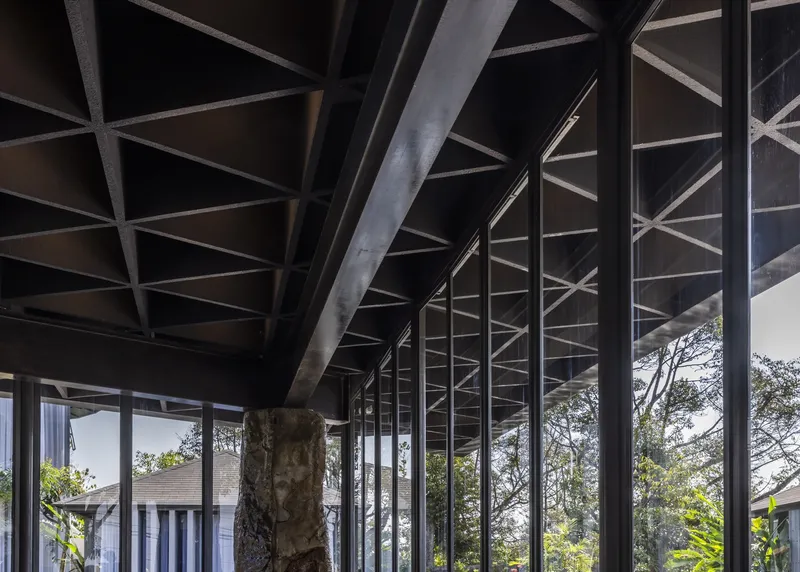
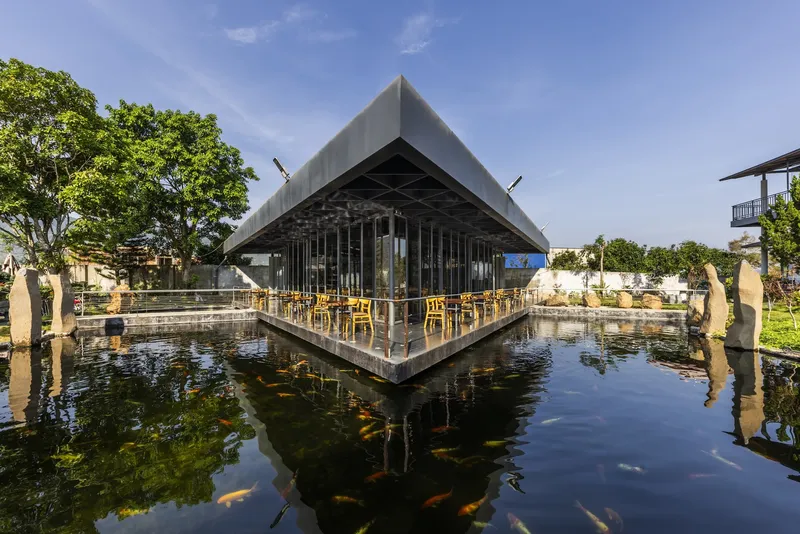
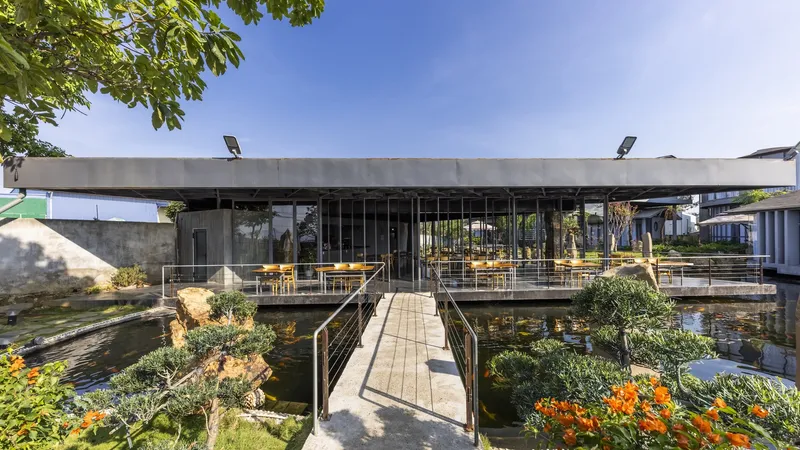
The I-beam structural system is left exposed and unpainted, its dark steel tone matching the locally sourced stone columns that carry the loads to the ground. The coffered ceiling created by this grid is one of the most striking elements of the project: a triangulated lattice of beams that transforms the underside of the roof into a deep, rhythmic pattern. A preserved tree trunk column punctuates the interior, a blunt reminder of the site's former condition that refuses to be polite about its presence.
Round steel columns lift the roof at the terrace edges, their slenderness a deliberate counterpoint to the bulk of the stone piers inside. The structural hierarchy is legible even from a distance: stone bears the primary loads, steel extends the canopy outward, and glass fills the gaps between. Nothing is hidden, and nothing needs to be.
Inside the Glass Box
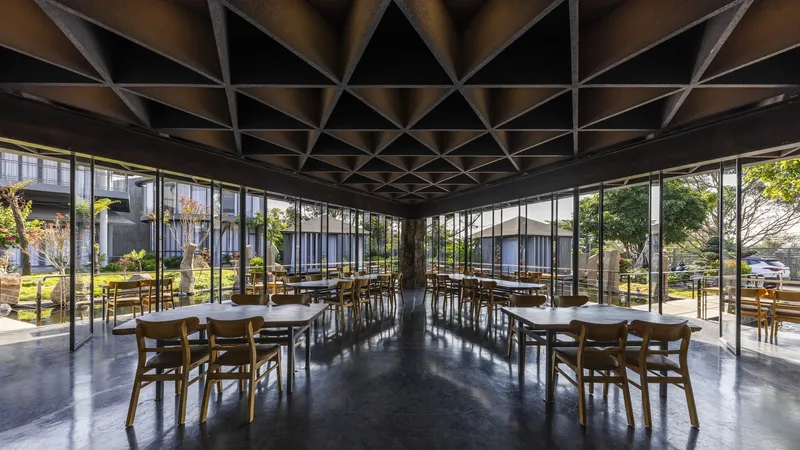
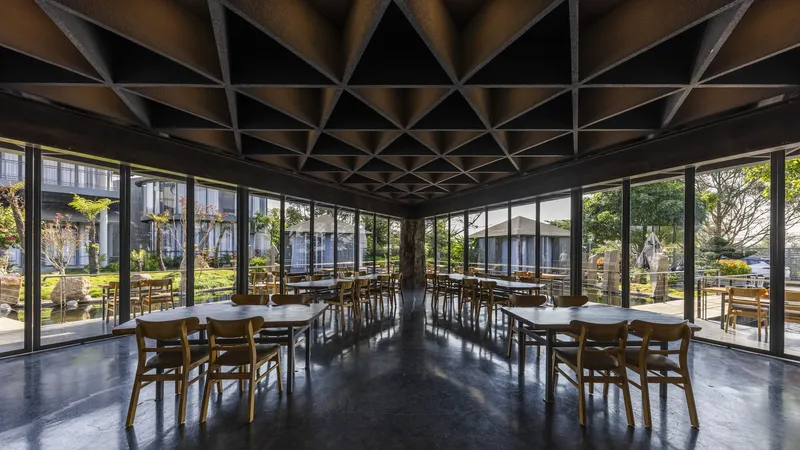
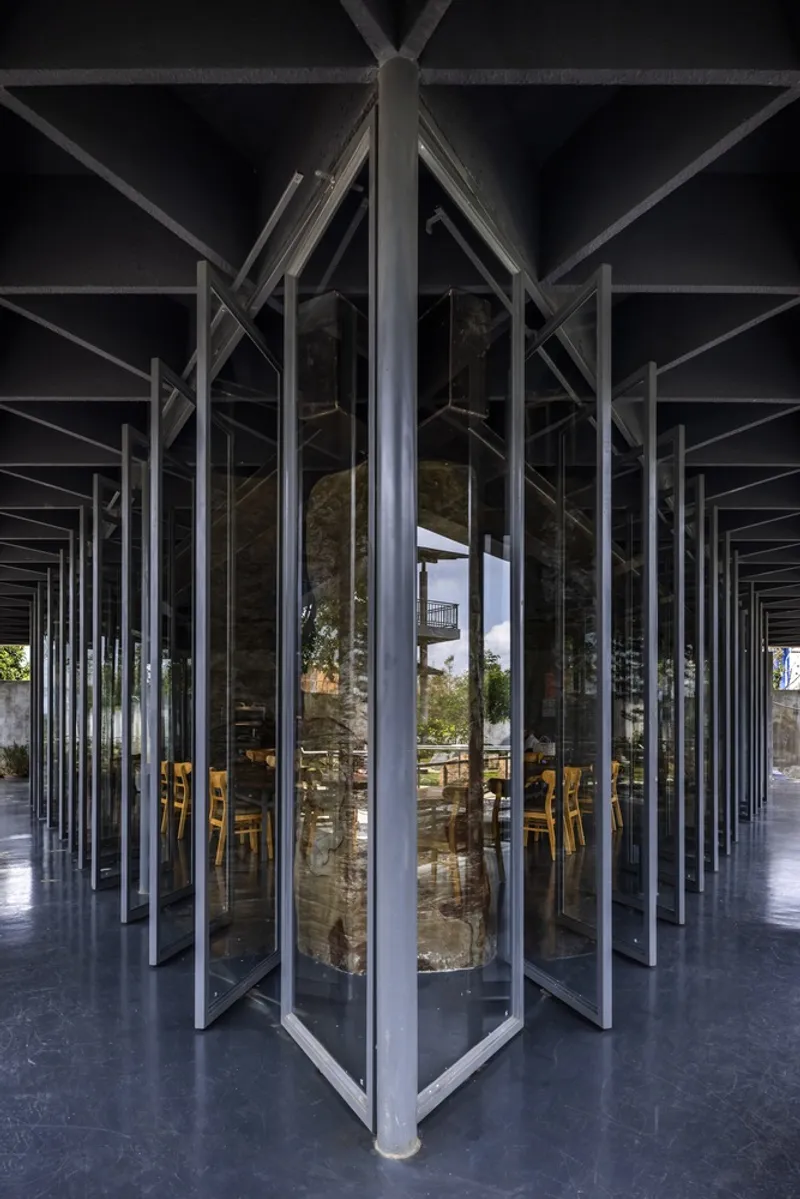
The interior dining space sits within a glass envelope so transparent that the room reads as a covered outdoor terrace rather than an enclosed room. Pivoting glass doors with vertical steel mullions allow the walls to open completely, collapsing any remaining distinction between inside and out. The coffered ceiling overhead provides a sense of shelter and architectural weight that the walls deliberately refuse to offer.
Furniture is kept simple and low, yielding the sightlines to the garden and pond beyond. The material palette stays consistently dark: steel, stone, polished concrete. There is no attempt at warmth through color; the warmth comes from the landscape pressing in on every side.
The Terrace as Mediator
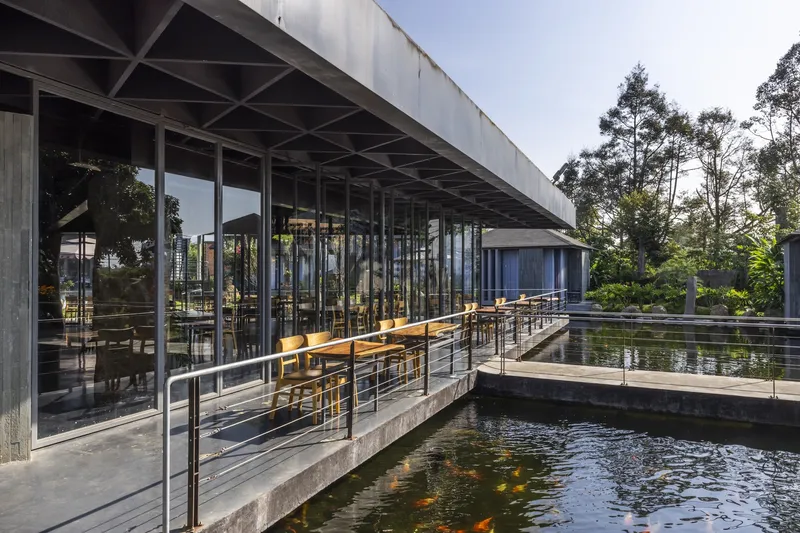

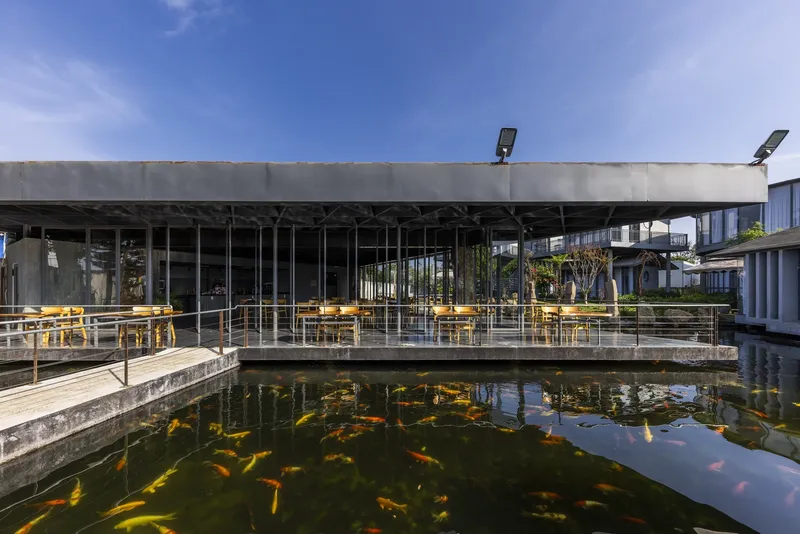
A series of covered terraces extend outward from the main pavilion, creating intermediate zones between the conditioned interior and the open landscape. Concrete slab roofs carried on slim steel columns shade these areas without enclosing them. Timber decks bridge over the water, connecting the pavilion to planted islands and the garden paths beyond. The sequence is deliberate: from street, through a covered threshold, past water, into the glass pavilion, and out again to the bungalows on the slope.
This is where the Hue reference becomes tangible. The royal palaces of the former imperial capital choreograph movement through alternating courtyards and halls, compressing and releasing space in a measured rhythm. La Do Coffee adapts that principle at a domestic scale, using the pond as a decompression chamber between the public front and the private rear of the site.
Twilight and the Double Image
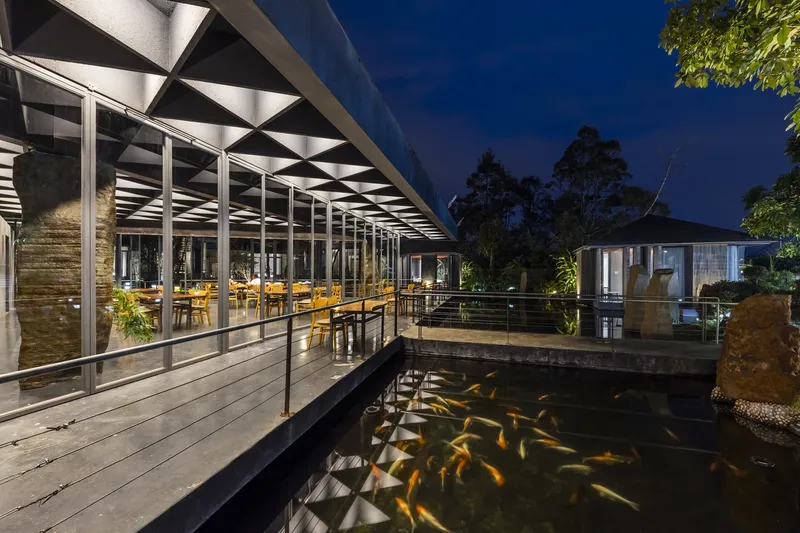
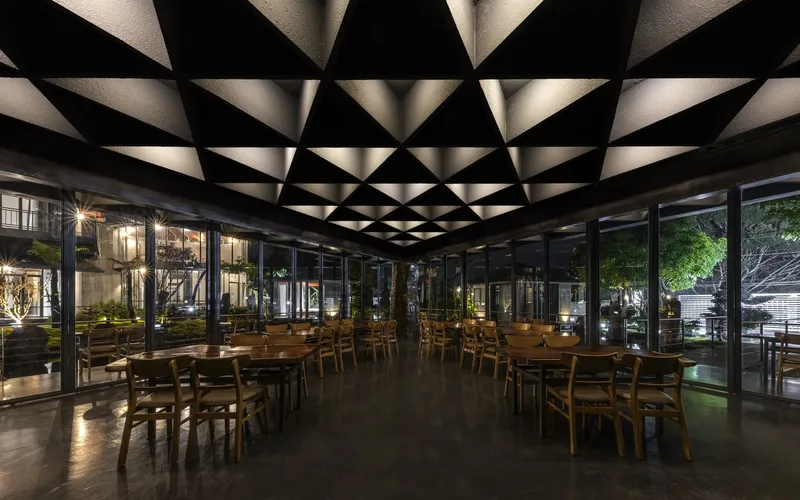
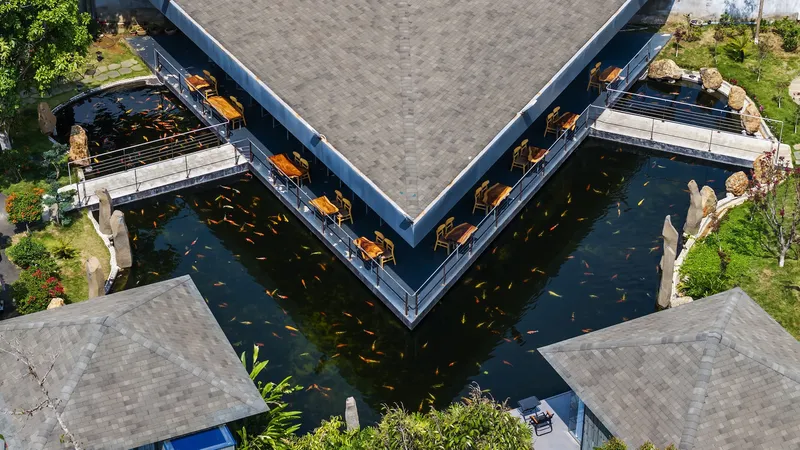
The project reveals a second life at dusk. When interior lighting activates the coffered ceiling and the glass walls become screens of warm light, the koi ponds catch and multiply the geometry below. The V-shaped cantilevered terrace, visible in plan from above, becomes a luminous figure floating on dark water. Yellow furniture, nearly invisible during the day, suddenly punctuates the composition with deliberate spots of color.
Photographed by Hiroyuki Oki, these twilight images make a strong case for the building as a piece of landscape infrastructure as much as architecture. The pavilion does not dominate its setting; it amplifies it, using light and reflection to extend the perceived space far beyond the actual footprint.
Why This Project Matters
Bao Loc is in the middle of a tourism boom driven by its cool climate and highland scenery, and the temptation to build flashy resort architecture is strong. La Do Coffee resists that impulse with a project grounded in local materials, passive climate strategy, and spatial ideas borrowed from Vietnam's own architectural heritage rather than imported trends. The central pond, the stone columns, the unpainted steel: none of these elements are expensive or exotic, yet together they produce an environment of genuine calm.
SPNG Architects and NTA-Architecture demonstrate here that a small commercial program, a café within a homestay resort, can carry serious architectural ambition without overreaching. The equilateral triangle is a strong formal gesture, but it is disciplined by its relationship to the water, the mountain view, and the sequential logic of the site plan. The result is a building that earns its geometry rather than wearing it as a costume.
La Do Coffee, by SPNG Architects and NTA-Architecture. Bao Loc City, Vietnam. 2,300 m² site. Completed 2023. Photography by Hiroyuki Oki.
About the Studio
Share Your Own Work on uni.xyz
If projects like this are the kind of work you want to make, uni.xyz is a place to publish your own, find collaborators, and enter design competitions.



Popular Articles
Popular articles from the community


The Earth Pod: 3D Printed Homes for Resilient Refugee Communities
The Earth Pod reimagines refugee housing through 3D printed homes made from clay, combining resilience, self-sufficiency, and rapid shelter.

Conexión: Biophilic Design Reimagines High-Rise Living in Hong Kong
Conexión reimagines high-rise living in Hong Kong through biophilic design, green facades, shared spaces, daylight, water and nature within.

The Ocean Hive: Sustainable Architecture for a Self-Sufficient Civilization at Sea
The Ocean Hive imagines sustainable architecture at sea, where modular habitats, algae, wave power and ocean waste sustain a growing colony.

Co-Life: Senior Housing Design That Reconnects Older Adults With the City
Co-Life reimagines senior housing design through healing gardens, shared streets, workshops, and a sustainable community across generations.


Similar Reads
You might also enjoy these articles


Hodi-Mandai Geram
Project Function: Preservation and revitalization of the Intangible heritage and socio-spatial identity of the Hodi by Housing, Cultural Memory Center, Sacred Grove, landscape, local tourism economy


Olio Towers: A Mid-Rise for Performers That Fuses Housing, Rehearsal, and Stage
Located blocks from Houston's Theater District, this modular tower stacks living units around a central performance atrium.

Oasis: Modular Green Housing Carved into Dhaka's Urban Fabric
A shortlisted Plugin Housing entry reclaims unauthorized settlements in Dhaka with stepped concrete volumes, green roofs, and ventilation-driven design.

Black Hole: A Floating Megastructure for the Post-Physical Era
Emiliano Mazzarotto envisions a spherical, self-scaling arena where e-sports, digital hotels, and holographic stadiums replace traditional public space.


Explore Architecture Competitions
Discover active competitions in this discipline



Challenge to reimagine the Iron Throne


Photograph architecture without architects


Illustrate the lost glory of Angkor Wat - Render Challenge


Design challenge to reuse E-waste
Comments (0)
Please login or sign up to add comments
No comments yet. Be the first to comment!