

Arts & Crafts Cayastá: Brick Ateliers Distributed as Civic Infrastructure Across an Argentine Town
A graduation thesis that scatters modular brick workshops across northern, central and southern Cayastá, turning plazas into open-air classrooms.


Small towns rarely get new educational buildings, and when they do, the instinct is to build one: a single institution, a single address, a single front door that half the population will never walk through. Arts & Crafts Cayastá refuses that logic. Instead of one monument, it proposes a network of brick ateliers spread across the town, each one opening onto a plaza so that learning a craft becomes as ordinary and visible as crossing the square. The result reads less like a school and more like social infrastructure, built at the scale of the neighbourhood.
Developed as a graduation thesis by Ayrton Caradec, Joel Sangoy, Ana Magdalena Molina and Ramiro Rubén Isaurralde Raitzin, the project is set in Cayastá, a settlement of roughly 4,450 inhabitants in the coastal corridor of Santa Fe Province, Argentina. The town has a strong communal identity but little structured space for non-formal education. The designers respond with a transdisciplinary method that ties pedagogy, territory and built form together, identifying northern, central and southern sites where public arts and crafts workshops can anchor everyday civic life.
A Chimney, a Fountain and Stepped Seats: The Plaza as Front Door
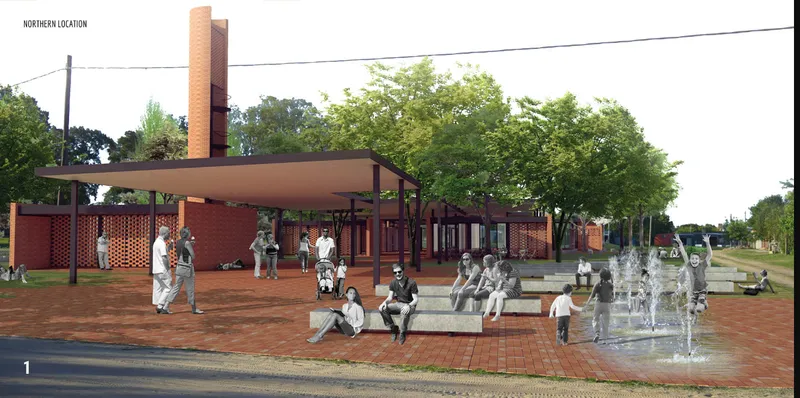
The opening rendering sets the tone. A flat-roofed brick pavilion sits low against the sky, punctuated by a tall chimney that works as a landmark in a town without many vertical markers. In front, stepped concrete seating descends toward a splashing fountain. There is no fence, no forecourt, no threshold to negotiate; the plaza simply flows into the building. This is the project's central argument made spatial: the workshop is an extension of public space rather than a destination hidden behind it.
The stepped seating matters more than it first appears. It can host an audience for a demonstration, a gathering after class or nothing at all, which is exactly the point. The designers describe open courtyards, shaded platforms and water features as triggers for spontaneous gatherings and informal workshops, and here the elements are arranged so that informal use is the default condition rather than a programmed event.
The Longitudinal Spine: A Covered Street Between Perforated Brick

The plan is organised through repeatable modules strung along a longitudinal circulation spine, and this view shows what that spine feels like at eye level. A paved brick walkway runs beneath a flat canopy, flanked by perforated brick walls. Families pass through while a reader sits along the edge. The corridor behaves like a covered street, a place to linger as much as a route between rooms.
The modular logic gives the scheme its long-term credibility: modules can be added as community needs grow, so the building can start modest and expand without losing coherence. The perforated masonry also reads as part of the climate-sensitive strategy the designers describe, which aims to reduce dependency on mechanical systems. Filtering light and air through the brick itself is a quiet, low-cost way to temper the spaces while keeping the corridor visually connected to its surroundings.
Double-Height Studios and a Vaulted Kitchen: Rooms Built for Shared Production


Inside, the ateliers favour flexibility over specialisation. The double-height studio carries an exposed brick wall and holds an improbable mix of activity at once: tango dancers, guitarists, an easel and an aerialist suspended on a hoop. The rendering is ambitious, but it makes a fair point about volume. A tall, open room can absorb music, movement and visual art without needing a dedicated space for each discipline, which is exactly what a town of a few thousand people requires.
The communal kitchen pushes the material language further. A brick vaulted ceiling spans long counters where cooks work side by side, and a glazed wall opens the room to the garden. The designers specify industrial-grade kitchens alongside large communal worktables, craft stations and open shelving, all oriented toward hands-on production. The tactile quality of exposed brick masonry, chosen for its durability, low maintenance and local identity, reinforces the artisanal character of the programme; the building looks made by hand because it teaches making by hand.
Painted Letters Under a Flowering Tree: Identity at the Neighbourhood Scale

The final rendering frames a brick pavilion from beneath a flowering purple tree, its walls covered in large painted letters while people rest on cube seats in the shade. The graphics turn the building into a signboard for itself, announcing its public purpose without a formal entrance canopy or institutional plaque. The tree clusters integrated into the site plan do similar work, offering shade and a reason to stay outdoors.
This image also captures the territorial strategy. Because the ateliers are distributed across northern, central and southern Cayastá rather than concentrated in one structure, each node can take on the character of its own neighbourhood. Educational opportunity becomes embedded in daily routes, a few blocks from home, which is a far stronger guarantee of access than any single well-equipped building on the edge of town.
Why This Project Matters
Arts & Crafts Cayastá makes a convincing case that sustainability in small communities is as much about distribution as it is about materials. The brick masonry, the modular spine and the passive climate approach are sensible choices, but the more radical move is urban: splitting the programme into accessible nodes and letting each one double as a plaza. It treats craft education as civic infrastructure, comparable to a square or a market, rather than a specialised service.
For a graduation thesis, the project shows unusual discipline in matching architectural language to social intent. Nothing here depends on spectacle; the chimney, the vault and the painted walls are modest gestures that give each atelier presence without separating it from the street. If more small towns approached public buildings this way, starting from how people already gather and building outward in repeatable modules, the gap between architecture and community life would be considerably narrower.
View the Full Project
About the Designers
Designers: Ayrton Caradec, Joel Sangoy, Ana Magdalena Molina, Ramiro Rubén Isaurralde Raitzin
Enter a Design Competition on uni.xyz
uni.xyz runs architecture and design competitions year-round that reward proposals with spatial conviction and real site intelligence.
Project credits: Arts & Crafts Cayastá by Ayrton Caradec, Joel Sangoy, Ana Magdalena Molina, Ramiro Rubén Isaurralde Raitzin.


Popular Articles
Popular articles from the community

Opera on the Sea: Driftwood Logic Shapes a Timber Opera House on Estonia's Coast
Trevor Orgill's opera house translates the entangled drift of floating timber into a civic building where wood, water, and music converge.

Aquadapt: An Underwater Habitat That Rewrites Its Rooms by the Hour
Curved modules ring the seabed while one shell shifts from breakfast room to cinema, farm and football pitch as residents' needs change.


FCC Arquitectura Expands a Portuguese Granite House with a Board-Marked Concrete Wing
In Portugal, JV House pairs a cleaned-up whitewashed and granite dwelling with a timber-shuttered concrete extension, courtyards and a garden pool.

Cube Design Draws an Ecological Corridor Between Two Shenzhen Hills with the Nankai Building
Beside Shenzhen's container docks, the Nankai Building pairs stacked balconies with a climbing green screen to connect two hillsides across its height.

Similar Reads
You might also enjoy these articles
Healing Façade: A Modular Chapel System That Restores Ethiopia's Sacred Forests
Winner of the Eco-Chapel competition, this circular timber façade collects water from air to rebuild soil and reforest degraded Ethiopian landscapes.
Kaffeebühnen: Where Coffee Shop Architecture Becomes a Civic Stage in Vienna
A linear sequence of timber boxes, transparent shells, and open yards turns the Viennese café tradition into a public performance space.
Eco Chapel: A Modular Forest Pavilion That Grows Like the Landscape It Protects
Hexagonal timber modules weave through existing trees, turning a chapel into a living system for prayer, education, and reforestation.


Urban Forest: A Vertical Ecosystem for 5,000 Workers in Singapore's Changi Business Park
Radially stacked pods and layered green decks turn a 7-acre plot into 47 acres of ecological workspace projected for 2040.

Explore Educational Building Competitions
Discover active competitions in this discipline

Challenge to design public laboratory

Challenge to reimagine the Iron Throne

Photograph architecture without architects

Illustrate the lost glory of Angkor Wat - Render Challenge
Comments (0)
Please login or sign up to add comments
No comments yet. Be the first to comment!