
SUSTAINABLE CONGLOMERATION
RESIDENTIAL HOUSING AT UCLA

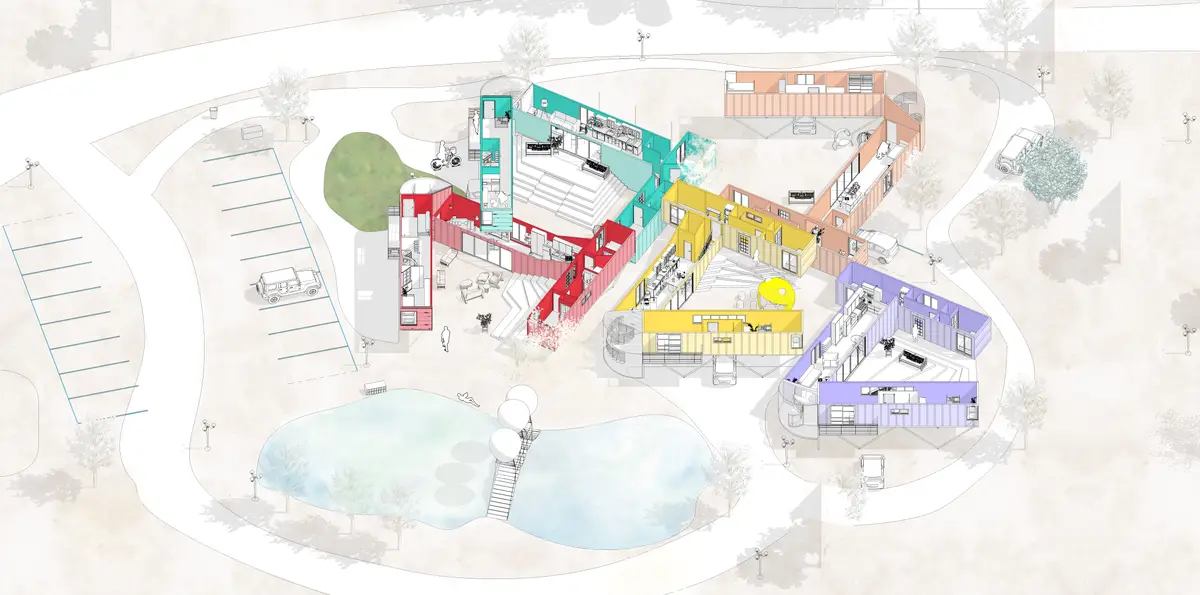
THE CONTAINER PROJECT explores the concept of sustainable design combined with the advantages of modular containers for housing units on University of Los Angeles’ existing housing property. While there are some concerns about using shipping containers for residency such as the durability of shipping containers and the practicality given how much insulation will be needed due to the makeup of the containers as well as the results of chemical residue, the request and interest in shipping containers as livable spaces has increased. That is partly due to access and ease to move around, but more so how quickly such containers can be made at the fraction of the cost of a regular track home. In addition, it is believed that making shipping containers out of reusable and recycled materials is one of the best and easiest solutions towards solving climate change.
The project aims to use recycled materials repurposed for student housing which will sit across from existing housing units, surrounded by plenty of trees and a pleasant environment. Shipping containers are perfect for the area of Los Angeles, California. Due to the location of campus being conveniently close to the ocean, it will be easy to maneuver the containers to the housing grounds. The preparation and travel can all be done within a 35 mile radius cutting down on transportation cost, time, and the amount of pollution that comes with getting shipping containers to meet the right requirements for living conditions. The area is in a nice location, and situated in the heart of campus - prospective students will look at the location and realize how close they are to any of the amenities they will immediately need.
The primary component will be fifteen 8 feet by 40 feet shipping containers. In recent years, the demand and desire for shipping container houses has risen, primarily because of the cost efficiency and is the perfect candidate for building student housing which functions adequately for the space that a university student would need. Even though the project brief emphasizes and calls for modularity, the desire of the finished design was not to keep the modules 90 degrees at all times and on the same plane. That is to say, the goal was not to create a linear or rectangular project. Rather, the goal was to use modular elements in a way that produced open courtyards, access to parking and an interest in elevation. The element of the curve was added as the idea of connecting containers through a pinwheel stair. The stair became the central means of access to the second stories of the housing units. Three individual storage containers would be combined to make one housing cluster, aimed for the students to connect in a more communal way. The courtyards and other exterior elements, down to the material choices were chosen to emphasize a more simplistic time of creating a program that works specifically to student life and their ease. From the location of mailboxes to the shape of the housing clusters which provide ample lighting and outdoor space for students to grow their own plants, as well as loading parking zones under the second story, the project aims to use primary resources and design to fulfill functions of everyday life.
One of the key considerations for the design of these units was to form communal spaces while simultaneously giving occupants privacy within individual rooms, decks and courtyards. A group of 3 students can synchronously enjoy cohabited spaces such as the kitchen, living, bathroom and study areas while independently relishing the privacy of their bedroom space. Each 8’ x 40’ container could be made to aid an individual’s living condition; it is enough room for a small bathroom kitchen and living space and bedroom. Keeping each container as an individual living space for one person does not allow for communal interactions which tends to be an important factor and key element to most university on-campus living. As social creatures, it is important to retain some identity of community thus for this project, the design suggests that each housing cluster could be divided into students with similar majors, time schedules surrounding their course load and like minds. This is only a suggestion because sometimes it is nice to live in a housing community where every person is of a unique background, ethnicity, culture, and major. The pond and the trees surrounding create an environment that feels like a step away from the university feeling. It gives students the chance to clear their mind, move away from daily chores and studying to a more peaceful part of the campus where they can convene with friends.
The process did take some time and several iterations based on our own study of our everyday life. As recent college students, there became this desire to do things in a functional yet innovative way with a modern look. The first iteration was a linear design, with detached module units. This was noted to provide no communal gatherings within the house itself. Thus, the decision became to create clusters of either three or four. To make modular and similar housing clusters, it was decided that five housing clusters of 3 was the best option. However, there was no rotation within any of the clusters nor any difference in heights between the containers. As stated, the idea for a rotation was to design less of a linear project - same with the elevations. There was no elevational interest in the project when all housing clusters were on one level; therefore the containers were offset from each other; with the exception of one housing unit which provides access for those with disabilities.
It is assumed the project can grow to incorporate more ADA accessible housing clusters. There can be a chance to make the project more linear, using the same floor plan but more modular shapes, meaning the containers at 60 degree angles can be at ninety degree angles. This will eliminate the need for extra extension materials to connect the two containers at the acute angle.
Shipping containers, just like many other options created in life, do come with their own share of problems. For instance, shipping containers need to be stacked exactly and once the containers are not stacked exactly on their corners, the structure will need steel reinforcement. The roof is not structural and will need to be replaced and reconsidered if considering stacking the shipping containers because steel reinforcing is very expensive. To use the shipping container’s original roof, one must add some sloped steel stud reinforcements to the roof and a small layer of rigid insulation will be added to help in water runoff. In addition, due to the fact that there are problems with insulation, the HVAC system will be rather vigorous. It is also harder to commit to passive strategies if the design maintains the container aesthetic. There will be lower ceilings as a result. To optimize the use of recycled shipping containers, the containers chosen should be a well-used shipping container; otherwise, a one-trip shipping container made out of mined steel (a nonrenewable resource) that could have served more useful as a means to ship cargo around the world. Shipping containers are especially useful when considering how easy it is to provide a place for the container to sit. The beams, or joists, known as cross members support the shipping container floor.
The materials were chosen to emphasize sustainability and to make a coherent project. Before using a container, one must rip out the pesticide-laced flooring and take measures to cover or encapsulate the toxic paints and dangerous chemicals that germinate within the container. Containers are made of steel shipping containers that when being transformed into residential spaces, have insulation and interior wall and floor finishes added for comfort and looks. The most familiar option for the insulation of these containers is the closed-cell spray polyurethane foam and works well to provide one of the highest R-values per inch and forms a competent vapor retarder. Due to the student housing clusters location within southern California where temperatures are not always as extreme, it seemed fit that Hempcrete could be used instead of a blanket insulation method. Hempcrete is a material similar to concrete but with less strength and works well only in moderate climates such as southern California. The most eco-friendly and natural way to insulate a shipping container residence is to use straw bales to the home’s exterior. Straw bales have R-values up to R-35 and resume the leftover products of grain agriculture. After adding a small stem wall to keep the straw bales free from ground moisture, the builder should plaster the straw bales with cement and lime stucco to further protect the bales from accumulating moisture. Although fiberglass insulation is a more common type of wall insulation in western countries and was taken out of consideration for this project due to its cost and lack of eco-friendly characteristics in comparison to Hempcrete. To help with the insulation, a green/living roof is placed on top of the main spaces of the container and help to block solar radiation in the warm climate is a supplement to traditional forms of insulation. Bamboo flooring is used throughout each of the units. Bamboo flooring is one of the most beneficial floorings for these housing types due to its availability, price, and biodegradability as long as suppliers use lower eco-impact methods when turning bamboo into fabric.
PROGRAM:
Fifteen 40’x8’ shipping containers
Five housing conglomerations (clusters) made of three 40’x8’containers each
Bldg. Footprint area needed: Approx. 9,600 SqFt.
Site Footprint area needed: Approx. 20,000 SqFt.
Site footprint (Actual): Approx. 126,000 SqFt.
One ADA housing cluster provided; with option to make others ADA accessible
Each housing clusters contains:
2 Full Bathrooms
1 Kitchen
1 primary Living Space
3 Bedrooms (2 out of 3 on Level 1)
One study space on the second level
Courtyard accommodations
Balcony on 2nd floor
2 Parking stalls under the 2nd level of each cluster

Popular Articles
Popular articles from the community


The Amber Palace Opera: A Geological Fiction Surfaces on Tallinn's Baltic Waterfront
Pierre Brillard reimagines a Baltic legend as a public landscape, opera house, and waterfront promenade rooted in Tallinn's coastal identity.

Cloaked Colonization: A Mobile Underwater Habitat That Moves Like a Fish
Micah Abaya's shortlisted EHC Pacific entry reimagines ocean settlement as a dispersed network of self-sustaining architectural organisms.

Singing Woman: An Opera House That Performs Before the Curtain Rises
Ovidiu Cristian Pavel's conceptual opera house translates Estonia's choral identity into a sculpted waterfront landmark facing the Baltic Sea.

Faces of the Soviet Avant-Garde: Turning Moscow's Street Names into an Open-Air Museum
A network of sculptural installations across a Moscow residential district transforms forgotten architect names into spatial encounters with cultural memor

Similar Reads
You might also enjoy these articles

The Rhythm of Seasons
A Farmers' Market Connecting Nature and the City

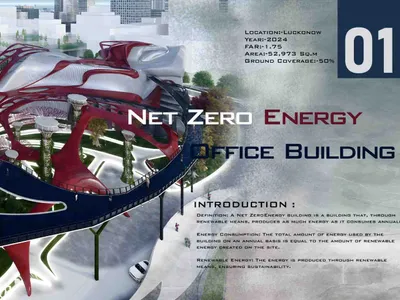
More Than a Building-Designing a Living System
More Than a Building-Designing a Living System
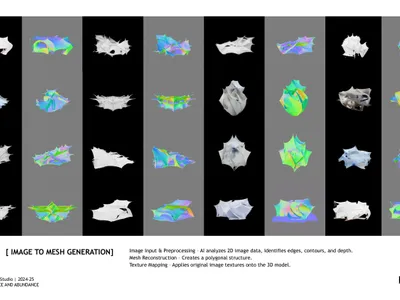
Base Beyond
DESERT COMPOUND ARID: TOURISM OF ABSENCE AND ABUNDANCE

Explore Residential Building Competitions
Discover active competitions in this discipline


Design a brochure to showcase the effects of the technosphere

Challenge to illustrate ‘A tale of Two Cities’

Deconstructivism - Illustration Design Challenge

Challenge to design mud housing for contemporary communities
Comments (0)
Please login or sign up to add comments
No comments yet. Be the first to comment!