

Architecture Infrastructure Assemblage: Rebuilding Bangladesh's Tannery Industry as a Social Ecosystem
A UnIATA '19 shortlisted entry applies Deleuze and Guattari's assemblage theory to relocate Hazaribagh's tanneries into a cleaner, worker-centred estate.


Most proposals for polluting industry start by moving the factory somewhere else. Architecture Infrastructure Assemblage starts by asking what a factory actually is: a shed, yes, but also a river, a wage, a market, a mosque and a supply chain stretching from cattle to export container. The project borrows the concept of assemblage from Gilles Deleuze and Felix Guattari, a bottom-up framework that reads social complexity through fluidity, exchangeability and multifunctionality. Applied here, it means treating the tannery as a network of interdependent parts rather than a single building type.
Designed by Pankaj and shortlisted in UnIATA '19, the scheme tackles the tannery industry of Bangladesh, the country's second-largest export-based sector and one of its most environmentally damaging. The focus is the relocation and redevelopment of the Hazaribagh tannery estate to the Savar Tannery Estate, a move that brings environmental degradation, absent infrastructure and social inequity to the surface all at once. Rather than treating relocation as a logistical exercise, the project uses it as an opportunity to redesign how the industry works spatially and socially.
A Collage That Puts Cattle, Capital and Protest in One Frame
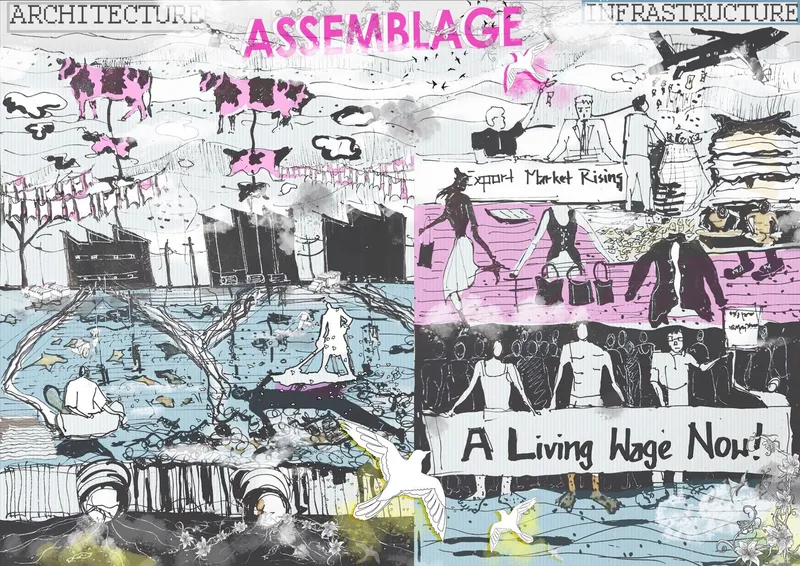
The opening collage serves as the project's thesis in visual form. Pink-patterned cows, factory sheds, an aircraft overhead and a polluted blue river share the frame with a protest banner reading A Living Wage Now. The juxtaposition is deliberate: raw material, production, global export and labour struggle are shown as a single continuous system. It is assemblage theory made legible without a paragraph of explanation.
The image also establishes the project's priorities. The river is not a backdrop but a casualty, and the workers are not abstract users but people with political demands. Everything that follows in the drawings is measured against these two pressures.
Reading the Industry Through Its History and Its Workers
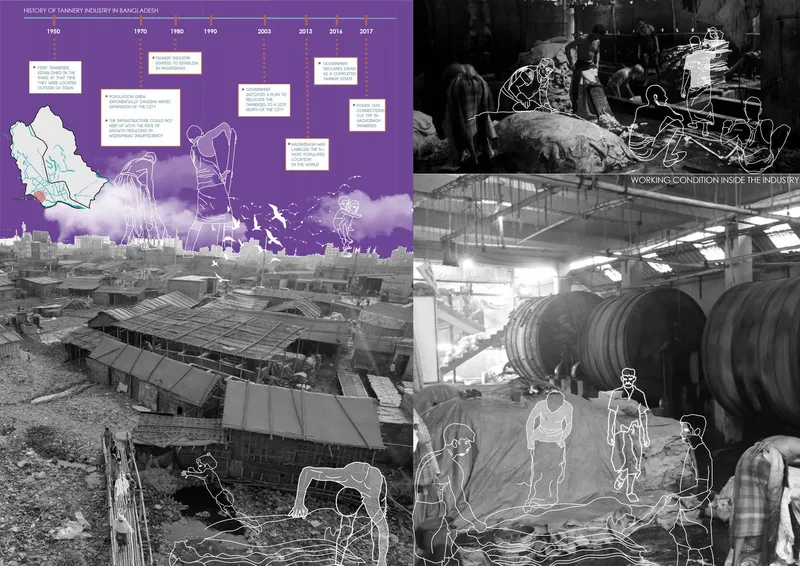
Before proposing anything, the second board traces the industry's evolution along a purple timeline, set against a photograph of tin-roofed shacks and black-and-white images of workers handling hides in drums. This is the sociality layer of the assemblage: the recognition that conditions at Hazaribagh emerged from decades of accumulated decisions, not a single failure of design.
The documentary photographs carry significant weight. They show the physical intimacy of tanning work, bodies close to chemical drums and hides, and they explain why the brief insists on ergonomic facilities and social spaces. Improved working conditions here are a structural response to what the research reveals, not a gesture of goodwill.
Factory Clusters Built Around Light, Courtyards and Controlled Outflow
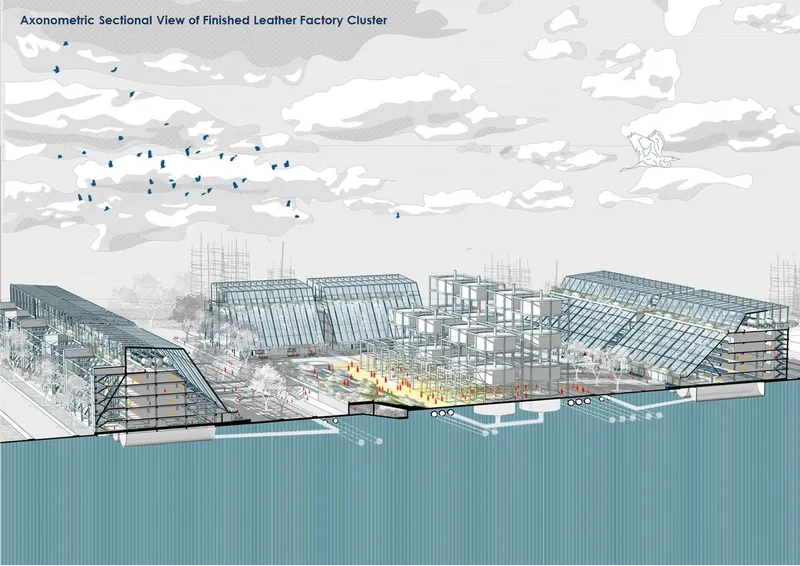
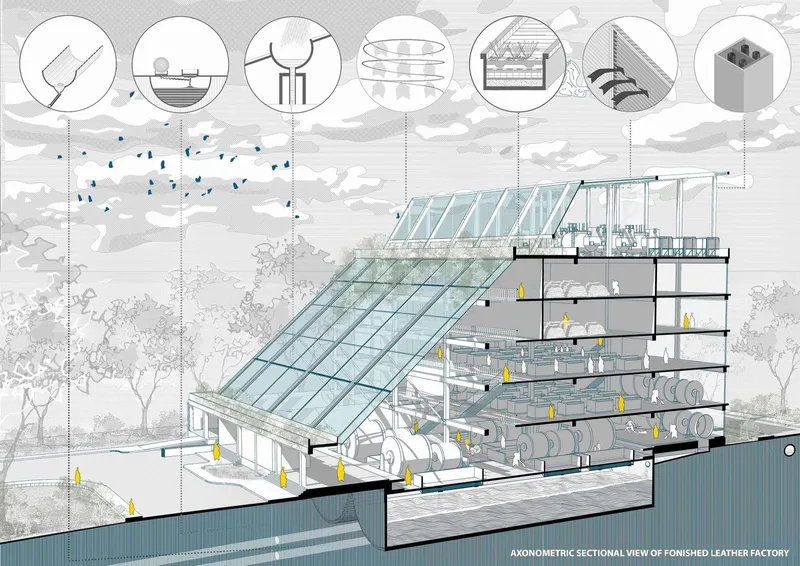
The axonometric sections reveal the architectural core of the proposal: finished leather factory clusters with glazed sloping roofs and a central courtyard. The courtyard breaks the deep-plan logic of conventional tannery sheds, drawing daylight and air into the working floors. Beneath the cluster, outfall pipes run toward the water, making the building's relationship with the river explicit rather than hidden. The drawing doesn't pretend that tanning produces no waste; instead, it shows where that waste goes and implies that it can be managed.
The multi-storey variant stacks machine floors beneath a sloped glass roof, with circular callouts detailing specific components. This is the spatiality layer at work: modular, adaptive industrial space designed to optimise resources and productivity. Combined with the green roofing and natural vegetation proposed for the clusters, the section suggests a factory type that can be repeated across the estate without becoming monotonous or ecologically inert.
A Riverfront Estate Where Treatment, Trade and Worship Share the Plan
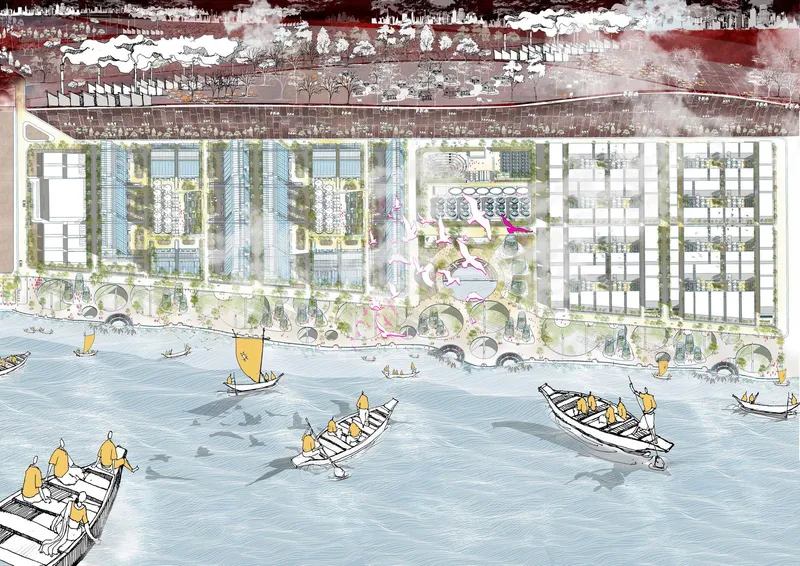
The aerial perspective shifts from building to territory. Rows of factory blocks are punctuated by circular planted pockets, while wooden boats with yellow-clad rowers move across the rippled water in the foreground. The river, polluted in the opening collage, is reimagined here as a working and living edge, still in use by the community rather than abandoned to effluent.
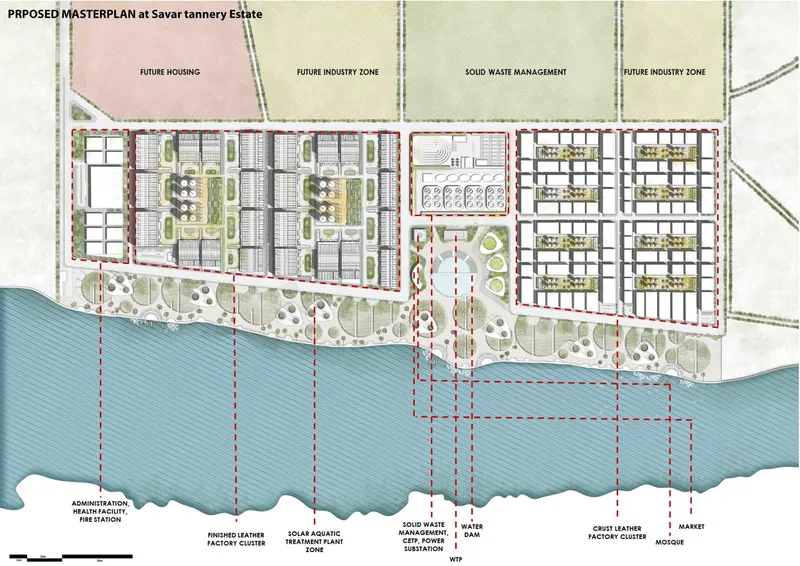
The masterplan clarifies the organisation of the estate. Red dashed outlines mark the factory clusters, a dedicated water treatment zone, a market and a mosque. The placement of treatment infrastructure alongside civic and religious programme is the project's strongest move: it positions environmental compliance and social life as integral parts of the industrial system rather than secondary concerns. The brief's solar aquatic treatment zones and water treatment plants, intended to meet international environmental standards, become visible components of the estate's structure.
Why This Project Matters
Industrial architecture is often the least examined category in student competitions, viewed as a backdrop rather than a design challenge. This entry shows the potential of that territory. By using assemblage theory as a working method instead of a decorative citation, Pankaj connects the cow, the drum, the wage, the outfall pipe and the mosque within a single argument. The result is a masterplan that measures success not by the quality of its sheds alone, but by the condition of the river and the lives of the people working beside it.
The relocation from Hazaribagh to Savar is a real and ongoing problem, and the proposal does not claim to resolve it completely. What it offers is a framework: modular clusters that can adapt, treatment infrastructure that is planned rather than retrofitted, and social programme placed at the heart of the plan. For a sector so central to Bangladesh's economy, that shift in thinking is worth taking seriously.
View the Full Project
About the Designers
Designer: Pankaj
Enter a Design Competition on uni.xyz
uni.xyz runs architecture and design competitions year-round that reward proposals with spatial conviction and real site intelligence.
Project credits: "Architecture Infrastructure Assemblage by Pankaj UnIATA '19 (uni.xyz).


Popular Articles
Popular articles from the community


The Amber Palace Opera: A Geological Fiction Surfaces on Tallinn's Baltic Waterfront
Pierre Brillard reimagines a Baltic legend as a public landscape, opera house, and waterfront promenade rooted in Tallinn's coastal identity.
Tsunami Convergenics: Turning Catastrophic Ocean Forces into Underwater Housing Infrastructure
A speculative underwater settlement off the coast of Onagawa, Japan, treats tsunamis and typhoons as energy sources rather than threats.
Opera by the Sea Estonia: Three Shells Dissolving Architecture into Tallinn's Coastline
A winning opera house proposal replaces monumental form with interconnected shells that blur the boundary between building, park and Baltic Sea.

Singing Woman: An Opera House That Performs Before the Curtain Rises
Ovidiu Cristian Pavel's conceptual opera house translates Estonia's choral identity into a sculpted waterfront landmark facing the Baltic Sea.

Similar Reads
You might also enjoy these articles


Hodi-Mandai Geram
Project Function: Preservation and revitalization of the Intangible heritage and socio-spatial identity of the Hodi by Housing, Cultural Memory Center, Sacred Grove, landscape, local tourism economy


Olio Towers: A Mid-Rise for Performers That Fuses Housing, Rehearsal, and Stage
Located blocks from Houston's Theater District, this modular tower stacks living units around a central performance atrium.

Oasis: Modular Green Housing Carved into Dhaka's Urban Fabric
A shortlisted Plugin Housing entry reclaims unauthorized settlements in Dhaka with stepped concrete volumes, green roofs, and ventilation-driven design.

Black Hole: A Floating Megastructure for the Post-Physical Era
Emiliano Mazzarotto envisions a spherical, self-scaling arena where e-sports, digital hotels, and holographic stadiums replace traditional public space.

Explore Architectural Assemblage Competitions
Discover active competitions in this discipline

Challenge to reimagine the Iron Throne

Photograph architecture without architects

Illustrate the lost glory of Angkor Wat - Render Challenge

Design challenge to reuse E-waste
Comments (0)
Please login or sign up to add comments
No comments yet. Be the first to comment!