

08014 Arquitectura Builds 24 Homes in Ibiza Using Seaweed Insulation and Earth-Filled Walls
A public housing block in Platja d'en Bossa turns local materials and bioclimatic courtyards into a quiet rebuke of the island's tourism sprawl.


Platja d'en Bossa sits at the southern edge of Ibiza, a strip of coast almost entirely given over to the machinery of mass tourism: superclubs, all-inclusive hotels, souvenir shops. It is not a place where you expect to find an argument for how architecture can serve residents rather than visitors. Yet that is precisely what 08014 arquitectura has delivered: 24 units of publicly promoted housing, commissioned by the Balearic Housing Institute (IBAVI), that treat sustainability not as a marketing claim but as a structural fact embedded in every wall, courtyard, and roof.
What makes the project worth studying is the specificity of its means. The building's thermoclay walls are filled with earth excavated from the site itself, increasing thermal mass while eliminating the need to truck in fill material. Roof insulation is made from dried poseidonia, the seagrass that washes up on Ibiza's beaches and was once a staple of local construction. These are not nostalgic gestures. They are performance decisions that bring non-renewable primary energy consumption down to 10.7 kWh/m²/year, low enough that no centralized heating system is required. In a Mediterranean climate shaped by hot summers and mild winters, the building breathes instead of burning fuel.
A Compact Fortress on a 43-Meter Square
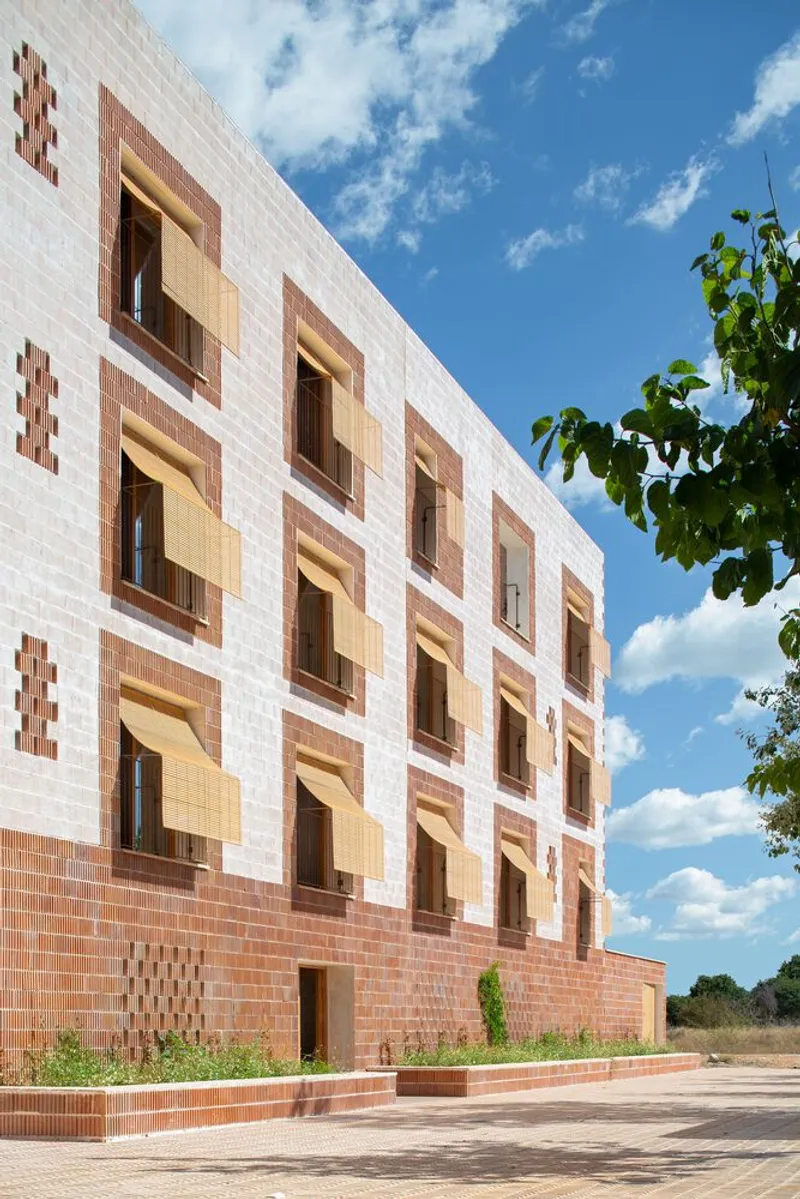
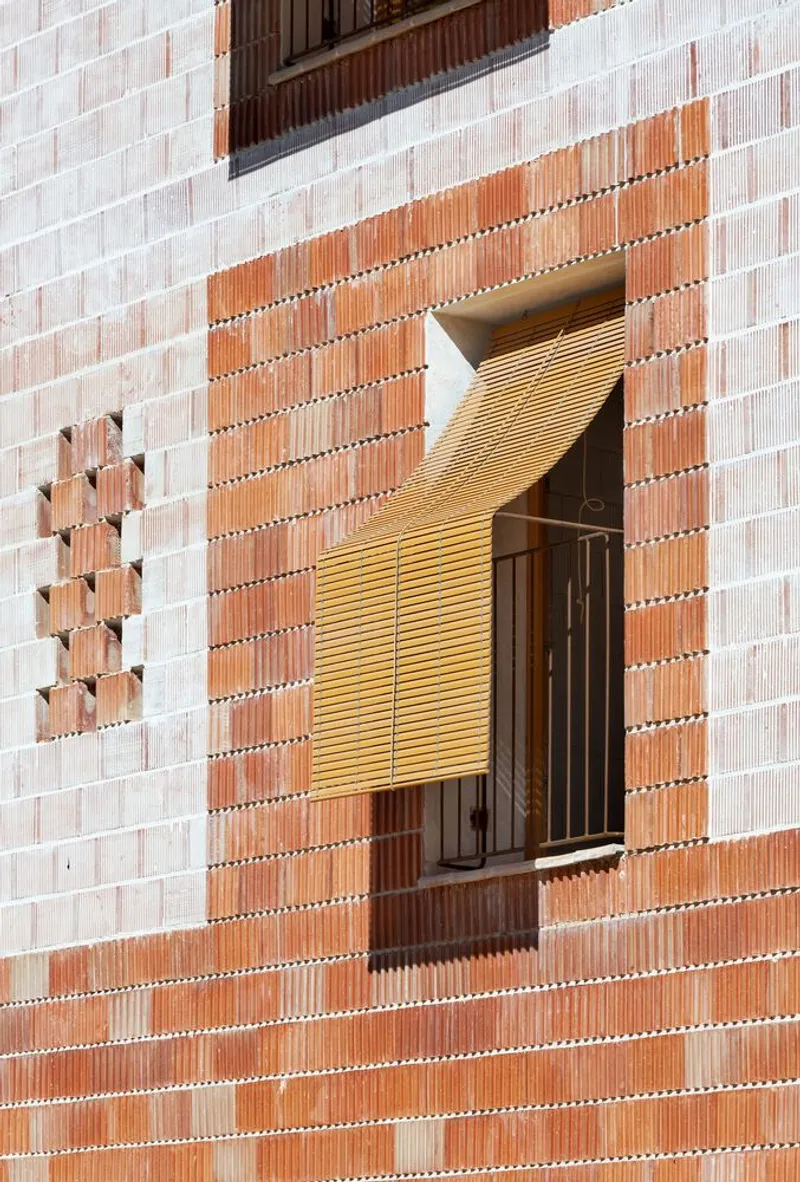
The plot is a tight 43 by 43 meters, rotated 45 degrees relative to the cardinal axes. 08014 arquitectura responded by pushing the volume to the limits of the buildable envelope, producing a freestanding four-story block that reads as a single, self-contained mass. From the street, the facade presents a disciplined grid of terracotta and off-white ceramic, with square window openings framed in a deeper red blocking that continues down to ground level and merges with the perimeter walls. The effect is monolithic but not forbidding. Timber-louvered shutters set within the brick openings give each unit a layer of individual control, breaking the facade rhythm just enough to signal that people live here.
The choice to occupy nearly all available ground area is deliberate. Rather than scattering buildings and creating leftover space, the architects concentrated the footprint and carved courtyards inward, freeing the roof and interior voids for greenery, light, and air movement. It is a strategy borrowed from the classical domus and the Islamic house: the life of the building faces inward, not outward.
Four Courtyards, Two Facades Per Room

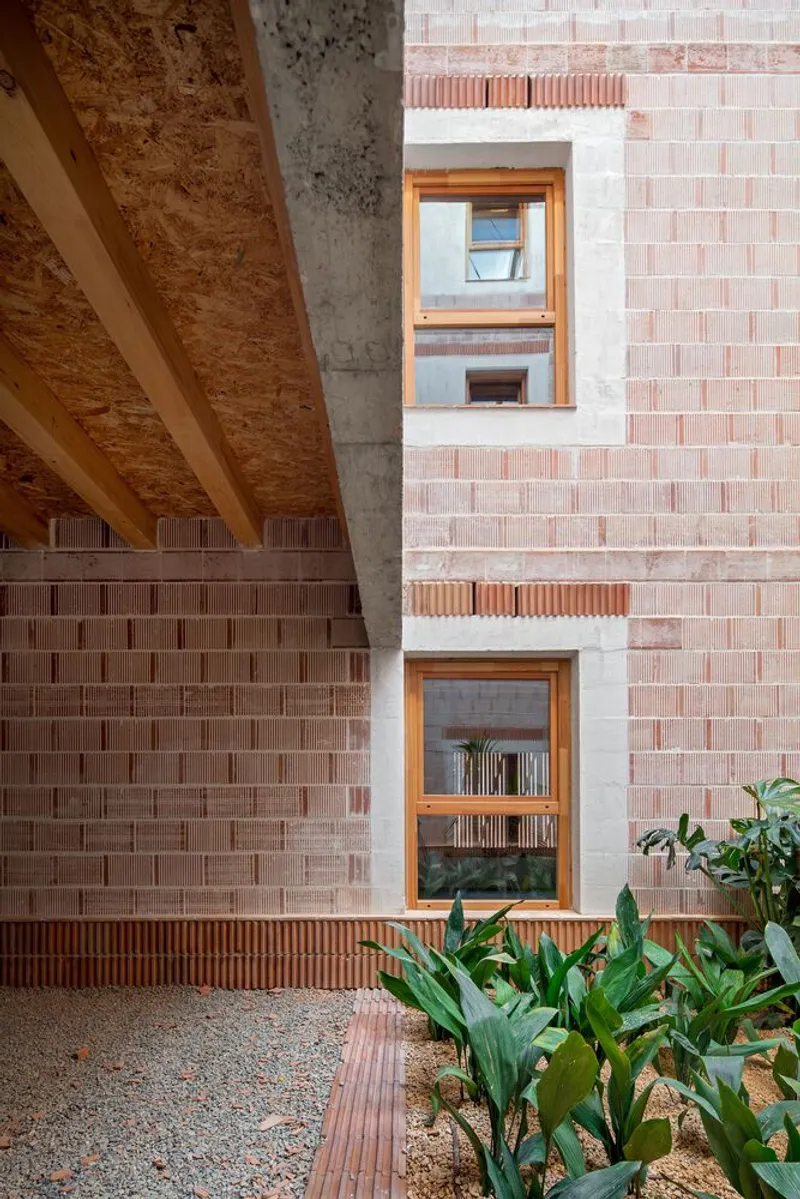

The plan is organized around four courtyards that punch through the volume, distributing light and air to every apartment. Three concentric strips of rooms surround a central circulation core. The outer band holds living rooms, bedrooms, and bathrooms; the inner ring accommodates kitchens and courtyard-facing spaces. Every room, including bedrooms, opens in two directions, guaranteeing cross ventilation and eliminating the dead-air pockets that plague conventional apartment blocks.
These courtyards are planted with palms, ferns, and other low-water species irrigated by rainwater collected from the roof and stored in an underground cistern at the front of the building. Angled sunlight rakes across terracotta walls and planted beds, producing conditions that shift through the day. The courtyards are not ornamental; they are the engine of the building's climate strategy, functioning as bioclimatic atriums. Glazed enclosures with operable solar protections allow them to accumulate heat in winter and vent hot air in summer.
Timber, Earth, and Seaweed: A Material Logic
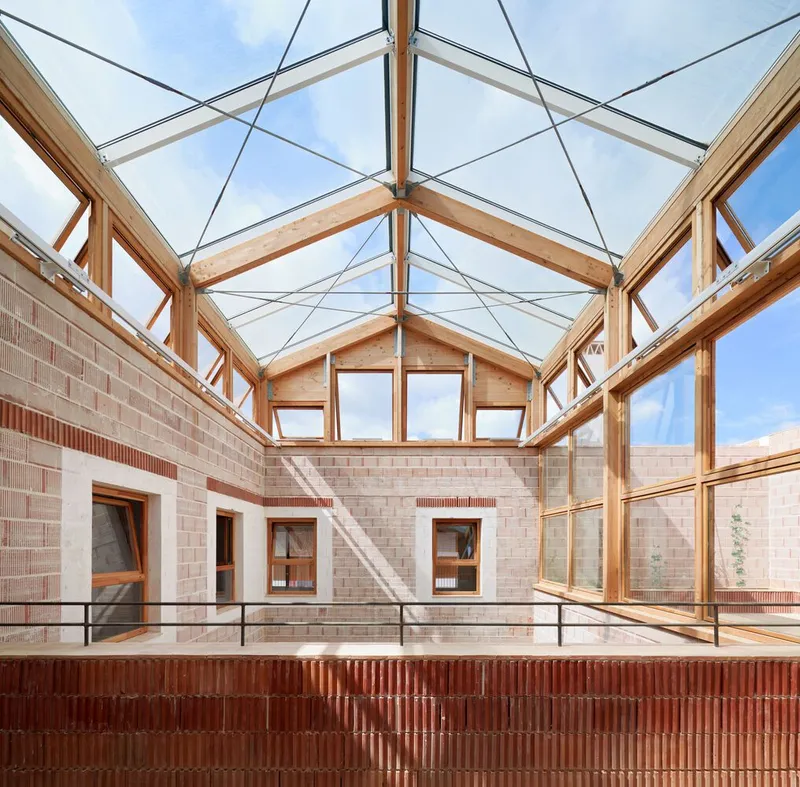

The atrium structures are built in timber, engineered by Egoin, with exposed beams and steel tension rods that hold the glazed courtyard covers in place. Inside the apartments, oriented strand board panels span between timber joists, giving ceilings a warm, grain-heavy texture that contrasts with the mineral palette of the walls. Timber also appears in door and window frames throughout the building, establishing continuity between interior and exterior.
The load-bearing walls, manufactured by Cerámica Utzubar as thermoclay units, form a structural mesh of nearly square rooms. Their cavities are packed with earth from the site excavation, a technique that doubles as acoustic insulation between units and dramatically increases thermal inertia. Facade insulation comes from recycled cotton; roof insulation from dried poseidonia seaweed. Ceramic floor tiles by Cerámicas Arcís and biomass-fired bricks complete a material palette in which almost nothing arrives from far away and almost nothing will end up in a landfill.
Living Inside the Walls
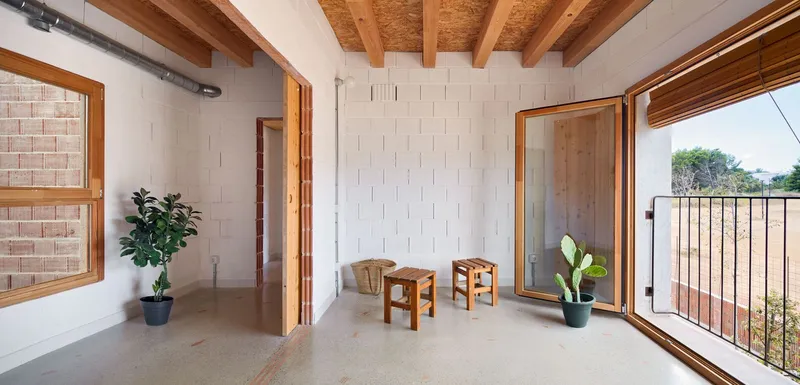
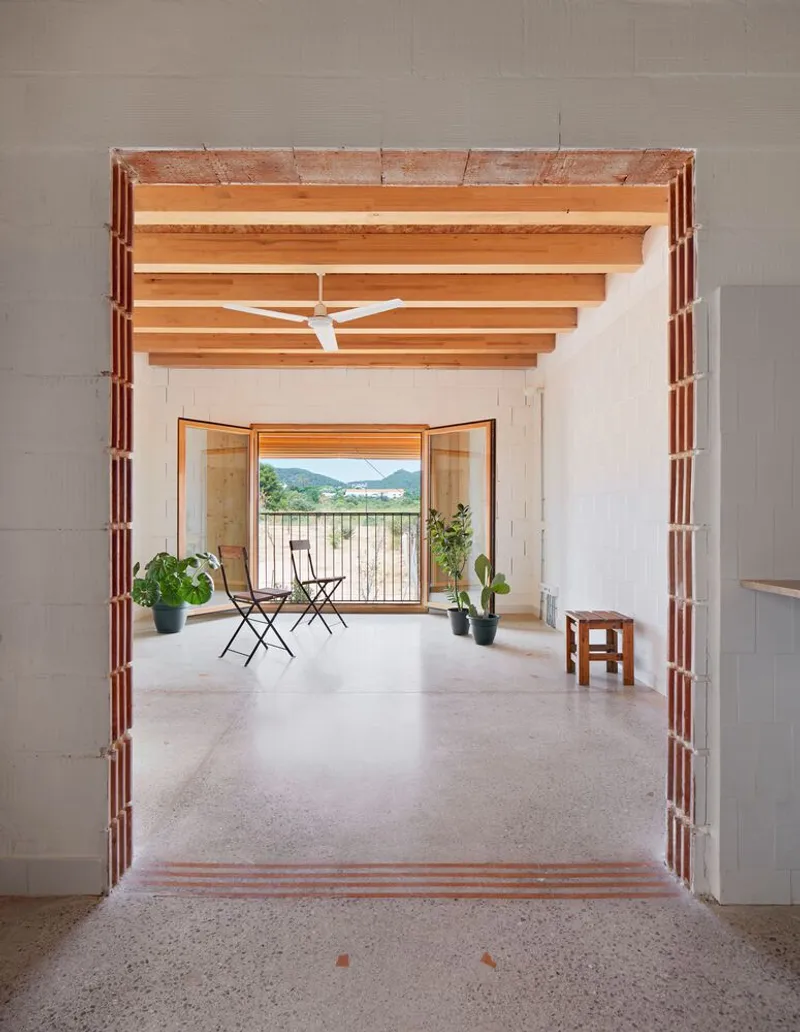
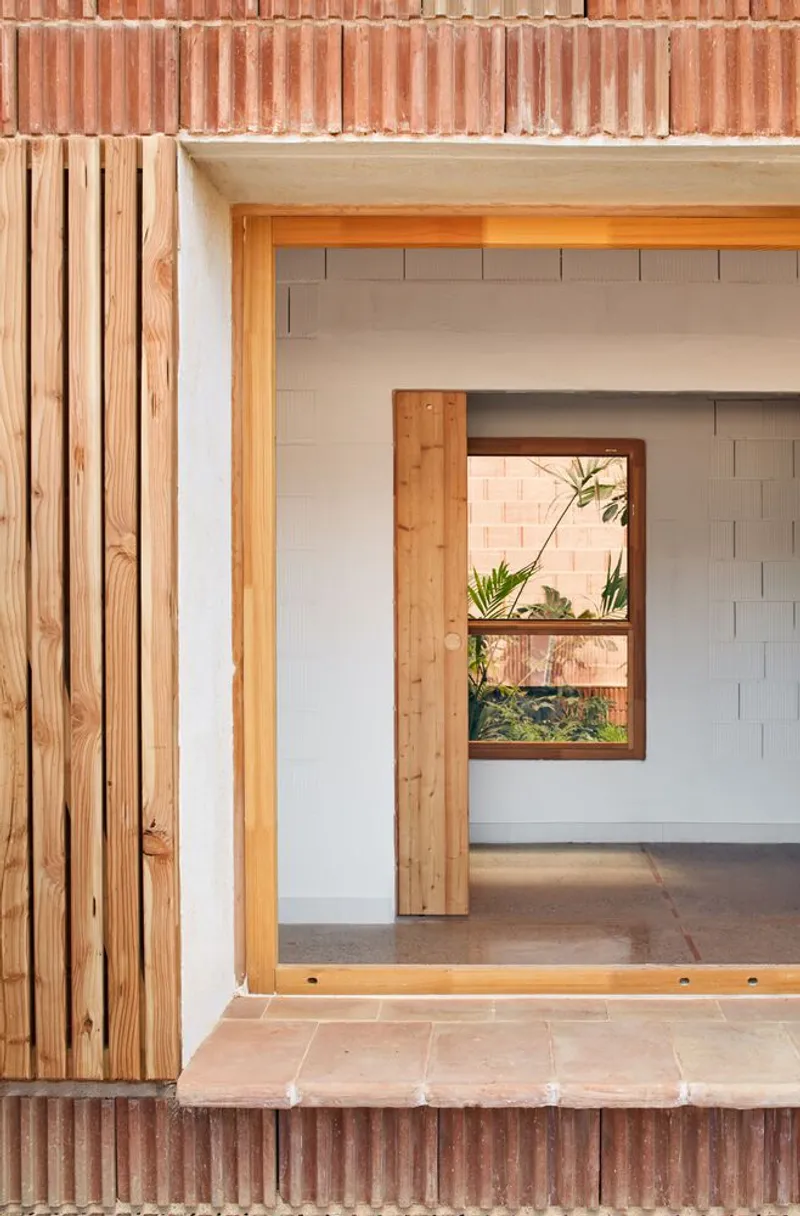
Step inside an apartment and the thickness of the envelope becomes palpable. Doorways are deep, framed in pink brick, and open onto views that layer interior, courtyard, and sky into a single sightline. Potted plants colonize balcony thresholds. Timber shutters swing on heavy hinges, controlling light and privacy without resorting to blinds or mechanical screens. The rooms feel both protected and connected, a quality that owes as much to the generous wall depth as to the plan's dual orientation.
The correspondence between structure and space is legible everywhere. Because the walls carry the loads, there are no columns interrupting living areas and no dropped ceilings concealing beams. What you see is what holds the building up. That honesty gives even modest-sized rooms a clarity and calm that more expensively finished apartments often lack.
Rooftop and Threshold

The roof terrace offers a glimpse of the sea beyond pink brick parapets, a reminder of just how close the building sits to the coastline. Diagonal shadows from the walls cut across the terrace surface, marking time in a way that air conditioning never could. Corridors at ground and upper levels are lined with concrete planters and timber soffits, blurring the line between hallway and garden. These thresholds, generous in dimension, function as shared living space rather than mere circulation.
Why This Project Matters
Public housing is often discussed in terms of cost per square meter or units delivered per year. Those metrics matter, but they tell you nothing about whether a building will remain comfortable, affordable to operate, and dignified to inhabit over decades. The Platja d'en Bossa project answers all three questions convincingly. By investing in passive strategies and local materials rather than mechanical systems and imported finishes, 08014 arquitectura has produced homes that cost less to run, age gracefully, and carry a carbon footprint roughly 30% below the typological average.
More broadly, the building demonstrates that sustainability and tradition are not separate agendas. Filling wall cavities with excavated earth, insulating roofs with dried seaweed, organizing rooms around courtyards for ventilation: these are old ideas, refined with contemporary engineering and driven by measurable performance targets. In a place where the economy runs on transient pleasure, this housing block makes a quiet, durable case for permanence.
Sustainable Public Housing in Platja d'en Bossa by 08014 arquitectura. Platja d'en Bossa, Ibiza, Spain. 2,596 m². Completed 2022. Photography by Pol Viladoms.
About the Studio
Share Your Own Work on uni.xyz
If projects like this are the kind of work you want to make, uni.xyz is a place to publish your own, find collaborators, and enter design competitions.


Popular Articles
Popular articles from the community


David Macias Steps a Doorless Stone and Plaster House Down a Tropical Colombian Hillside
In the humid hills of Colombia, Threshold House replaces the front door with an open void and terraces its 850 m² down the slope instead of fighting it.

U.GA Architects Wraps an Oval Rooftop Pool in Curved Board-Formed Concrete on Busan's Jeollidan-gil
In Busan's Jeonpo-dong, a 454 m² mixed-use block stacks a neighborhood facility, guest rooms and an oval rooftop pool inside spiraling concrete walls.

Juan García Correa, John González and Claudia Rueda Sink a Circular Amphitheater into a Manizales Engineering Building
On the La Nubia campus in Manizales, Colombia, the S1 Building folds labs and offices into a hillside of ramped lawns that double as a campus route.

LT2A and OPEN Architectes Thread a Brick and Glass High School Through a Wooded Belgian Campus
In Braine-l'Alleud, a 3,000 m² wing for Collège Cardinal Mercier pairs pale brick with a glazed colonnade, deferring to a small chapel and a dense wood.

Similar Reads
You might also enjoy these articles


Hodi-Mandai Geram
Project Function: Preservation and revitalization of the Intangible heritage and socio-spatial identity of the Hodi by Housing, Cultural Memory Center, Sacred Grove, landscape, local tourism economy


Olio Towers: A Mid-Rise for Performers That Fuses Housing, Rehearsal, and Stage
Located blocks from Houston's Theater District, this modular tower stacks living units around a central performance atrium.

Oasis: Modular Green Housing Carved into Dhaka's Urban Fabric
A shortlisted Plugin Housing entry reclaims unauthorized settlements in Dhaka with stepped concrete volumes, green roofs, and ventilation-driven design.

Black Hole: A Floating Megastructure for the Post-Physical Era
Emiliano Mazzarotto envisions a spherical, self-scaling arena where e-sports, digital hotels, and holographic stadiums replace traditional public space.

Explore Residential Building Competitions
Discover active competitions in this discipline

Challenge to design mud housing for contemporary communities

Challenge to reimagine the Iron Throne

Photograph architecture without architects

Illustrate the lost glory of Angkor Wat - Render Challenge
Comments (0)
Please login or sign up to add comments
No comments yet. Be the first to comment!