
Architektūros linija Wraps a Lithuanian Sports Campus in a Corrugated Metal Spectrum
A sprawling training center in the forest town of Druskininkai uses bold color coding and timber interiors to humanize athletic infrastructure.


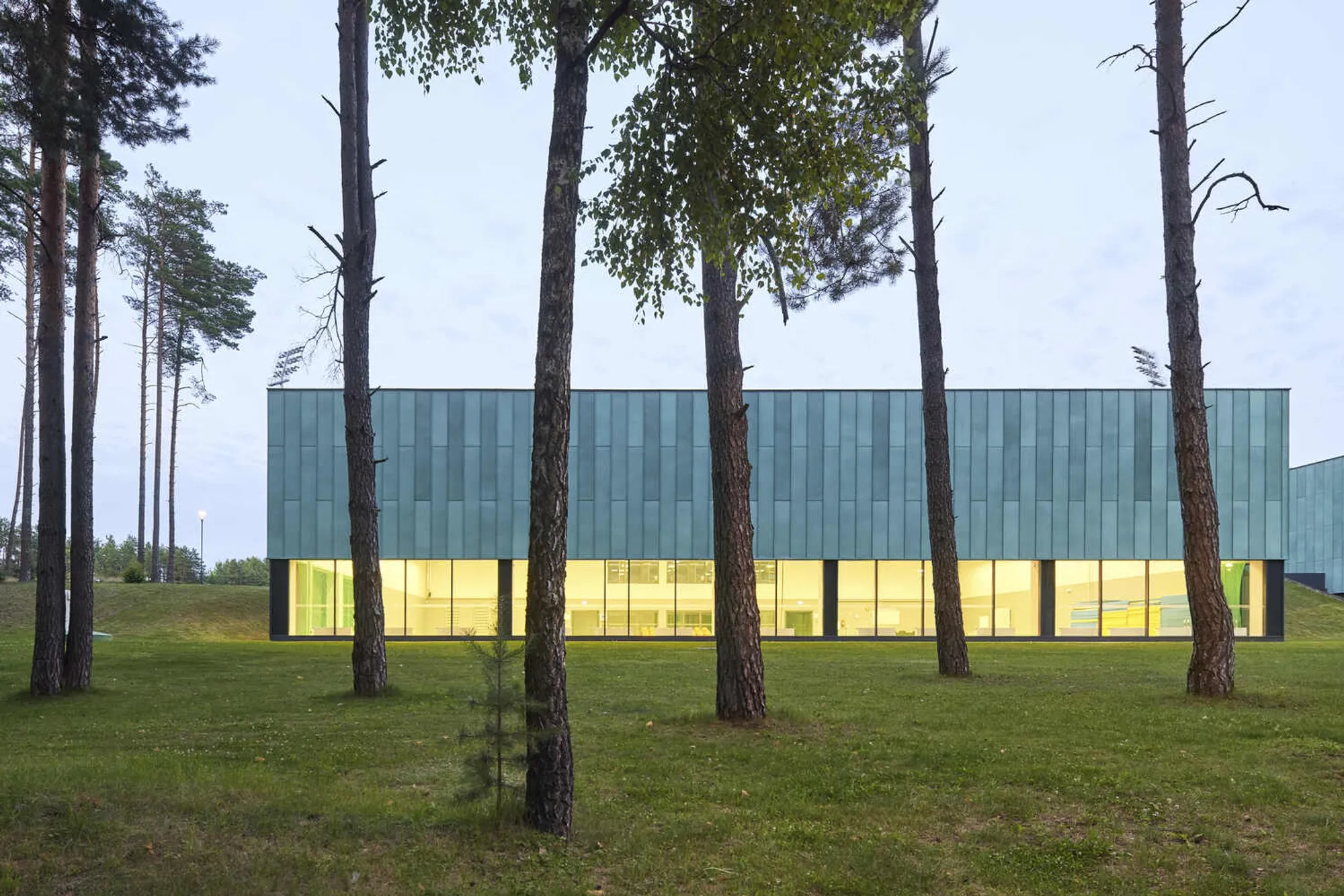
Sports training facilities rarely aspire to civic presence. They tend toward utilitarian sheds: functional, forgettable, and sequestered behind parking lots. The Sportsmen Training Center in Druskininkai, designed by Architektūros linija, pushes hard against that default. Spread across a forested campus in the Lithuanian spa town, the complex gathers a swimming pool, basketball courts, a fitness center, and a full athletics stadium under a family of buildings unified by an aggressive palette of corrugated metal cladding in turquoise, red, yellow, and green.
What makes the project interesting is not the color alone but the decision to treat color as a navigational and spatial system rather than decoration. Each volume is coded by hue, and the vertical orientation of the corrugated fins gives each facade a shifting optical texture as you move past it. The buildings sit low, tucked into grassy berms and shielded by pine trees, so the bright panels register as flashes between the trunks rather than as a single monolithic statement. It is a campus that reveals itself gradually, which is exactly the right approach for a site embedded in one of Lithuania's most landscape-conscious towns.
A Campus Grounded in the Forest Edge
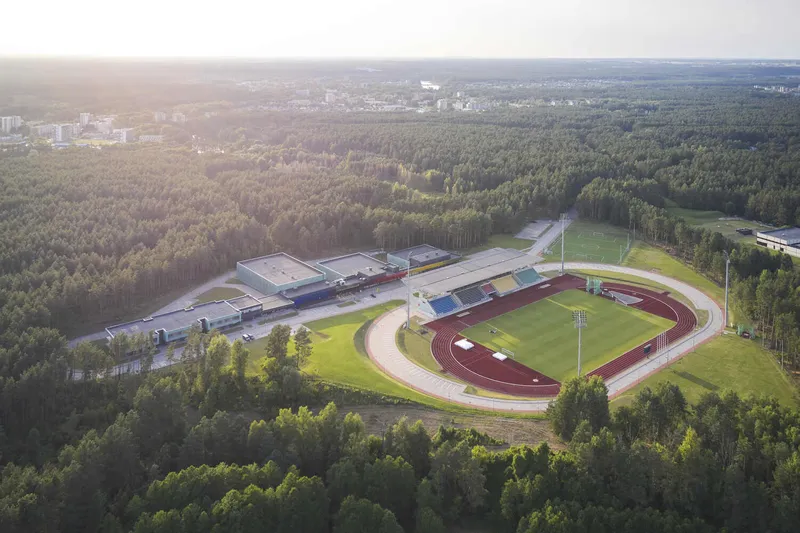


The aerial view tells the story plainly. An oval athletics track sits at the heart of the site, ringed by dense forest on three sides and a loose constellation of auxiliary buildings along connecting paths. Rather than concentrating all program into a single megastructure, Architektūros linija distributed the complex into discrete volumes, each with its own massing profile. The result reads less like a sports facility and more like a small institutional district.
From ground level, the entry road curves gently past long horizontal facades, with graded lawn banks softening the transition from landscape to architecture. Street lamps and pine trees establish a rhythm that keeps the scale domestic despite the buildings' considerable length. The strategy is deliberate: you arrive through landscape, not through a parking lot, and the architecture earns attention only after the setting has already done its work.
Corrugated Color as a Cladding System


The facade system deserves close reading. Vertical corrugated metal panels in saturated hues are set with dark reveals between them, creating a fine-grained rhythm that changes character depending on the angle of approach and the quality of light. Up close, the panels have a tactile, almost industrial quality. From a distance, they flatten into broad bands of color that identify each building at a glance.
At the corners, contrasting panels meet cleanly, turning the junctions into graphic moments rather than awkward intersections. The red and yellow fin projections along one facade push the system into three dimensions, casting thin shadows that animate the surface throughout the day. It is a straightforward material used with enough compositional discipline to feel inventive.
The Glazed Ground Floor and the Floating Volume


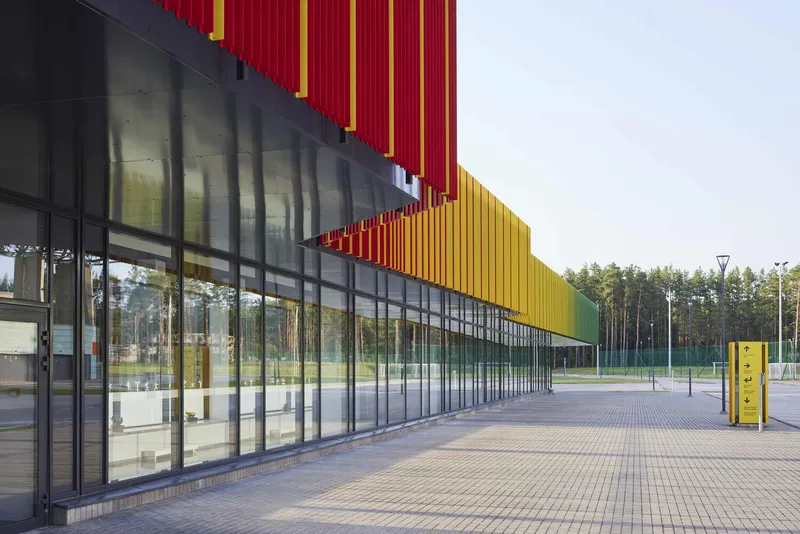
A recurring move across the campus is the elevation of the solid, color-clad volume above a transparent ground floor. The effect is consistent: the heavy upper mass appears to float over a luminous base, reversing the visual weight you would expect. At dusk, when the interior lighting takes over, this inversion becomes theatrical. The buildings glow from beneath their own cladding, pulling visitors toward entrances without the need for overt signage.
The full-height glazed corridors serve double duty as circulation spines and as a visual connection between interior program and exterior landscape. One particularly effective moment occurs where a wood-clad upper floor cantilevers over a recessed entry, drawing a crowd onto the adjacent lawn. The architecture is generous with its thresholds, blurring where the public realm ends and the building begins.
Interior Volumes: Timber, Light, and Legibility
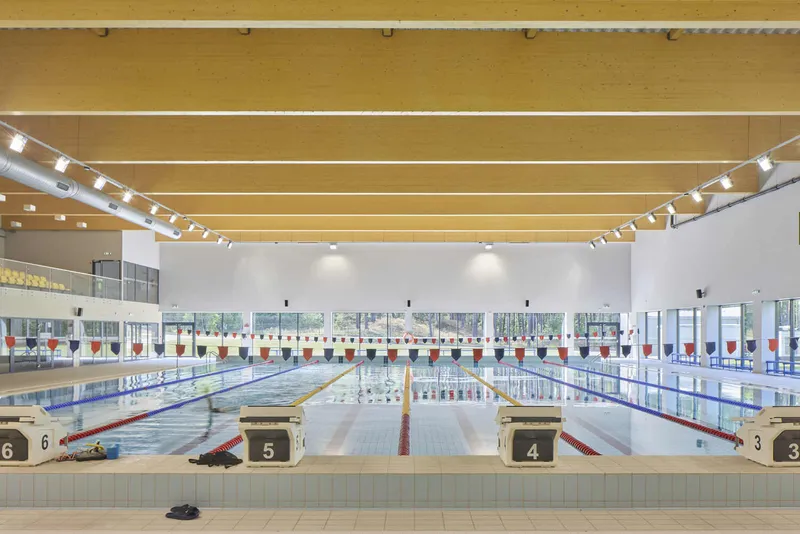

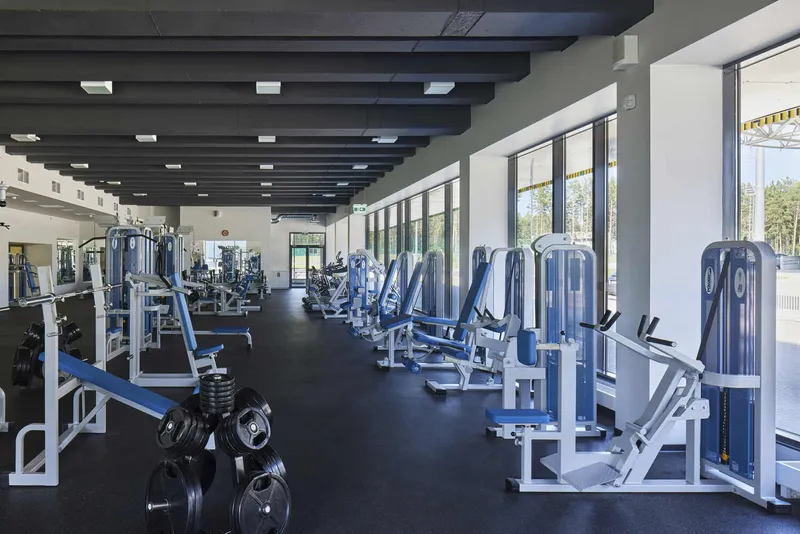
Inside, the palette shifts from metal to timber. The Olympic swimming pool is lined with timber ceiling panels and track lighting, producing a warm envelope around the cool blue water. The basketball court follows the same logic: timber overhead, retractable seating at the perimeter, and a generous sense of height that keeps the space from feeling compressed. These are not luxury interiors, but they are considered ones, and the consistency of the material language across very different program types is one of the project's quiet strengths.
The fitness areas take a different tack, exposing black ceiling beams against floor-to-ceiling windows that flood the workout zones with daylight. The contrast between the dark overhead plane and the bright perimeter gives these rooms an almost loft-like character, a welcome departure from the sealed, artificially lit gyms that dominate the typology.
Back of House with Character

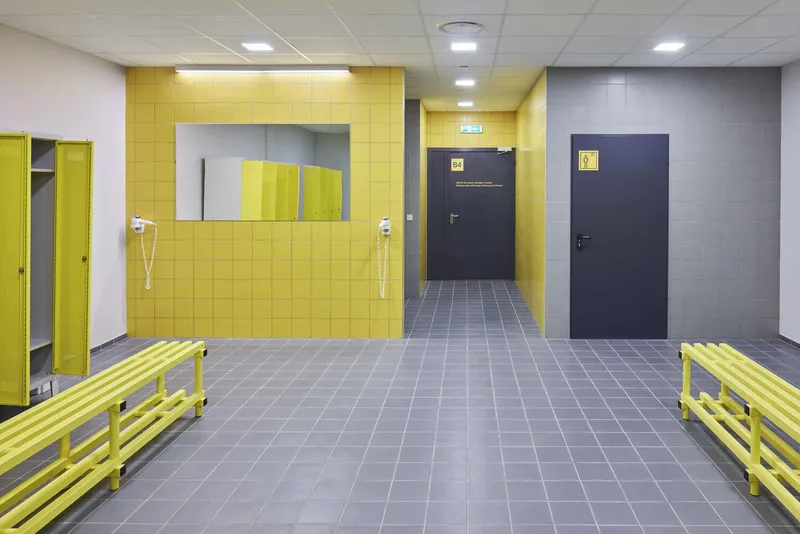
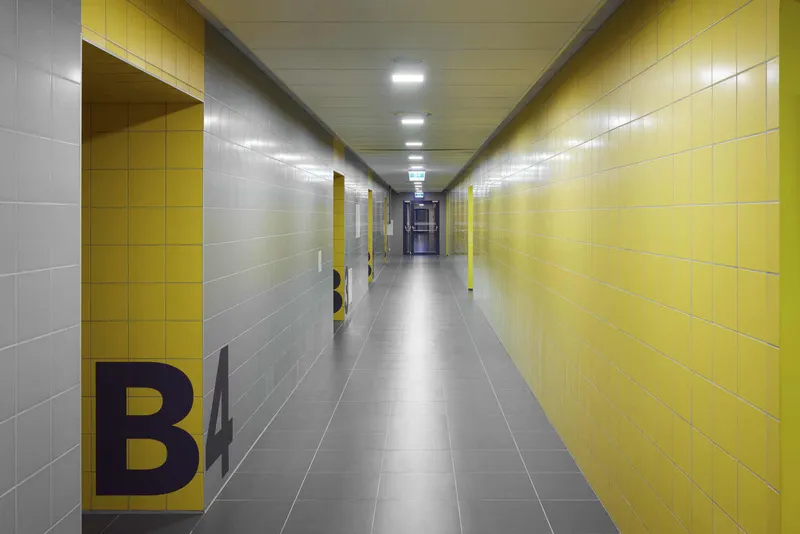
The locker rooms and corridors are where most sports facilities give up on design, but here they carry the color logic indoors. Orange metal cabinets pair with timber benches in one locker room; a yellow tiled wall anchors another. Long corridors with two-tone tile walls and recessed lighting maintain a sense of order and intention that extends the architectural narrative into the building's least glamorous spaces.
It is a small thing, but it matters. Athletes and visitors spend significant time in these transitional zones, and the decision to invest design energy here signals that the building respects its users at every moment, not just when they are performing.
The Stadium: Steel Trusses and Colored Seats

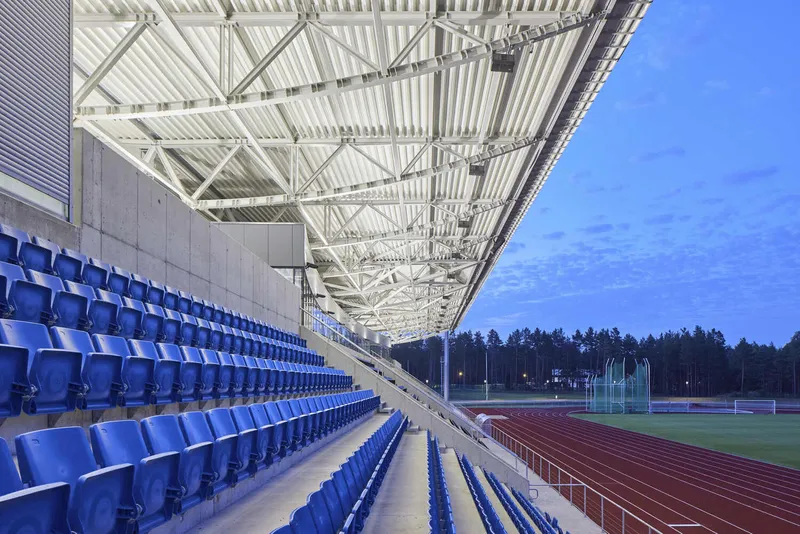
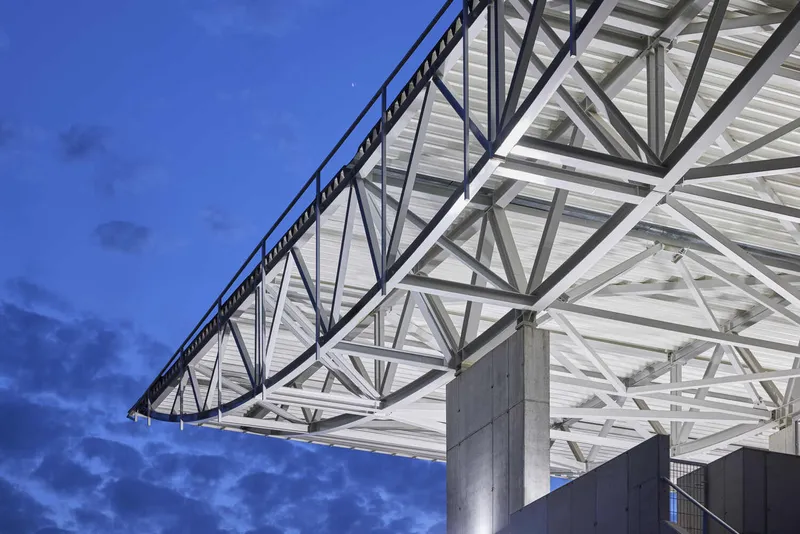
The athletics stadium is the campus anchor, and its cantilevered white steel truss roof is the single most dramatic structural gesture in the project. Supported by concrete columns, the canopy extends well beyond the seating bowl, sheltering spectators while remaining visually light against the sky. At twilight, the exposed truss geometry catches the last ambient light and reads almost as sculpture.
Below, color-coded seating sections in blue and other hues echo the facade palette, binding the stadium to the rest of the campus. The framed view from a covered walkway, looking through an exposed steel truss toward the field, is one of the most compelling spatial moments on the site: it compresses depth, layers structural elements, and rewards the pedestrian who chooses to move through the complex on foot.
Thresholds and Edges at Dusk
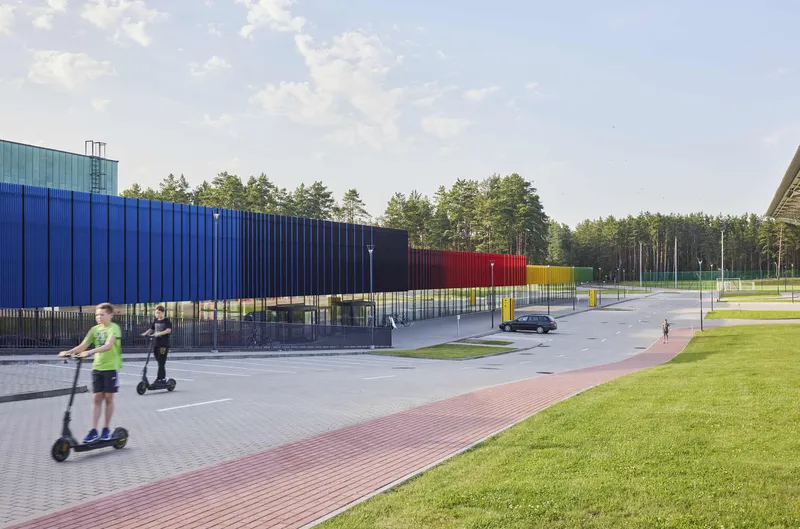
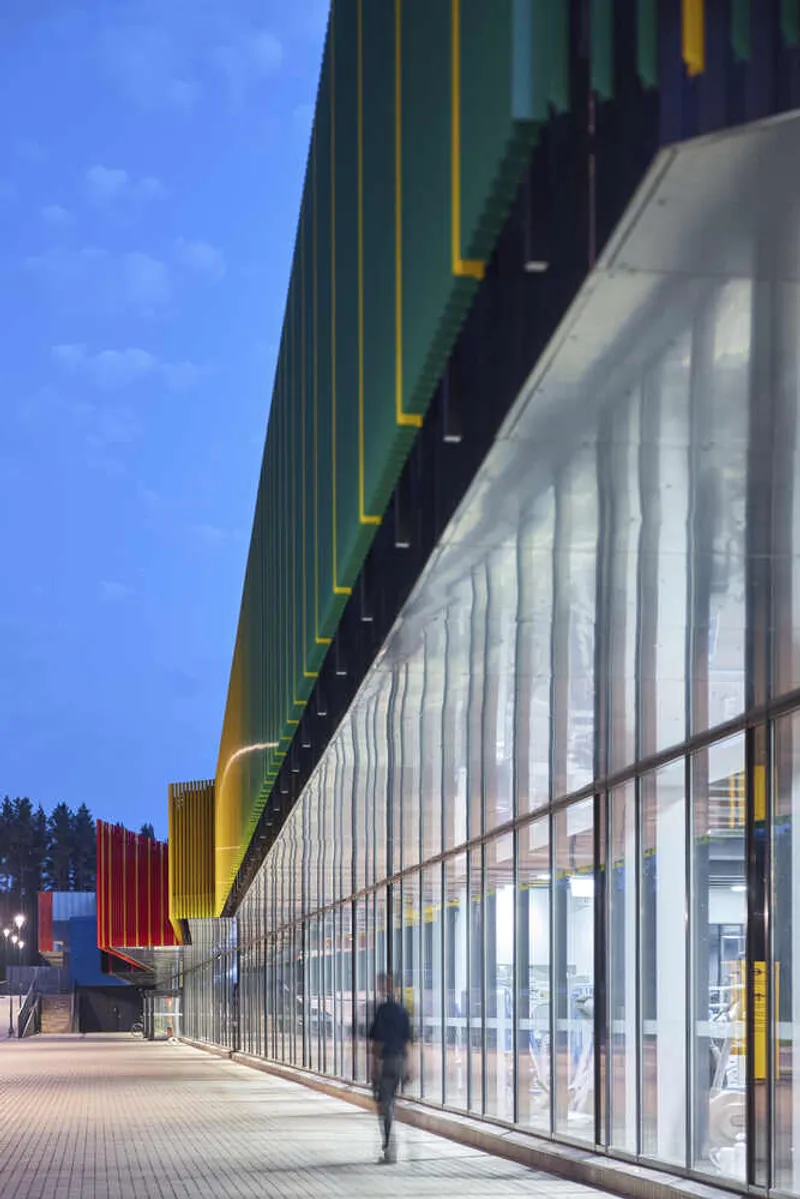
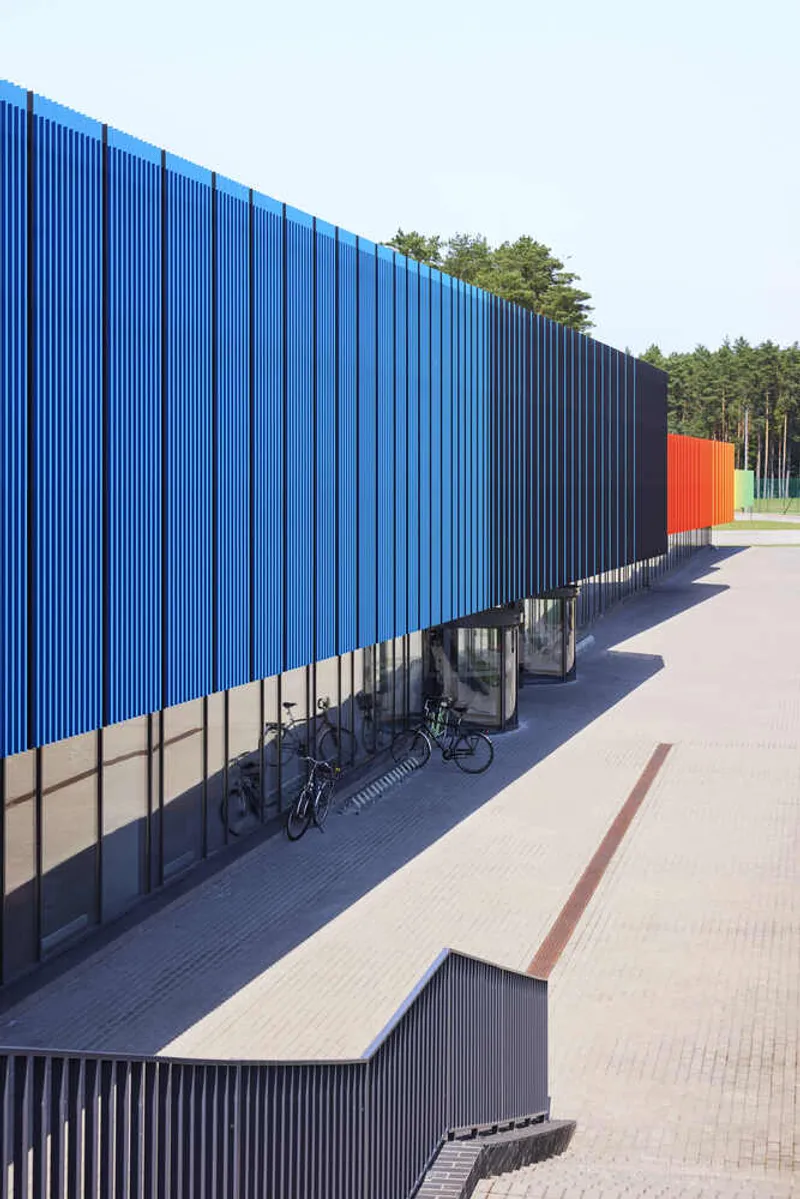
Several of the most telling images capture the campus at dusk, when the relationship between the glazed ground floors and the opaque upper volumes becomes most legible. Children ride scooters past multicolored facades. A figure passes along a walkway beneath blue vertical cladding with bicycles parked below. These are not staged compositions; they are incidental encounters that suggest the buildings have already been absorbed into daily life.
The elevated walkways and covered paths that stitch the volumes together reinforce the campus as a walkable district. You are always sheltered, always oriented by color, and always within sight of the landscape. It is infrastructure that encourages lingering rather than efficient throughput.
Plans and Drawings
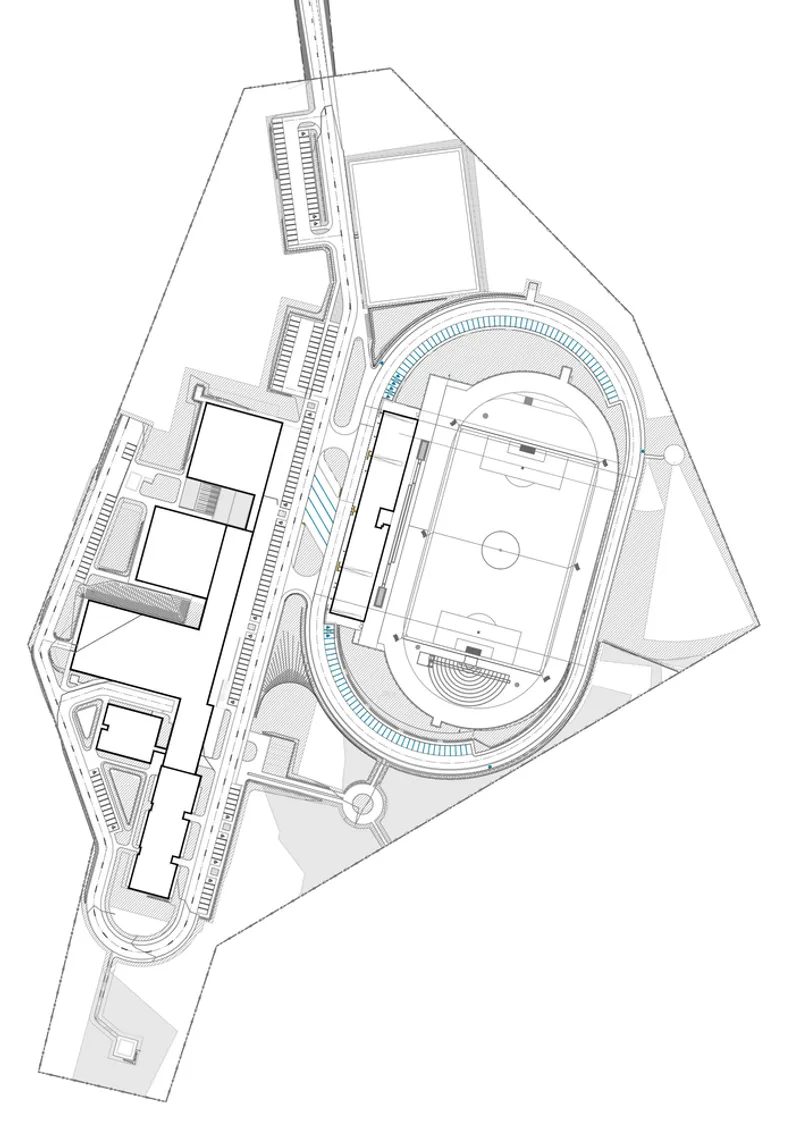

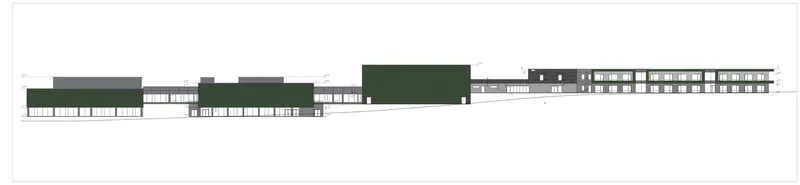
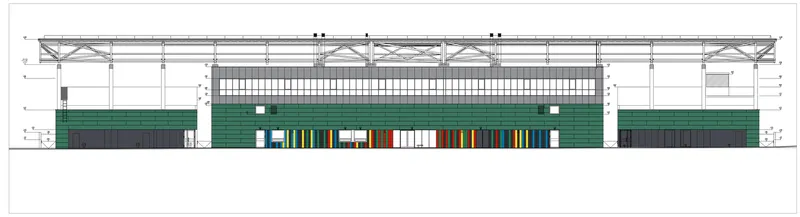
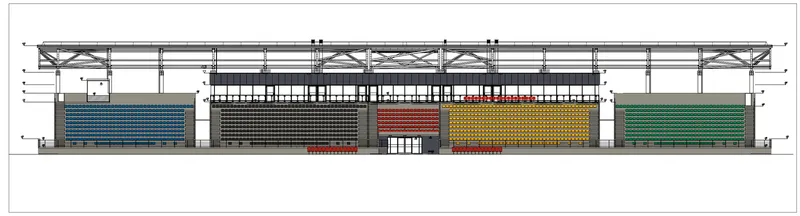
The site plan confirms the distributed campus strategy: the oval stadium sits at the compositional center, with auxiliary buildings arrayed along circulation paths that trace loose arcs through the pine forest. The elevation drawings are especially revealing. The long horizontal profile with its varied massing and a tall tower element at one end demonstrates how the architects controlled the silhouette across a considerable length without resorting to monotony.
The facade elevations also make the color system legible as a deliberate compositional decision. Blue, brown, yellow, and green panels are organized in modular sequences beneath the steel truss structures, producing a visual rhythm that is systematic yet unpredictable. The exposed truss roof above a green facade with colorful vertical panels below suggests that the structural logic and the cladding logic were designed in tandem, each reinforcing the other.
Why This Project Matters
Athletic infrastructure is one of architecture's great missed opportunities. Governments spend heavily on these buildings, communities depend on them, and yet the design conversation rarely moves beyond questions of span and ventilation. The Sportsmen Training Center in Druskininkai demonstrates that a sports campus can operate as a piece of civic architecture: legible, generous with its public edges, and rooted in its landscape context. The corrugated metal palette is not just visual flair; it is a wayfinding system, a material economy, and a strategy for giving identity to buildings that would otherwise register as anonymous sheds.
Architektūros linija has built something that respects both its program and its site. The pine forest and grassy berms are not afterthoughts; they are integral to the way the architecture is perceived. The timber interiors give warmth to spaces that could easily feel clinical. And the decision to invest design attention in locker rooms and corridors, not just in the swimming pool and the stadium, speaks to a holistic ambition that is rare in this building type. Druskininkai now has a sports campus that functions as a public landscape, and that alone makes it worth studying.
Sportsmen Training Center in Druskininkai by Architektūros linija. Druskininkai, Lithuania. Photography by Norbert Tukaj.
About the Studio
Share Your Own Work on uni.xyz
If projects like this are the kind of work you want to make, uni.xyz is a place to publish your own, find collaborators, and enter design competitions.


Popular Articles
Popular articles from the community


Co-Life: Senior Housing Design That Reconnects Older Adults With the City
Co-Life reimagines senior housing design through healing gardens, shared streets, workshops, and a sustainable community across generations.

Conexión: Biophilic Design Reimagines High-Rise Living in Hong Kong
Conexión reimagines high-rise living in Hong Kong through biophilic design, green facades, shared spaces, daylight, water and nature within.

The Earth Pod: 3D Printed Homes for Resilient Refugee Communities
The Earth Pod reimagines refugee housing through 3D printed homes made from clay, combining resilience, self-sufficiency, and rapid shelter.

Hill & Cross Opera: Sculptural Opera House Architecture Shaped by Tallinn’s Landscape and Identity
Hill & Cross Opera reimagines opera house architecture in Tallinn through its sculptural hill, civic plaza, glass wave and a luminous cross.


Similar Reads
You might also enjoy these articles


Hodi-Mandai Geram
Project Function: Preservation and revitalization of the Intangible heritage and socio-spatial identity of the Hodi by Housing, Cultural Memory Center, Sacred Grove, landscape, local tourism economy


Olio Towers: A Mid-Rise for Performers That Fuses Housing, Rehearsal, and Stage
Located blocks from Houston's Theater District, this modular tower stacks living units around a central performance atrium.

Oasis: Modular Green Housing Carved into Dhaka's Urban Fabric
A shortlisted Plugin Housing entry reclaims unauthorized settlements in Dhaka with stepped concrete volumes, green roofs, and ventilation-driven design.

Black Hole: A Floating Megastructure for the Post-Physical Era
Emiliano Mazzarotto envisions a spherical, self-scaling arena where e-sports, digital hotels, and holographic stadiums replace traditional public space.

Explore Sports Architecture Competitions
Discover active competitions in this discipline



Challenge to design a barrier free sports center


Challenge to design an outdoor ice-rink and park


Challenge to reimagine the Iron Throne


Photograph architecture without architects
Comments (0)
Please login or sign up to add comments
No comments yet. Be the first to comment!