

Green Stadium Montpellier: Where Urban Farming Meets the Sports Arena
A laminated timber stadium in Montpellier dissolves the boundary between athletic infrastructure, agriculture, and public parkland.


What if a stadium could feed its city? The Green Stadium Montpellier starts from that provocation, embedding terraced planting beds and urban farming directly into the architecture of a sports venue. Rather than treating landscape as decoration around a concrete bowl, this design makes agriculture structural, threading planted terraces through seating tiers and promenades so that the act of growing food becomes inseparable from the act of gathering for sport.
Designed by Misak Terzibasiyan as a People's Choice contender in Staydium 2020, the project is sited in Montpellier and proposes a stadium that operates as a continuous public landscape rather than a gated enclosure. Its undulating laminated timber roof and open ground plane invite the surrounding neighborhood in, positioning the building as an urban hub with agricultural, recreational, and athletic programs layered into a single form.
A Promenade That Grows Things
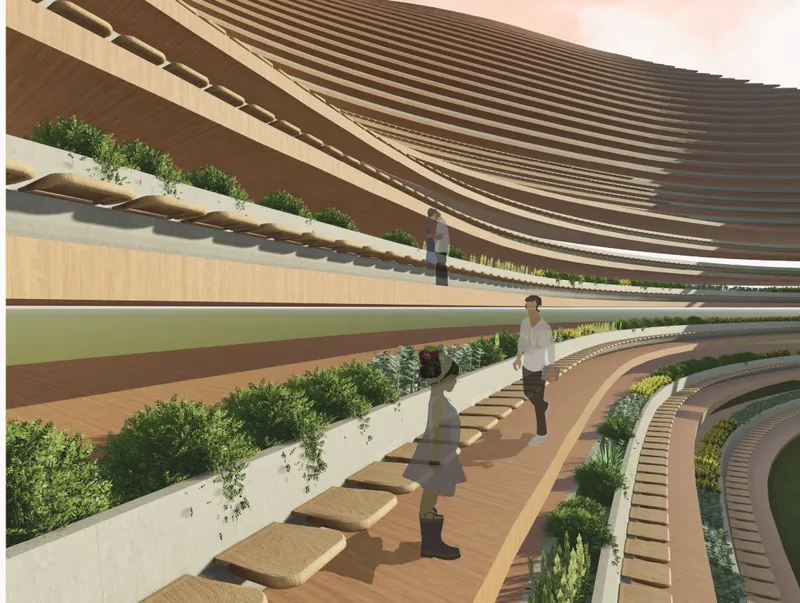
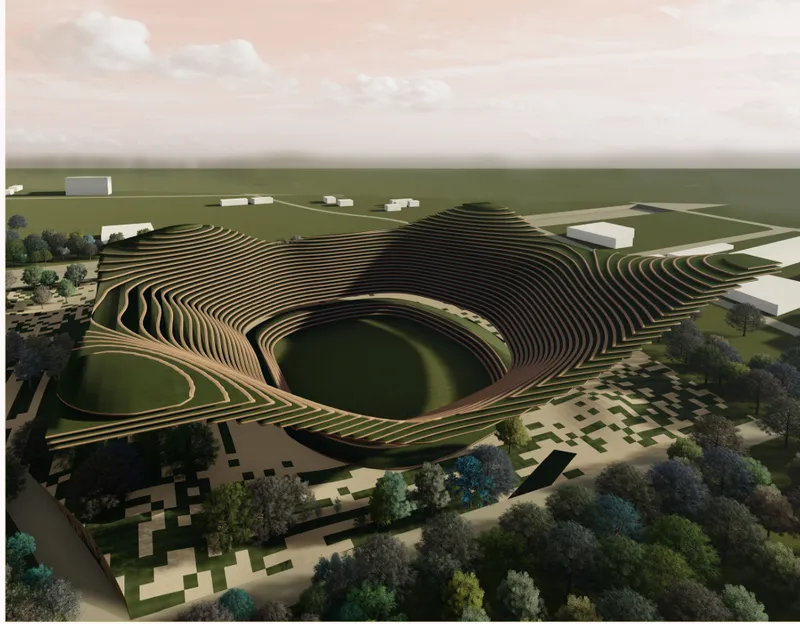
The interior promenade is the project's most compelling space. Terraced planting beds step down alongside curved wooden seating, all sheltered beneath a horizontal laminated timber roof that filters light without sealing it out. The effect is closer to a covered market garden than a concourse. Visitors move through productive landscape rather than past it, and the timber structure overhead reinforces the organic continuity between architecture and cultivation.
From above, the undulating roof reads as a topographic landform wrapping a central void. The aerial view reveals how trees punctuate the perimeter, blurring the edge between the stadium's footprint and its surrounding landscape. The central opening keeps the playing field oriented to open sky while the surrounding timber canopy defines a sheltered threshold zone for the agricultural and social programs.
Layering Landscape, Structure, and Roof
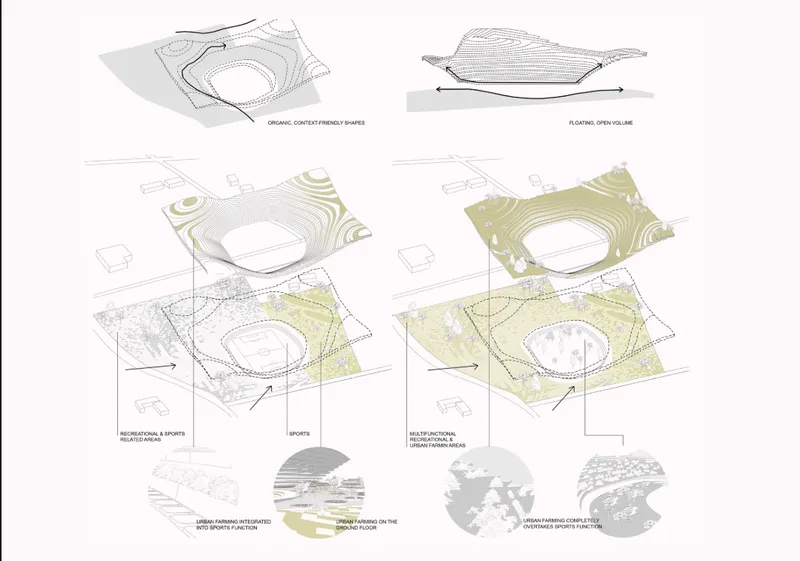
A diagram series breaks the design into its constituent layers: landscape at the base, structural framework in the middle, and the flowing roof form on top. Plan and section drawings show how each layer operates independently but locks together to create the building's wavy horizontal profile. The logic is additive rather than monolithic; the stadium is assembled from landscape up, not from enclosure down.
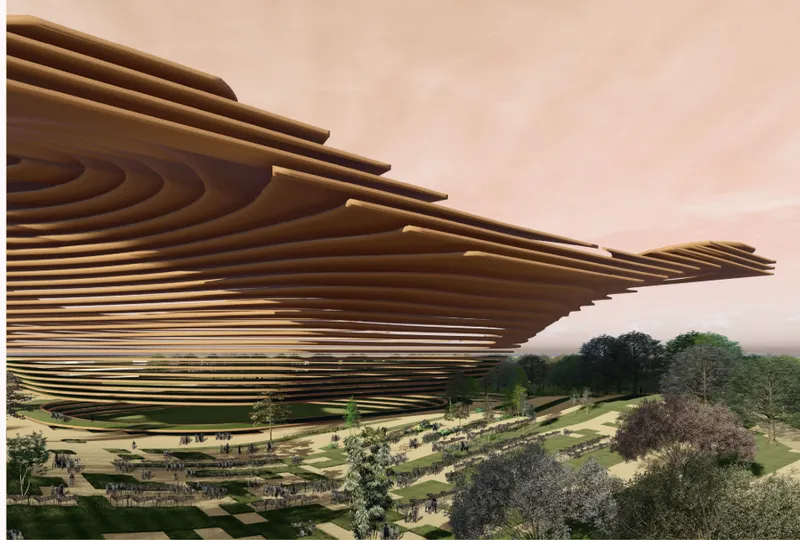
At dusk, the side elevation reveals the cantilevered timber roof extending well beyond the building's base, sheltering the landscaped grounds beneath it. The cantilever is generous enough to define outdoor rooms without walls, creating covered public space that remains permeable to air and views. The horizontal layering of timber members gives the structure a geological quality, as if the roof were a sedimentary formation pressed flat by time.
Public Ground Beneath the Canopy
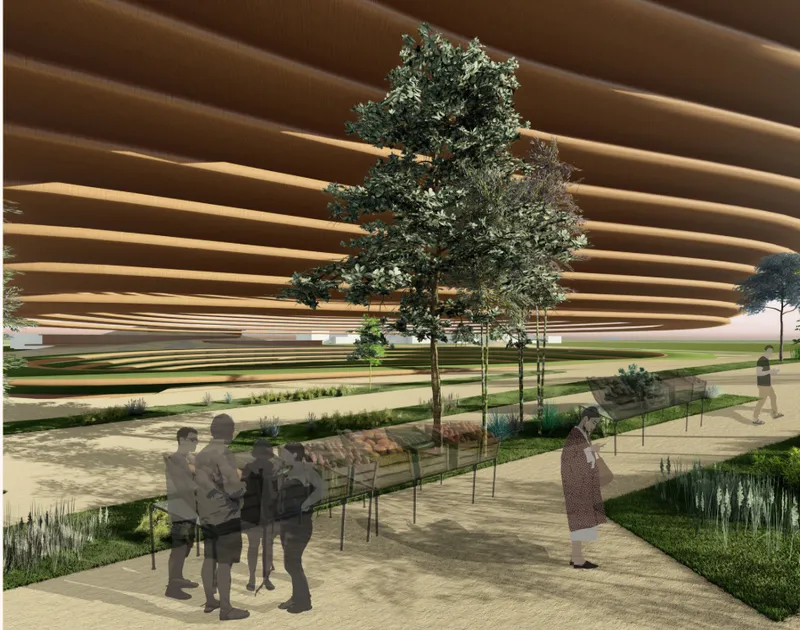
At ground level, the stadium dissolves into parkland. Visitors walk past planted beds and mature trees, moving freely beneath the laminated timber roof without encountering turnstiles or barriers. The absence of a conventional facade is deliberate: this is a building designed to be entered from any direction, at any time, for reasons that have nothing to do with a scheduled match. The planted beds serve as both landscape infrastructure and food production, reinforcing the symbiotic relationship between sport and agriculture that drives the entire concept.
The Bowl in Section: Seating, Planters, and Trees
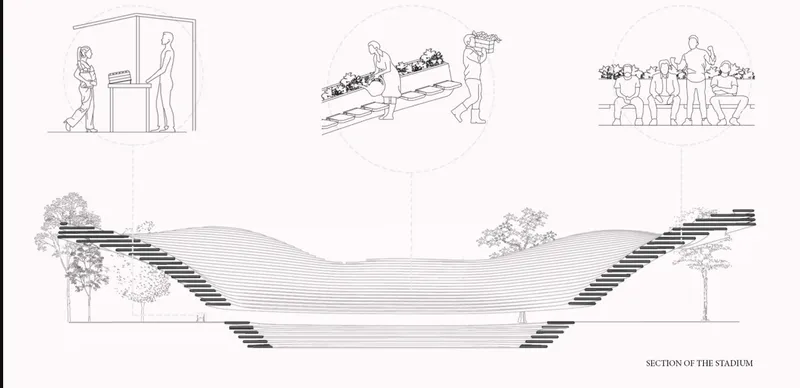
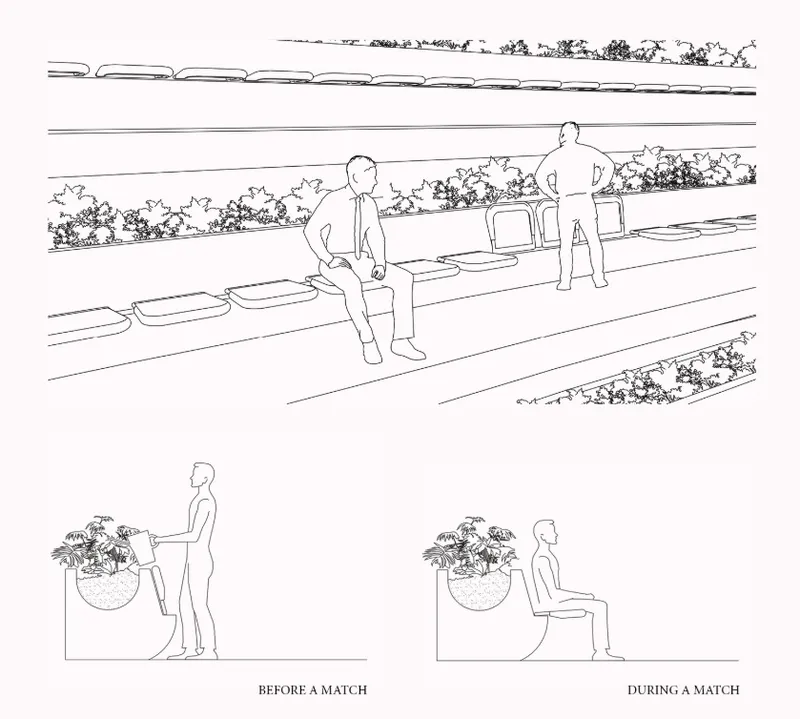
Two sectional drawings expose the stadium's bowl-shaped profile. Terraced seating descends toward the pitch in the conventional manner, but flanking trees and integrated planters interrupt the expected uniformity of the grandstand. The sections show how vegetation is not an afterthought applied to the roof but a structural layer woven into the seating tiers themselves. Detail vignettes of people standing and sitting in these planted zones illustrate the intended scale: intimate, walkable, and close enough to the soil to touch it.
The result is a seating bowl that reads more like a terraced hillside than a sports facility. By alternating rows of seats with rows of plants, the design ensures that even on non-match days the stadium has a reason to be occupied. It becomes a productive landscape that happens to contain a pitch, rather than a pitch surrounded by empty seats.
Why This Project Matters
Stadiums are among the most resource-intensive building types, and their utilization rates are notoriously low. Most sit empty for the vast majority of the year, consuming land and energy while contributing little to daily urban life. The Green Stadium Montpellier confronts that inefficiency head on by making the building productive in its idle state. Urban farming, public promenades, and open parkland ensure the structure serves its neighborhood continuously, not just on match days.
Terzibasiyan's proposal is speculative, but its core argument is practical: if a stadium must occupy a significant parcel of urban land, it should give something back every single day. The laminated timber structure, the integrated planting, and the elimination of a hard perimeter all point toward a model where large-scale sports architecture operates as civic infrastructure rather than a periodic spectacle. That shift in expectation, from event venue to productive landscape, is the project's most valuable contribution.
View the Full Project
About the Designers
Designer: Misak Terzibasiyan
Enter a Design Competition on uni.xyz
uni.xyz runs architecture and design competitions year-round that reward proposals with spatial conviction and real site intelligence.
Project credits: Green Stadium Montpellier by Misak Terzibasiyan Staydium 2020, (uni.xyz).


Popular Articles
Popular articles from the community


Manzana Morphosis: Stretching Barcelona's Grid into a Living Landscape for 2050
A radical reworking of the Eixample manzana turns density into a tool for generous public space, vertical ecology, and environmental performance.

Opera by the Sea Estonia: Three Shells Dissolving Architecture into Tallinn's Coastline
A winning opera house proposal replaces monumental form with interconnected shells that blur the boundary between building, park and Baltic Sea.

Opera on the Sea: Driftwood Logic Shapes a Timber Opera House on Estonia's Coast
Trevor Orgill's opera house translates the entangled drift of floating timber into a civic building where wood, water, and music converge.
Faces of the Soviet Avant-Garde: Turning Moscow's Street Names into an Open-Air Museum
A network of sculptural installations across a Moscow residential district transforms forgotten architect names into spatial encounters with cultural memor

Similar Reads
You might also enjoy these articles

Pixel Gardens: One Repeated Module Stacked Into a Terraced Social Housing Tower for Famagusta
Salem Bader's shortlisted housing tower builds a vertical neighbourhood from one repeated module, offsetting units to carve terraces, light and air.

Bao Huynh Watercolor Atelier: A Serene Art Retreat in Hội An
Bao Huynh Watercolor Atelier in Hội An blends multifunctional art spaces, sustainable design, local materials, and family-friendly living in a serene environment.

Atelier Macri Concept Store Interior Design by CASE-REAL
Atelier Macri store features a "ko" counter, walnut wood details, cork displays, blending retail, gallery, and seamless customer experiences.

Manuel Vargas Izquierdo Stadium and High-Performance Sports Center: Architectural Excellence in Jalpa de Méndez
The Manuel Vargas Izquierdo Stadium blends sustainable design, inclusive sports facilities, and cultural-inspired architecture, revitalizing Jalpa de Méndez’s public spaces.

Explore Sports Architecture Competitions
Discover active competitions in this discipline

Challenge to design a barrier free sports center

Challenge to design an outdoor ice-rink and park
Comments (0)
Please login or sign up to add comments
No comments yet. Be the first to comment!