

TAHA Studio Weaves a Beachfront Restaurant from Stone, Timber, and Tropical Air in Vietnam
Hai Au Restaurant dissolves the boundary between dining and landscape through colonnaded pavilions, reflecting pools, and layered courtyards along the coas


Most beachfront restaurants treat the ocean as a backdrop: a nice view beyond a wall of glass. TAHA Studio takes a different position with Hai Au Restaurant, a sprawling complex of gabled pavilions that treats the entire site as a negotiation between interior and exterior. The building does not face the water so much as it absorbs the landscape, pulling light, air, and vegetation through a sequence of colonnaded walkways, courtyards, and reflecting pools that make the act of arriving at your table feel like moving through a garden.
What makes the project genuinely compelling is not the tropical material palette, which is familiar territory in Vietnamese contemporary architecture, but the spatial strategy. Rather than a single volume, TAHA Studio fragments the program into a constellation of pavilion-scaled rooms linked by covered passages. Each room captures a different quality of light and a different relationship to the outdoors. The result is a restaurant that feels simultaneously intimate and generous, a place where a meal unfolds across thresholds rather than within four walls.
A Colonnade That Builds the Street
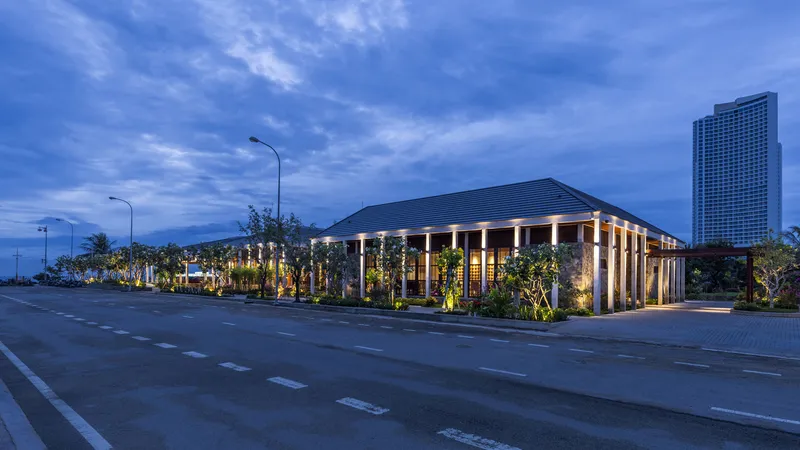
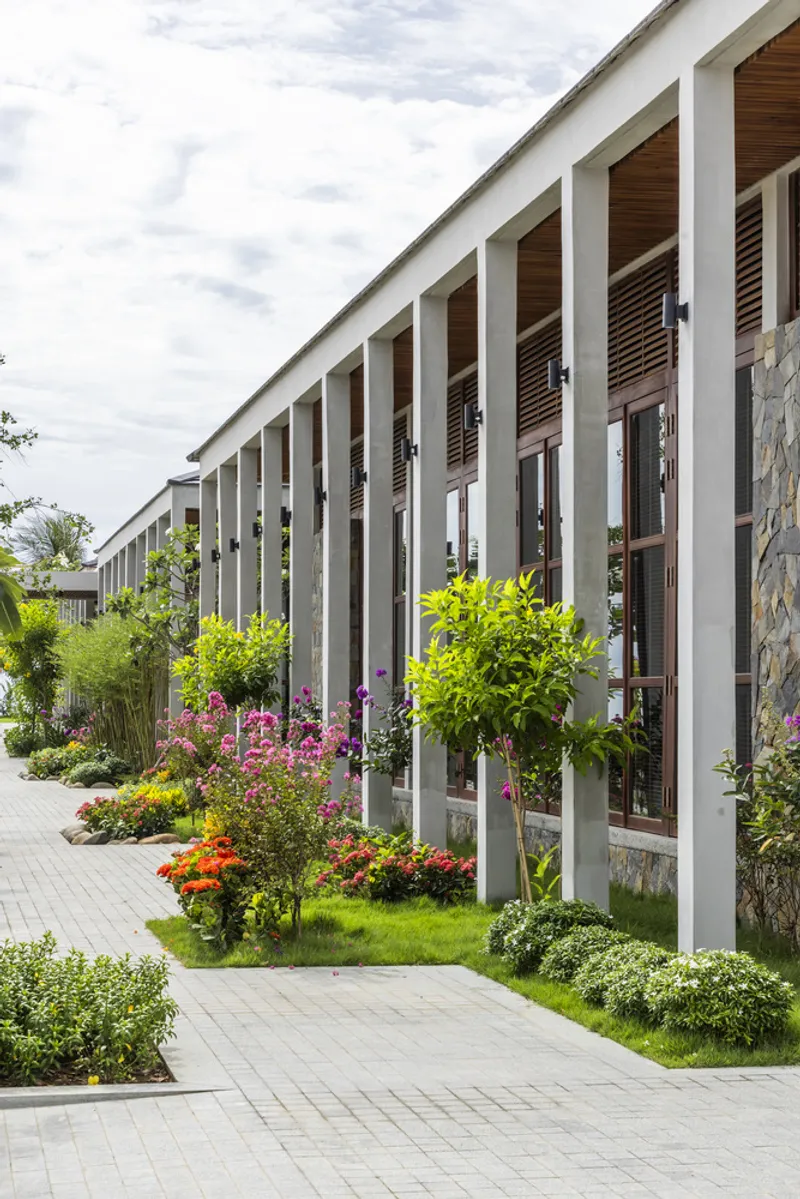
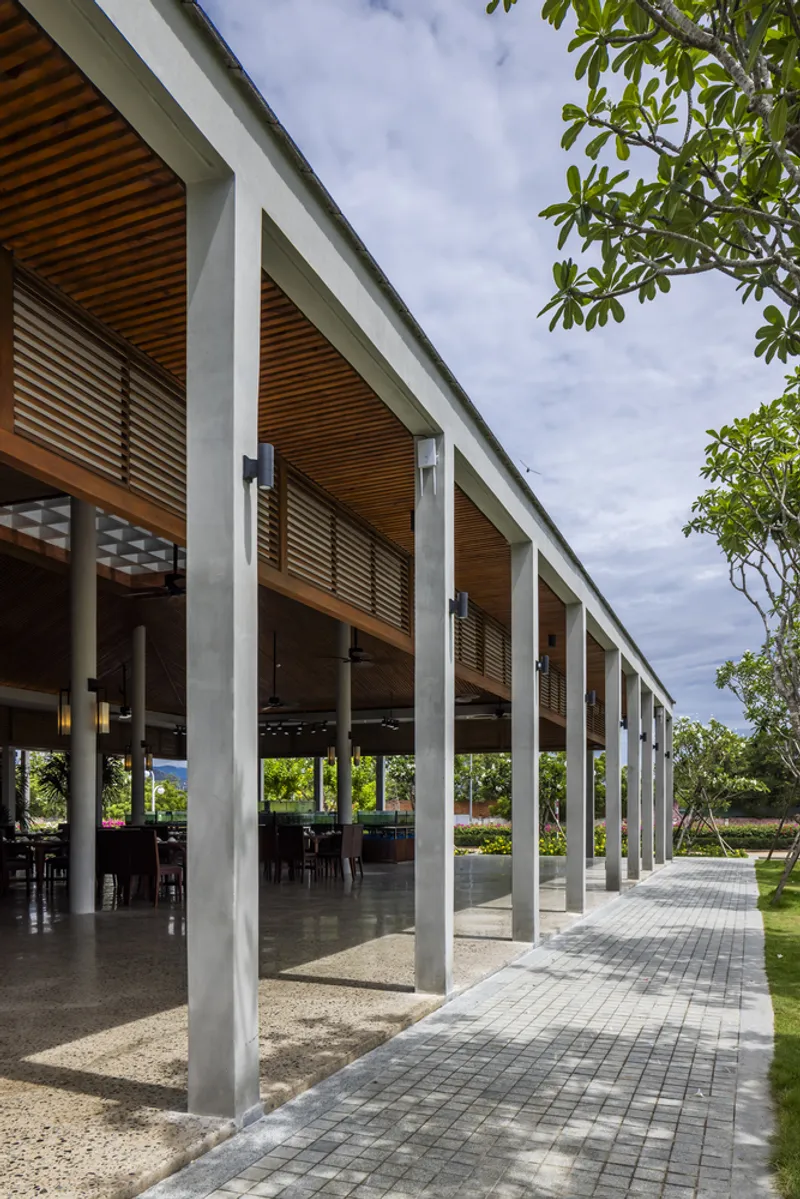
Along its street edge, the restaurant presents a long colonnaded facade of white concrete columns screened by timber louver panels. At dusk, warm uplighting transforms the colonnade into a lantern, but during the day the composition reads as civic infrastructure: a covered sidewalk, planted beds of flowering shrubs, and a disciplined rhythm of verticals that gives the building a public face without resorting to signage or spectacle.
The timber slat soffit running continuously overhead ties the colonnade together and softens the concrete structure. It is a move borrowed from traditional Vietnamese shophouse design, where a deep overhang mediates between the intensity of the street and the privacy of the interior. Here it works at a larger scale, establishing a threshold zone that belongs equally to the city and to the restaurant.
Stone, Water, and the Art of Arrival
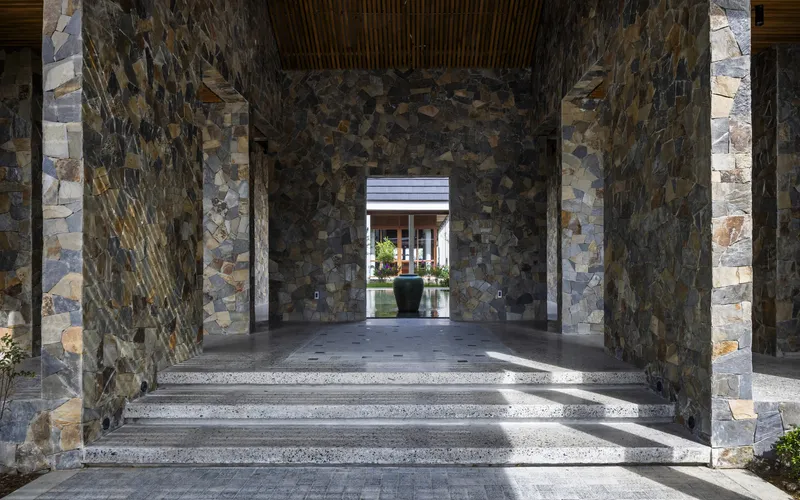
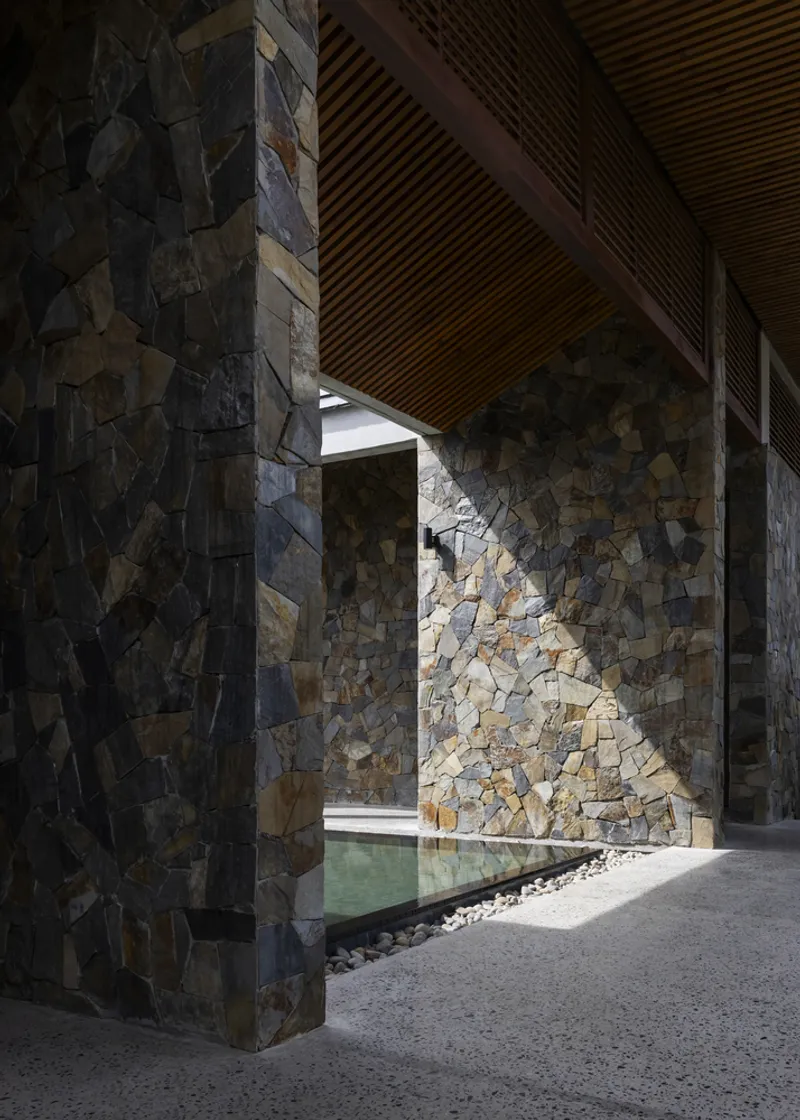
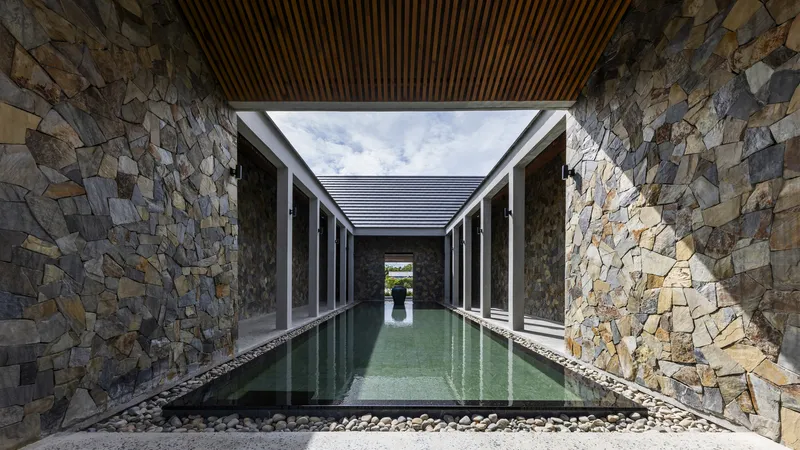
Entry into the restaurant is choreographed through a series of mosaic stone walls, reflecting pools, and framed vistas. The vestibule uses rough, irregular stone cladding on its columns to create a tactile density that slows you down, each successive threshold narrowing and then widening the view ahead. A shallow reflecting pool runs alongside the path, its still surface doubling the timber slatted ceiling above.
These are not decorative gestures. The water cools the air moving through the passages, and the stone's thermal mass moderates temperatures in a climate where mechanical cooling would otherwise dominate. TAHA Studio uses the same elements to solve environmental and atmospheric problems simultaneously, which is the hallmark of architecture that actually takes the tropics seriously rather than merely referencing them.
Courtyards as Connective Tissue
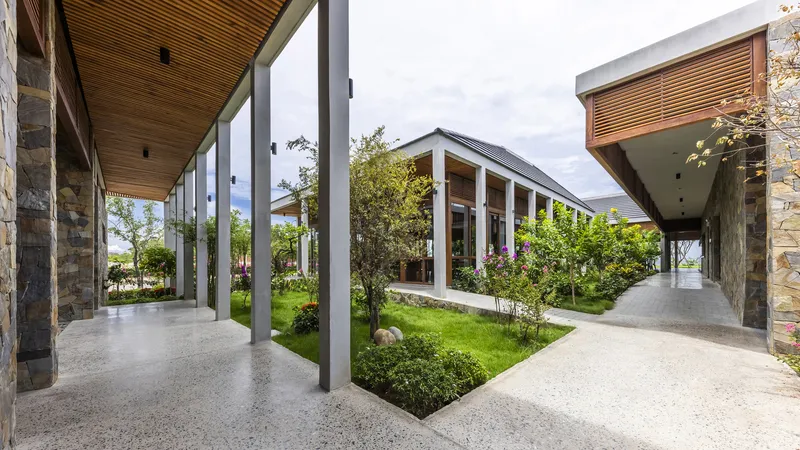
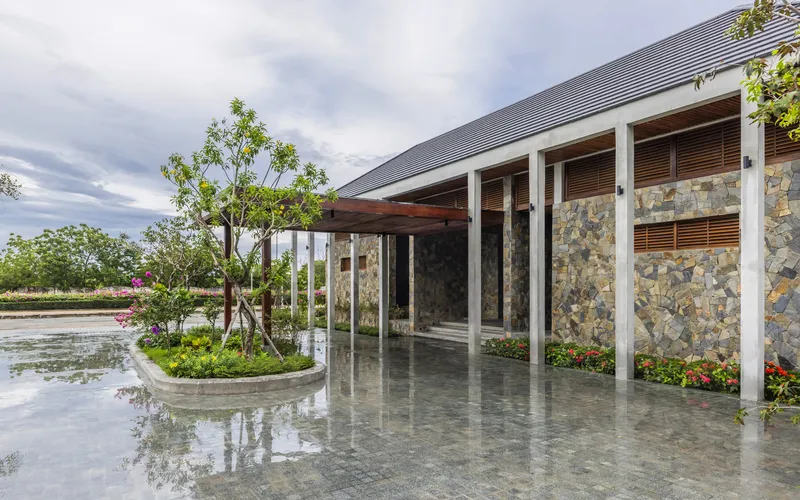
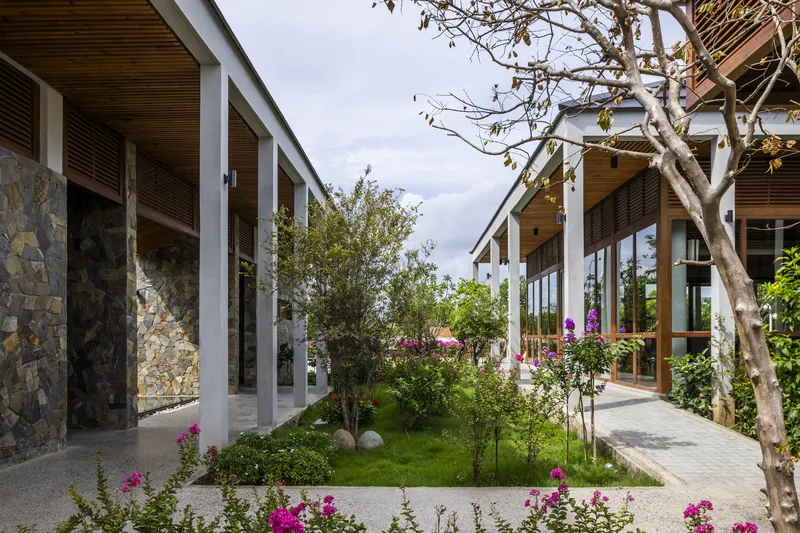
The courtyards at Hai Au are not leftover space between buildings. They are the primary organizing device. Gravel paths, planted beds, and flowering shrubs fill the gaps between pavilions, creating micro-gardens that ventilate the complex while providing visual relief from the dining rooms. After rain, wet paving catches reflections of the white columns and timber soffits, and the whole composition takes on a luminous calm.
Covered walkways line the courtyard edges, offering shaded routes between dining spaces. The columns along these walkways are sometimes smooth concrete, sometimes clad in the same rough mosaic stone seen at the entry, creating subtle shifts in texture as you move through the complex. Bare trees and dense tropical plantings alternate, suggesting seasons and growth rather than a fixed, manicured landscape.
Dining Under Timber and Light
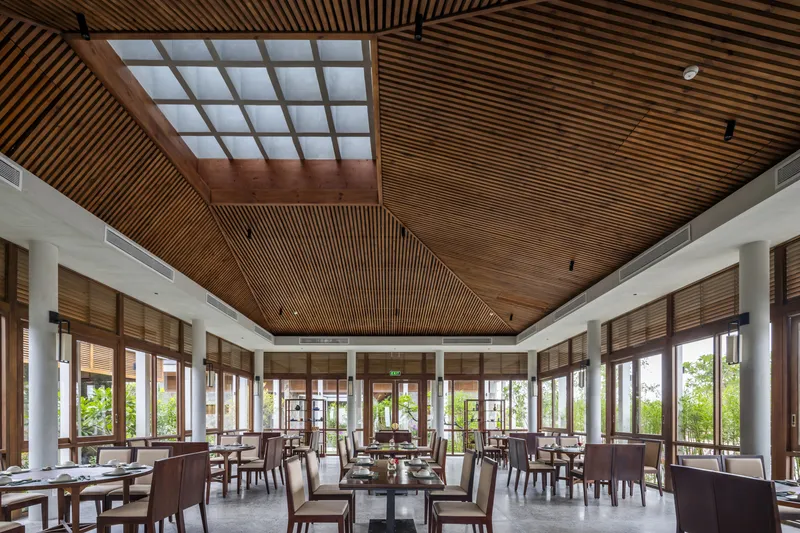
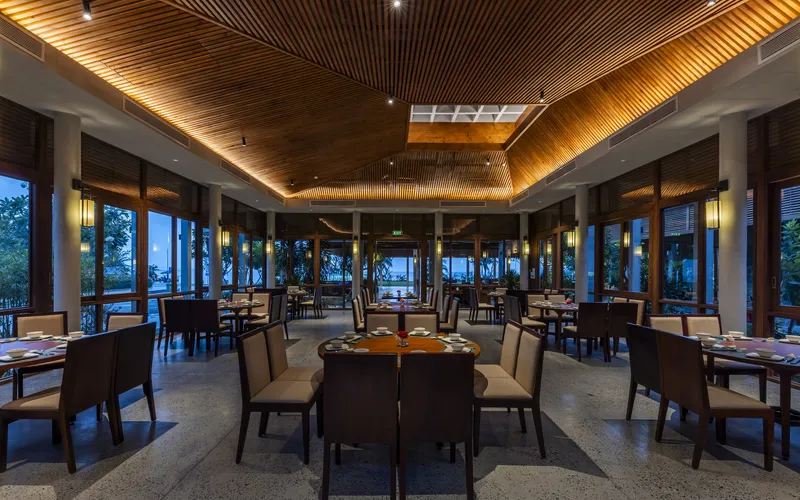
Inside the dining pavilions, timber slatted ceilings are the dominant overhead surface. In the main room, a central skylight grid punches through the ceiling plane, casting a controlled wash of natural light across the tables below. At twilight, the timber surfaces glow under concealed artificial lighting, and floor-to-ceiling glazing opens the room to water views that feel earned rather than simply given.
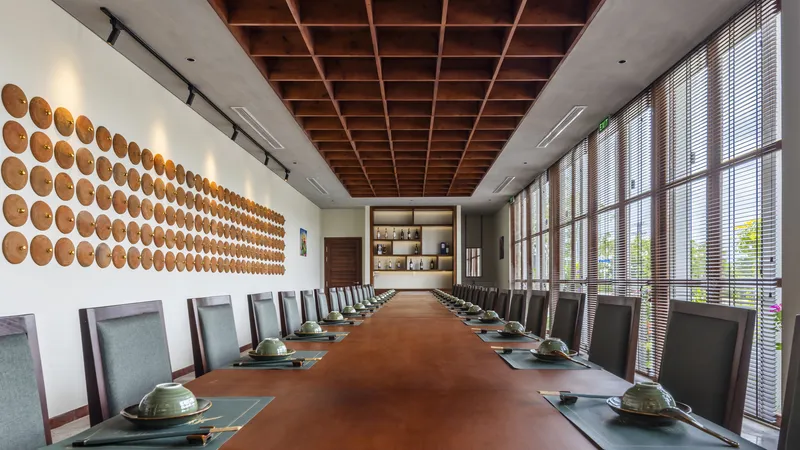
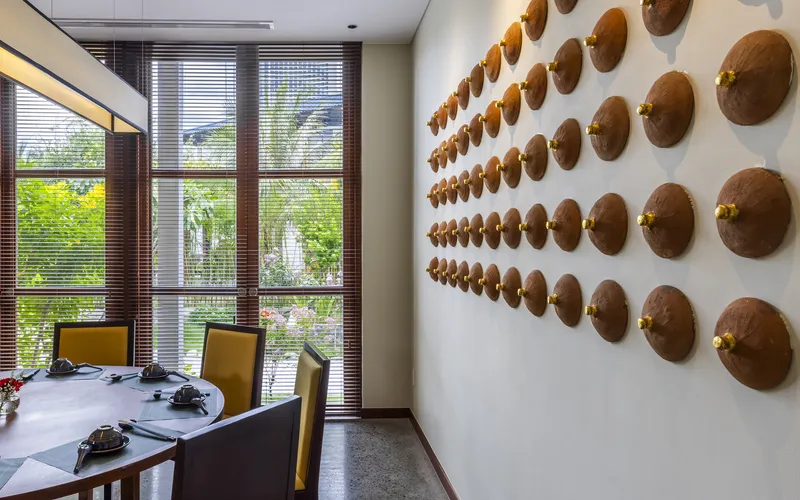
A private dining room introduces a different character: a coffered timber ceiling, wooden blinds filtering daylight into horizontal bands, and a circular wall installation of copper discs that adds a warm metallic texture. The space is quieter and more enclosed, proof that TAHA Studio understands variety within a consistent material language. Each room has its own quality of light, yet they all clearly belong to the same building.
Framing the Landscape
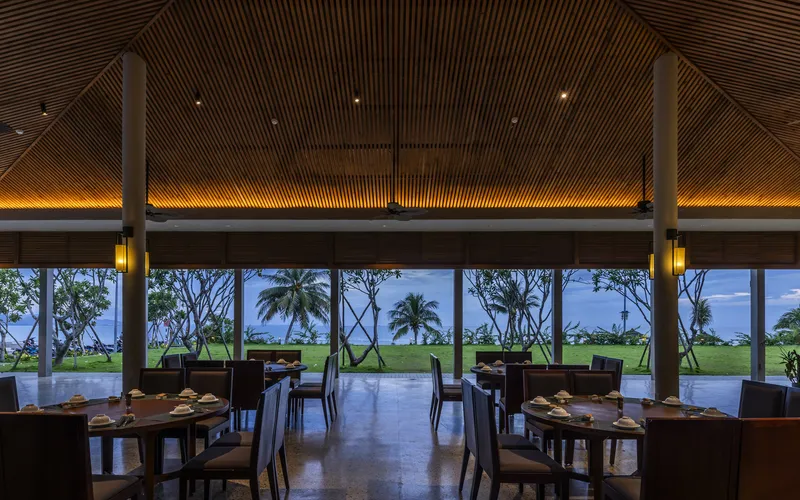
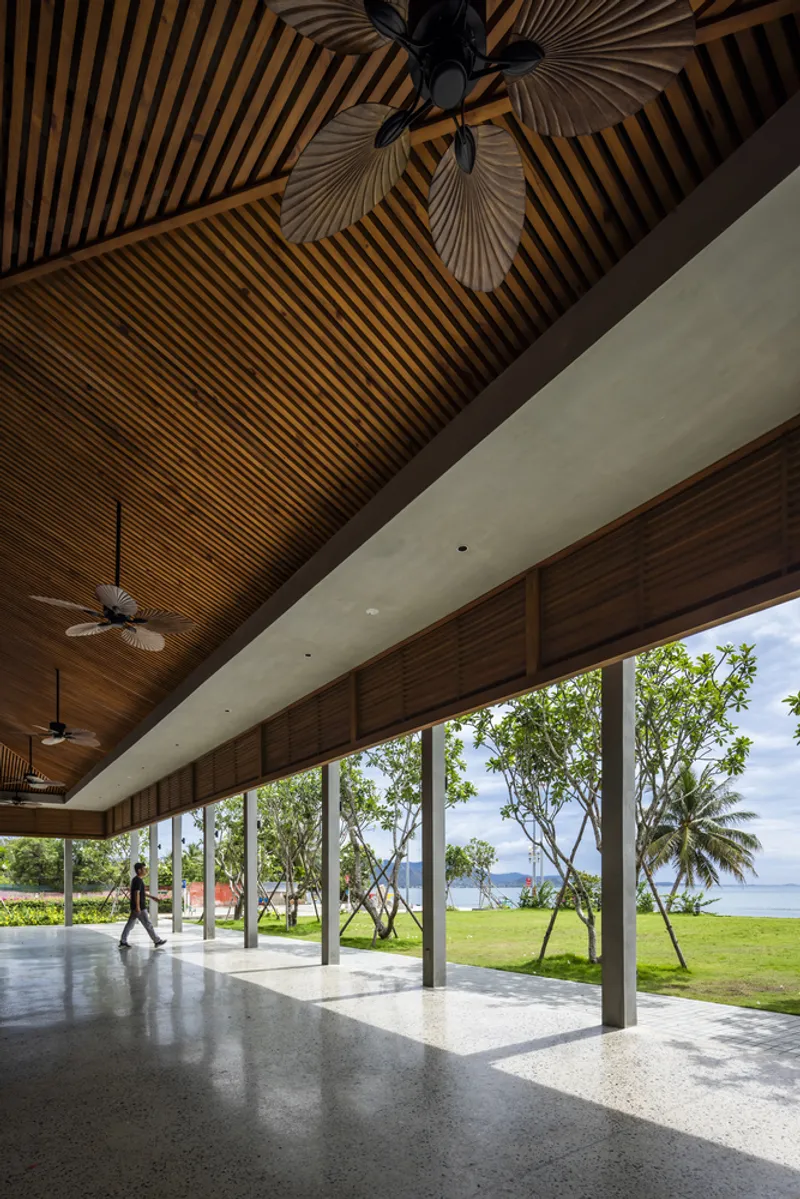
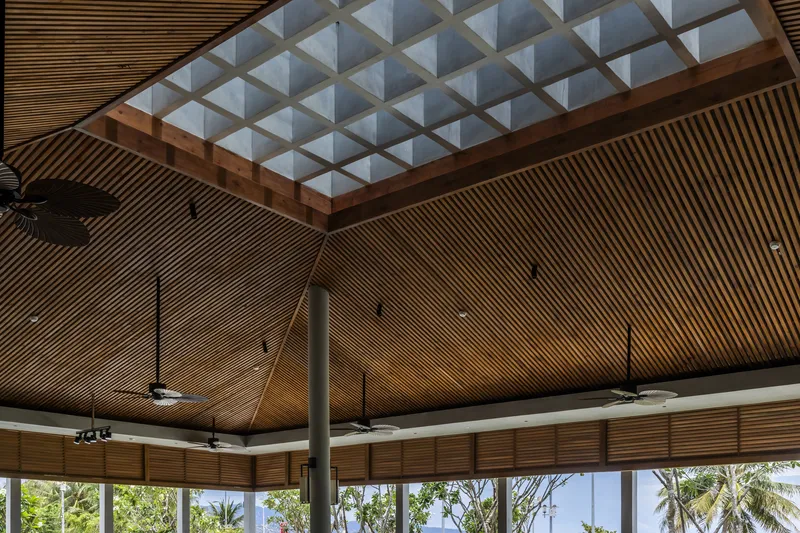
The relationship between inside and outside is never accidental. One dining space frames palm trees and a manicured lawn through full-height glazing, composing the garden as a deliberate picture. An open pavilion with a terrazzo floor looks out over coastal palms and sky, functioning almost as a covered terrace. Overhead, a pyramidal skylight set within the timber slatted ceiling allows palm fronds to press against the glazing, collapsing the distance between architecture and canopy.
These framing devices give each space a distinct orientation. You are always aware of where the water is, where the garden is, where the street is. The building makes the site legible rather than abstracting it away.
Materiality Along the Passages
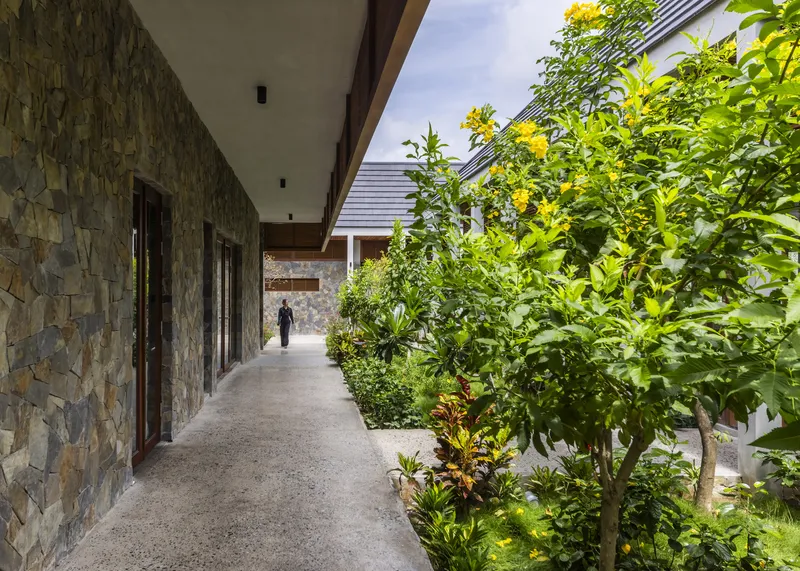
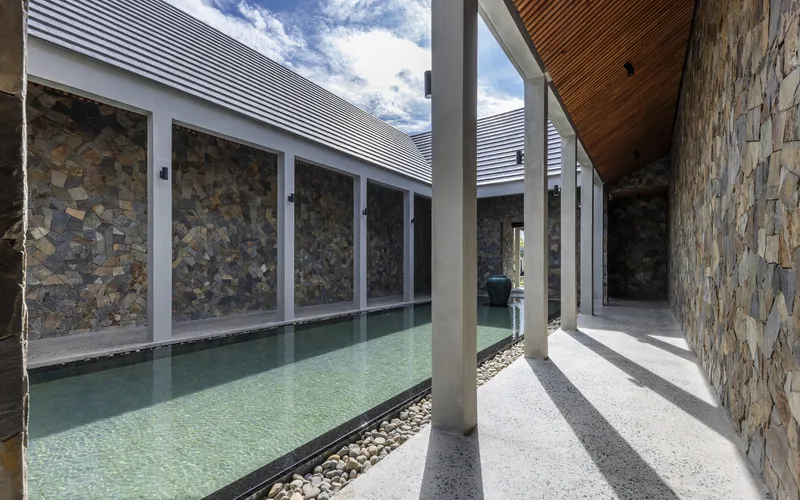
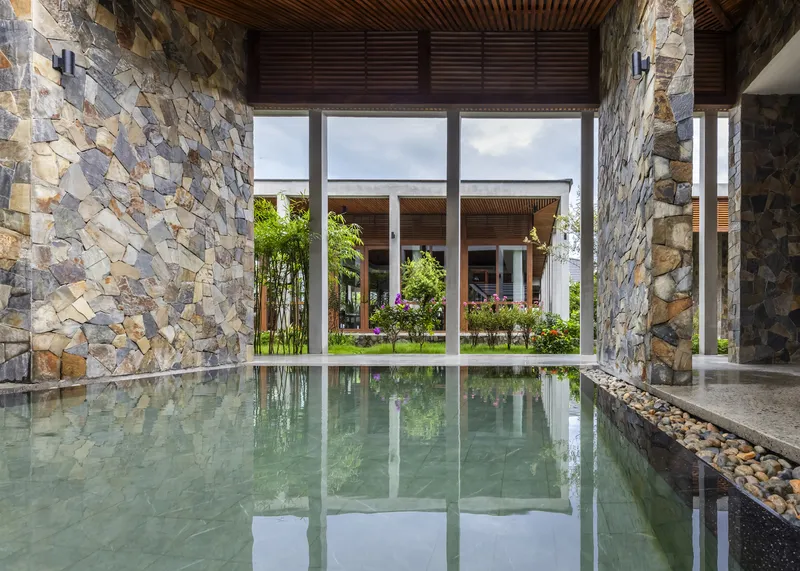
The outdoor corridors connecting the pavilions deserve attention on their own. Along one passage, a rough stone wall rises beside dense tropical plantings, and the path narrows to a single figure's width. Shadows from the timber soffit stripe the ground. Along another, a shallow pool with pebble edging catches afternoon light and cools the air moving toward the dining rooms.
An interior reflecting pool flanked by curved stone walls introduces an almost grotto-like atmosphere, with the timber slatted ceiling pressing low overhead. These are generous moments of spatial compression that make the open pavilions feel even more expansive by contrast. The material palette stays tight throughout: stone, timber, water, concrete. Nothing is applied; everything is structural or environmental.
The Aerial View and Physical Models
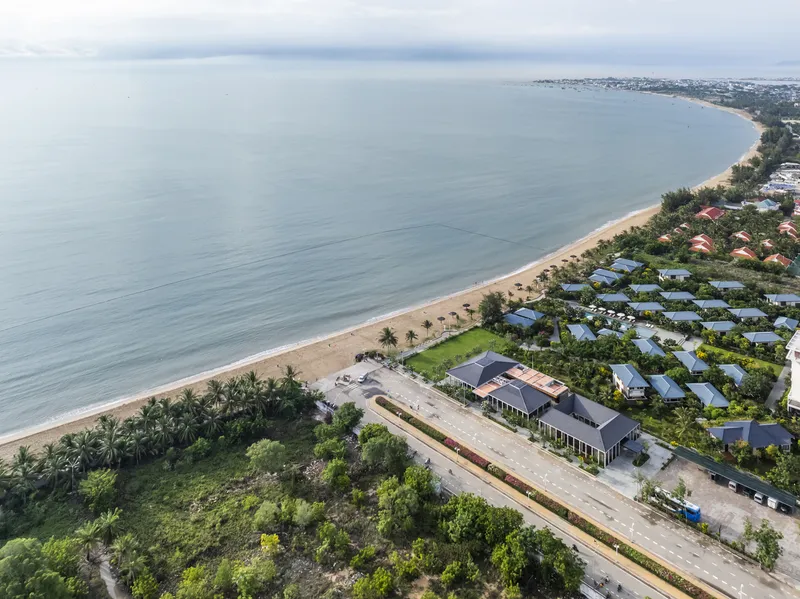
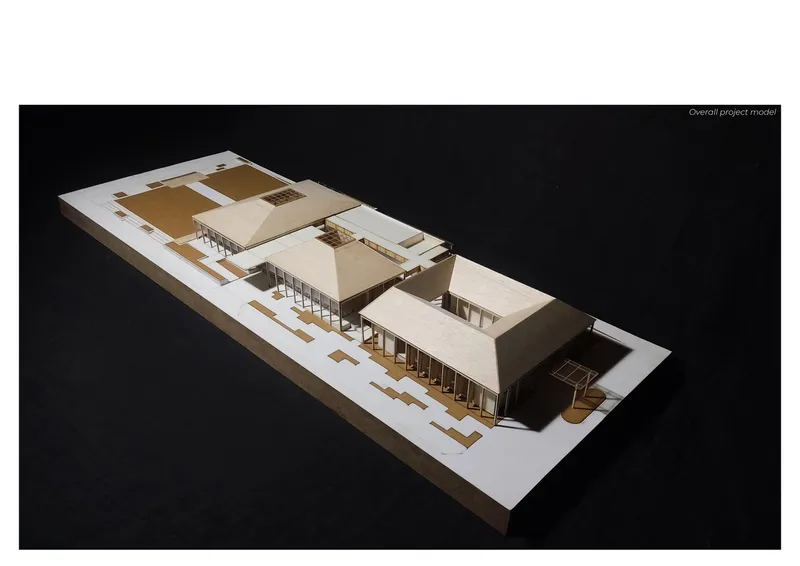
Seen from above, the complex reads as a cluster of gabled roofs nestled between palm trees and a sandy beach. The pitched forms sit low against the landscape, their scale deliberately modest. There is no landmark gesture, no swooping roofline competing with the coastline. The architecture defers to the trees.
Physical models reveal the logic more clearly: interlocking gabled volumes create a field of courtyards and colonnaded walkways, with pyramidal roof peaks marking the major dining rooms. The top view shows how tightly the pavilions are packed, yet how much open space remains between them. It is a dense plan that reads as porous, which is the project's essential trick.
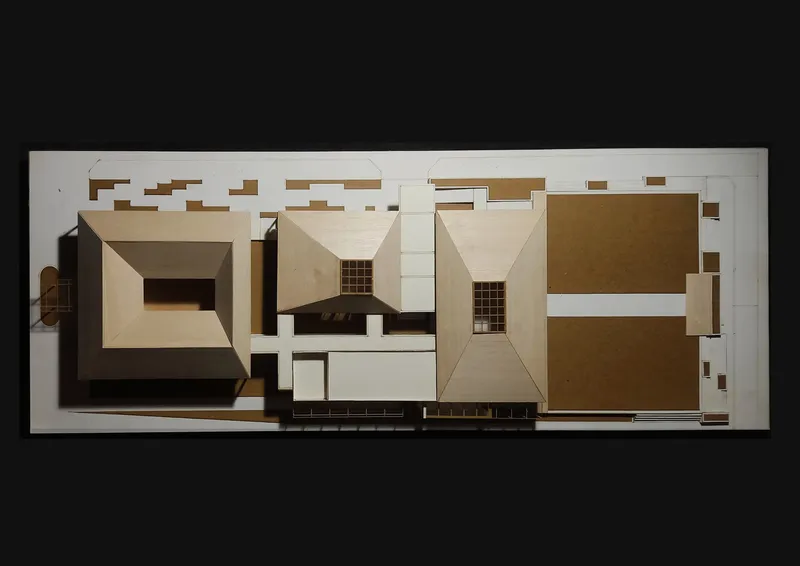
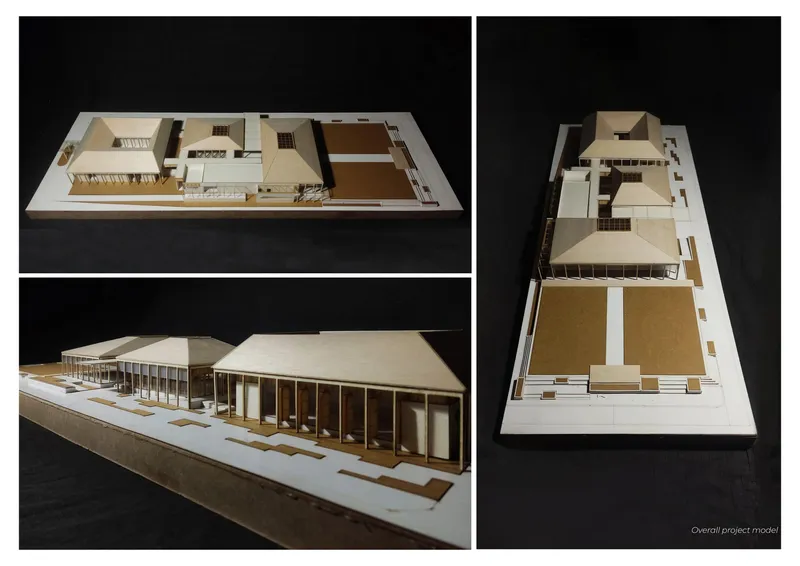
The model studies also make visible the interior courtyards that would be impossible to read from ground level. These voids are proportionally generous, far larger than the rooms they serve, which explains why the building breathes so well in Vietnam's humid coastal climate.
Plans and Drawings
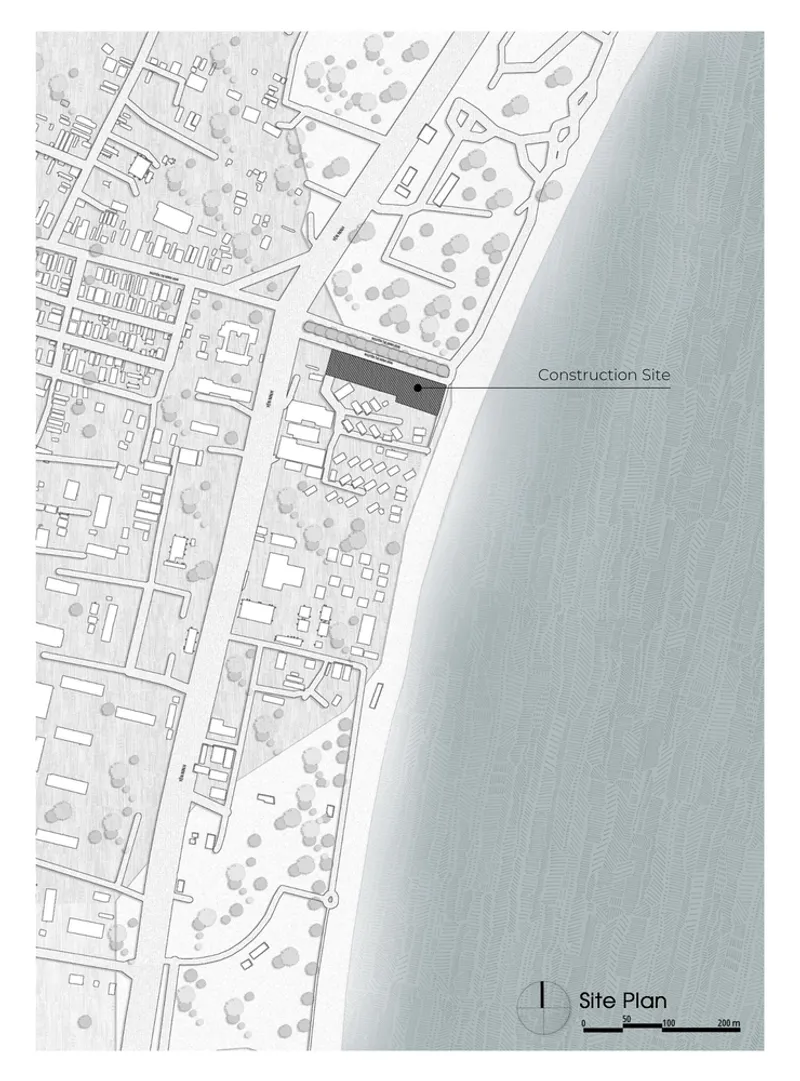
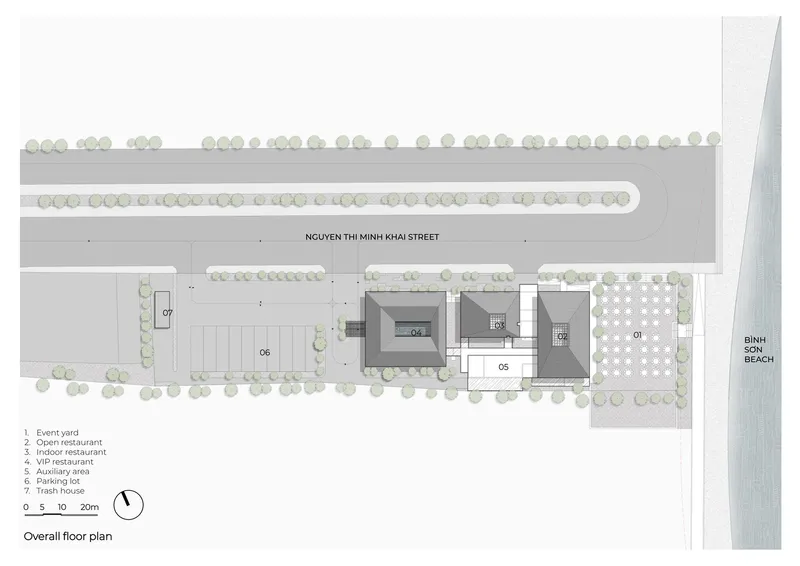
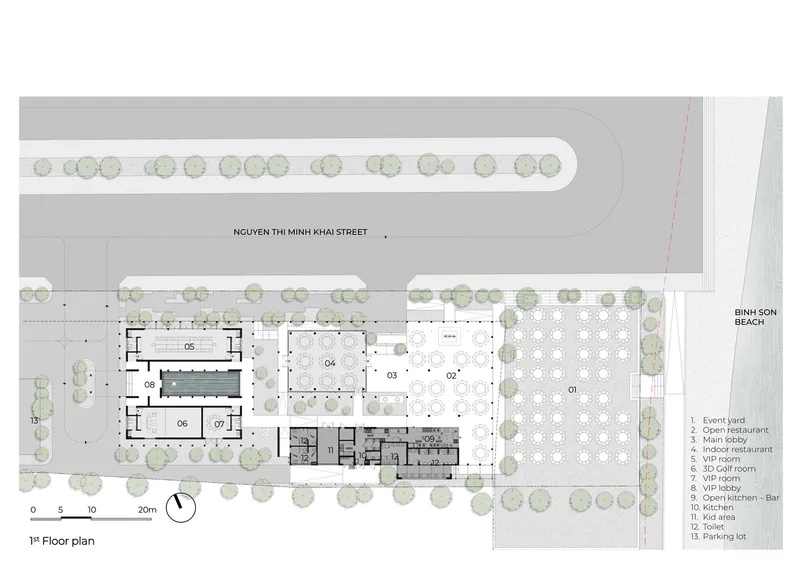
The site plan confirms what the aerial view suggests: the building mediates between a waterfront promenade and an urban street grid, with vegetation buffering both edges. The floor plan reveals how the pavilion volumes are arranged along a loose east-west axis, with courtyards opening toward the beach. A patterned outdoor terrace at the seafront edge extends the dining program into the open air.
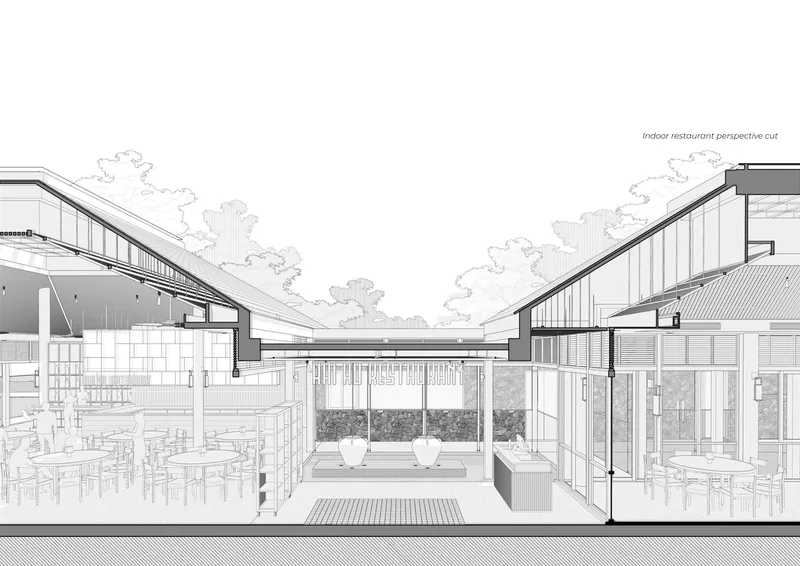
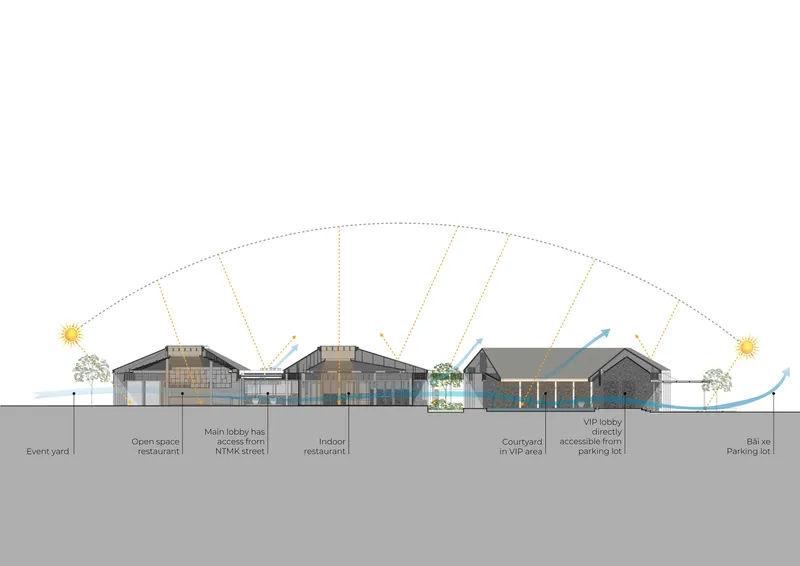
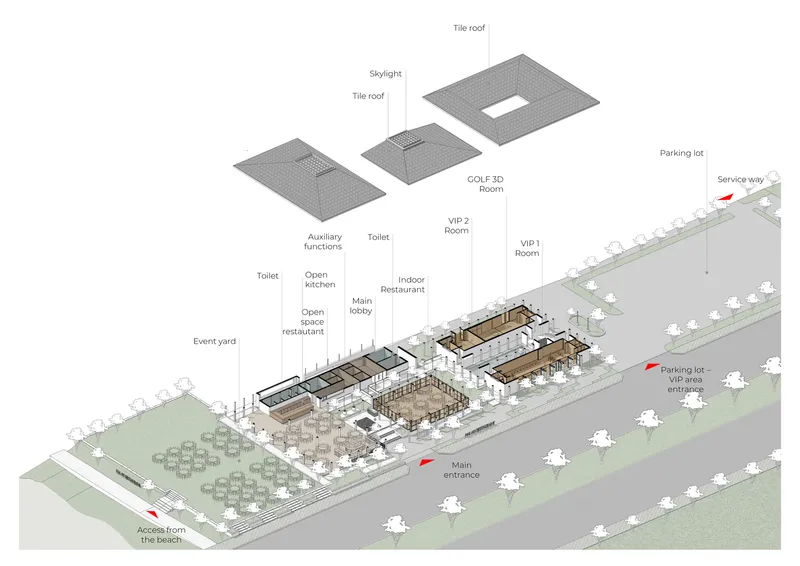
Section drawings illustrate the pitched rooflines and their relationship to solar angles, with path diagrams showing how the overhangs and roof peaks manage direct sun throughout the day. The perspective section through the dining spaces reveals how courtyards are sandwiched between glazed walls, creating visual depth while enabling cross-ventilation. An axonometric exploded view isolates the tile roof elements hovering above the plan, making clear that the roof system is a distinct architectural layer designed to shade and ventilate the spaces beneath.
Why This Project Matters
Hai Au Restaurant is significant because it demonstrates that tropical sustainability is a spatial problem, not a technological one. TAHA Studio does not rely on green roofs, solar panels, or certification checklists. Instead, the firm works with courtyards, water, stone mass, and cross-ventilation to produce a building that stays cool, stays beautiful, and stays connected to its site. The environmental performance is inseparable from the architectural experience.
Beyond its climate strategies, the project offers a compelling model for hospitality architecture in Southeast Asia. It refuses the sealed glass box and the air-conditioned interior in favor of porosity, thresholds, and layered passages that make dining a journey through landscape. In a region where beachfront development often means erasure of context, Hai Au sits lightly, defers to its palms, and lets the air in.
Hai Au Restaurant by TAHA Studio, Vietnam. Photography by Hiroyuki Oki.
About the Studio
Share Your Own Work on uni.xyz
If projects like this are the kind of work you want to make, uni.xyz is a place to publish your own, find collaborators, and enter design competitions.


Popular Articles
Popular articles from the community


The Amber Palace Opera: A Geological Fiction Surfaces on Tallinn's Baltic Waterfront
Pierre Brillard reimagines a Baltic legend as a public landscape, opera house, and waterfront promenade rooted in Tallinn's coastal identity.


David Ortega Stacks a Two-Story Mexico City Penthouse Around a Steel Stair and a Pergola-Shaded Roof Terrace
In Colonia Roma, a 300 m² penthouse uses oak joinery, a planted steel stair and a slatted roof pergola to make a new-build apartment feel like a house.

Cube Design Draws an Ecological Corridor Between Two Shenzhen Hills with the Nankai Building
Beside Shenzhen's container docks, the Nankai Building pairs stacked balconies with a climbing green screen to connect two hillsides across its height.

graciastudio Turns a Viewless Tijuana Lot Inward Around a Courtyard of Concrete, Timber and Trees
In Tijuana, Jorge Gracia's GA2 House stacks a timber-clad private floor over exposed concrete and replaces a missing view with a planted interior patio.

Similar Reads
You might also enjoy these articles


Hodi-Mandai Geram
Project Function: Preservation and revitalization of the Intangible heritage and socio-spatial identity of the Hodi by Housing, Cultural Memory Center, Sacred Grove, landscape, local tourism economy


Olio Towers: A Mid-Rise for Performers That Fuses Housing, Rehearsal, and Stage
Located blocks from Houston's Theater District, this modular tower stacks living units around a central performance atrium.

Oasis: Modular Green Housing Carved into Dhaka's Urban Fabric
A shortlisted Plugin Housing entry reclaims unauthorized settlements in Dhaka with stepped concrete volumes, green roofs, and ventilation-driven design.

Black Hole: A Floating Megastructure for the Post-Physical Era
Emiliano Mazzarotto envisions a spherical, self-scaling arena where e-sports, digital hotels, and holographic stadiums replace traditional public space.

Explore Vietnam Architecture Competitions
Discover active competitions in this discipline

Challenge to reimagine the Iron Throne

Photograph architecture without architects

Illustrate the lost glory of Angkor Wat - Render Challenge

Design challenge to reuse E-waste
Comments (0)
Please login or sign up to add comments
No comments yet. Be the first to comment!