
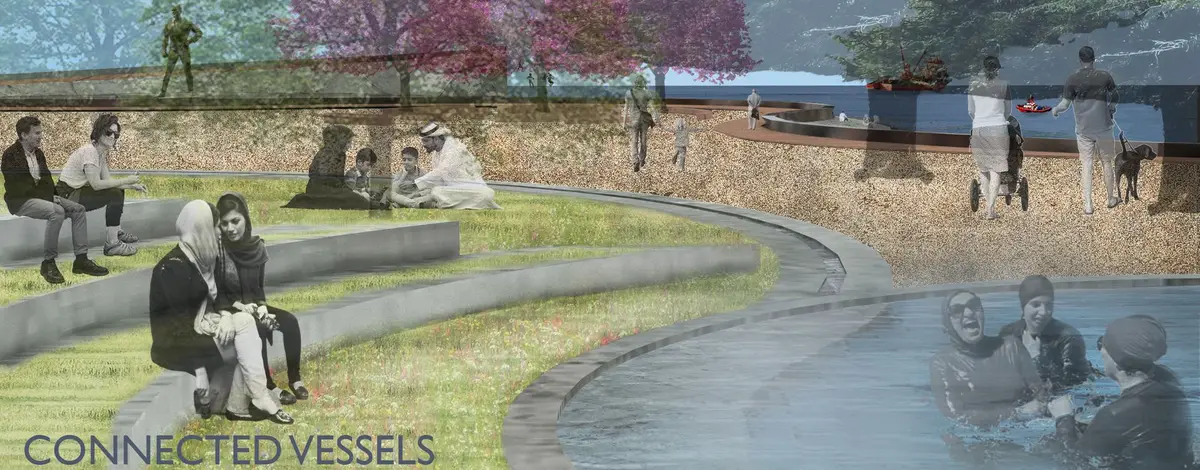
Connected Vessels: An Open-Loop Water System Woven into Public Landscape
A shortlisted entry for Ripple reimagines urban hydrology through interconnected vessels that collect, purify, and release water on-site.


What if a public plaza could function like a living organism, drinking in rainwater, filtering it through its own infrastructure, and breathing it back out? Connected Vessels proposes exactly that: an open-loop water system where a series of interconnected vessels collect, purify on-site, and release water in a continuous cycle. The result is not merely a park or a plaza but a self-sustaining hydrological landscape, one that treats water management as spatial design rather than hidden engineering.
Designed by Shai Haber-Thaler, Connected Vessels was a shortlisted entry for Ripple, a competition focused on water-conscious design. The project integrates natural filtration systems, permeable surfaces, rain gardens, and underground cisterns into a landscape that doubles as generous public space. Green corridors, shaded pathways, and native vegetation work alongside the hydrological infrastructure to promote biodiversity, urban cooling, and community life.
Archways and Corridors That Frame a Living System
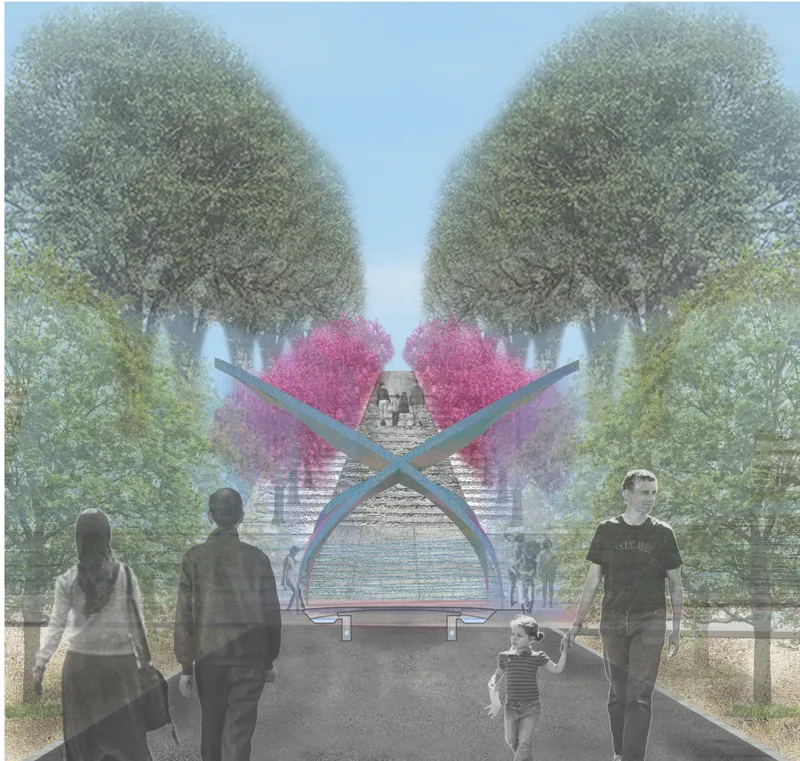
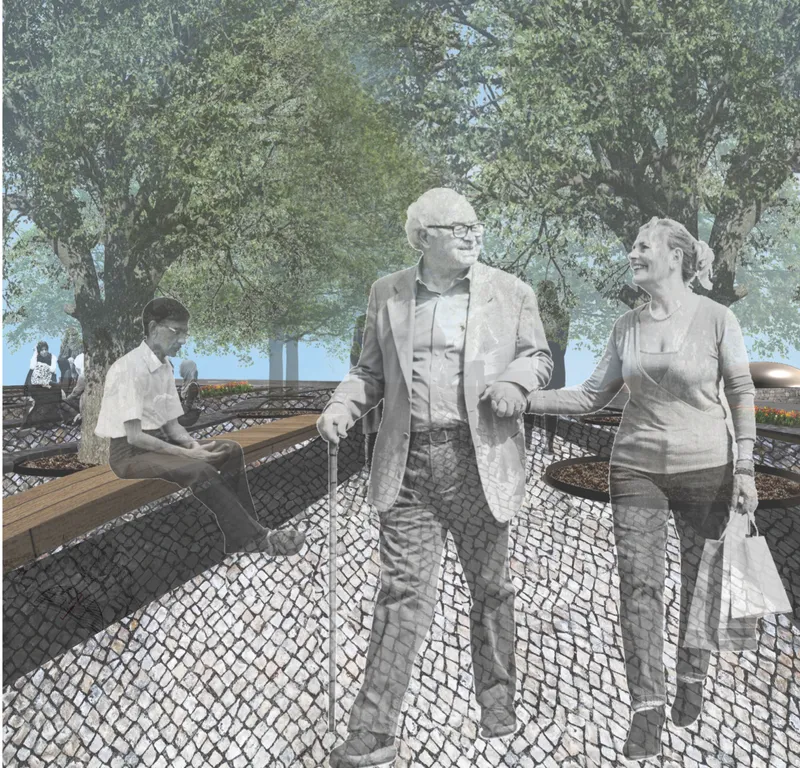
The entry sequence sets the tone immediately. A curved archway frames a tree-lined pathway flanked by pink flowering plants, drawing visitors into the landscape rather than past it. The arch is not decorative; it functions as a threshold between the conventional streetscape and the regenerative interior of the site. Beyond it, a plaza with diamond-patterned paving and timber benches sits beneath established trees, offering a gathering space that feels settled and permanent despite being designed from scratch.
These spaces prioritize community engagement by making the water infrastructure legible and inviting. You don't just pass through; you sit, observe the planted corridors, and begin to understand that the ground beneath you is working. The paving patterns are not arbitrary. They signal the permeable surfaces below, a quiet nod to the hydrological engineering that makes the entire project function.
Stone, Concrete, and Planted Terraces as Water Infrastructure
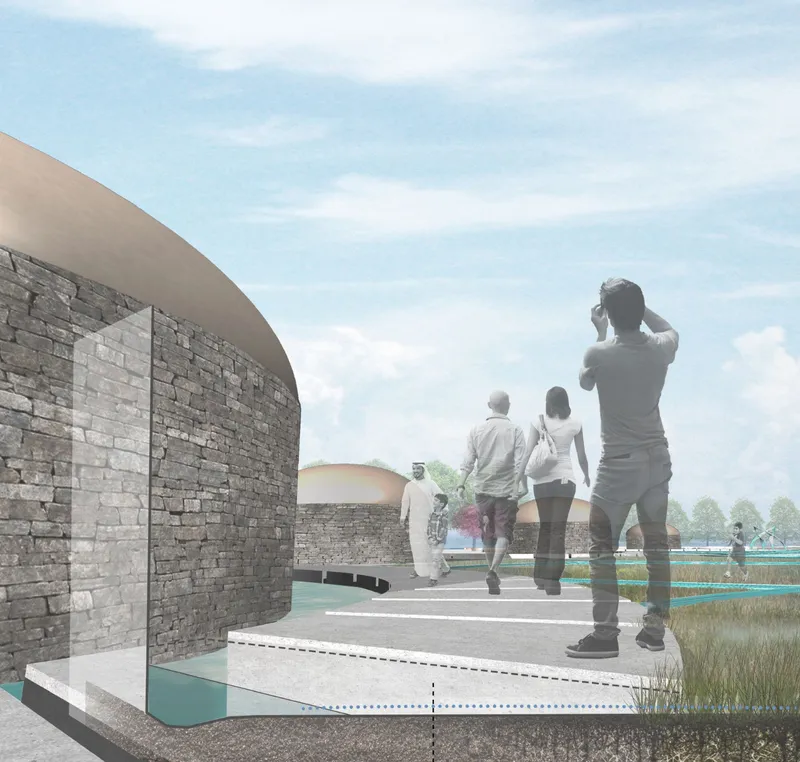
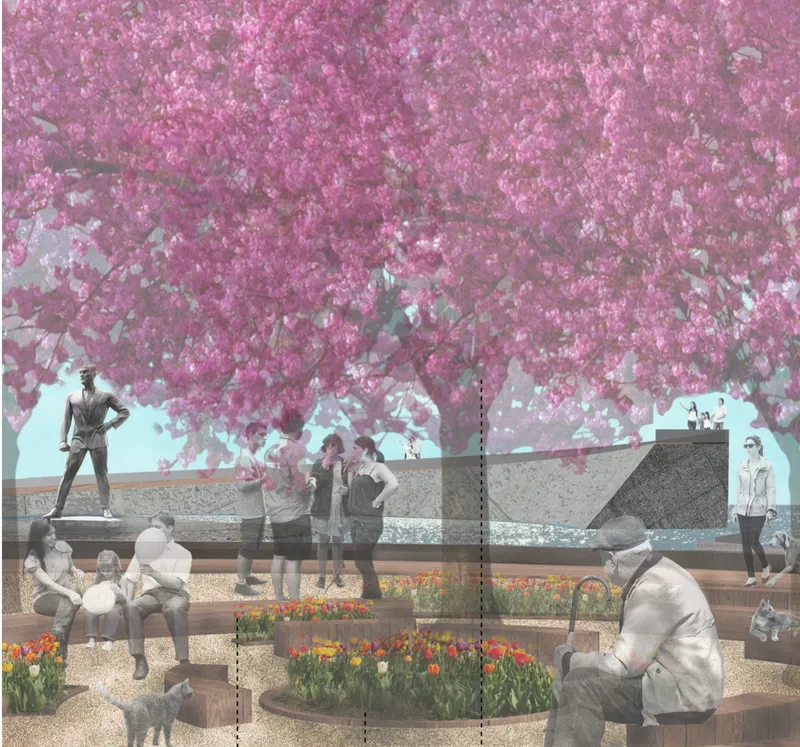
The project's material palette is deliberate. Curved stone walls run alongside stepped concrete terraces planted with grasses, creating a topography that channels and slows water movement. These are not retaining walls in the conventional sense; they are the vessels of the title, guiding collected rainwater through planted zones where natural filtration occurs before the water moves deeper into the system.
A secondary plaza introduces a circular planted bed surrounded by pink flowering trees and a bronze statue, anchoring the space with a civic focal point. The design moves between the ecological and the social with confidence: rain gardens and native vegetation do the work of purification, while the spatial composition invites people to linger. The symbiosis is real, not metaphorical. Visitors experience it physically by walking the terraces, sitting among the planted grasses, and watching stormwater become landscape.
Sections Reveal the Hidden Cisterns and Permeable Ground
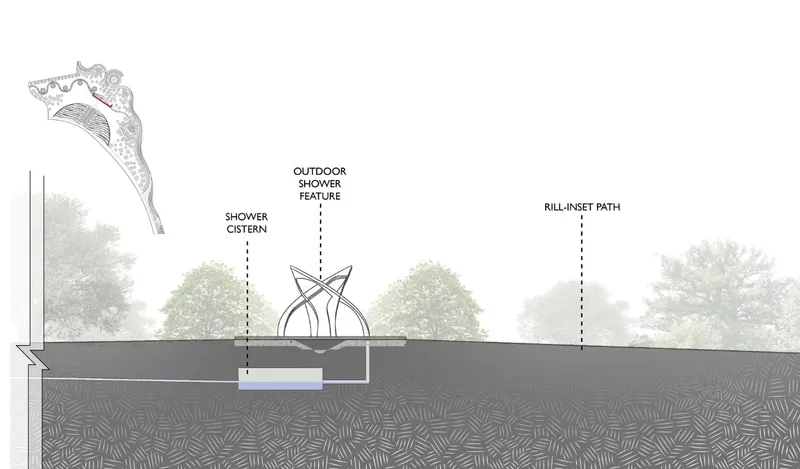
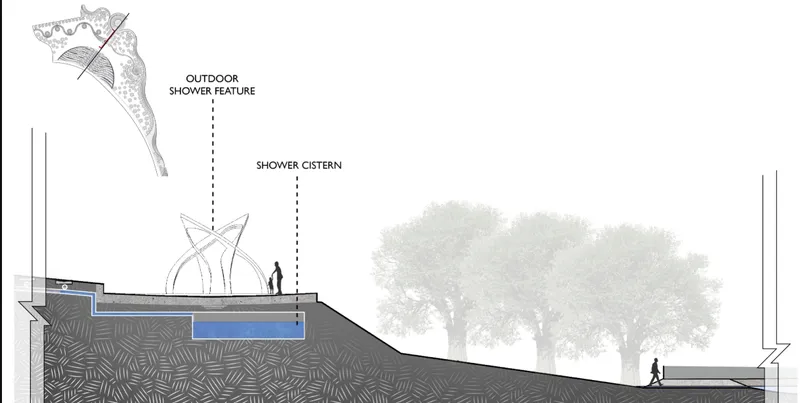
The three section drawings are where the project's ambition becomes fully legible. The first shows an outdoor shower feature fed by an underground cistern, with the pathway and surrounding landscape forming a continuous surface above the hidden infrastructure. The second section cuts through sloped terrain to reveal how the cistern sits beneath a sculptural shower element, using gravity and topography to move water without mechanical pumping. It is a clean piece of hydrological engineering dressed in the language of landscape architecture.
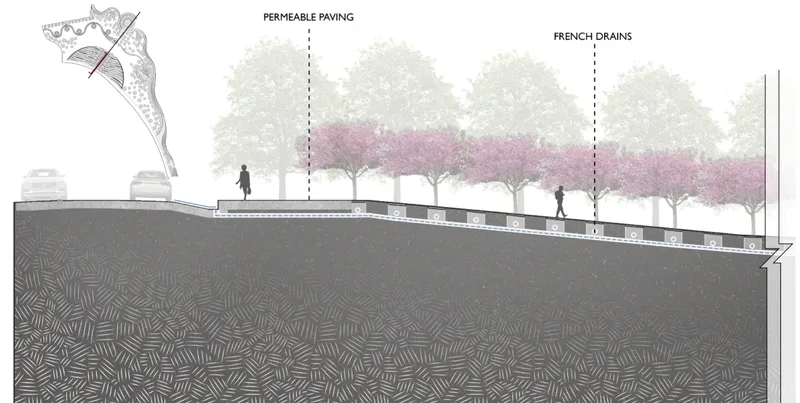
The third section focuses on the permeable paving surface itself, showing the layers beneath the ground plane that allow water to infiltrate rather than run off. Pink flowering trees and pedestrians occupy the surface, but the real action is below: gravel beds, filter layers, and storage volumes that complete the open-loop cycle. Together, these drawings make the argument that regenerative urban planning is not an add-on but a structural principle. Every surface, slope, and planting decision serves the water system.
Why This Project Matters
Connected Vessels offers a replicable model for climate-conscious urban infrastructure. Rather than treating stormwater management as an engineering problem to be buried underground and forgotten, the project surfaces its logic, literally and spatially. Cisterns, permeable paving, rain gardens, and natural filtration become the generators of public space rather than obstacles to it. The design argues that resilient landscapes and generous civic spaces are the same thing.
Shai Haber-Thaler's contribution is not just a landscape proposal; it is a position on how cities should metabolize water. The open-loop system, where collection, purification, and release happen in sequence across a walkable public terrain, suggests that the next generation of urban parks will be defined less by their aesthetic signature and more by what they do. Connected Vessels does a great deal, quietly and legibly, and that restraint is its strength.
View the Full Project
About the Designers
Designer: Shai Haber-Thaler
Enter a Design Competition on uni.xyz
uni.xyz runs architecture and design competitions year-round that reward proposals with spatial conviction and real site intelligence.
Project credits: Connected Vessels by Shai Haber-Thaler Ripple (uni.xyz).


Popular Articles
Popular articles from the community


longwave studio Reorganizes a 112 m² Tainan Apartment Around the Daily Routines of a Family and Two Cats
In Tainan, Taiwan, birch plywood, rust-red furniture and a freestanding plaster wall link arrival, storage, work and family life in one apartment.

LT2A and OPEN Architectes Thread a Brick and Glass High School Through a Wooded Belgian Campus
In Braine-l'Alleud, a 3,000 m² wing for Collège Cardinal Mercier pairs pale brick with a glazed colonnade, deferring to a small chapel and a dense wood.

U.GA Architects Wraps an Oval Rooftop Pool in Curved Board-Formed Concrete on Busan's Jeollidan-gil
In Busan's Jeonpo-dong, a 454 m² mixed-use block stacks a neighborhood facility, guest rooms and an oval rooftop pool inside spiraling concrete walls.

Cube Design Draws an Ecological Corridor Between Two Shenzhen Hills with the Nankai Building
Beside Shenzhen's container docks, the Nankai Building pairs stacked balconies with a climbing green screen to connect two hillsides across its height.

Similar Reads
You might also enjoy these articles


Vereda Arquitetos Renovates a 40-Square-Meter Apartment Inside Niemeyer's Copan Building
A compact unit in São Paulo's most iconic residential tower gets a material overhaul that pairs exposed concrete with bold blue Formica.

Shakur's House: Exposed Brick as an Interior Organiser in a 168 m² Mashhad Residence
Brick moves indoors in this Mashhad residence, where masonry walls, glass partitions and teal planes sequence a compact home without closing it off.

Day and Night Park: A Time-Based Urban Newsstand in Beijing
A temporary urban newsstand in Beijing blending travel, light, and reading through poetic colors, compact form, and community-focused design.

Modernist Patio Renovation in El Masnou, Barcelona by Oliver Segura Arquitectura + Cebrià Arquitectura
Modernist patio renovation blending tradition and innovation with a movable pool, leveled floors, and Catalan materials in El Masnou.


Comments (0)
Please login or sign up to add comments
No comments yet. Be the first to comment!