
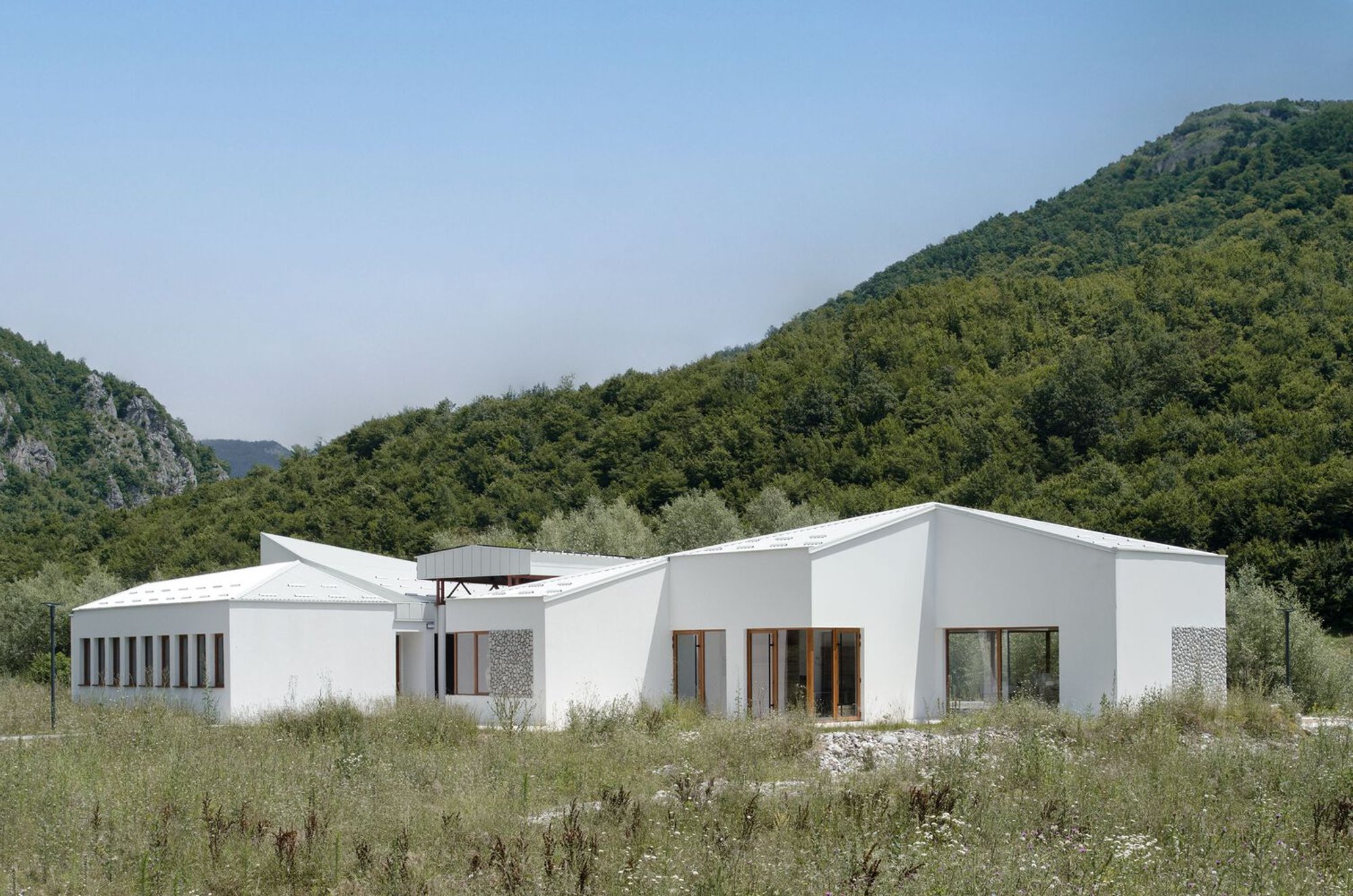
ARHINGinženjering Scatters a Cluster of White Gabled Volumes Along Montenegro's Bistrica River
A visitor center near Đalovića Cave in Bijelo Polje uses group form and local river stone to root tourism architecture in its gorge landscape.

Somewhere in northern Montenegro, the Bistrica River carves through a forested gorge on its way past the entrance to Đalovića Cave, one of Europe's longest. Until recently, there was little architecture mediating between the road, the river, and the cable car that hauls visitors up to the cave mouth. ARHINGinženjering, led by architects Jasmina Salković Kujović and Elvira Muzurović Alihodžić, has changed that with a visitor center that reads less like a single building and more like a small settlement: a loose constellation of white, pitched-roof volumes gathered around a central breezeway on the river's coastal plain.
What makes the project genuinely interesting is the way it refuses monolithic form. Rather than planting one large box beside a spectacular natural feature, the architects applied a principle they call "group form," splitting the program into distinct but interconnected volumes that cluster, overlap, and open toward the water. The result is a building you can walk around and through, one that frames the mountains from every angle while keeping its own profile low enough to let the gorge do the talking.
Group Form as a Landscape Strategy
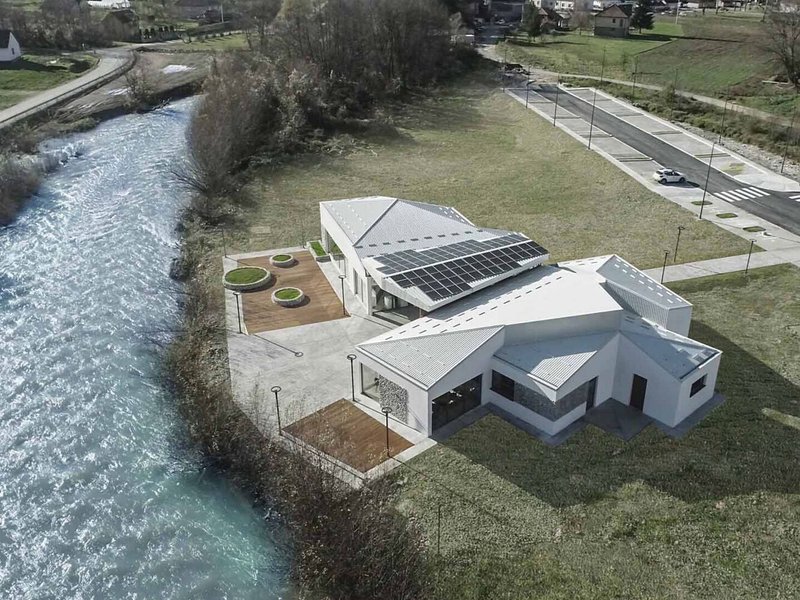
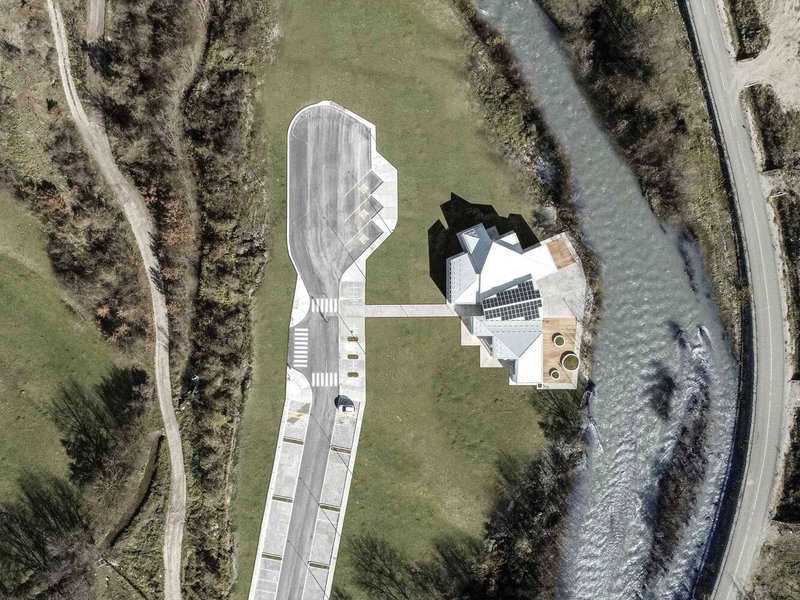
Seen from above, the visitor center is immediately legible as a family of forms rather than a single object. Angular wings radiate from a covered spine, their multi-pitched roofs tilted at a consistent 16 degrees but oriented in different directions, creating a silhouette that echoes the jagged ridgelines behind. Solar panels cap the canopy, 46 in total, turning the largest roof surface into a micro power plant that offsets operational energy.
The siting is strategic. The building sits between the river bend and the access road, with a parking court on the uphill side and a timber deck stretching toward the water on the other. Visitors arrive by car, orient themselves in the central hall, and are funneled toward the cable car station that ascends to Đalovića Cave. The architecture choreographs that sequence without ever blocking the panorama.
Two Wings, Two Programs
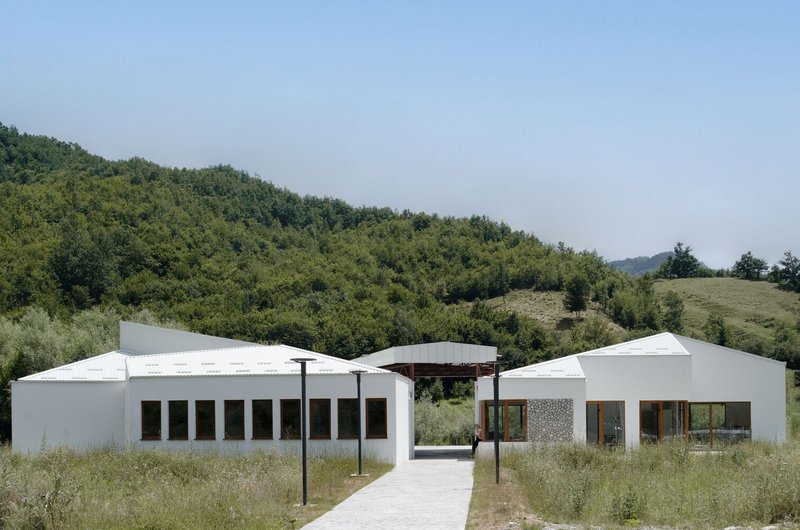
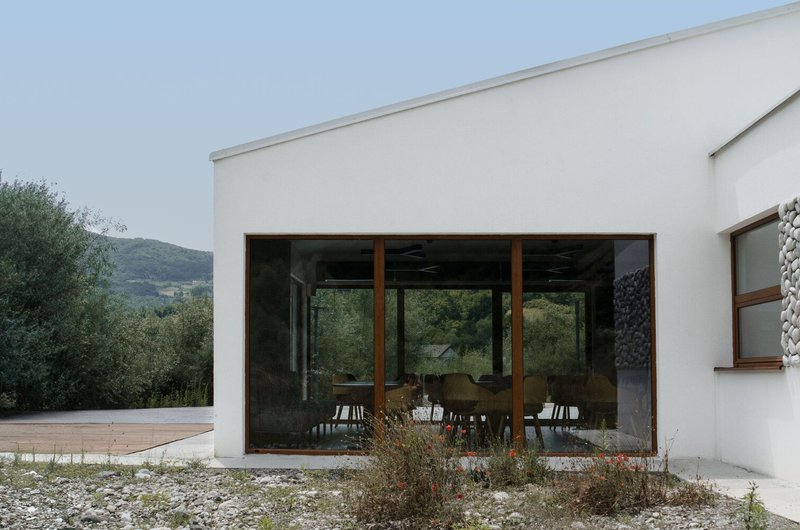
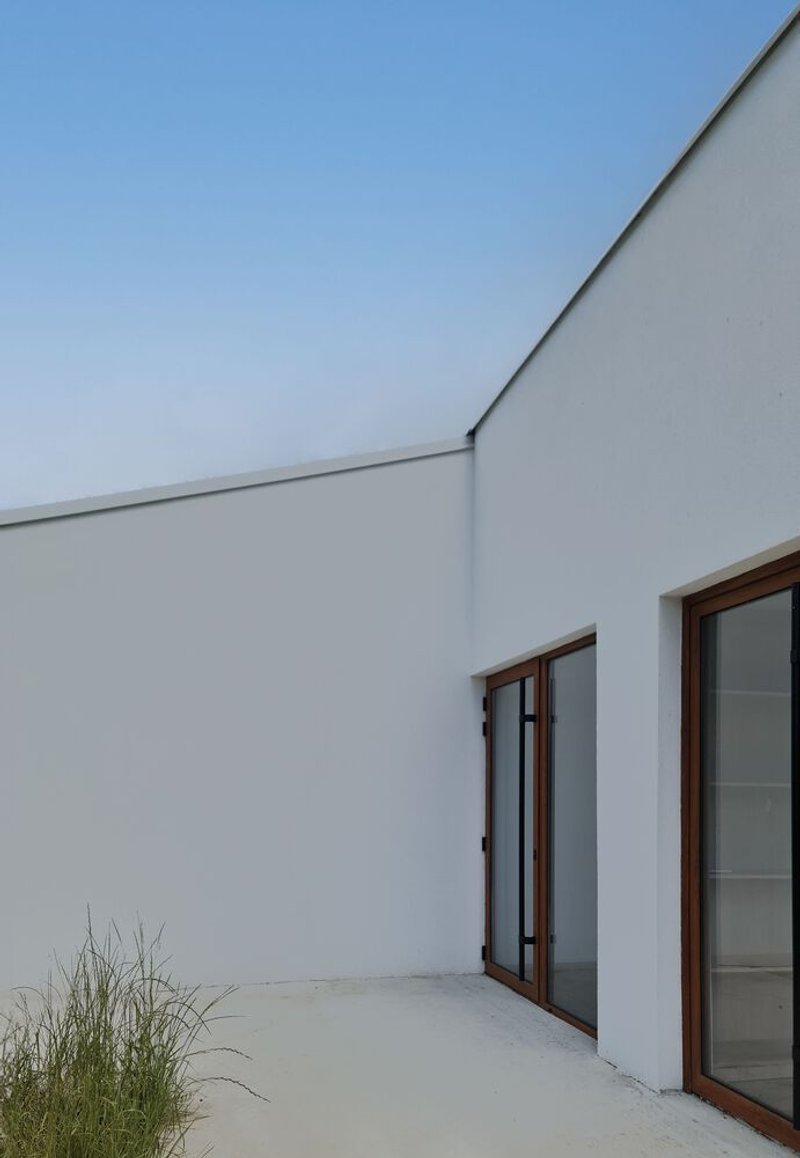
The functional split is clean. The right wing holds a restaurant, café-bar, and sanitary facilities, spaces oriented toward the river so diners look out at water rather than asphalt. The left wing houses the info desk, souvenir shop, a small museum-exhibition area, presentation hall, and administrative offices. Between them, the covered hall operates as an extended terrace: open enough to feel like landscape, enclosed enough to shelter visitors from weather.
Sliding timber-framed glass doors along the restaurant facade blur the threshold between dining room and courtyard. The effect is generous without being wasteful. Single-story construction keeps structure simple and costs controlled, and the open breezeway reduces reliance on mechanical ventilation by channeling airflow through the complex.
River Stone as Material Identity
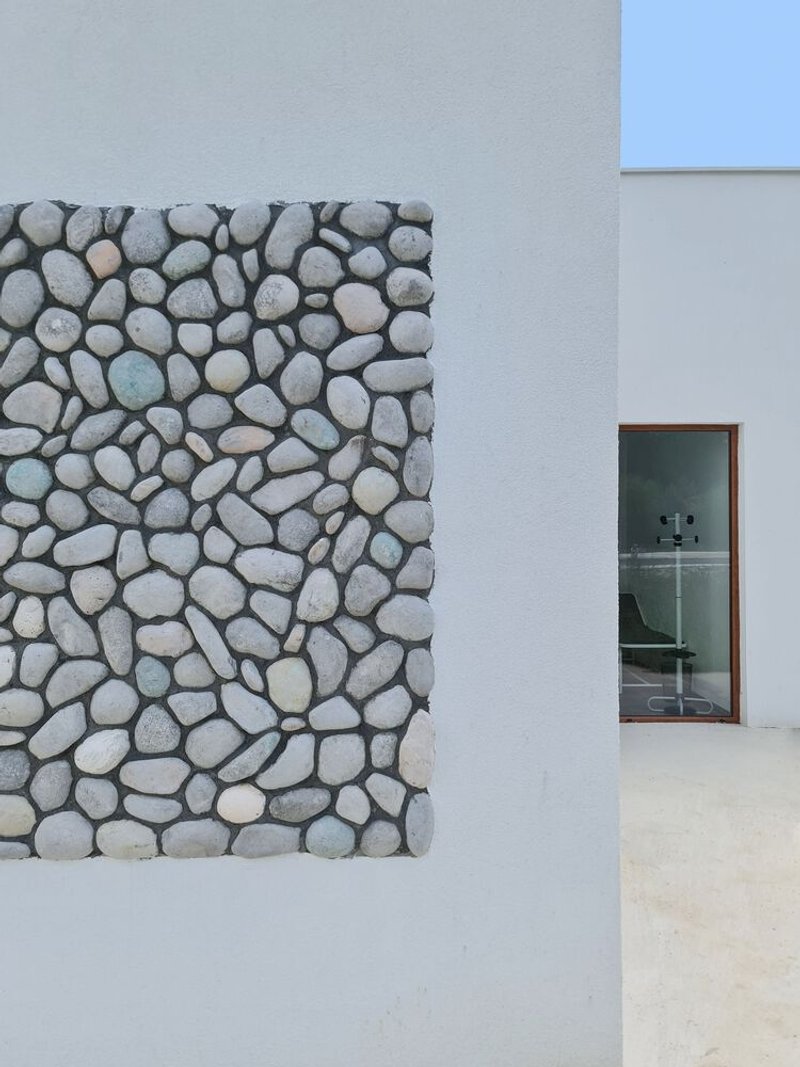
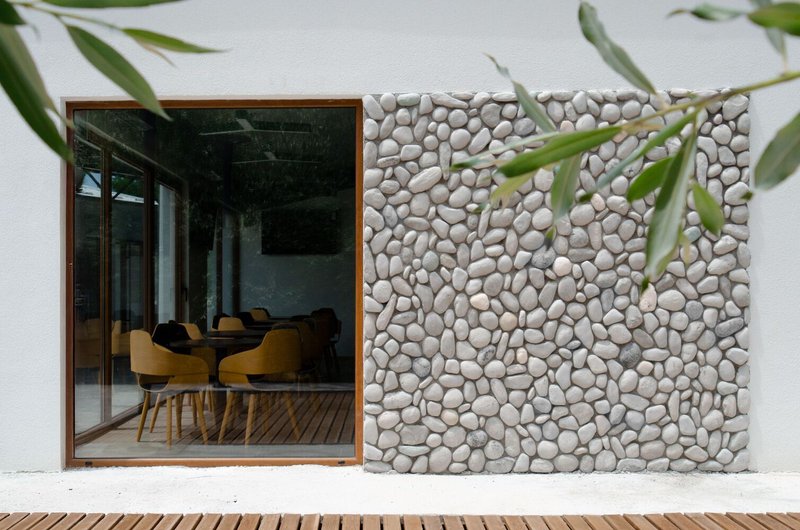
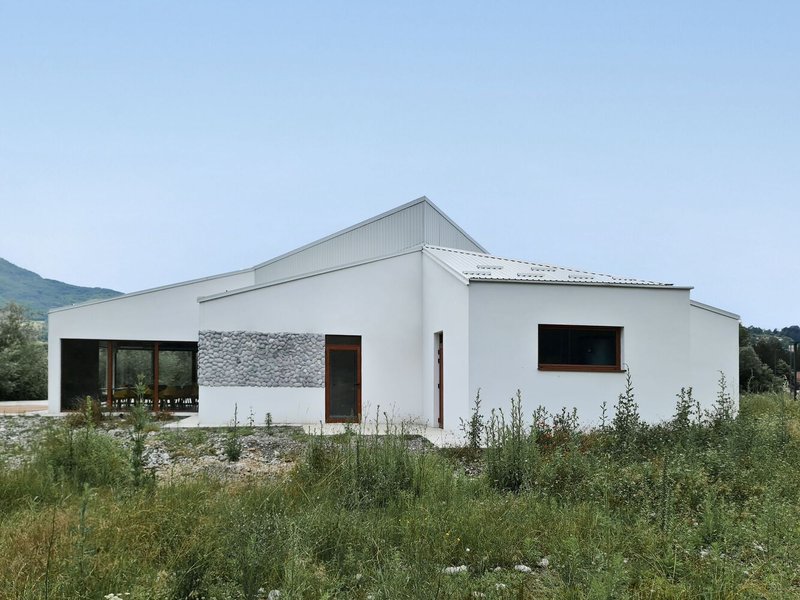
The material palette is deliberately restrained: white stucco for the primary wall surfaces, concrete for the structure, and rounded river pebbles for accent panels that punctuate the facades. Those stone inserts do real work. They pull the riverbed's texture onto the building's skin, grounding the architecture in its geology without resorting to pastiche. Set into smooth plaster, each pebble panel reads almost like a geological cross-section, a window into the substrate the building sits on.
The contrast between slick white render and rough stone is the project's strongest visual move. It establishes a tension that prevents the forms from feeling generic: these are not abstract white boxes but volumes that acknowledge their specific place, where limestone mountains meet glacial river deposits.
Courtyard and Deck: Landscape as Architecture
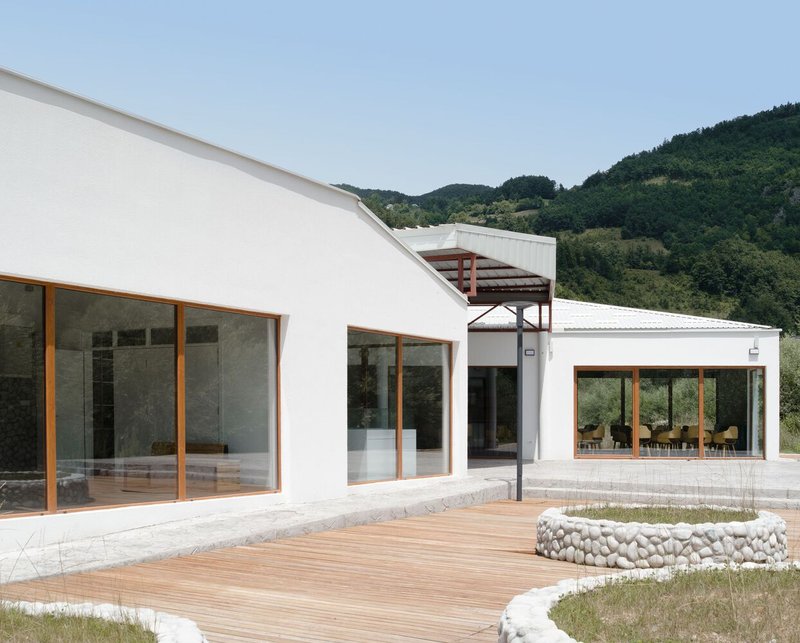
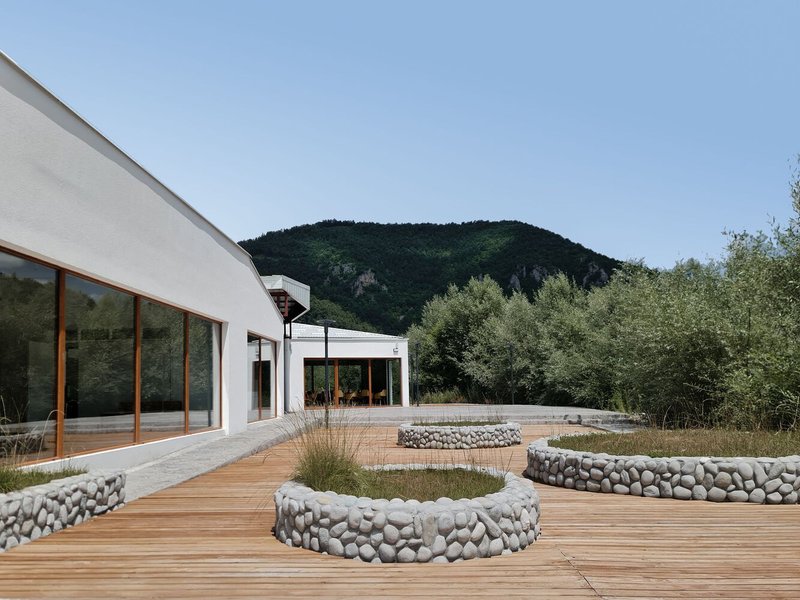
Between and around the volumes, the ground plane is articulated with the same care as the walls. Timber decking extends the interior floor level outdoors, creating terraces that function as open-air rooms. Circular planters filled with river stone anchor the deck, while gravel beds border the base of the buildings, softening the transition between architecture and meadow.
The courtyard space between the two wings is the social heart of the complex. Framed by white rendered walls and timber-framed doors, it channels views toward the distant mountains while keeping the scale intimate. It is a clever inversion: the most enclosed outdoor space offers the most expansive vista.
Roofline and Forest Edge
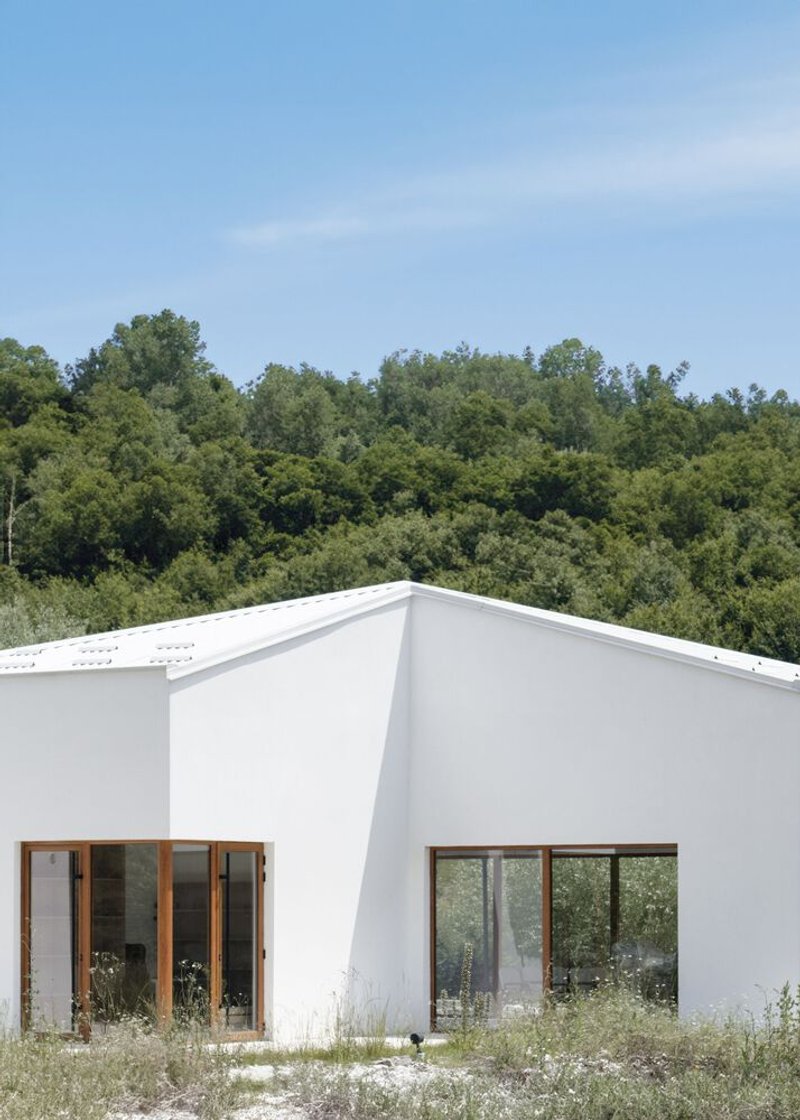
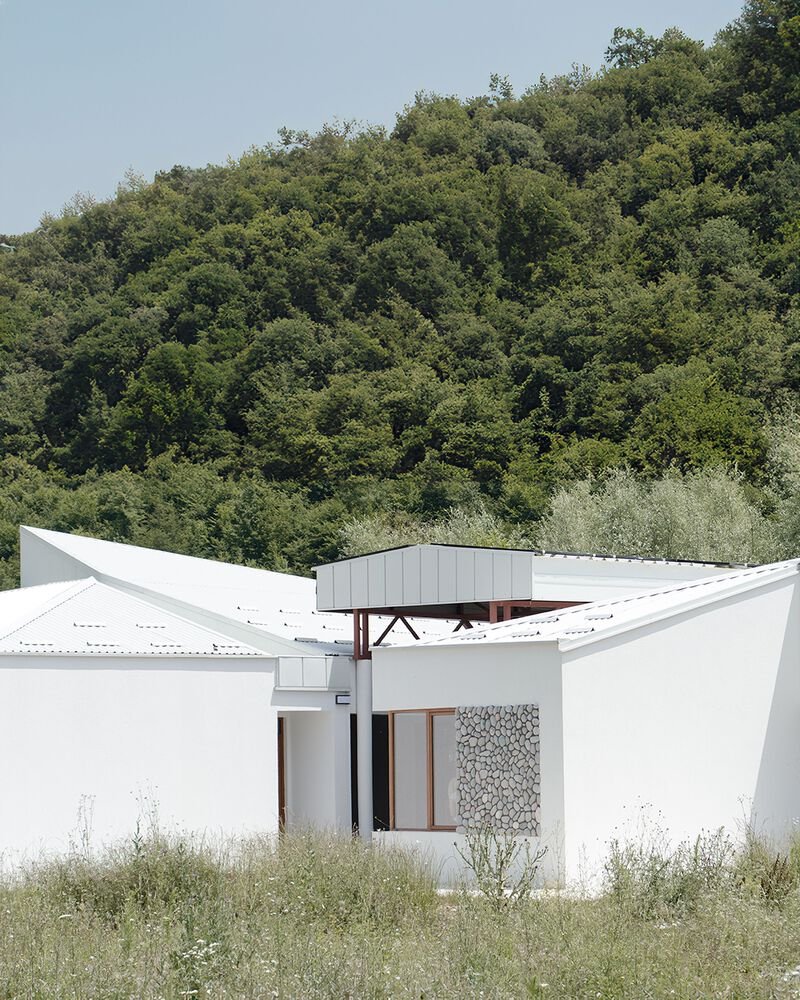
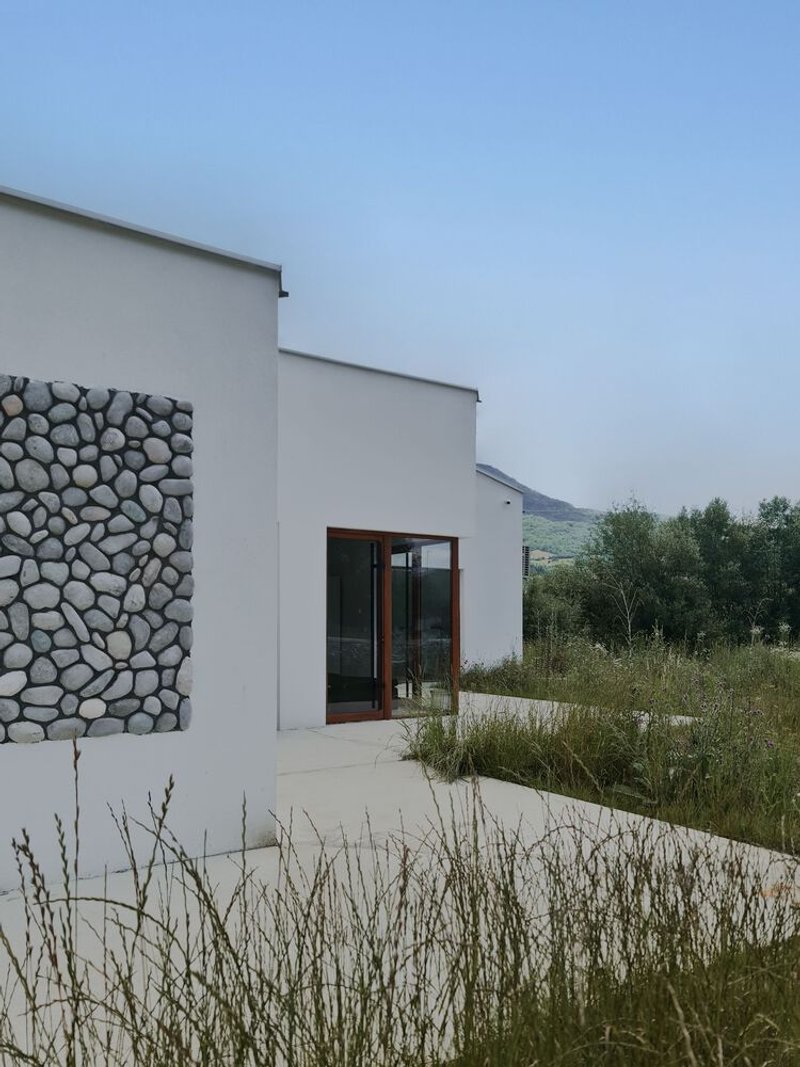
From the lower road and the river itself, the visitor center is mostly roofline. The folded metal roofs, all pitched at the same shallow angle, create a rhythmic profile that sits comfortably against the dense forest behind. White walls catch afternoon light and glow against the green canopy, making the building visible as a landmark without dominating.
Wildflowers and tall grasses are allowed to grow right up to the facades. The absence of manicured landscaping at the perimeter is a deliberate choice: it lets the building settle into the meadow rather than hovering above it, reinforcing the idea that this architecture belongs to its gorge rather than merely occupying it.
Plans and Drawings
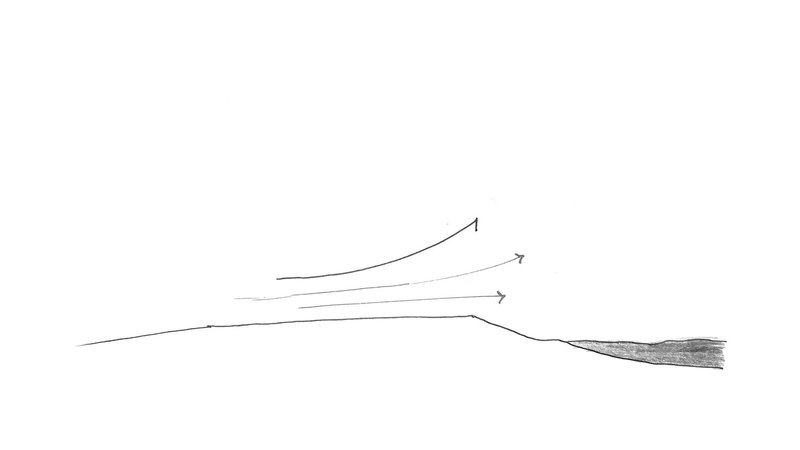
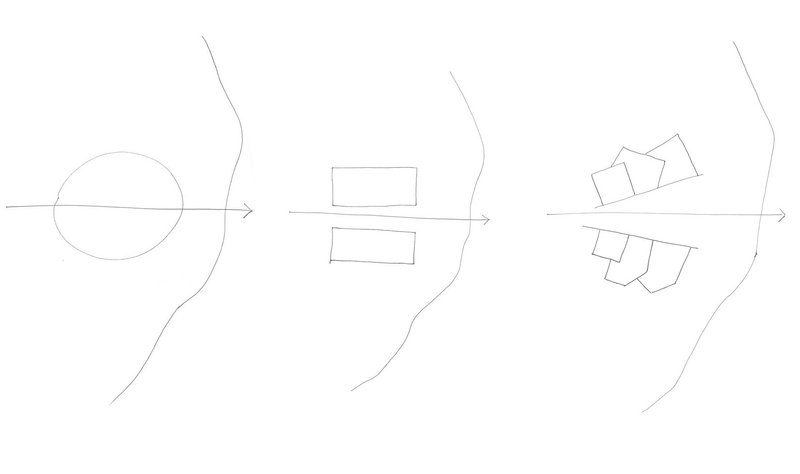
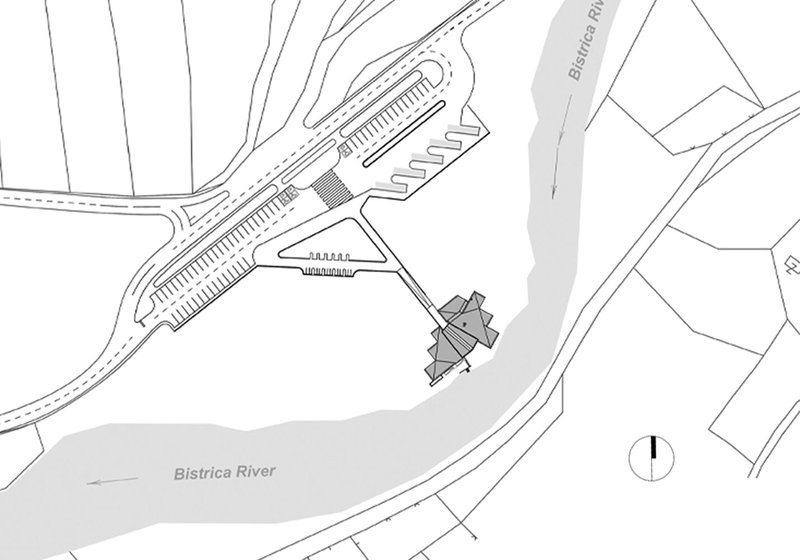
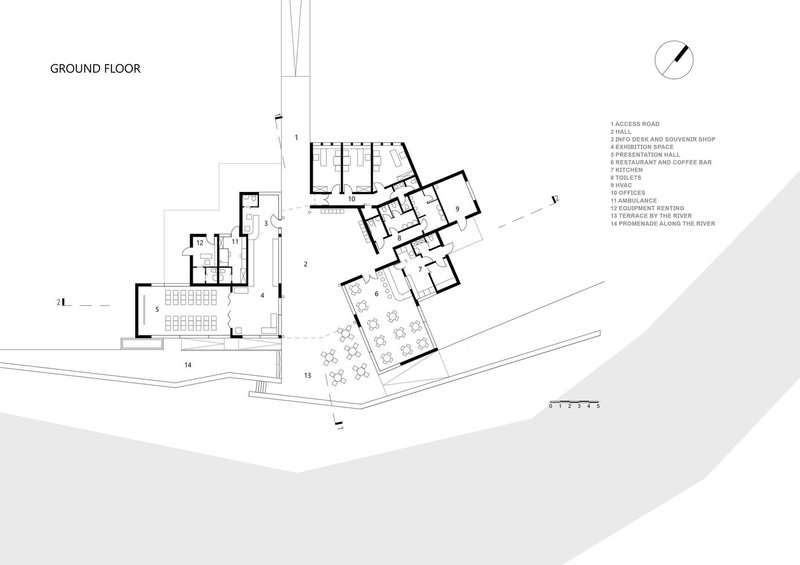
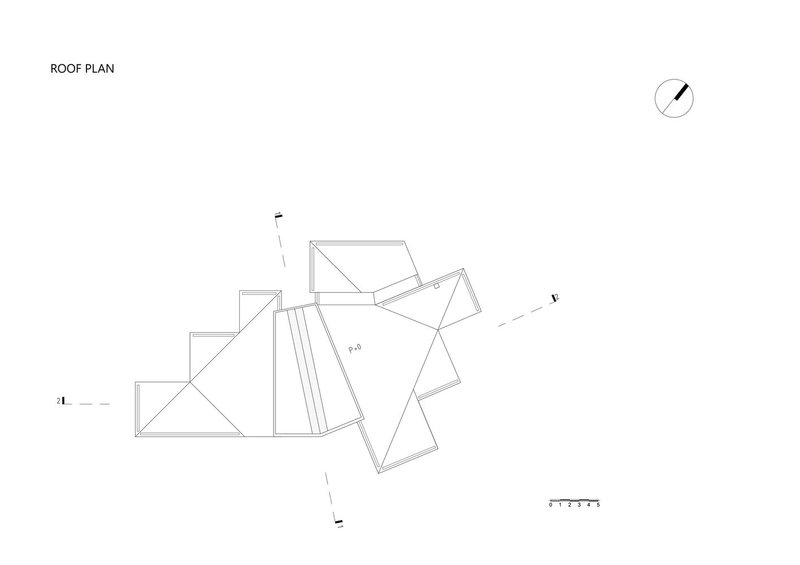
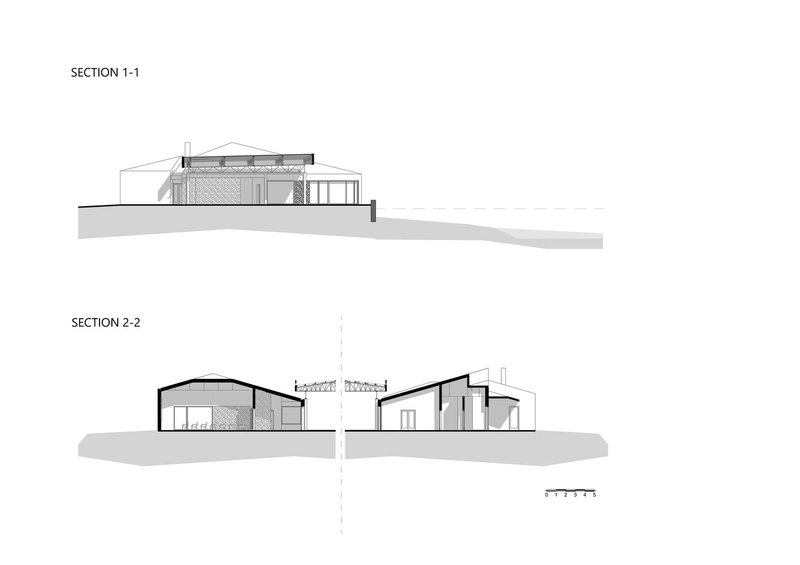
The concept diagrams trace the design logic from flowing river-inspired lines to a shaded wedge form, then through a three-stage geometric transformation that yields the final cluster. It is a process the architects describe as transposition: abstracting the landscape's energy into buildable geometry. The site plan confirms how tightly the building is locked into the river bend, while the ground floor plan reveals the angular wings radiating from a central circulation spine. Sections show modest interior volumes, some vaulted, some flat-ceilinged, that step with the terrain.
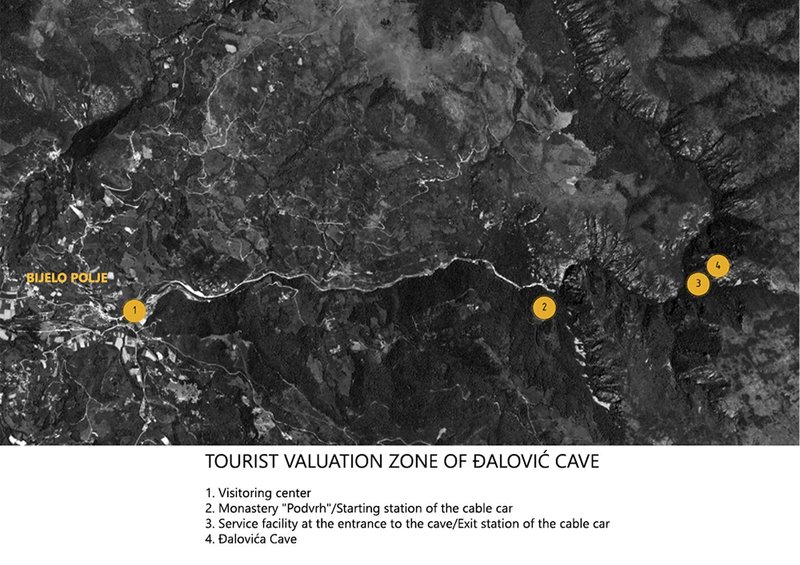
The aerial site map places the visitor center within a broader network of tourism infrastructure across the forested valley. It makes clear that the building is not a standalone destination but a node: a point of arrival, orientation, and departure toward the cave and the monastery at Podvrh. That networked thinking is reflected in the architecture itself, which distributes program across volumes the way the valley distributes attractions across geography.
Why This Project Matters
Visitor centers for natural landmarks face a persistent design dilemma: they need to be visible and functional enough to serve tourists while remaining subordinate to the landscape that draws people in the first place. ARHINGinženjering resolves this by fragmenting the building into a village-like cluster that never competes with the gorge for attention. The group form approach, the low profile, and the river stone materiality all work in service of that restraint.
The project also demonstrates that sustainability in a rural Montenegrin context does not require high-tech facades or parametric gymnastics. Passive ventilation through open breezeways, solar panels on an already necessary canopy, local pebbles embedded in walls: these are pragmatic, replicable strategies. For a country still building its eco-tourism infrastructure, this visitor center offers a convincing proof of concept, one where the architecture does just enough and the river does the rest.
Visitor Center Đalovića Pećina, designed by ARHINGinženjering (architects Jasmina Salković Kujović and Elvira Muzurović Alihodžić), Bijelo Polje, Montenegro. Photography by Lejla Nurković.
About the Studio
Share Your Own Work on uni.xyz
If projects like this are the kind of work you want to make, uni.xyz is a place to publish your own, find collaborators, and enter design competitions.




Popular Articles
Popular articles from the community

Inside a Timeless Mumbai Residence by Aether Studio
Aether Studio's 2,250 sq ft apartment in Malad, Mumbai uses marble, brass, boucle, and disciplined restraint to build a quiet retreat from the city.

Milan Crossover: Sustainable Architecture for a New Fashion Culture in Milan
Milan Crossover transforms fashion culture through sustainable architecture, linking material libraries, remake studios, and public runways.
Reincarnation Weaves a Three-Story Retreat into the Green Landscape of Rural Bangladesh
Ara Manor in Narsingdi dissolves the line between domestic architecture and its lush surroundings through screens, courtyards, and planted rooftops.
Eco Chapel: A Green Architecture Pavilion Designed in Symbiosis with the Forest
Eco Chapel uses green architecture to weave prayer, learning and reuse into a forest pavilion shaped by modular hexagonal canopies for life.


Similar Reads
You might also enjoy these articles

Olio Towers: A Mid-Rise for Performers That Fuses Housing, Rehearsal, and Stage
Located blocks from Houston's Theater District, this modular tower stacks living units around a central performance atrium.
Oasis: Modular Green Housing Carved into Dhaka's Urban Fabric
A shortlisted Plugin Housing entry reclaims unauthorized settlements in Dhaka with stepped concrete volumes, green roofs, and ventilation-driven design.

Black Hole: A Floating Megastructure for the Post-Physical Era
Emiliano Mazzarotto envisions a spherical, self-scaling arena where e-sports, digital hotels, and holographic stadiums replace traditional public space.
Compact & Sustainable Living in Piraeus: A Four-Level Family Home Built Around Light and Air
A narrow townhouse in one of Greece's densest port cities uses a central atrium and passive strategies to house three generations under one roof.

Explore Architecture Competitions
Discover active competitions in this discipline




The International Standard for Design Portfolios


The Global Benchmark for Architecture Dissertation Awards


The Global Benchmark for Graduation Excellence


Challenge to reimagine the Iron Throne
Comments (0)
Please login or sign up to add comments
No comments yet. Be the first to comment!