

SWIRL
Visit another zone everytime you step into the structure!

Children have a unique ability to interpret anything as something to play. They have limitless imagination for playing and they are very good at embodying their imagination in the real life. Additionally, Child playground is an essential place in developmental age of children. It is crucial both physical and mental development although today’s children are flooded with tablets and all those electronic devices which mitigates their movement. As designers and architects, we strived to develop an approach for playground which corresponds children imagination, their physical development and most importantly we aimed to design a playground for endless fun!
We started design research with identifying user definition and site analysis. After we comprehend whom we design for, we dived into children’s world and tried to see the world from their window. Therefore, design concept that we suggest is based on creating paths and at the intersection of those paths, we create different energy zones to gather children. Creating paths yield us less traffic jam on the playground, different routes for children so they do not easily get bored every time they step into the playground and they can orientate themselves with paths. The site is divided into many paths which takes to directly design area. Therefore, if wee conceive paths as entrance routes from the potential roads, we can think of a radial grid system to make playground more accessible from every point of the site.
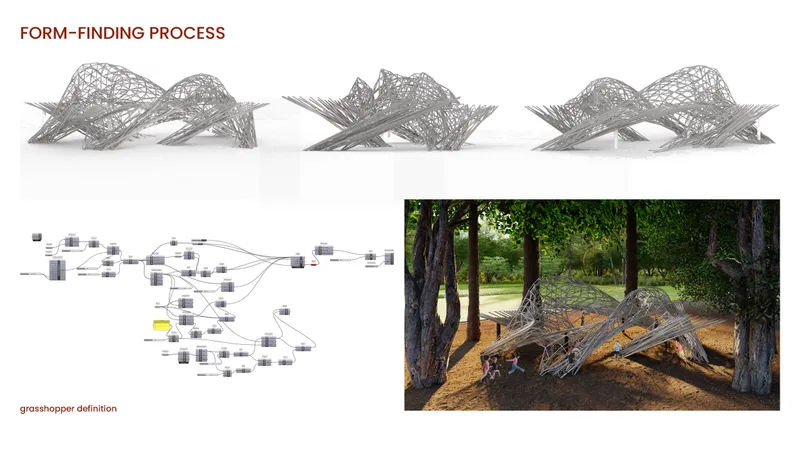
Figure 1.
We derived different energy zones from the activities of different age groups. We design four zones which are Active Zone, Interaction Zone, Free Zone and Quiet Zone. The zones are studied on radial grid system to come up with possible zone relations in the structure. The active zone is placed more in an obtusangular way since it is the largest zone and the quiet zone is placed relatively far away from different zones. Interaction zone serves as a zone and also a circulation space to keep interaction between zones. Free zone is located in the center and offer many game options based on children’s imagination.
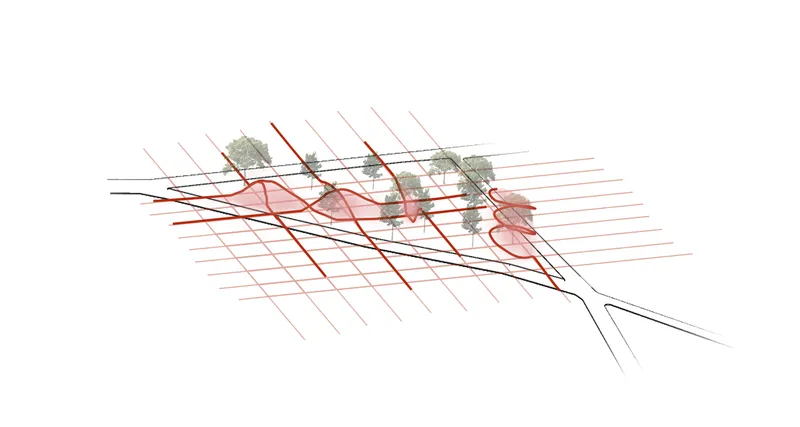
Figure 2.
In the beginning, the design was conceived as a free form net surface made of textile which provides multiple games for children.(Figure 1.) Furthermore paths were designed as regular grid system not radial system. (Figure 2.) Although this free net form gives many options to children, it can be exhausting to stand on a free surface after a while. It also arises an issue of security since all surfaces are reachable. We also wanted to children more visible to parents on playground which this first designed structure did not allow. Therefore we kept studying for new forms. (Figure 3) This free net surface was designed with wooden sticks to give stability to structure. Since we design in a place including many trees, we wanted to use wooden material to keep visual material continuity and also wooden material is one of the local materials of Warsaw.
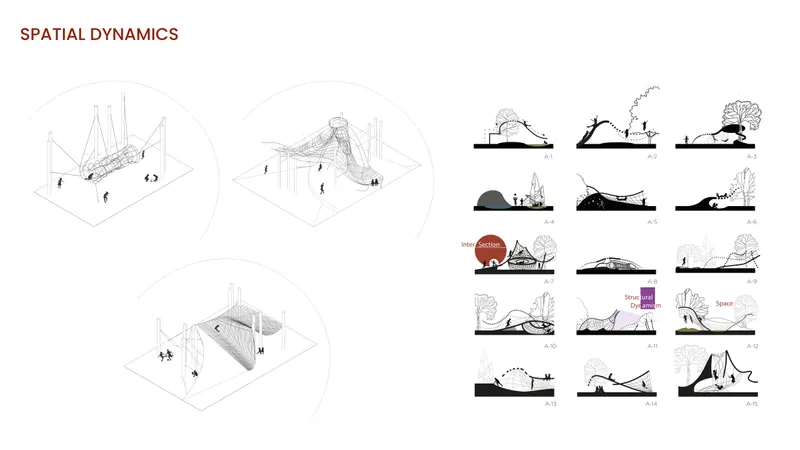
Figure 3.
The crucial and exciting part of the design is the moment when we created a solid surface which follows topography movement and emphasize the entrances of playground. It gives balance and orientation to children which plays on net surfaces. The children are more visible to parents. The playground provides multiple options for children’s imagination. The solid surface starts from ground and arises to the center. The solid surface also serve as a shelter for Quiet zone which requires sound proofing. The Quiet zone is covered with wooden solid surface and tight net surfaces to provide quiet and dim space for children who wants to read or sit.
Net surfaces are made from textile and they can be produced from residual parts of fabric factories. We use three different net surfaces which are tight, regular and loose surface depending on activity. Sticks which are made of steel and covered with wooden material bear the solid surface and also create the required tensile strength for net surfaces. Sticks are important for security cautions as well. The wooden solid surface is made of wooden plaques. It can be easily assembled in any design area after cutting with proportioned size. The connection between plaques is made with bolts which is more durable technique in terms of assembling and disassembling. Some part of the ground is covered with rubber to provide smooth surface in case of any falling.
The site is conceived as a whole to design a structure which looks as if it is complementary part of the site. We also made design decisions about site with using circle guides and created some lighting elements, information boards and parent seating areas.
The final design which we called Swirl is a playground to welcome all children with its accessible paths. Once you enter the Swirl, you start to explore many different areas for playing and also it triggers your imagination and allow you to create your own game in Free Zone. When you get tired and take a deep breath for some time you can relax in Quiet Zone. As soon as you save your energy you can keep going sliding, climbing in Active Zone but this time with a different route. This different routes also help you find new friends alike you along Interaction Zone, so keep your eyes open when you are wandering around Interaction Zone. Have fun!
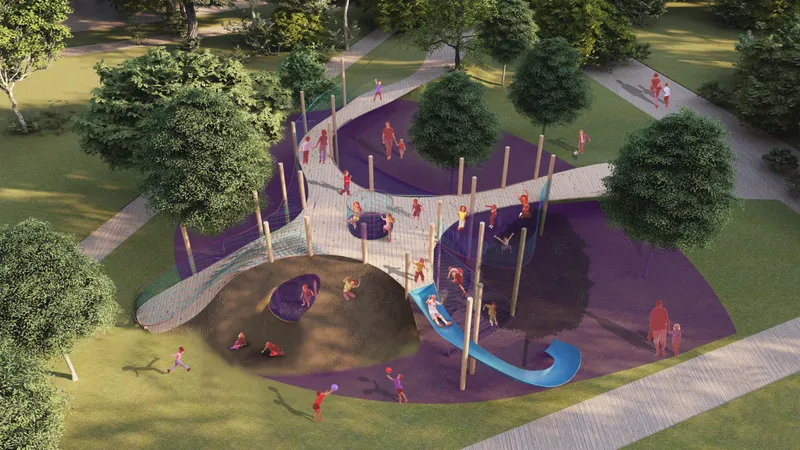
Figure 4.
ARCHITECTS
Hanım Gülsüm Karahan
Ahsen Zeynep Doğan
Haticetül Kübra Saraoğlu
Baha Tekin


Popular Articles
Popular articles from the community


Manzana Morphosis: Stretching Barcelona's Grid into a Living Landscape for 2050
A radical reworking of the Eixample manzana turns density into a tool for generous public space, vertical ecology, and environmental performance.

Singing Woman: An Opera House That Performs Before the Curtain Rises
Ovidiu Cristian Pavel's conceptual opera house translates Estonia's choral identity into a sculpted waterfront landmark facing the Baltic Sea.

Cloaked Colonization: A Mobile Underwater Habitat That Moves Like a Fish
Micah Abaya's shortlisted EHC Pacific entry reimagines ocean settlement as a dispersed network of self-sustaining architectural organisms.

Opera by the Sea Estonia: Three Shells Dissolving Architecture into Tallinn's Coastline
A winning opera house proposal replaces monumental form with interconnected shells that blur the boundary between building, park and Baltic Sea.

Similar Reads
You might also enjoy these articles

Shakur's House: Exposed Brick as an Interior Organiser in a 168 m² Mashhad Residence
Brick moves indoors in this Mashhad residence, where masonry walls, glass partitions and teal planes sequence a compact home without closing it off.

Day and Night Park: A Time-Based Urban Newsstand in Beijing
A temporary urban newsstand in Beijing blending travel, light, and reading through poetic colors, compact form, and community-focused design.

Modernist Patio Renovation in El Masnou, Barcelona by Oliver Segura Arquitectura + Cebrià Arquitectura
Modernist patio renovation blending tradition and innovation with a movable pool, leveled floors, and Catalan materials in El Masnou.

Alto Residencial Coop: Cooperative Housing Development in Santiago de Compostela by Carbajo Barrios Arquitectos
A linear cooperative housing complex blending white volumes and perforated metal façades, enhancing community living, natural light, privacy, and urban integration.

Explore Virtual Spaces Competitions
Discover active competitions in this discipline


Challenge to reimagine the Iron Throne

Photograph architecture without architects

Illustrate the lost glory of Angkor Wat - Render Challenge

Design challenge to reuse E-waste
Comments (0)
Please login or sign up to add comments
No comments yet. Be the first to comment!