
Sylva Village: An Eco-Village Where Architecture Becomes a Living Organism
In Boa Vista, Brazil, circular courtyards and reforestation corridors weave 50 families into a regenerative landscape of shared living.


What happens when architecture stops being a container for life and starts behaving like life itself? In Boa Vista, Roraima, at the northern edge of Brazil's Amazon basin, a cluster of timber pavilions, circular courtyards, and reforestation corridors proposes an answer. Sylva Village treats the eco-village not as a collection of sustainable houses but as a single organism: a project where spatial form, social program, and ecological restoration are wired into the same circulatory system.
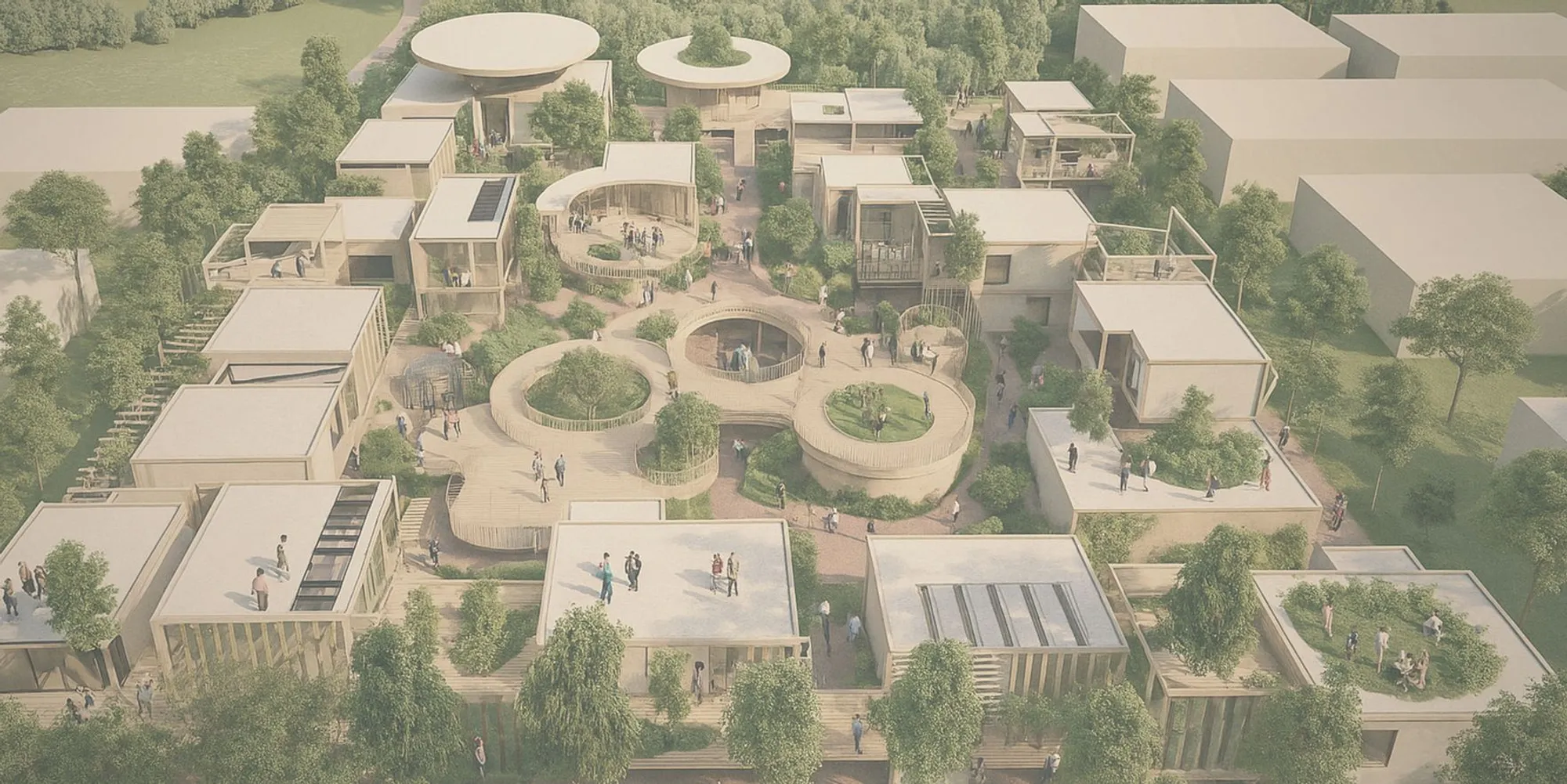
Designed by ETAA Studio and entered as a People's Choice Award submission in the Live Green competition, Sylva Village is scaled for 50 families. Its master plan integrates residential clusters, community gardens, multipurpose halls, sport zones, observation decks, and childcare spaces, all threaded together by organic pathways and courtyard sequences. The site itself tells a story of transition: structured urban textures along the southern edge dissolve into dense greenery toward the north, staging a literal gradient from city to forest.
Timber Pavilions Along a Curved Forest Edge
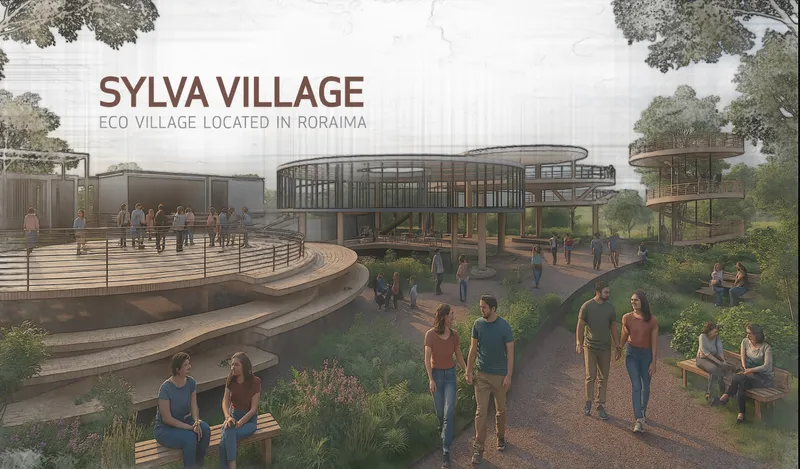
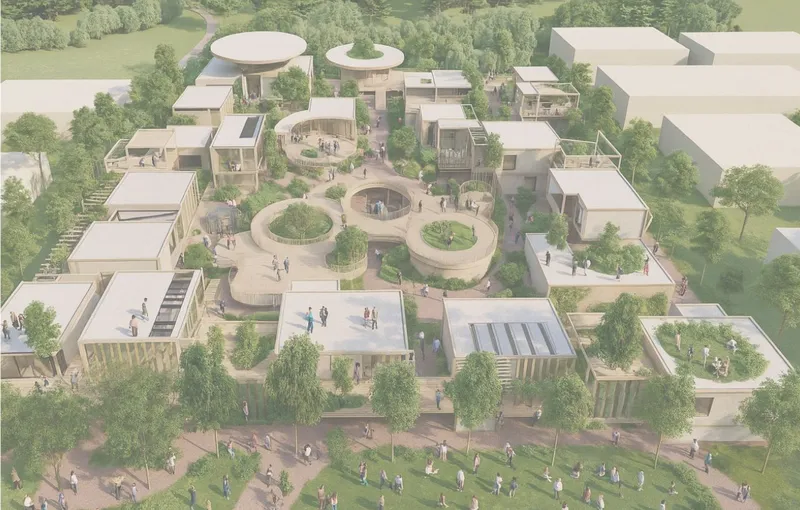
The ground-level rendering reveals the project's material and spatial logic at human scale. Timber-framed pavilions sit along gently curved pathways, their lightweight structures allowing vegetation to press close. There is no hard boundary between building and landscape; the architecture invites the canopy in rather than holding it at arm's length. From above, the aerial view clarifies the organizational geometry: circular terraced courtyards anchor clusters of flat-roofed volumes, while tree-lined pathways stitch planted gardens into a continuous green network. Native species like Mangifera indica create shaded microclimates between structures, turning circulation into a cooled, biodiverse corridor.
The arrangement is deliberate about hierarchy. Pedestrian, bicycle, car, and green zones each occupy distinct spatial layers, minimizing carbon impact and prioritizing low-speed movement. The courtyards function as what the designers call "social lungs," drawing in light and wind while hosting communal gathering. The effect is an architecture that breathes, both climatically and socially.
Concentric Terraces as Communal Infrastructure
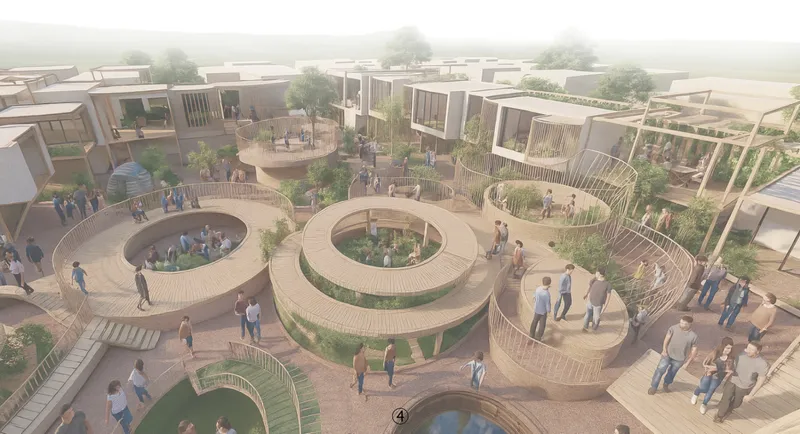
The ground-level perspective of the concentric circular terraces is perhaps the project's most evocative image. Woven timber screens wrap the terraced form, filtering light and creating layered thresholds between interior and exterior. Groups of people gather in the misty atmosphere, suggesting a space designed less for programmed activity and more for spontaneous encounter. The circular geometry here is not decorative; it generates a centripetal social force, pulling residents inward toward shared space rather than pushing them into isolated units.
These courtyards sit at the heart of the project's community-centered strategy. Natural ventilation and sunlight penetrate deep into the residential zones through these openings, reducing dependence on mechanical systems. The woven screens recall local craft traditions while performing as passive shading devices, a detail that grounds the project's biophilic ambitions in material specificity rather than abstraction.
A Circular Diagram for Circular Thinking
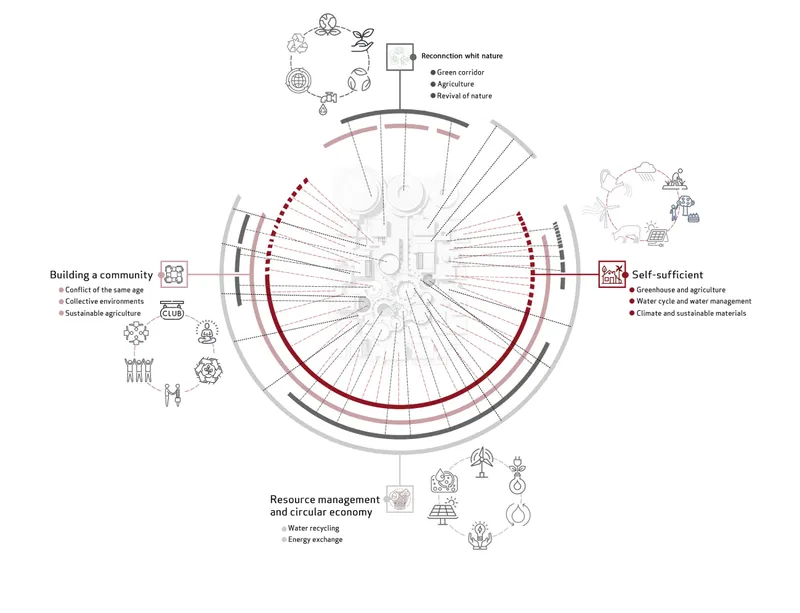
The thematic diagram radiating from a central core maps the four design pillars that organize Sylva Village: nature-inspired sustainable architecture, community-centered sustainable living, eco-friendly infrastructure, and reconnection with natural roots. What makes the diagram useful, rather than merely graphic, is how it reveals the project's insistence on integration. Reforestation is not an add-on to housing; it is structurally linked to social programming, passive cooling strategies, and green corridor planning. Every zone radiates from the same core, reinforcing the idea that ecological and social systems cannot be separated without diminishing both.
Below Grade: The Invisible Infrastructure of Regeneration
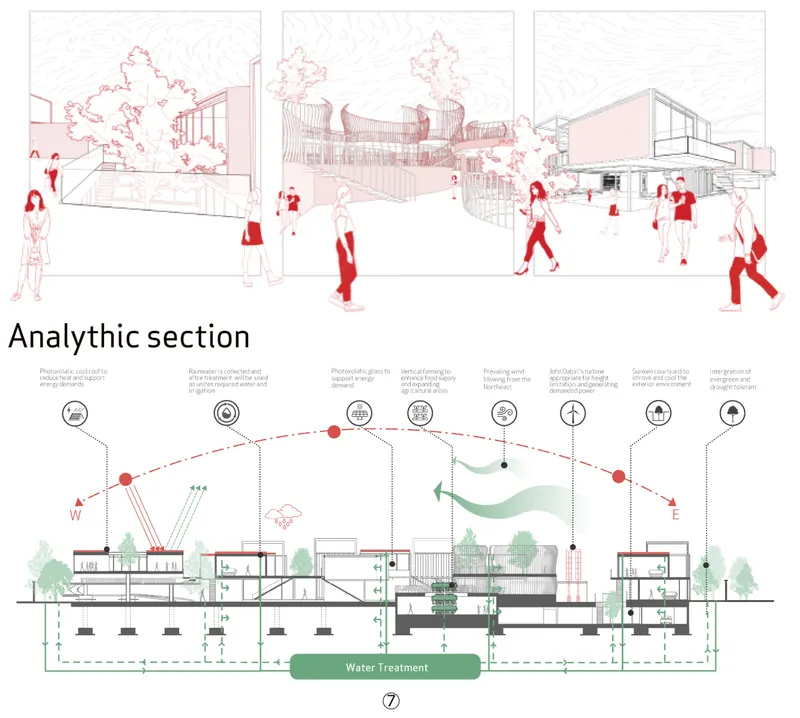
The section drawing cuts through the project to expose what pedestrians never see: water treatment systems operating below grade, processing and recycling water within the site's own boundaries. Above, annotated pedestrian circulation flows across planted surfaces, connecting the residential clusters to communal programs. The drawing makes a clear argument that genuine sustainability lives in infrastructure as much as in form. Renewable systems, passive cooling, and circular water management are not layered on top of the architecture; they are built into its cross-section.
By integrating these systems into the ground plane, the designers free the surface for what matters most to daily life: uninterrupted green space, gathering areas, and the ecological corridors that link the village to the surrounding landscape. It is a quiet but critical decision, one that separates performative sustainability from the operational kind.
Why This Project Matters
Sylva Village operates at a scale and in a context where regenerative design is not optional but necessary. Boa Vista sits at the doorstep of one of the planet's most consequential biomes, and the project directly addresses the regional pressures of deforestation and biodiversity loss. By embedding reforestation, native habitat restoration, and circular resource systems into a residential master plan for 50 families, ETAA Studio demonstrates that housing can be an instrument of environmental repair rather than a driver of further extraction.
More broadly, the project challenges the assumption that eco-villages must sacrifice urban vitality for ecological virtue. The layered spatial composition, from the concentric timber terraces to the below-grade water treatment, proves that density, community, and biodiversity can coexist within the same organism. For a competition entry, Sylva Village carries an unusual level of systemic ambition, suggesting a model of development that other rapidly urbanizing regions in the tropics would do well to study.
View the Full Project
About the Designers
Designer: ETAA Studio
Enter a Design Competition on uni.xyz
uni.xyz runs architecture and design competitions year-round that reward proposals with spatial conviction and real site intelligence.
Project credits: Sylva Village by ETAA Studio Live Green (uni.xyz).




Popular Articles
Popular articles from the community


Conexión: Biophilic Design Reimagines High-Rise Living in Hong Kong
Conexión reimagines high-rise living in Hong Kong through biophilic design, green facades, shared spaces, daylight, water and nature within.

AL-JANNAH: Sustainable Architecture and Permaculture for Afghan Widows
AL-JANNAH uses sustainable architecture and permaculture to create resilient oasis of housing, learning, work and renewal for Afghan widows.

Co-Life: Senior Housing Design That Reconnects Older Adults With the City
Co-Life reimagines senior housing design through healing gardens, shared streets, workshops, and a sustainable community across generations.

The Musturak Paradise: Senior Living Architecture for a Connected Future in Temara, Morocco
The Musturak Paradise reimagines senior living architecture in Temara via private homes, social spaces, culture, community, and shared care.


Similar Reads
You might also enjoy these articles
The Musturak Paradise: Senior Living Architecture for a Connected Future in Temara, Morocco
The Musturak Paradise reimagines senior living architecture in Temara via private homes, social spaces, culture, community, and shared care.

The Leaf Center: Cultural Center Architecture for Social Integration in Amsterdam
Cultural center architecture becomes a bridge at The Leaf Center, connecting international students with Amsterdam through art and exchange.
Conexión: Biophilic Design Reimagines High-Rise Living in Hong Kong
Conexión reimagines high-rise living in Hong Kong through biophilic design, green facades, shared spaces, daylight, water and nature within.

Wander to Wonder: Modular Playground Design for Children in Kutupalong Refugee Camp
Wander to Wonder uses modular playground design to create flexible, imaginative play spaces for children in Kutupalong refugee camp.


Explore Sustainable Design Competitions
Discover active competitions in this discipline



Challenge to reimagine the Iron Throne


Photograph architecture without architects


Illustrate the lost glory of Angkor Wat - Render Challenge


Design challenge to reuse E-waste
Comments (0)
Please login or sign up to add comments
No comments yet. Be the first to comment!