
TAC Taller Alberto Calleja Carves a Black Concrete House into a Mexican Woodland Clearing
Casa Mavra deploys two angular volumes of pigmented concrete across a 10,000-square-meter site in Valle de Bravo's forested hills.


The Greek word mavra means black, and TAC Taller Alberto Calleja took that etymology literally. Casa Mavra is a 1,300-square-meter residence built almost entirely from black-pigmented concrete, positioned at the center of a flat, ten-thousand-square-meter clearing in the wooded hills of San Juan Atezcapan, near Valle de Bravo. The material choice is not decorative posturing. Surrounded by dense canopy, the house absorbs the shadows of its neighboring trees rather than reflecting them, making the building feel less like an imposition on the landscape and more like a geological event that simply emerged from the soil.
What makes this house worth studying is its organizational logic. Two angular wings splay outward from a central patio in a roughly X-shaped plan, one housing the social program and the other containing private bedrooms. A single continuous wall transforms from vertical enclosure into roof plane, collapsing the distinction between structure and skin. Circular and square voids puncture the concrete overhead, letting rain, light, and time into a building that could otherwise feel hermetic. The result is a monolith that breathes.
Two Wings, One Wall

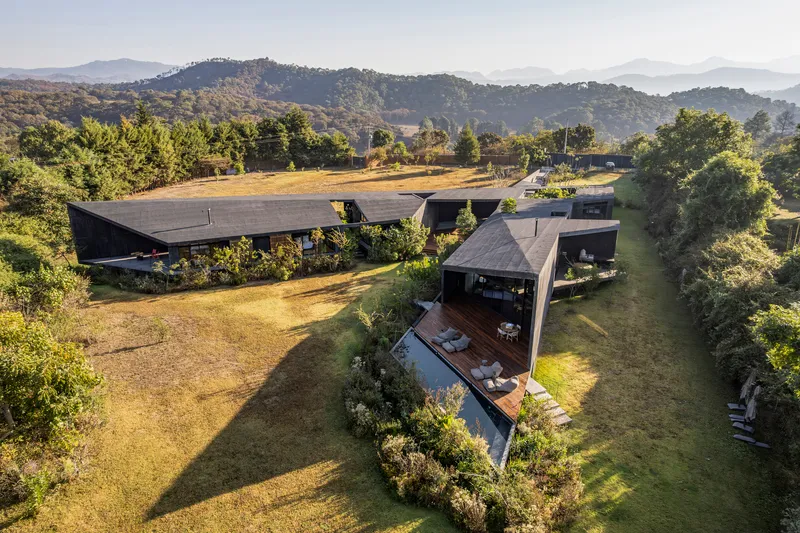
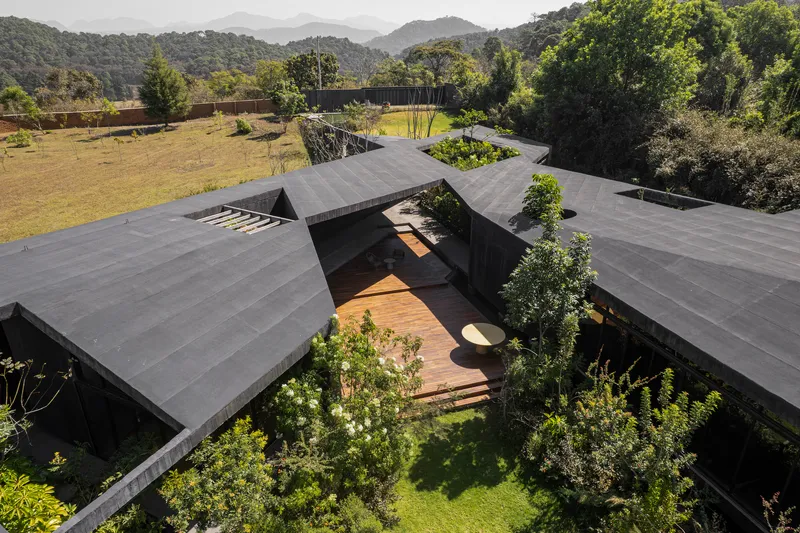
From the air, the plan reads clearly: two low-slung volumes unfold across the clearing, their angular rooflines generating sharp geometries against soft grass and scattered trees. The western, more horizontal wing organizes the social life of the house, with living room, dining area, and kitchen arranged around planted patios. The eastern wing is private, its bedrooms accessed through a network of corridors and connecting nodes that feel more like a small village than a single residence.
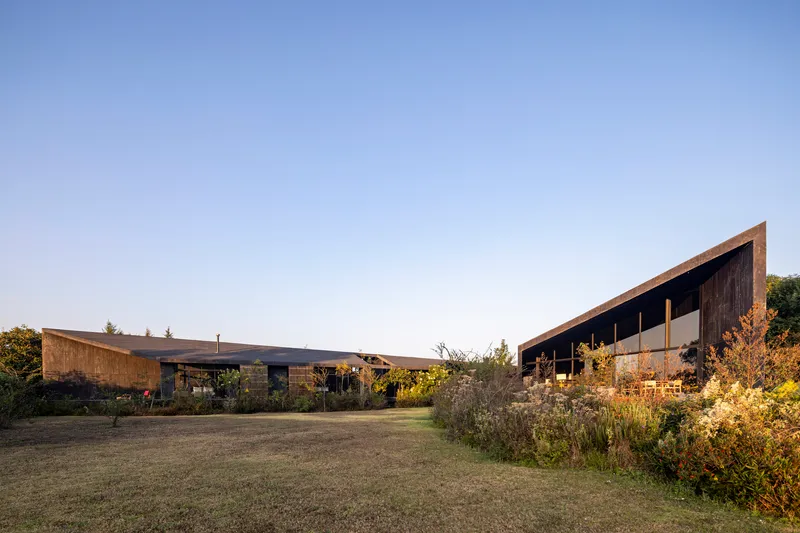
The decision to keep the building low, never competing with the surrounding tree canopy for height, gives Casa Mavra a grounded, almost territorial quality. Cantilevered roof planes extend outward like protective arms, casting deep shade over terraces and blurring the line between interior and exterior. Semi-covered corridors connect the two wings, so moving through the house always involves a passage through open air.
Black Concrete as Shadow

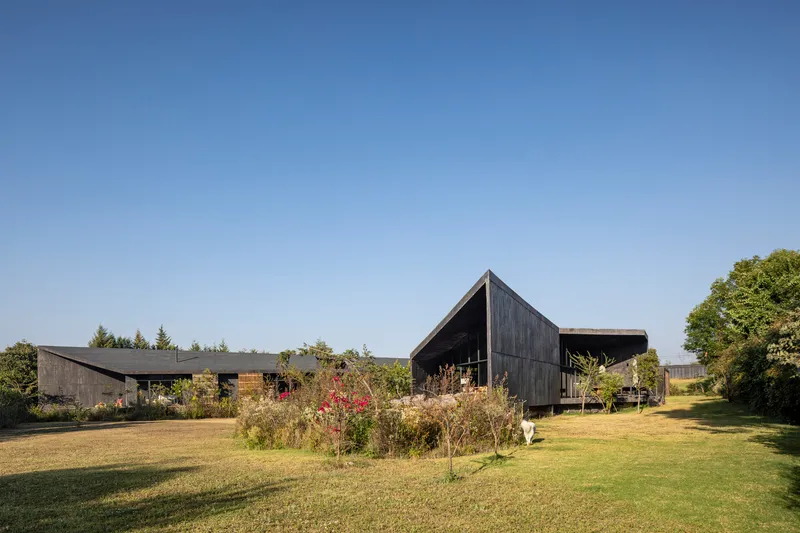
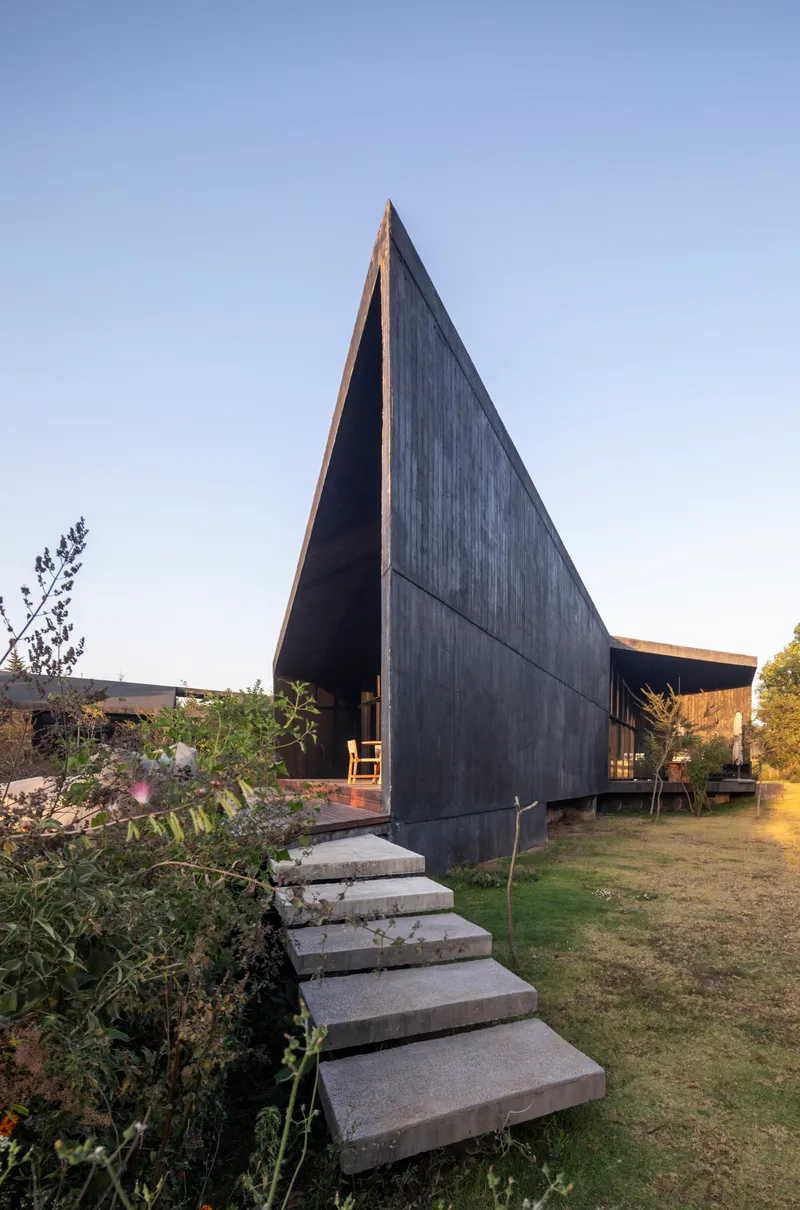
There is virtually no decorative flair on the exterior. The facades present themselves as sheer planes of black concrete, punctuated only by small, precisely placed window openings. Board-formed textures give the surfaces a directional grain, but the material palette refuses to diversify. Where most architects would introduce a secondary cladding or a contrasting accent, Alberto Calleja doubles down on monochrome severity.
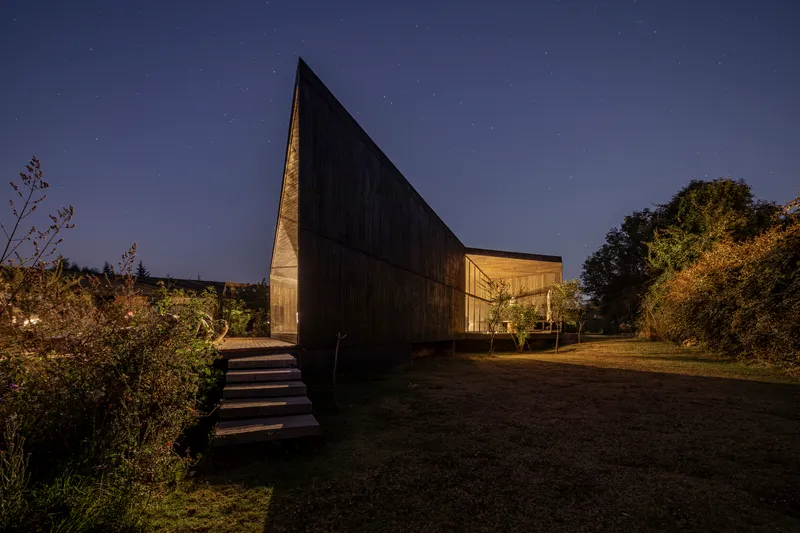
The gamble pays off because of the site. Against the warm tones of dry grass at dusk or the deep green of Valle de Bravo's forest, the black volumes look less stark than they would in an urban context. They absorb ambient color from the landscape rather than projecting their own. At night, the house nearly disappears, legible only through the warm glow of interior light escaping through its openings.
Light as Liturgy
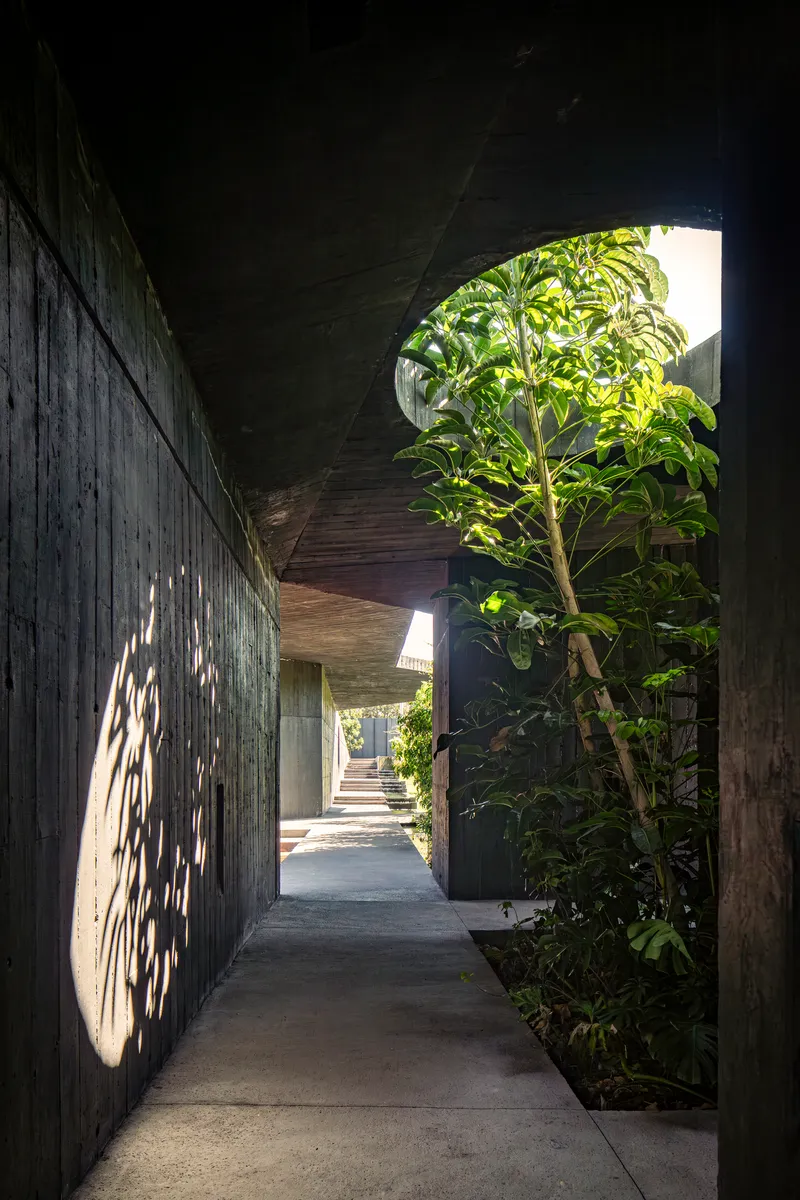

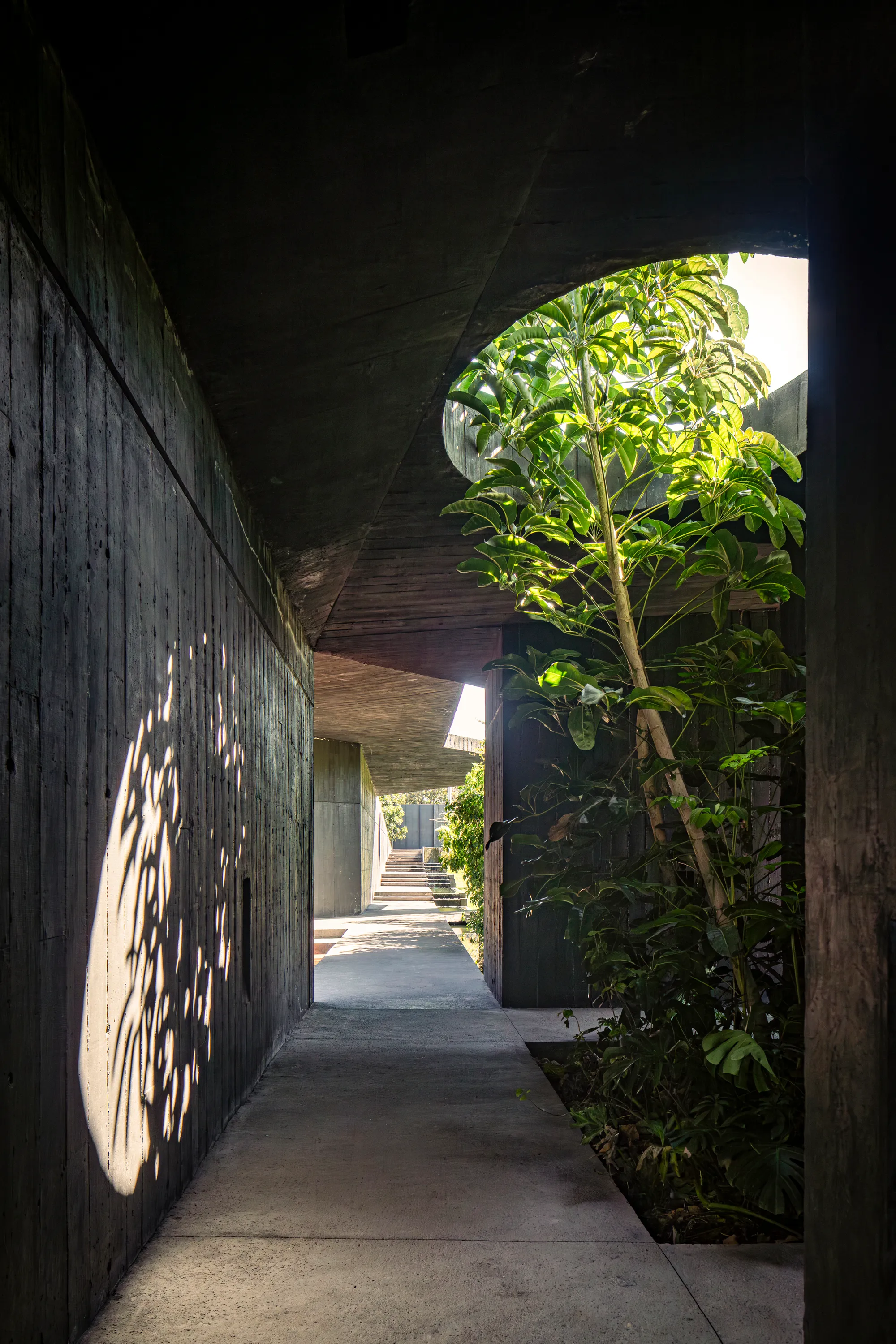
The interior corridors are where Casa Mavra reveals its more lyrical ambitions. Overhead, geometric cutouts in the concrete roof, circles and squares, channel daylight into shafts that shift position and intensity throughout the day. Planted alcoves along the corridor walls bring vegetation inside the section, so ferns and small trees grow within the thickness of the architecture itself. The effect recalls Luis Barragán's interest in light as a spiritual medium, though the language here is harder, more mineral.
A triangular skylight in one courtyard frames a patch of canopy overhead, turning the sky into a framed composition visible only from below. These moments of controlled porosity prevent the continuous concrete wall from becoming oppressive. They also serve a practical climate strategy: the openings allow cross ventilation and controlled rain entry into internal gardens, keeping the house cool without mechanical intervention in a temperate highland climate.
Living Under Angular Planes

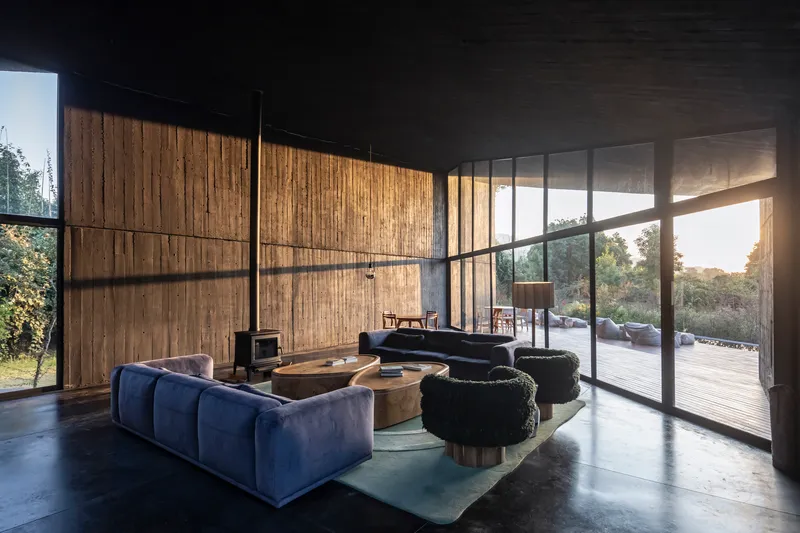
Beneath the angular roof planes, the social spaces open generously toward the landscape. A covered terrace with scattered seating occupies the zone where roof meets ground, creating an outdoor room shaded by geometry alone. Inside, vertical timber wall panels and floor-to-ceiling glazing soften the concrete palette and draw the eye toward the surrounding trees. The material shift from black concrete to warm timber marks the threshold between the protective shell and the inhabited interior.
At night, Casa Mavra transforms. The illuminated glass pavilion glows against the dark timber volume beside it, and under a starlit sky the house looks almost like a terrestrial observatory. The contrast between the massive, opaque concrete and the transparent living spaces creates a tension that keeps the architecture from settling into any single mood.
Site and Landscape
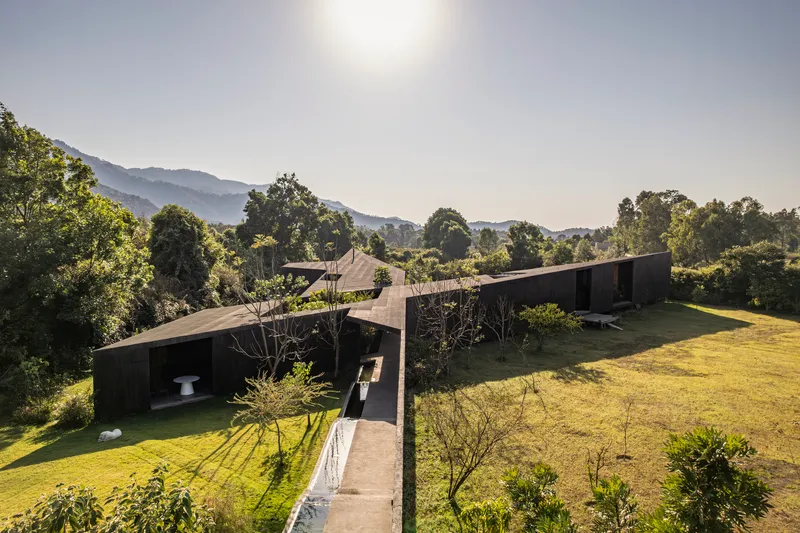
The approach to the house is choreographed. A stepped path enters from the south, running alongside a water feature that guides visitors from the street toward the entrance patio and eventually connects to the pool. The linearity of this sequence, water running parallel to movement, gives the arrival a processional quality. You are not simply walking to a front door; you are being drawn along a channel.
Internal patios preserve native plants and trees that existed before construction, allowing the building footprint to accommodate the landscape rather than erase it. Planted beds fill the gaps between clustered volumes, and timber walkways link pavilions across open lawn. The site strategy maintains visual and spatial continuity with the surrounding forest, ensuring the house reads as a clearing within the woods rather than a compound carved out of them.
Plans and Drawings
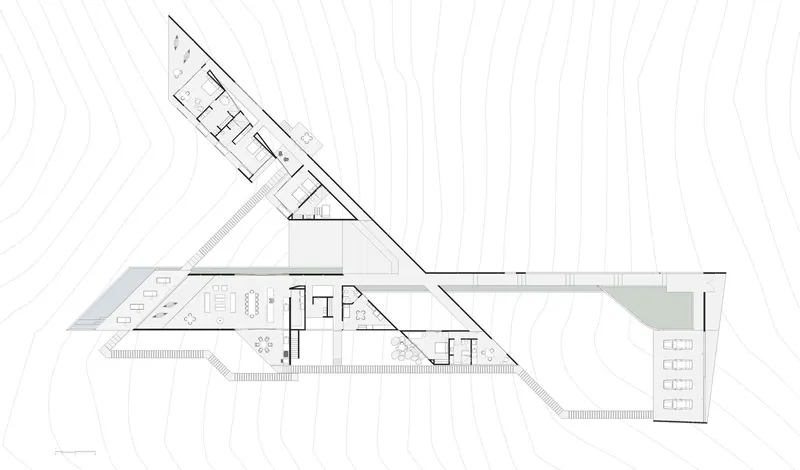
The floor plan confirms what the aerial photographs suggest: two angular wings intersect at a central core, generating the X-shaped footprint that defines the house's spatial logic. Topographic contours around the plan reveal the flatness of the site, which explains the architects' decision to keep the building horizontal rather than terracing it into a slope. The central patio, visible as a void between the two wings, acts as both divider and connector, a space that belongs to both programs while remaining fully open to the sky.
Why This Project Matters
Casa Mavra is a study in commitment. Where many residential projects hedge their bets with material variety and stylistic pluralism, TAC Taller Alberto Calleja pursues a single idea, the continuous black concrete wall, to its logical extreme. The result is a house that gains its richness not from surface variation but from the interplay between a monolithic shell and the light, water, and vegetation it admits. Every circle punched through the roof, every planted alcove, every triangular skylight earns its presence precisely because the surrounding material is so unyielding.
The project also demonstrates that black, a color architects often treat as a graphic accent, can function as a full-spectrum environmental strategy. By absorbing rather than reflecting the colors and shadows of its wooded context, Casa Mavra dissolves into its setting in a way that a white or grey house never could. It is a house that grows darker as the forest around it deepens, and that is a more sophisticated form of site sensitivity than any green roof or living wall could achieve.
Casa Mavra by TAC Taller Alberto Calleja, led by Alberto Calleja. San Juan Atezcapan, Mexico. 1,300 m². Completed 2023. Photography by Onnis Luque.
About the Studio
Share Your Own Work on uni.xyz
If projects like this are the kind of work you want to make, uni.xyz is a place to publish your own, find collaborators, and enter design competitions.




Popular Articles
Popular articles from the community

AL-JANNAH: Sustainable Architecture and Permaculture for Afghan Widows
AL-JANNAH uses sustainable architecture and permaculture to create resilient oasis of housing, learning, work and renewal for Afghan widows.

Riyadh For All: Intergenerational Urban Design for Active Aging in Rabat
Riyadh For All reimagines urban design in Rabat with intergenerational co-living, adaptive courtyards, and Moroccan cultural exchange today.

Conexión: Biophilic Design Reimagines High-Rise Living in Hong Kong
Conexión reimagines high-rise living in Hong Kong through biophilic design, green facades, shared spaces, daylight, water and nature within.

Hill & Cross Opera: Sculptural Opera House Architecture Shaped by Tallinn’s Landscape and Identity
Hill & Cross Opera reimagines opera house architecture in Tallinn through its sculptural hill, civic plaza, glass wave and a luminous cross.

Similar Reads
You might also enjoy these articles

Bao Huynh Watercolor Atelier: A Serene Art Retreat in Hội An
Bao Huynh Watercolor Atelier in Hội An blends multifunctional art spaces, sustainable design, local materials, and family-friendly living in a serene environment.

Atelier Macri Concept Store Interior Design by CASE-REAL
Atelier Macri store features a "ko" counter, walnut wood details, cork displays, blending retail, gallery, and seamless customer experiences.

Manuel Vargas Izquierdo Stadium and High-Performance Sports Center: Architectural Excellence in Jalpa de Méndez
The Manuel Vargas Izquierdo Stadium blends sustainable design, inclusive sports facilities, and cultural-inspired architecture, revitalizing Jalpa de Méndez’s public spaces.

KAKR Buluh Awar Hall: Revitalizing Community and Ecology Through Bamboo Architecture
Community built bamboo hall revitalizes Buluh Awar village, empowering youth, restoring ecology, celebrating vernacular craftsmanship through sustainable architecture and culture.




Comments (0)
Please login or sign up to add comments
No comments yet. Be the first to comment!