
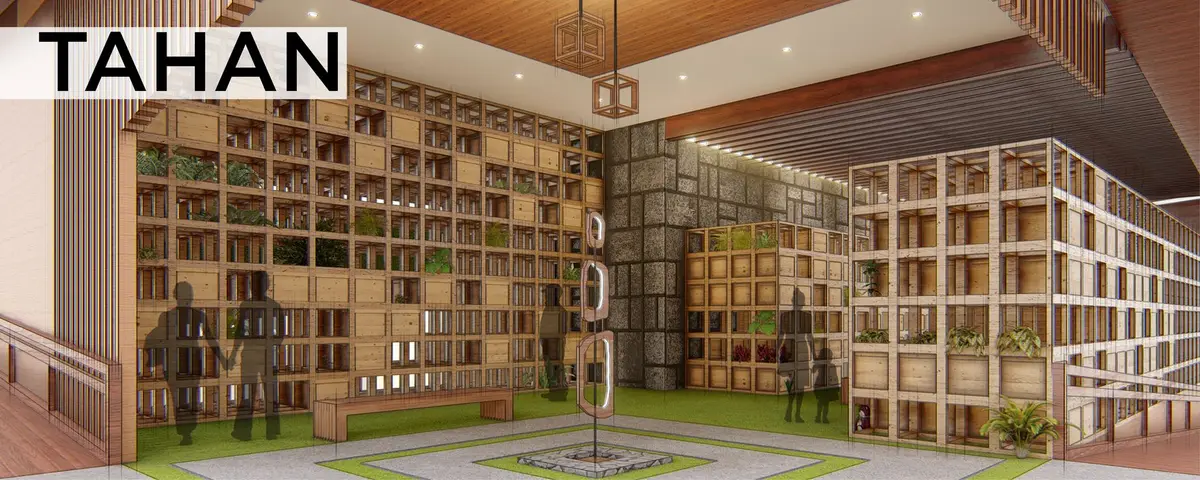
TAHAN: A Vertical Cemetery That Refuses to Separate Life from Death
A high-rise memorial tower in timber and greenery merges burial gardens, civic plazas, and community spaces into one vertical urban structure.


What if a cemetery could also be a café, a co-working space, a garden plaza, and a place where people walk their dogs at dusk? TAHAN takes the single most avoided typology in urban architecture and flips it into a hybrid civic tower where mourning and daily life share the same vertical axis. Named after the Filipino word tahanan, meaning home or dwelling place, the project treats the afterlife not as something to be banished to the urban periphery but as something woven into the rhythm of a neighborhood.
Designed by Kyle Babst and published on uni.xyz, TAHAN proposes a twisting, timber-clad tower that stacks civic programs on its lower levels and garden-like cemetery zones above. The concept confronts a real and growing crisis: as urban populations expand and horizontal land vanishes, traditional cemetery models become spatially and ecologically untenable. Babst's response is neither timid nor morbid. It is an architectural argument that death care can be a catalyst for public space, sustainability, and cultural inclusivity.
A Covered Terrace Between Worlds
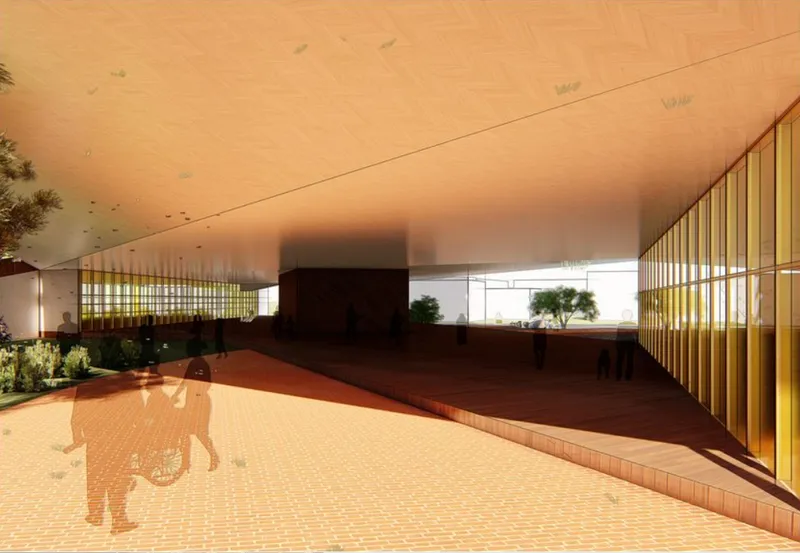
The interior atmosphere of TAHAN is immediately disarming. A covered terrace opens onto a tiled reflecting pool flanked by timber decking, with vertical screening filtering light into a warm, sheltered volume beneath a timber ceiling. The space reads more like a contemplative resort pavilion than anything associated with burial. That cognitive dissonance is the point. By designing memorial-adjacent spaces that invite lingering, rest, and even pleasure, TAHAN strips away the cultural aversion that keeps cemeteries isolated from everyday urban life.
Stacked Volumes, Planted Roofs, and a Civic Ground Plane
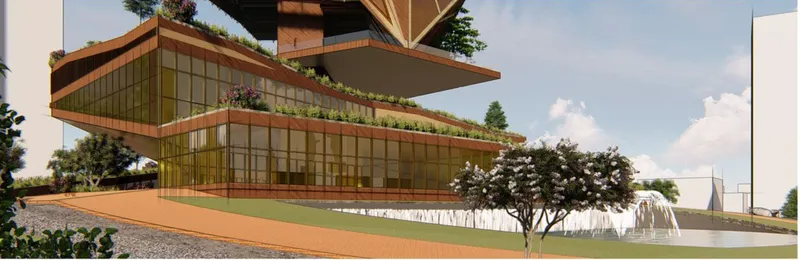
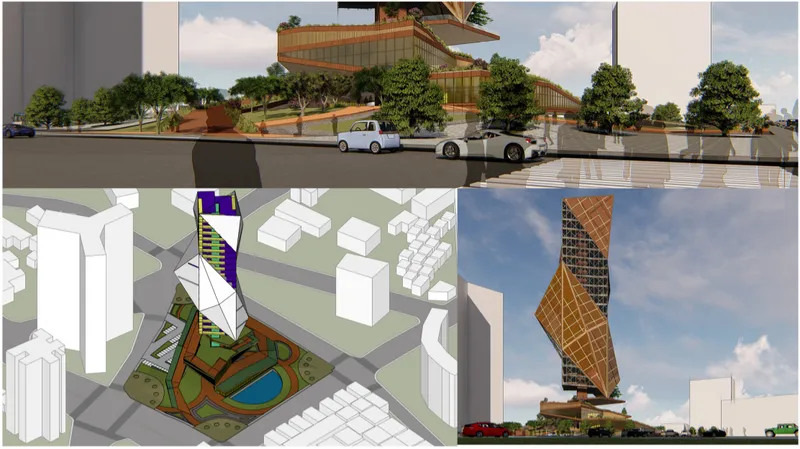
Seen from the street, TAHAN reads as a series of stacked volumes with glazed facades, each topped with planted roofs and trees. The massing is not monolithic; it breaks down into identifiable horizontal bands that give the tower a legible hierarchy. Lower levels house cafés, learning centers, shops, and co-working areas, while upper levels transition into the memorial program: freestanding memorial walls, biodegradable casket gardens, and modular urn niches in ventilated timber-clad interiors.
The composite rendering and axonometric site plan reveal how four entry plazas anchor each corner of the site, each representing diverse global cultures and faiths. These plazas funnel visitors toward the building's central core, reinforcing an ethos of inclusivity. The twisted timber facade shifts in appearance depending on viewing angle, a deliberate formal gesture that echoes the multifaceted nature of the life-death threshold the building straddles.
Form Development: From Podium to Twisted Tower
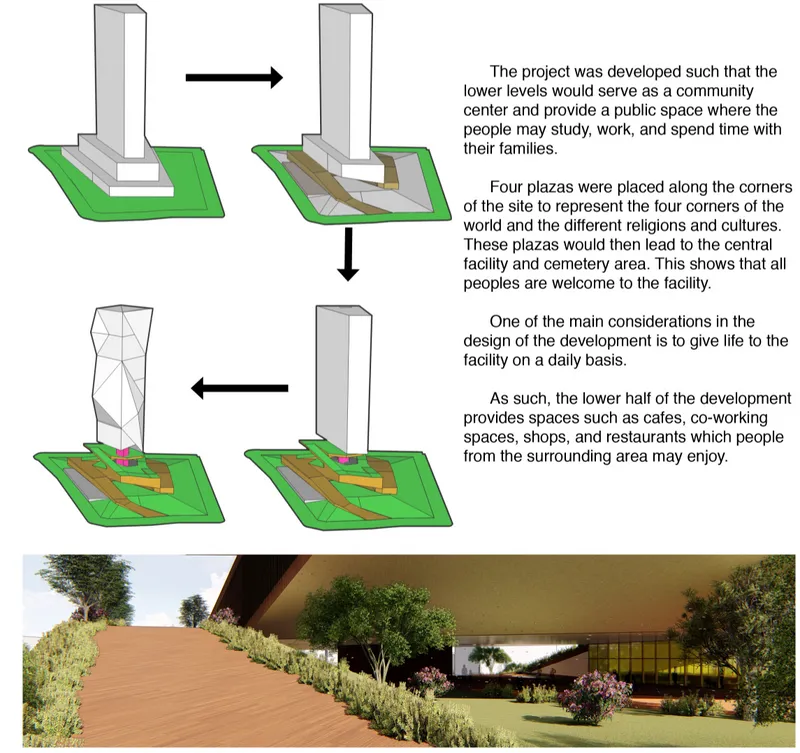
A diagrammatic sequence traces the tower's formal evolution from a simple podium to the final twisted volume, showing how the landscaped ground plane and plazas inform the building's footprint before the upper mass begins its geometric rotation. The twist is not decorative. It generates orientation-dependent facades that respond differently to sun, wind, and sightline, while the uniform structural core beneath maintains functional efficiency and future scalability. The ramped circulation system that winds through the tower doubles as a ceremonial procession route, transforming the act of ascending to the memorial levels into a spatial ritual accessible to people of all ages and abilities.
Cantilevered Gardens Where Grief Meets Green Burial
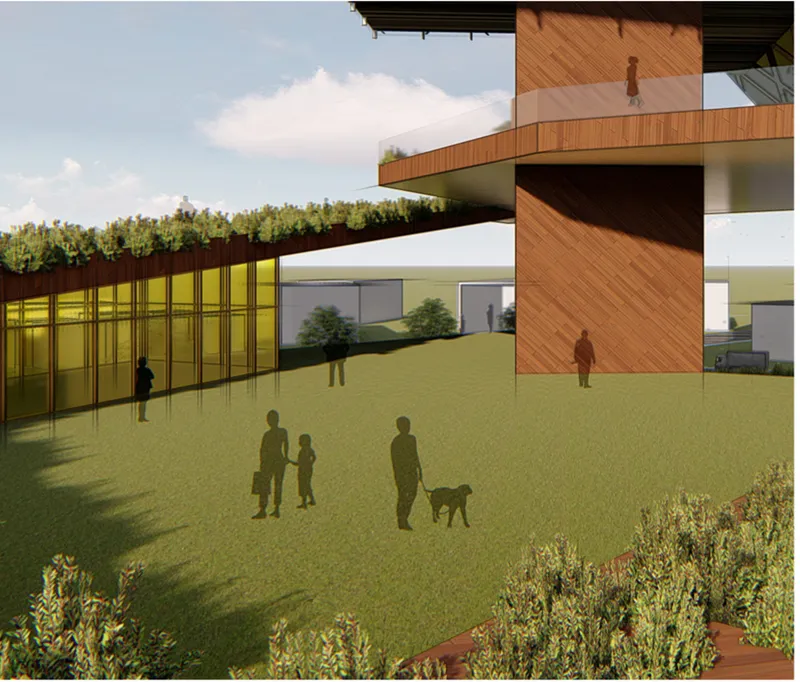
One of the project's most compelling moments occurs at the cantilevered terraces, where timber-clad volumes extend over lawns populated by figures and, notably, a dog. The rendering captures a scene that could belong to any well-designed public park, yet it sits on the edge of a cemetery tower. This is where TAHAN's sustainable death care strategies become spatial: biodegradable green caskets placed in open garden lots, cremation ashes scattered around memorial trees, and modular niches for urns integrated into the building's ventilated timber skin. By going vertical, the design conserves horizontal land while embedding ecological burial practices into an architecture that people actually want to visit.
A Dusk Plaza That Belongs to the Living
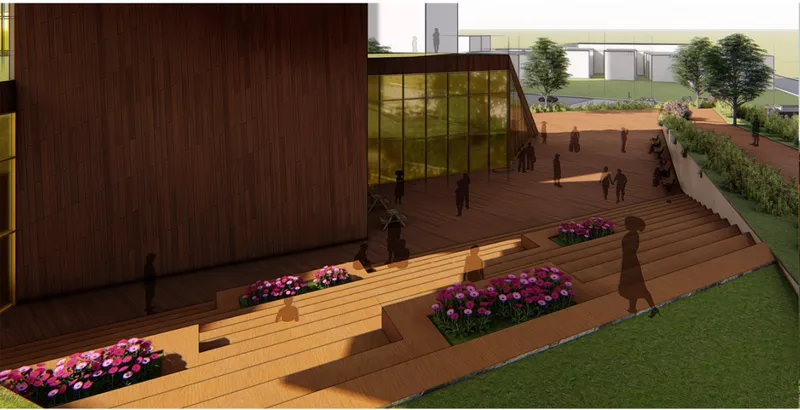
The elevated timber deck plaza at dusk, lined with planted beds of purple flowers and populated by figures in casual repose, encapsulates TAHAN's central ambition. It is a space that belongs entirely to the living, yet it sits within a structure dedicated to honoring the dead. The warmth of the timber, the color of the planting, and the soft twilight atmosphere combine to produce a public space that could sustain daily foot traffic, social gathering, and quiet reflection in equal measure. There is no gate, no somber threshold. The cemetery and the city share the same deck.
Why This Project Matters
TAHAN matters because it refuses the premise that death and daily life require separate architectures. Most vertical cemetery proposals remain confined to the speculative fringes, treated as provocations rather than buildable ideas. Babst's project pushes past provocation by grounding its concept in programmatic specificity: named burial typologies, defined civic uses on distinct levels, cultural entry plazas, and a legible circulation strategy. It is a scheme that could be briefed, not just exhibited.
More broadly, the project reframes sustainability in death care as an architectural opportunity rather than a logistical burden. In cities where cemetery land is exhausted and cremation rates are climbing, the question is not whether vertical burial will happen but how well it will be designed. TAHAN offers a serious, spatially generous answer: a hybrid tower where the memory of the dead enriches the daily life of the living, wrapped in timber, rooted in cultural respect, and open to the sky.
View the Full Project
About the Designers
Designer: Kyle Babst
Enter a Design Competition on uni.xyz
uni.xyz runs architecture and design competitions year-round that reward proposals with spatial conviction and real site intelligence.
Project credits: TAHAN, by Kyle Babst.


Popular Articles
Popular articles from the community


Opera on the Sea: Driftwood Logic Shapes a Timber Opera House on Estonia's Coast
Trevor Orgill's opera house translates the entangled drift of floating timber into a civic building where wood, water, and music converge.


ETEH Reworks the Shared Spaces of São Domingos School in Brazil Around Timber, Color and Hanging Plants
At São Domingos School in Brazil, 436 m² of hall, refectory and library are recast with timber joinery, a yellow and blue code and trailing greenery.

FCC Arquitectura Expands a Portuguese Granite House with a Board-Marked Concrete Wing
In Portugal, JV House pairs a cleaned-up whitewashed and granite dwelling with a timber-shuttered concrete extension, courtyards and a garden pool.

graciastudio Turns a Viewless Tijuana Lot Inward Around a Courtyard of Concrete, Timber and Trees
In Tijuana, Jorge Gracia's GA2 House stacks a timber-clad private floor over exposed concrete and replaces a missing view with a planted interior patio.

Similar Reads
You might also enjoy these articles

Cube Design Draws an Ecological Corridor Between Two Shenzhen Hills with the Nankai Building
Beside Shenzhen's container docks, the Nankai Building pairs stacked balconies with a climbing green screen to connect two hillsides across its height.

Praksis A and Studio Sted Bend a Red Timber Cabin Across the Granite of Norway's Southern Coast
On the southern Norwegian coast, a 105 m² cabin follows the rock on slender posts, pairing red cladding outside with pine, brick and plywood within.

David Ortega Stacks a Two-Story Mexico City Penthouse Around a Steel Stair and a Pergola-Shaded Roof Terrace
In Colonia Roma, a 300 m² penthouse uses oak joinery, a planted steel stair and a slatted roof pergola to make a new-build apartment feel like a house.

PARALELA and LB2 Thread a Public Walkway Through the Base of a Las Condes Residential Tower
In Las Condes, Santiago, the Hamlet Building gives its fenceless ground floor to a 70-metre wooded passage linking two streets and the metro.

Comments (0)
Please login or sign up to add comments
No comments yet. Be the first to comment!