

Taste Bloom: 50 Restaurants Organized Around a Living Aromatic Courtyard
A modular three-tiered dining complex in New York City where composting, rainwater harvesting, and fragrant gardens close the loop between food and archite


What if fifty restaurants could share a single garden and, in doing so, feed it back? Taste Bloom takes that proposition literally. Organic waste from kitchens becomes compost for a central aromatic courtyard planted with lavender, rosemary, basil, and thyme, whose fragrance drifts through open facades and into every dining room. The result is a closed-loop ecosystem where architecture, gastronomy, and horticulture are not parallel concerns but interlocking systems, each sustaining the others.
Designed by Esra Aşirt, Taste Bloom is the winning entry of The Chef's Palette competition. The project imagines a site in New York City where 50 diverse restaurants, from street-level cafes to experimental fine dining, coalesce into a single three-story complex organized on a 6x6 modular grid. Rather than treating each restaurant as an isolated unit, Aşirt structures the entire ensemble around a shared sensory core: an open courtyard that functions as communal garden, air purifier, and spatial anchor.
A Horizontal Mass in a Green Field


Seen from above, Taste Bloom reads as a long, terraced horizontal building set into a generous green landscape. The aerial view reveals how each of the three levels steps back to create outdoor terraces that face inward toward the courtyard, ensuring that every restaurant maintains a visual and physical connection to the planted center. The five programmatic diagrams alongside illustrate how Aşirt tested different configurations before arriving at a vertical hierarchy: popular, accessible eateries on the ground floor; fine dining and interactive culinary experiences with sea-view terraces on the first floor; and luxury, health-focused experimental restaurants on the second floor.
The modular grid governs both plan and section, giving the complex structural regularity without visual monotony. Steel and wooden supports form a hybrid structural system that balances durability with the warmth of natural materials, while the facade incorporates passive ventilation strategies for thermal comfort. The stepping massing means upper-level diners look down into the garden canopy, while ground-floor guests sit nearly at grade with the planting beds.
Plans and Sections That Reveal Circulation Logic

The floor plan and section drawings expose the project's operational backbone. Separate service routes, kitchen ventilation systems, and material flow paths run parallel to but apart from guest circulation, so that the sensory experience remains uninterrupted. The sections show how the open courtyard cuts through the building mass, creating a void that pulls daylight deep into the interior while maintaining sightlines from upper terraces down to the ground-level garden. Rendered perspective views at the building entries convey the transition from the urban sidewalk into the fragrant courtyard: a threshold shift designed to signal that you are entering a different kind of dining environment.
The Courtyard as Sensory Engine


Circular planting beds arranged beneath circular roof cutouts define the courtyard's geometry and its atmosphere. Sunlight pours through the openings, creating shifting pools of light on the garden floor throughout the day. The planting palette is deliberately culinary: lavender, rosemary, basil, and thyme were chosen not only for fragrance but because they tie directly to the cuisines being served in surrounding restaurants. This garden is the physical manifestation of the project's closed-loop ambition. Organic waste from kitchens is composted and returned to these beds as fertilizer, while rainwater collected through roof-integrated channels irrigates the plantings and serves facility cleaning needs.
From the adjacent dining areas, the courtyard is visible through full-height glazing and slatted timber ceilings that filter light into warm, rhythmic patterns. The interior rendering shows diners seated just behind the glass, their tables oriented toward the garden so that the view of circular planting beds and shifting daylight becomes part of the meal itself. The transparency of the facade is not decorative; it is the mechanism by which the aromatic garden performs its sensory work on every restaurant simultaneously.
Dining Rooms That Dissolve into the Garden


Two interior renderings demonstrate how Aşirt calibrates the boundary between indoor dining and outdoor garden. In one, seated figures occupy a ground-level restaurant with glazed walls that frame the circular courtyard beyond, collapsing the distinction between eating indoors and eating in a garden. In the other, a multi-level atrium opens up vertically with a spiral staircase connecting floors, planted beds interrupting the hard surfaces of the dining area, and tables scattered among greenery. The effect is of a building that has been colonized by its own landscape.
These spaces reveal the project's broader argument: that sustainable restaurant architecture does not have to mean austerity or technical display. The composting system, rainwater harvesting channels, and passive ventilation are all present, but they recede behind the experiential richness of timber, greenery, and light. Guests encounter the sustainability as atmosphere, as the scent of rosemary rather than as a diagram on a wall.
Why This Project Matters
Taste Bloom stands out because it treats the restaurant not as an isolated interior but as one node in a metabolic cycle. Waste becomes soil, soil becomes fragrance, fragrance becomes part of the meal. The 6x6 modular grid accommodates 50 wildly different culinary programs while maintaining a coherent architectural identity, proving that diversity and order are not opposed. The vertical stratification, from casual ground-floor eateries to experimental second-floor concepts, gives the complex a legible social gradient without physical barriers.
For a competition asking designers to rethink the relationship between food and space, Aşirt's response is convincing because it is systemic rather than scenic. The aromatic courtyard is not a decorative amenity appended to the building; it is the organizing principle from which structure, program, sustainability, and atmosphere all derive. That integration, where architecture literally grows from the food it serves, is the core achievement of the project.
View the Full Project
About the Designers
Designer: Esra Aşirt
Enter a Design Competition on uni.xyz
uni.xyz runs architecture and design competitions year-round that reward proposals with spatial conviction and real site intelligence.
Project credits: Taste Bloom by Esra Aşirt The Chef's Palette (uni.xyz).


Popular Articles
Popular articles from the community


ETEH Reworks the Shared Spaces of São Domingos School in Brazil Around Timber, Color and Hanging Plants
At São Domingos School in Brazil, 436 m² of hall, refectory and library are recast with timber joinery, a yellow and blue code and trailing greenery.

David Ortega Stacks a Two-Story Mexico City Penthouse Around a Steel Stair and a Pergola-Shaded Roof Terrace
In Colonia Roma, a 300 m² penthouse uses oak joinery, a planted steel stair and a slatted roof pergola to make a new-build apartment feel like a house.


Opera on the Sea: Driftwood Logic Shapes a Timber Opera House on Estonia's Coast
Trevor Orgill's opera house translates the entangled drift of floating timber into a civic building where wood, water, and music converge.

Singing Woman: An Opera House That Performs Before the Curtain Rises
Ovidiu Cristian Pavel's conceptual opera house translates Estonia's choral identity into a sculpted waterfront landmark facing the Baltic Sea.

Similar Reads
You might also enjoy these articles

Aquadapt: An Underwater Habitat That Rewrites Its Rooms by the Hour
Curved modules ring the seabed while one shell shifts from breakfast room to cinema, farm and football pitch as residents' needs change.

Play: Fragments of Their World: Remembered Architecture Rebuilt as a Modular Playground for Refugee Camps
Tom Gardner abstracts domes, arches and towers from the homelands of displaced families into a kit of child-scaled play parts for camp settlements.
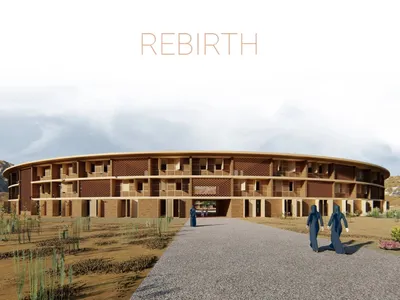
REBIRTH: A Circular Settlement Where Afghan Widows and Their Children Rebuild Life Together
A shortlisted Resile entry turns the circle into a protective ring of timber and brick, gathering homes, classrooms and gardens around a shared landscape.

The Main Dream: A Recycled Plastic Kit That Lets Refugee Children Build Their Own Playground
Thirty-centimetre interlocking cubes that connect on three axes turn play into construction, letting children author the spaces they occupy.

Comments (0)
Please login or sign up to add comments
No comments yet. Be the first to comment!