
TCMA
Descend into Turkey's history of art.
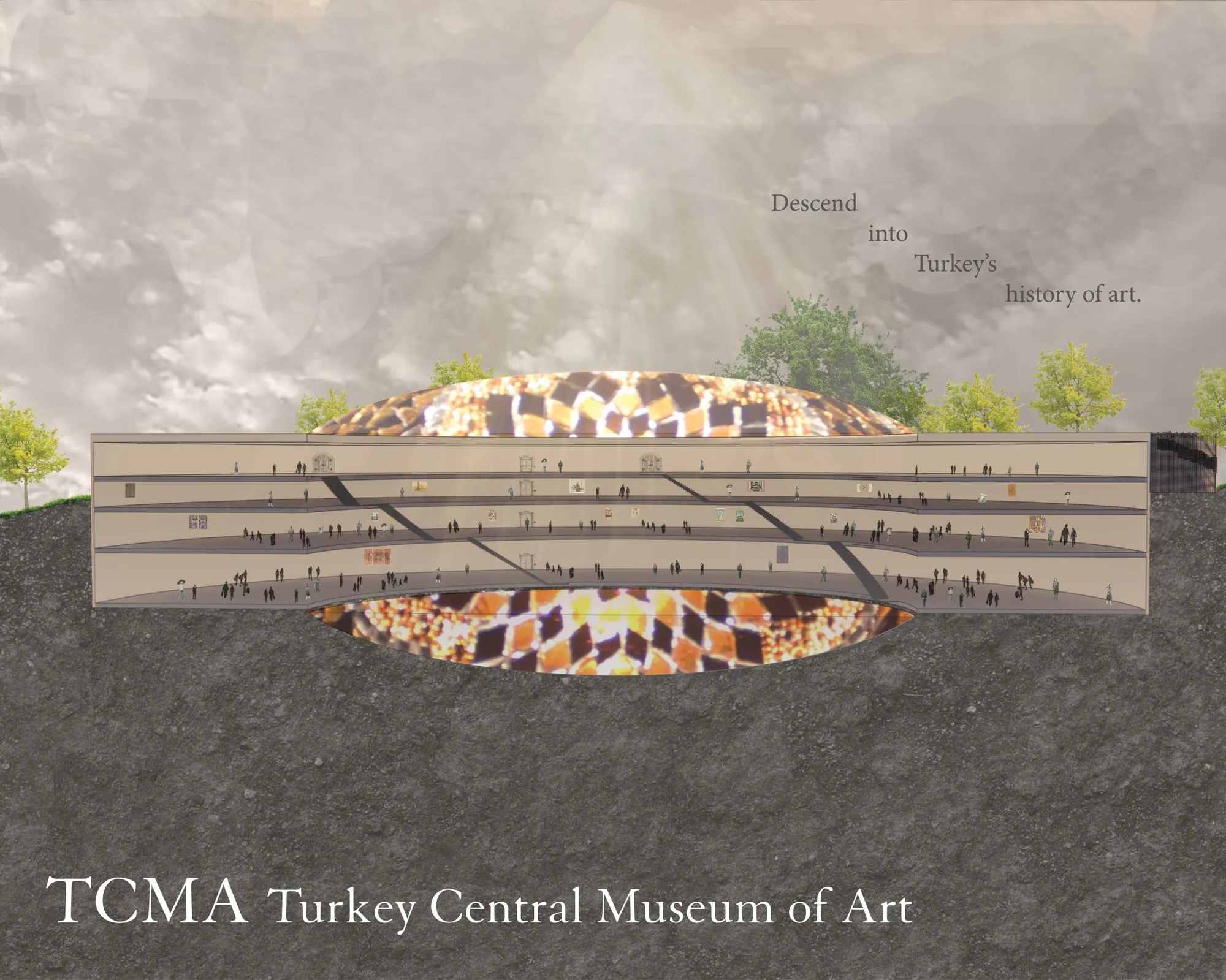
Turkey is riddled with fascinating history, culture, and art. With this consideration in mind, the Turkey Central Museum of Art (TCMA) was designed with the intent of giving its user a tool to experience Turkish art throughout history. Circulation plays a key role in the organization of the project - with each of the three main time periods of art (byzantine, ottoman, and contemporary) revealing themselves as the user moves down the museum's spiral path.
When beginning to create iterations of the basic spiral circulation decided upon, parti models were explored using everyday materials, namely paper, wire, cardboard, and plates. By exploring scaled-down, simplistic form models, each iteration was able to lead the project closer to ease of circulation and optimal usage of space constraints.
The first floor is used as a lobby space that includes an information desk, cafe, gift shop, casual seating, and the upper glass dome. As the user descends down the spiral, they begin to explore Turkish art dating back to the 11th century, including silk textiles from the Byzantine Period - heavily influenced by Roman Catholicism. During the time of the silk road, silk was imported from China, which artists of the time period used to mill and create scenes depicting the profane and fantastic - contrasting the period's typical realist style. On the next floor down, the user will enter the realm of 16th century Turkish art, dating back to the middle of the Ottoman Period. This includes pottery (Iznik tiles), embroidery, Ebru (“marbled paper”), and miniatures. Ebru art consists of mineral and vegetable dyes that are spread on water, which then paper is laid on top, creating unique patterns. Turkish miniatures, under the islamic influence were a form of “illuminated” or illustrated manuscripts. This form of art initiated the beginning of seeing painting as an art rather than for functional use. It became popular, selling widely in markets where street artist vendors would gather to display their works. The next floor (lowest floor) is a transition from the middle of the Ottoman Period to the end of the Ottoman period and contemporary art, and consists of art from the 18th century. After the popularization of Turkish miniatures, calligraphy became the latest form of popular, accessible art in the country. This museum features calligraphy under the islamic influence, which artists in the 1700s used to write the quran and other important texts and manuscripts. Art from the 20’s century is also displayed, with impressionist scene paintings featuring pops of bright colour, commonly seen painted in Turkey today. Connected to the bottom floor, there is a lower glass dome, which connects the periods together by mirroring the dome above it.
The museum is constructed mainly out of brick and cement, materials accessible to the Kayseri area, while stained glass was used for the outer dome to mimic Turkish mosaic and lamp art. The four outdoor entrances are constructed out of brick, carefully placed in order to diffuse through the cracks and allow the user to experience a transition stage before entering the TCMA. The glass dome above the brick facade is the source of natural lighting for the building, diffusing sunlight and creating coloured fractals as the day goes by, as the spiral borders the light well created by the hollow centre space that reaches all the way to the lowest floor.

Popular Articles
Popular articles from the community


Conexión: Biophilic Design Reimagines High-Rise Living in Hong Kong
Conexión reimagines high-rise living in Hong Kong through biophilic design, green facades, shared spaces, daylight, water and nature within.

Riyadh For All: Intergenerational Urban Design for Active Aging in Rabat
Riyadh For All reimagines urban design in Rabat with intergenerational co-living, adaptive courtyards, and Moroccan cultural exchange today.

The Ocean Hive: Sustainable Architecture for a Self-Sufficient Civilization at Sea
The Ocean Hive imagines sustainable architecture at sea, where modular habitats, algae, wave power and ocean waste sustain a growing colony.

Hill & Cross Opera: Sculptural Opera House Architecture Shaped by Tallinn’s Landscape and Identity
Hill & Cross Opera reimagines opera house architecture in Tallinn through its sculptural hill, civic plaza, glass wave and a luminous cross.

Similar Reads
You might also enjoy these articles
The Rhythm of Seasons
A Farmers' Market Connecting Nature and the City


More Than a Building-Designing a Living System
More Than a Building-Designing a Living System
Base Beyond
DESERT COMPOUND ARID: TOURISM OF ABSENCE AND ABUNDANCE
Comments (0)
Please login or sign up to add comments
No comments yet. Be the first to comment!