

td-Atelier and ENDO SHOJIRO DESIGN Resurrect a 1931 Kyoto Timber House for Its Next Century
A nearly centennial wooden residence in northern Kyoto is carefully peeled back and rebuilt around light, memory, and a triangular courtyard.


A house built in 1931 on a plot carved out by the Rakuhoku First District Land Readjustment Project, one of northern Kyoto's earliest urban planning schemes, has survived wars, earthquakes, and three generations of a single family. Now td-Atelier and ENDO SHOJIRO DESIGN, led by Masaharu Tada and Endo Shojiro, have renovated it at 127 square meters to carry the house into its second century. The neighborhood still holds a handful of prewar timber residences, and this one was clearly worth saving.
What makes the project compelling is the degree to which it refuses nostalgia without abandoning history. The architects have stripped the house down to its post-and-beam skeleton, introduced new spatial devices like a triangular courtyard and split-level platforms, and then let the original timber structure remain entirely legible. The result is not a museum piece and not a gut-job. It is a house that knows exactly how old it is and does not pretend otherwise.
Reading the Street
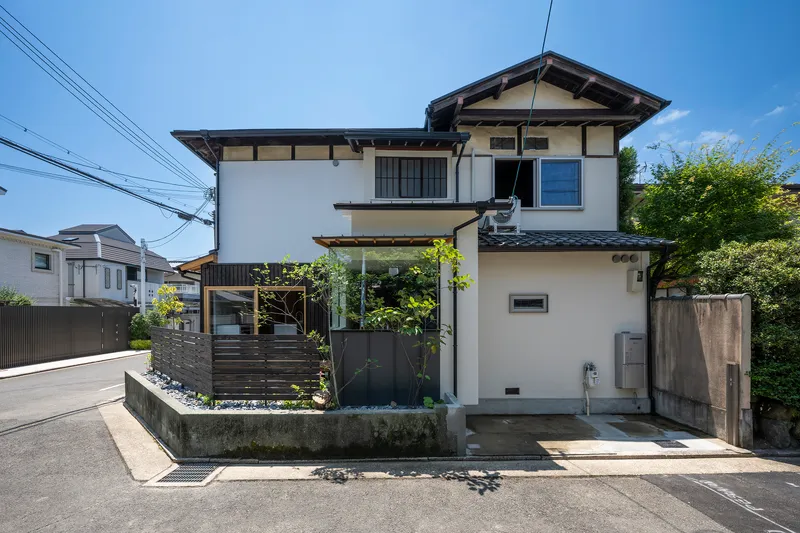
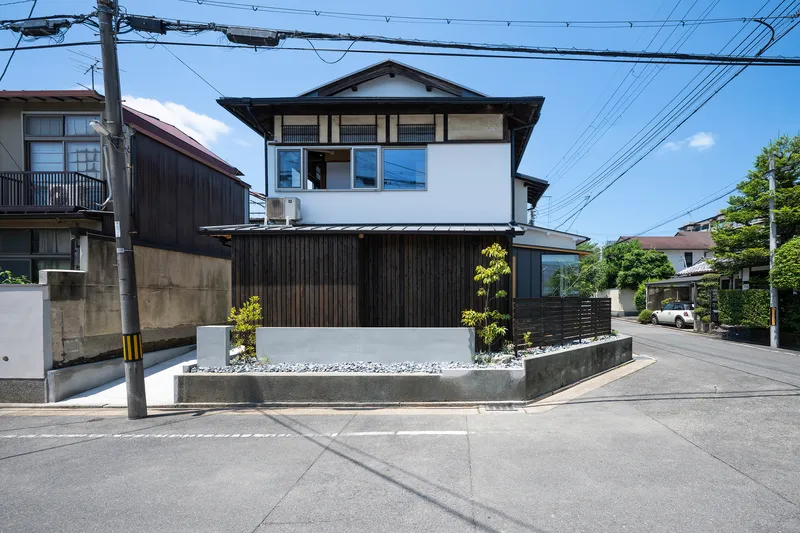
From the street, the house announces its renovation without shouting. White stucco on the upper level meets charcoal timber cladding at the base, a material split that grounds the building visually while hinting at the layered history inside. Horizontal dark screens provide privacy and filter light, and a small planted garden softens the threshold between public sidewalk and domestic interior.
The facade respects the refined residential character of the surrounding Kitayama streets. Overhead wires and neighboring rooflines establish the visual datum; the house sits comfortably within it. There is no desire to stand out. The move is subtler: a two-tone composition that reads as both old and new without forcing the question.
Skeleton as Interior
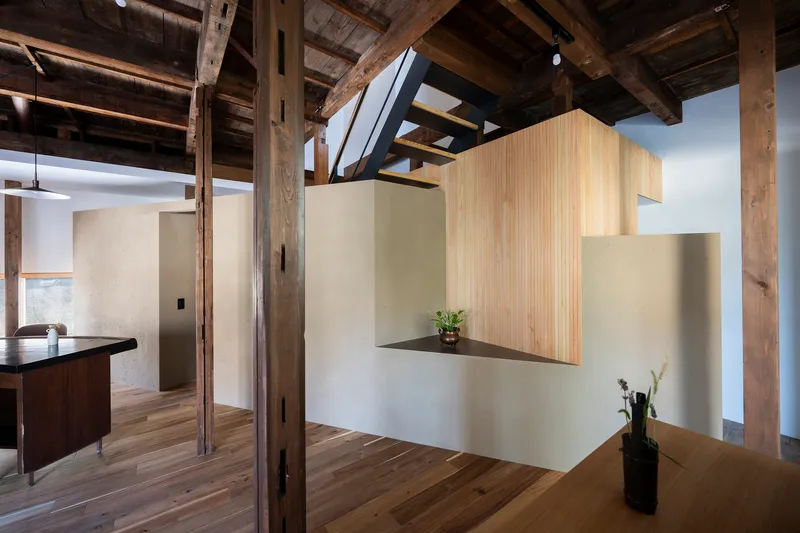
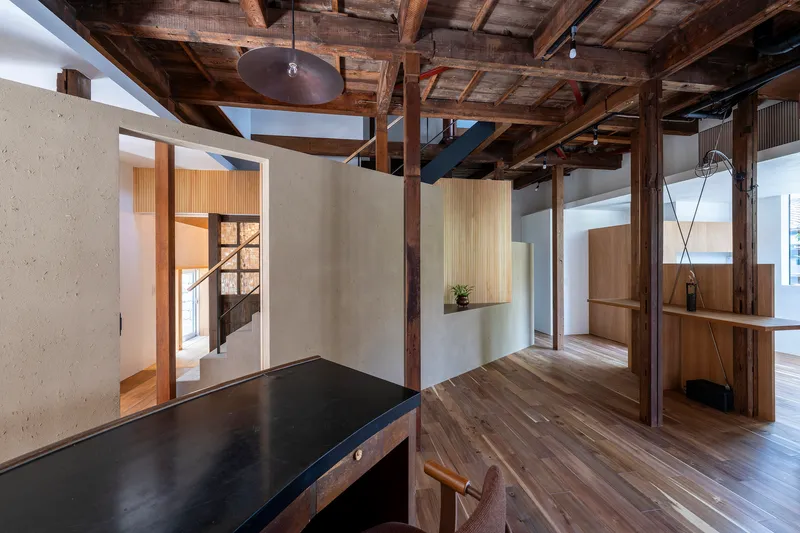
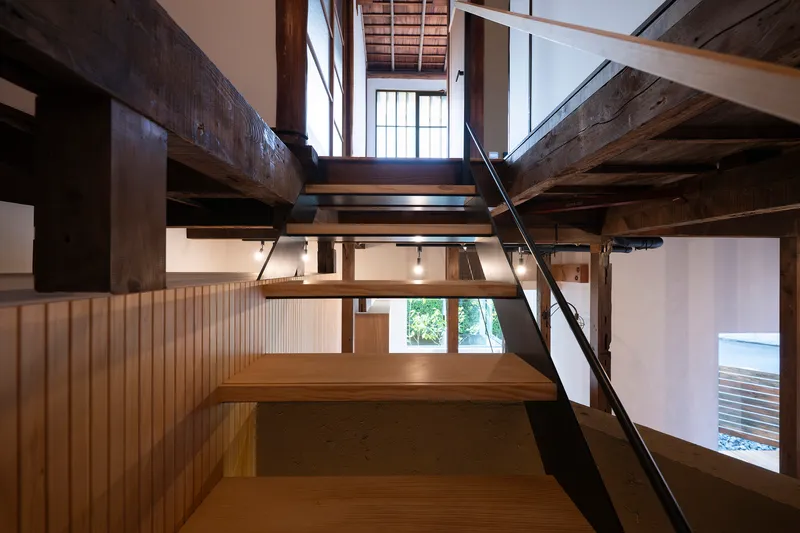
The renovation's strongest gesture is the decision to leave the original timber structure fully exposed. Nearly a century of patina on the posts and beams coexists with fresh white plaster infill walls, creating a visual tension that is both honest and beautiful in the literal sense: it reveals the bones of the building. Skylights punch through the roof plane to wash these timbers in natural light, turning structure into ornament.
Split-level platforms connected by angled steel stairs allow the architects to work within the existing framework while generating new spatial variety. The old floor heights are not sacred; they are negotiated. Steel elements are kept thin and dark so the heavy timber reads as the primary structural system, which it is. Plaster volumes below and between the beams become almost furniture-scaled objects within the larger frame.
The Kitchen as Center


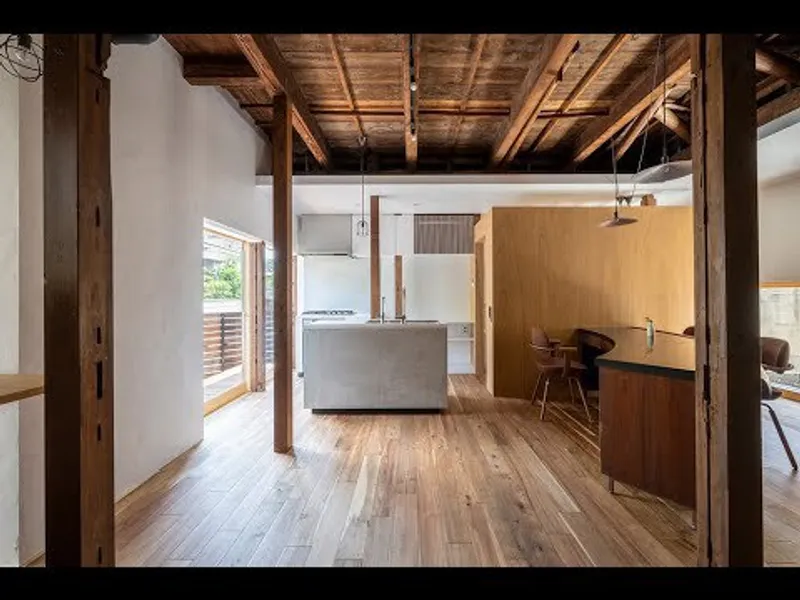
An open kitchen and dining area occupies what feels like the gravitational center of the house. A freestanding island, surfaced in white, sits beneath heavy timber ceiling joists that run the full span. Pendant lights drop at deliberate intervals. A doorway opens to an exterior deck, pulling daylight deep into the plan. The kitchen is doing double duty as a living room, and the architects have sized it generously enough to carry that weight.
What works here is the material contrast: the warmth and grain of the original wood ceiling pressing down against the cool minimalism of the island and fixtures. Products from manufacturers including Rinnai, HARMAN, and Toto are integrated without spectacle. The room is practical, not performative, which suits a house that has been cooking meals for almost a hundred years.
Courtyard and Borrowed Light


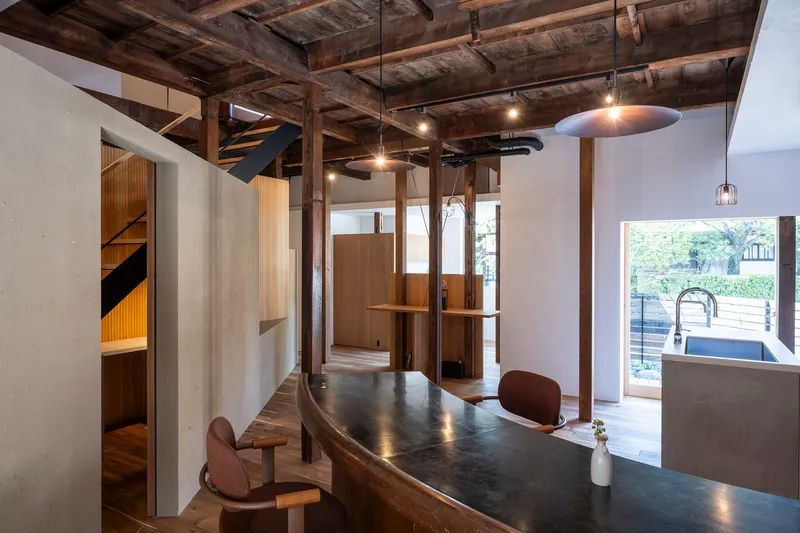
A triangular courtyard, visible in the plan drawings, is the renovation's key spatial invention. It brings light and ventilation into the center of a deep, narrow Kyoto plot, a problem that prewar houses in the city almost universally share. Shoji screens and framed openings control the relationship between interior rooms and this garden, maintaining the traditional layered threshold between inside and outside.
Landscape architecture by Michikusa, co.Ltd. keeps the courtyard planting spare and deliberate. A triangular steel shelf holding a small plant against a plaster wall captures the project's sensibility in miniature: geometry, restraint, and the careful placement of a living thing.
Circulation and Vertical Connections


Two distinct stair types handle the vertical circulation. An open-tread steel staircase rises above a white plaster volume, reading as a contemporary insertion against the timber frame. Elsewhere, a timber staircase with open risers ascends between original wood columns and slatted wall panels, maintaining the material continuity of the old house. The contrast is deliberate: it lets you know exactly which parts are 1931 and which are 2025.
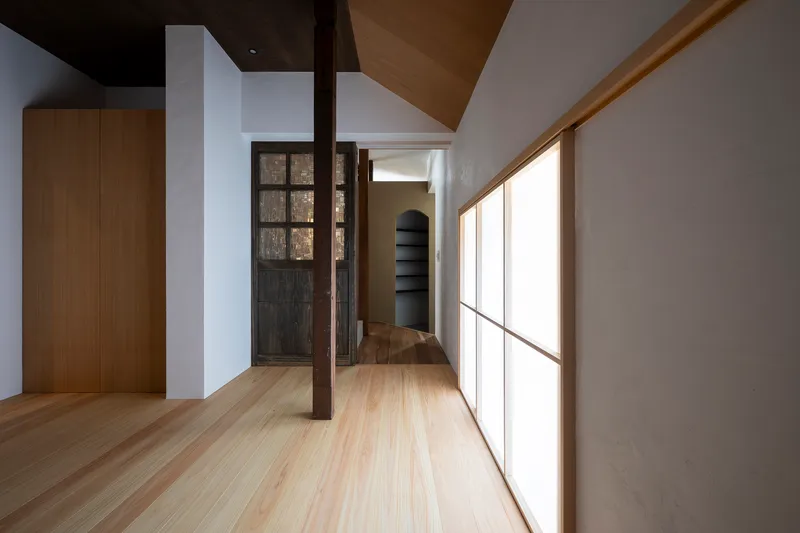
An upper floor hallway with a translucent panel wall diffuses light from the courtyard side while the exposed timber column at the turn anchors you spatially. These are tight, efficient moves in a 127 square meter plan where every centimeter matters.
Tradition Held in Place
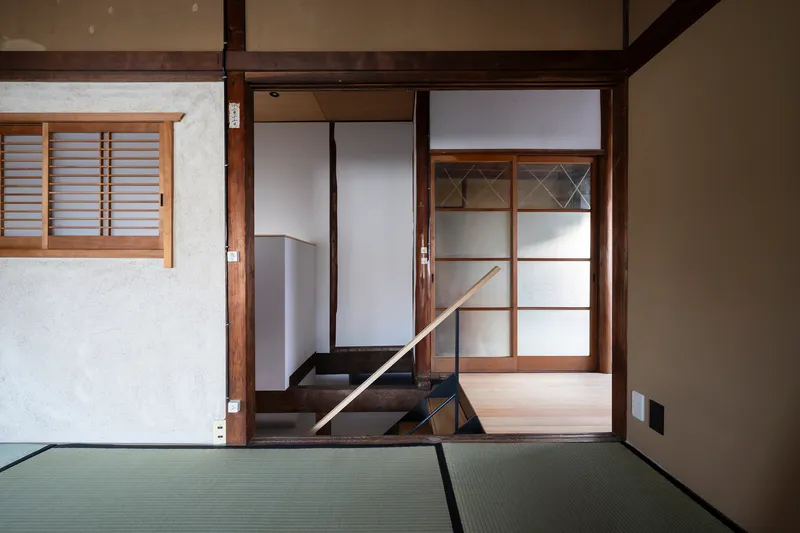


A tatami-mat room with sliding screen doors survives as a direct link to the house's original spatial language. It sits next to a steep stair visible through timber columns, a juxtaposition that lets the old room breathe without isolating it in a preservation bubble. The architects understand that a tatami room in a renovated Kyoto house is not a gesture; it is an expectation, and they deliver it without irony.
A corner study nook with timber shelving and a high clerestory window offers a different register entirely: private, compact, with a borrowed view over neighboring rooftops. The bathroom vanity, with its floating white sink and curved mirror, is resolved with similar economy. These smaller rooms demonstrate that the care applied to the public spaces extends to every corner of the plan.
Plans and Drawings
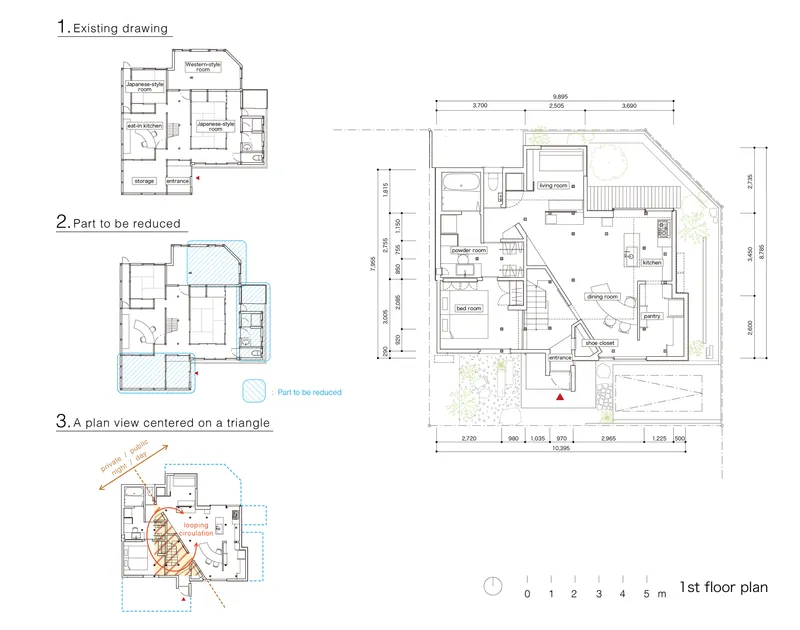
The floor plan drawing is revealing. It shows the existing layout, a series of reduction diagrams illustrating what was removed, and the final first-floor arrangement with the triangular courtyard carved into the plan. The subtractive logic is clear: the architects gained space by taking it away, opening the center of the house to air and light. The courtyard's triangular geometry is not arbitrary; it negotiates the angles of the existing structural grid and the plot boundary, making the most of an irregular leftover space.
Why This Project Matters
Kyoto's stock of prewar wooden houses is shrinking. Every year, houses like this one are demolished and replaced with anonymous infill, erasing the physical record of the city's residential urbanism. This renovation by td-Atelier and ENDO SHOJIRO DESIGN demonstrates that a 94-year-old timber house can be structurally viable, spatially inventive, and fully contemporary without sacrificing its identity. The triangular courtyard is a small but consequential move that solves the deep-plan lighting problem common to these plots, and the exposed structure turns age into an asset.
More broadly, the project offers a model for how renovation can operate as a form of both preservation and design. The house does not freeze the past or erase it. It negotiates, year by year, beam by beam, between what was built in 1931 and what is needed now. For a house approaching its centennial, that negotiation is the most generous gift its architects could offer.
Old Residence in Kitayama by td-Atelier and ENDO SHOJIRO DESIGN. Lead architects: Masaharu Tada and Endo Shojiro. Kyoto, Japan. 127 m². Completed 2025. Photography by Kohei Matsumura.
About the Studio
td-Atelier
Share Your Own Work on uni.xyz
If projects like this are the kind of work you want to make, uni.xyz is a place to publish your own, find collaborators, and enter design competitions.


Popular Articles
Popular articles from the community


David Macias Steps a Doorless Stone and Plaster House Down a Tropical Colombian Hillside
In the humid hills of Colombia, Threshold House replaces the front door with an open void and terraces its 850 m² down the slope instead of fighting it.

longwave studio Reorganizes a 112 m² Tainan Apartment Around the Daily Routines of a Family and Two Cats
In Tainan, Taiwan, birch plywood, rust-red furniture and a freestanding plaster wall link arrival, storage, work and family life in one apartment.

Jaramillo Van Sluys Arquitectura and Urbanismo Turn a Demolished Registry Lot in Quito into an Orchard Plaza
In Quito's Centro Histórico, a 2,800 m² plaza exposes the San Agustín convent wall and redraws its lost Augustinian orchard in volcanic stone.

U.GA Architects Wraps an Oval Rooftop Pool in Curved Board-Formed Concrete on Busan's Jeollidan-gil
In Busan's Jeonpo-dong, a 454 m² mixed-use block stacks a neighborhood facility, guest rooms and an oval rooftop pool inside spiraling concrete walls.

Similar Reads
You might also enjoy these articles


LAVA Architecten Gives Vocational Education a Sawtooth-Roofed Face on a Mechelen School Campus
In Mechelen, Belgium, a 2,053 m² STEM school on a 6×6 m grid turns workshops and classrooms into rooms that can be rearranged as teaching changes.

KEMA Studio Turns a Derelict Marvila Attic into a 60 m² Lighthouse Apartment Above Lisbon
In Lisbon's Marvila district, a rebuilt roof, four skylights and two plywood volumes turn an unlivable attic into a bright home facing the Tagus.

Pixel Gardens: One Repeated Module Stacked Into a Terraced Social Housing Tower for Famagusta
Salem Bader's shortlisted housing tower builds a vertical neighbourhood from one repeated module, offsetting units to carve terraces, light and air.

Bao Huynh Watercolor Atelier: A Serene Art Retreat in Hội An
Bao Huynh Watercolor Atelier in Hội An blends multifunctional art spaces, sustainable design, local materials, and family-friendly living in a serene environment.

Explore Traditional Architecture Competitions
Discover active competitions in this discipline

Challenge to design luxury tourism on rails

VR headsets Storefront design competition

Bring back Drive In's

Designing a staircase for a client
Comments (0)
Please login or sign up to add comments
No comments yet. Be the first to comment!