

Teleno Studio Turns a 56 m² Madrid Apartment into a Theater of Filtered Light
Inside a 19th-century building in central Madrid, shadow becomes the primary material for a small apartment renovation.


Most apartment renovations in historic European centers begin with a simple ambition: bring in more light. Teleno Studio, led by Antonio Cordero Castro and Cristian Álvarez Blanco, took the opposite approach. Their renovation of a 56 m² apartment in a 19th-century Madrid building, titled Casa en Penumbra, treats shadow not as a problem to solve but as the primary architectural material. The result is a domestic interior that feels closer to a Baroque still life than to the white-walled minimalism that has dominated Iberian renovation culture for the past decade.
What makes the project genuinely interesting is how it achieves mood without gimmickry. There is no theatrical dimming system, no black paint used for shock value. Instead, the architects choreograph light through layered thresholds, heavy curtains, textured surfaces, and a rich material palette of copper, dark marble, olive green paint, and limestone. Every surface is calibrated to absorb, reflect, or filter, making the apartment feel both intimate and spatially generous despite its modest footprint.
Thresholds That Frame and Filter
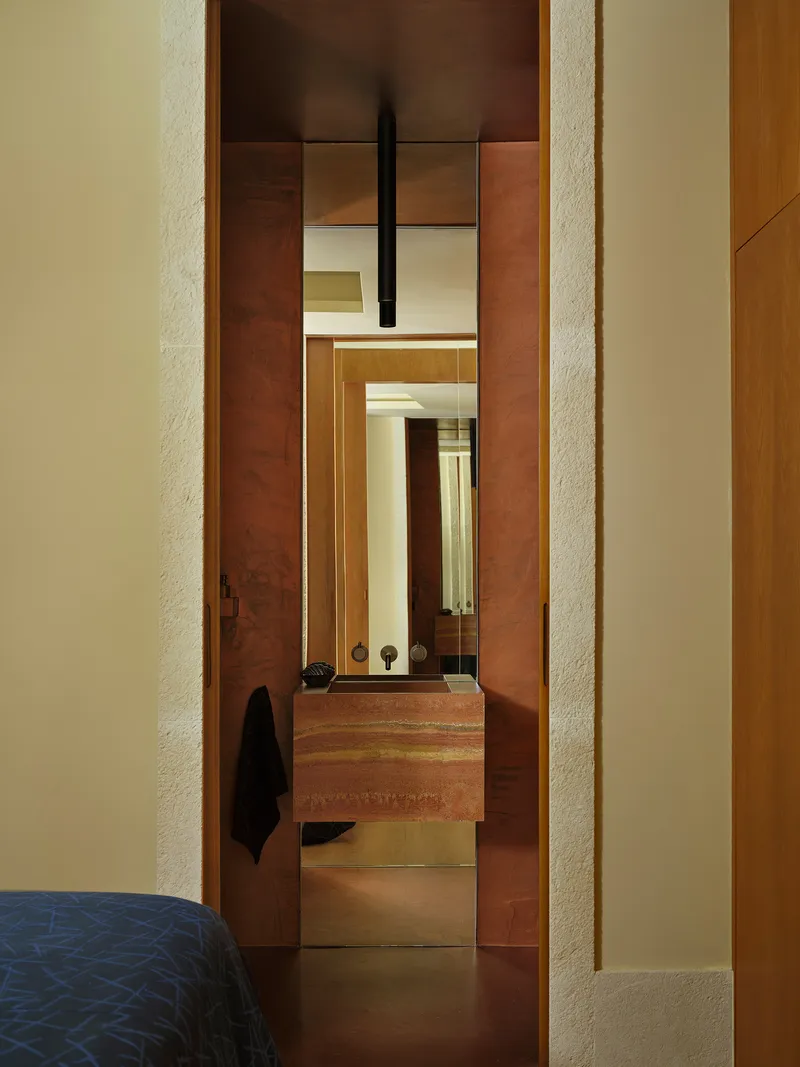
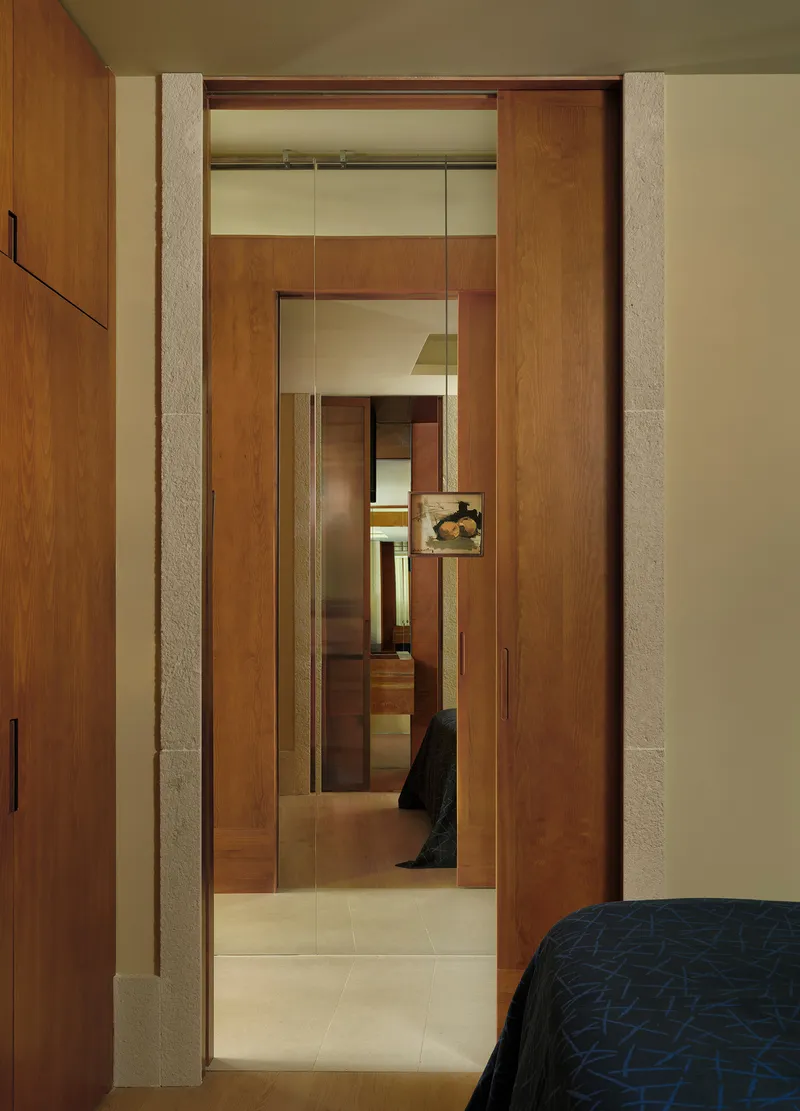
The apartment's spatial sequence is organized through a series of layered doorways that compress and release views as you move between rooms. Timber-framed openings and limestone portal frames stack in depth, creating the kind of enfilade perspective typically associated with much larger dwellings. A view from the living space through to the ensuite bathroom passes through at least three distinct threshold conditions, each trimmed in a different material: timber, red stone, lighter limestone.
Sliding timber doors reinforce this layering. They can close rooms off entirely or stand open to extend sightlines across the full depth of the plan. In a 56 m² apartment, this kind of spatial telescoping is essential. The architects understand that perceived size has as much to do with visual depth as it does with actual square meters.
A Material Palette Built for Low Light


The color and material choices here are deliberately calibrated for an interior that receives modest natural light. Olive green wall panels, velvet upholstery in a similar tone, and dark marble surfaces all thrive in shadow. Under bright conditions, these materials would risk feeling heavy. In the controlled half-light of this apartment, they glow.
Textured columns in the living room add vertical relief that catches ambient light at grazing angles, while a pyramidal floor lamp and yellow curtains introduce warm pools of illumination that feel more like candlelight than electric light. The dining nook, upholstered in muted tones and framed by olive paneling, reads as a space designed for lingering. Nothing in the palette demands attention. Everything absorbs it.
Copper and Stone in the Kitchen


The kitchen is the most materially assertive room. Copper-clad wall panels catch and redistribute whatever light enters, their reflectivity creating a warm, diffused glow that shifts throughout the day. Below, dark cabinetry and a dark marble backsplash ground the space, while oak paneling along the adjacent wall introduces a softer, tactile counterpoint.
A ribbed kitchen island bridges the cooking zone and the living area, its sculptural profile adding visual weight to an otherwise compact plan. White pendant lights hang overhead, providing functional illumination that reads as deliberate punctuation against the darker surfaces. The perforated vent above the cooking wall is a quietly clever detail: it fulfills a prosaic ventilation requirement while echoing the project's broader interest in filtering and controlling the passage of air and light.
Intimate Corners


Teleno Studio has a talent for carving out corners that feel like self-contained worlds. A seating nook pairs a round blue table with bentwood stools beneath a paper pendant, creating a composition that belongs in a Vermeer painting. A reading alcove, lined in horizontal white timber cladding and framed by yellow curtains, offers the apartment's one bright counterpoint: a space where light is invited rather than filtered.
The bedroom, glimpsed through a timber doorway, takes the enclosure logic furthest. Patterned textile bedding and built-in shelving transform a compact alcove into something that feels deliberately cocooned. In an apartment conceived around shadow, the bedroom is the innermost room, the deepest point in the gradient from public to private, from light to dark.
Copper Warmth in the Bathroom

The bathroom extends the copper palette from the kitchen, wrapping walls in a warm metallic tone that feels both luxurious and restrained. A wall-mounted mirror reflects dried flowers, a small domestic gesture that reinforces the apartment's overall mood: lived-in, personal, unconcerned with photographic perfection. The red stone portal frame visible from the approach lends the bathroom a sense of ceremony unusual for such a utilitarian room.
Plans and Drawings

The floor plan reveals an angular footprint that is anything but a simple rectangle. The apartment's irregular geometry, a consequence of its position within a 19th-century building, generates the oblique sightlines and compressed thresholds that define the spatial experience. Bedroom, living area, and kitchen are arranged in a sequence that moves from the most private to the most social zone, with the layered doorways visible in plan as a deliberate chain of apertures connecting one end of the apartment to the other.
Why This Project Matters
Casa en Penumbra is a quiet argument against the tyranny of brightness in contemporary residential design. For years, the default ambition for small urban apartments has been to maximize light: knock out walls, install skylights, paint everything white. Teleno Studio demonstrates that the opposite strategy can produce spaces that feel not only larger but more emotionally resonant. Shadow, when treated with precision, creates depth, hierarchy, and intimacy that bright, flat illumination simply cannot.
The project also shows how material intelligence can compensate for spatial limitation. At 56 m², the apartment cannot afford wasted moves, and none are present. Every surface, every threshold, every piece of furniture participates in a coherent atmospheric strategy. The fact that the architects achieved this within the constraints of a 19th-century building fabric, without demolishing walls or inserting new openings, makes the accomplishment more impressive. Sometimes the most radical renovation is the one that leaves the envelope intact and changes everything you feel inside it.
House in Penumbra (Casa en Penumbra) by Teleno Studio, led by Antonio Cordero Castro and Cristian Álvarez Blanco. Located in Madrid, Spain. 56 m². Completed in 2025. Photography by Germán Saiz.
About the Studio
Share Your Own Work on uni.xyz
If projects like this are the kind of work you want to make, uni.xyz is a place to publish your own, find collaborators, and enter design competitions.


Popular Articles
Popular articles from the community

Opera by the Sea Estonia: Three Shells Dissolving Architecture into Tallinn's Coastline
A winning opera house proposal replaces monumental form with interconnected shells that blur the boundary between building, park and Baltic Sea.
Faces of the Soviet Avant-Garde: Turning Moscow's Street Names into an Open-Air Museum
A network of sculptural installations across a Moscow residential district transforms forgotten architect names into spatial encounters with cultural memor

Manzana Morphosis: Stretching Barcelona's Grid into a Living Landscape for 2050
A radical reworking of the Eixample manzana turns density into a tool for generous public space, vertical ecology, and environmental performance.
Tsunami Convergenics: Turning Catastrophic Ocean Forces into Underwater Housing Infrastructure
A speculative underwater settlement off the coast of Onagawa, Japan, treats tsunamis and typhoons as energy sources rather than threats.

Similar Reads
You might also enjoy these articles

Bao Huynh Watercolor Atelier: A Serene Art Retreat in Hội An
Bao Huynh Watercolor Atelier in Hội An blends multifunctional art spaces, sustainable design, local materials, and family-friendly living in a serene environment.

Atelier Macri Concept Store Interior Design by CASE-REAL
Atelier Macri store features a "ko" counter, walnut wood details, cork displays, blending retail, gallery, and seamless customer experiences.

Manuel Vargas Izquierdo Stadium and High-Performance Sports Center: Architectural Excellence in Jalpa de Méndez
The Manuel Vargas Izquierdo Stadium blends sustainable design, inclusive sports facilities, and cultural-inspired architecture, revitalizing Jalpa de Méndez’s public spaces.

KAKR Buluh Awar Hall: Revitalizing Community and Ecology Through Bamboo Architecture
Community built bamboo hall revitalizes Buluh Awar village, empowering youth, restoring ecology, celebrating vernacular craftsmanship through sustainable architecture and culture.

Explore Light & Shadow Competitions
Discover active competitions in this discipline

Challenge to design luxury tourism on rails

VR headsets Storefront design competition

Bring back Drive In's

Designing a staircase for a client
Comments (0)
Please login or sign up to add comments
No comments yet. Be the first to comment!