
Telling Bridge: A Landmark of Sustainable Urban Design in Copenhagen
A storybook-inspired pedestrian bridge redefining Copenhagen’s waterfront through sustainable urban design and cultural storytelling.


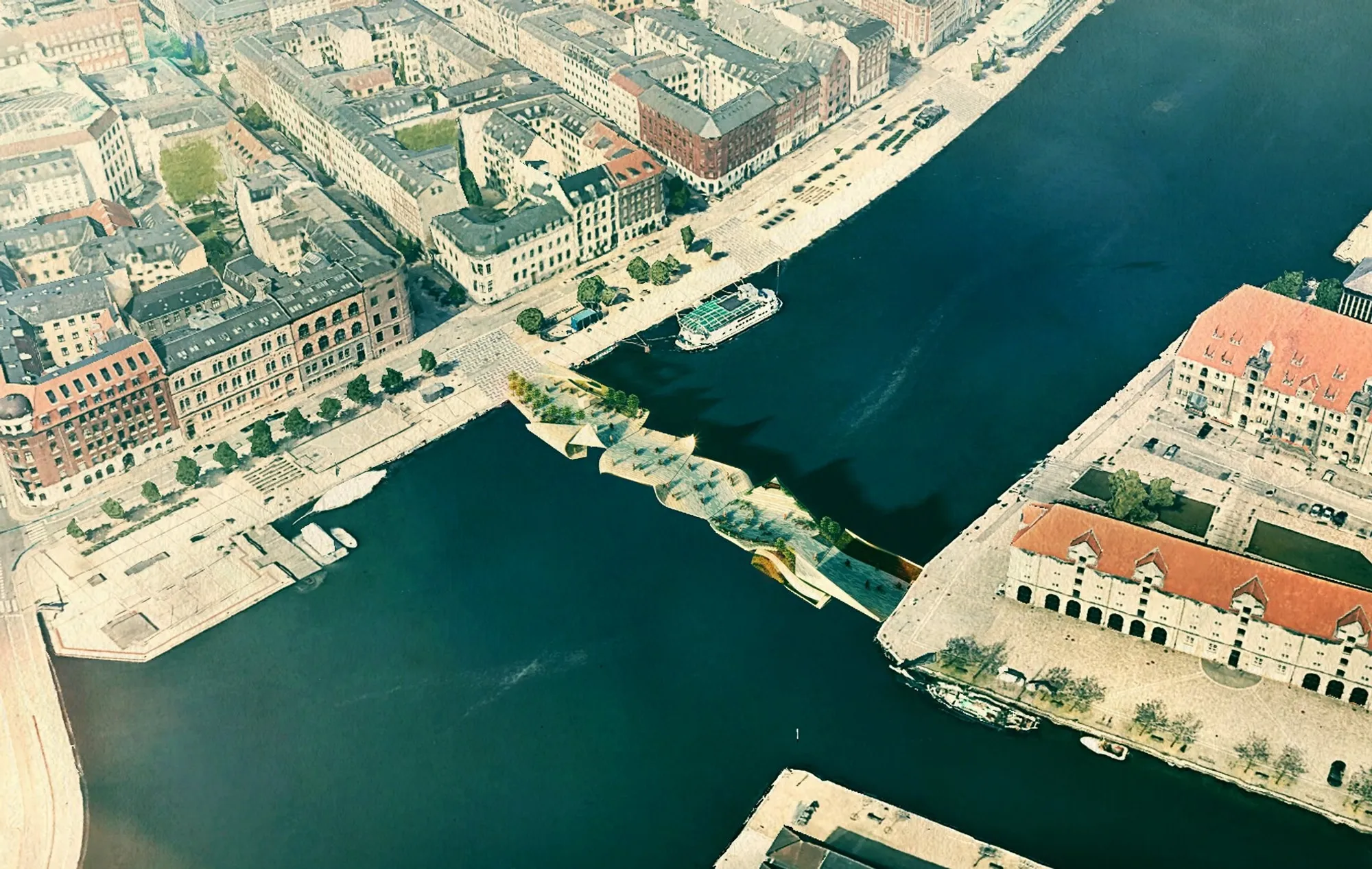
The Telling Bridge is more than a crossing over water: it is an ambitious example of sustainable urban design that merges infrastructure, culture, and public life. Designed as a new landmark for Copenhagen’s inner harbor, the bridge celebrates Denmark’s literary heritage by drawing inspiration from the timeless fairy tales of Hans Christian Andersen.
Conceived by XIAO LIN, Lee Mika, and Yue Cao, the project transforms a functional pedestrian and cycling bridge into a narrative-driven public space. Its form resembles pages from a storybook floating gently on the water’s surface, with corners rolled and curved as though someone is flipping through a beloved tale. In doing so, the bridge becomes both a physical and symbolic connector, linking city districts while linking past and present.
A Cultural Landmark on Copenhagen’s Waterfront
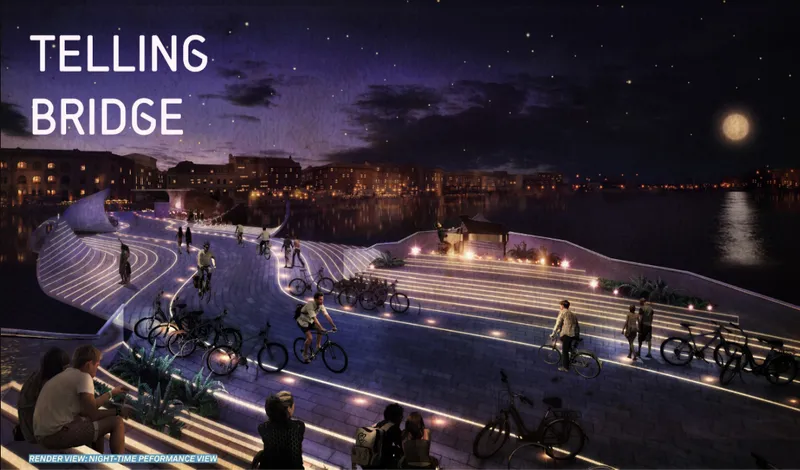
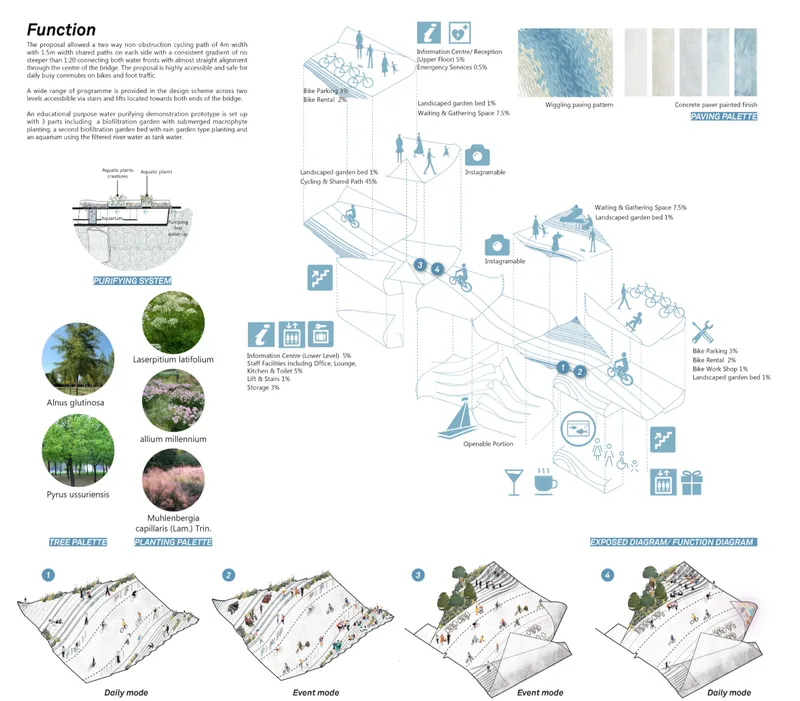
Situated within the Copenhagen Inner Harbour, the Telling Bridge enhances the urban waterfront through experiential design. Rather than functioning as a conventional transit structure, it operates as an extension of public space. The undulating surface, inspired by paper sheets in motion, creates varying spatial experiences: open gathering terraces, intimate seating steps, and dynamic cycling lanes.
The bridge’s architectural language draws directly from storytelling. Its flowing geometry mirrors the rhythm of narrative progression, while the layered platforms suggest pages unfolding across the harbor. The result is a new cultural landmark that celebrates movement, imagination, and public engagement.
Multi-Level Sustainable Infrastructure
At its core, the Telling Bridge is a highly efficient piece of sustainable infrastructure. Designed primarily for non-motorized transport, it features:
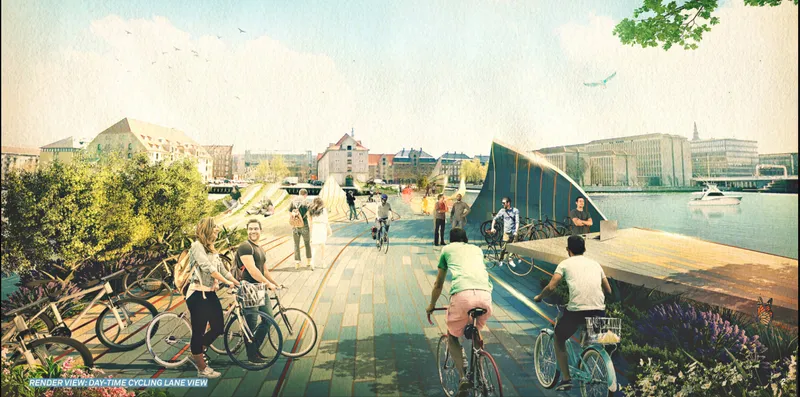
- A 4-meter-wide non-obstruction cycling path
- 1.5-meter pedestrian lanes on both sides
- Accessible ramps and vertical circulation
- Landscaped gathering zones and viewing platforms
The structure integrates daily mobility with flexible programming. During regular hours, it supports safe and efficient commuting. In event mode, portions of the bridge open and transform into performance spaces and public terraces. This adaptability reinforces its role as an urban catalyst rather than merely a passageway.
Openable Mechanism and Adaptive Design
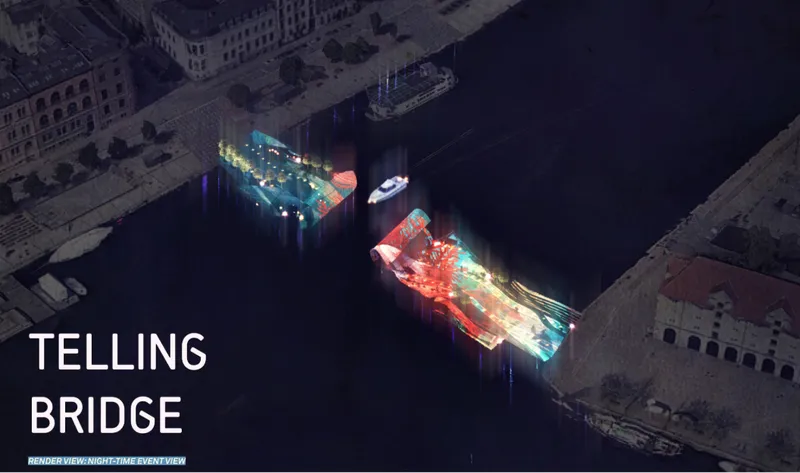
A defining feature of the bridge is its openable mechanism. Two single-leveled panels, designed like folded pages, can lift to allow boat traffic to pass. When opened, the bridge creates a dramatic sculptural gesture across the water, resembling a fan of pages suspended mid-air.
The central access lanes ensure uninterrupted pedestrian and cyclist movement even when the bridge is partially activated. This thoughtful engineering demonstrates how sustainable urban design can balance infrastructure efficiency with poetic expression.
Ecological Integration and Water Purification
Beyond mobility and culture, the Telling Bridge contributes to environmental performance. Integrated landscaped beds and native plant species soften the hardscape and introduce biodiversity into the harbor context. Selected tree and plant palettes enhance seasonal variation while improving microclimate conditions.
The project also proposes a water purification system beneath the structure. Aquatic plants and filtration layers work together to improve harbor water quality. By embedding ecological systems within public infrastructure, the bridge exemplifies how urban design can operate as both cultural artifact and environmental solution.
Day and Night Identity
The bridge presents two distinct urban identities.
Day Mode: A vibrant cycling and pedestrian corridor animated by sunlight, greenery, and open views toward the harbor skyline.
Night Mode: A luminous public stage where integrated lighting traces the contours of the “pages.” Subtle LED strips emphasize movement lines, while event programming can transform the bridge into a floating cultural venue.
From a distance, the illuminated structure appears as glowing sheets drifting across the water, turning everyday infrastructure into a performative landmark.
A Bridge as Narrative Architecture
The Telling Bridge demonstrates how sustainable urban design can move beyond functionality into experiential architecture. It embodies narrative architecture: where form, material, and movement collectively tell a story.
By referencing Andersen’s fairy tales, the bridge positions Copenhagen not only as a city of cyclists and waterfront renewal, but also as a city of imagination. It reflects how infrastructure can express identity, foster social interaction, and integrate ecological intelligence.
Redefining the Role of the Contemporary Bridge
Traditionally, bridges are engineered objects defined by efficiency and structure. The Telling Bridge challenges this paradigm by operating simultaneously as:
- A pedestrian and cycling connector
- A waterfront public plaza
- A cultural performance platform
- An ecological intervention
- A symbolic landmark
In doing so, it expands the vocabulary of contemporary bridge design. The project illustrates that sustainable urban design is not only about reducing environmental impact, it is about enhancing civic life.
The Telling Bridge stands as a visionary proposal that merges storytelling, sustainability, and public space. Designed by XIAO LIN, Lee Mika, and Yue Cao, it transforms Copenhagen’s harbor into a living narrative, where architecture becomes literature, and infrastructure becomes experience.
As cities worldwide seek innovative approaches to resilient waterfront development, the Telling Bridge offers a compelling model: one where sustainable urban design is poetic, adaptable, and deeply rooted in cultural memory.




Popular Articles
Popular articles from the community


The Earth Pod: 3D Printed Homes for Resilient Refugee Communities
The Earth Pod reimagines refugee housing through 3D printed homes made from clay, combining resilience, self-sufficiency, and rapid shelter.

Hill & Cross Opera: Sculptural Opera House Architecture Shaped by Tallinn’s Landscape and Identity
Hill & Cross Opera reimagines opera house architecture in Tallinn through its sculptural hill, civic plaza, glass wave and a luminous cross.

AL-JANNAH: Sustainable Architecture and Permaculture for Afghan Widows
AL-JANNAH uses sustainable architecture and permaculture to create resilient oasis of housing, learning, work and renewal for Afghan widows.

Conexión: Biophilic Design Reimagines High-Rise Living in Hong Kong
Conexión reimagines high-rise living in Hong Kong through biophilic design, green facades, shared spaces, daylight, water and nature within.


Similar Reads
You might also enjoy these articles

Eco Chapel: A Green Architecture Pavilion Designed in Symbiosis with the Forest
Eco Chapel uses green architecture to weave prayer, learning and reuse into a forest pavilion shaped by modular hexagonal canopies for life.
Kaffeebühnen: Coffee Shop Architecture Designed as a Civic Stage Between Vienna’s City and Park
Kaffeebühnen turns coffee shop architecture into a civic stage, linking Vienna’s park edge, urban life, warm timber yards, and coffee craft.
Healing Façade: Sustainable Architecture for Reforestation, Community, and Sacred Ecology in Ethiopia
Healing Façade reimagines sustainable architecture as a living wall that restores soil, catches water and renews Ethiopia's forest churches.


Urban Forest: A Vertical Ecosystem for 5,000 Workers in Singapore's Changi Business Park
Radially stacked pods and layered green decks turn a 7-acre plot into 47 acres of ecological workspace projected for 2040.
Comments (0)
Please login or sign up to add comments
No comments yet. Be the first to comment!