

Temp Project Hides a VIP Fitting Room Inside a Mahogany Cabinet in This Kyiv Showroom
Gunia Project's flagship occupies a former Panamanian embassy on a historic street near Kyiv's Golden Gate, layering ceramic and carved wood over 19th-cent


There is a mahogany cabinet in the Gunia Project showroom that, at first glance, looks like every other piece of heritage millwork lining the walls of this former Panamanian embassy. Open it, and you step through a concealed passage into a private VIP fitting room. That kind of theatrical sleight of hand could feel gimmicky in a lesser project, but here it is simply the most legible example of a design strategy that runs through every surface: treating old fabric not as scenography to preserve under glass, but as live material to be occupied, reworked, and pressed back into service.
Temp Project, led by Anastasiia Tempynska, designed the 180 m² flagship for Ukrainian fashion and lifestyle brand Gunia Project on Zolotovoritska Street, steps from the Golden Gate where medieval Kyiv once began. The building's late-19th-century shell, its coffered ceilings, ornamental medallions, and paneled walls, offered a dense starting point. Rather than stripping the space to a neutral container, the team kept those layers and introduced a deliberate counterpoint of forest-green ceramic tile, slim metal display structures, and bespoke furniture that references traditional Ukrainian woodcarving. The result sits somewhere between concept store and gallery, organized as a constellation of themed rooms radiating from a central lounge.
Arriving on Zolotovoritska Street


The street facade is understated almost to the point of anonymity: rusticated stone, a pair of storefront windows, white canvas awnings. Nothing screams retail destination, and that restraint is intentional. Gunia Project trades in layered symbolism rather than loud branding, and the shopfront extends that ethos. You notice the address before you notice the brand. Step through the threshold, though, and the green-tiled doorway immediately recalibrates your expectations, framing a view into a room of paneled display cabinets and ornamental ceilings that signals something more intimate and considered than a typical fashion shop.
The Ceramic Wall as Anchor

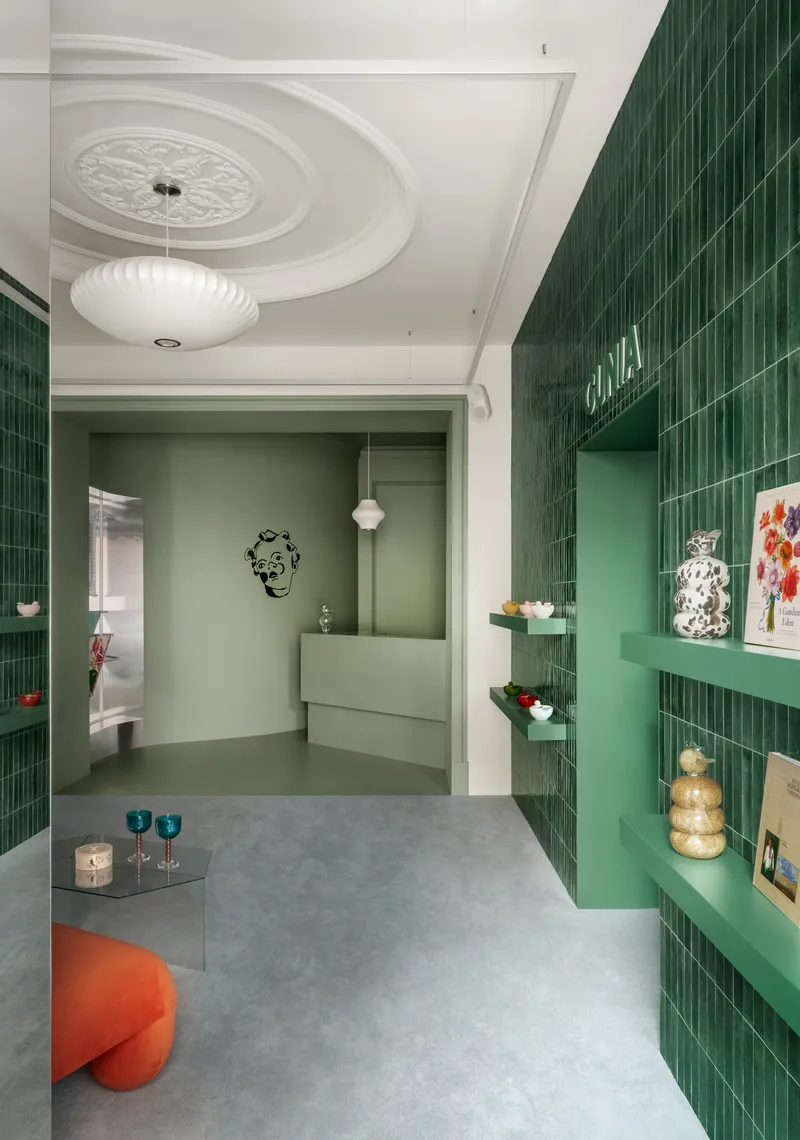
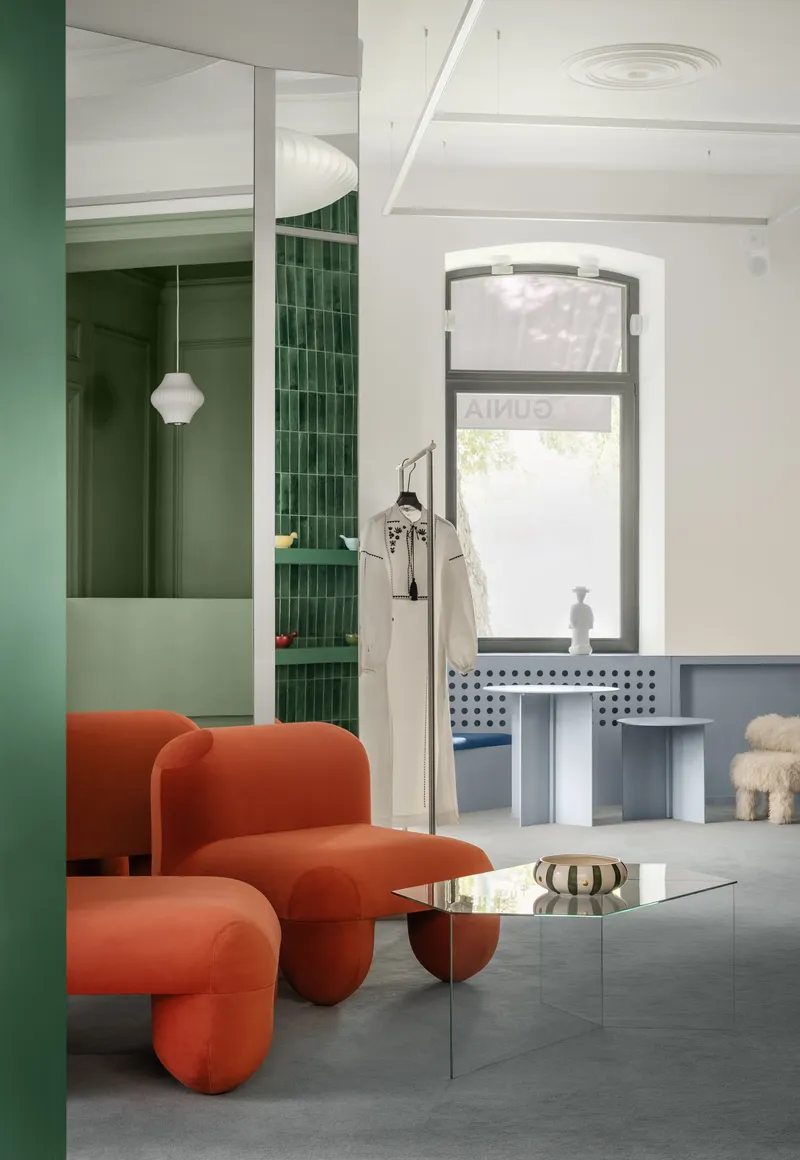
The most commanding material decision in the showroom is the forest-green ceramic tile that wraps entire walls in the lounge and recurs in niches, doorways, and the fitting room. Hand-laid with deliberate imprecision, the tiles introduce a tactile rhythm that makes the 19th-century plasterwork above feel almost weightless by comparison. The pairing is not period-correct, and it is not trying to be. It reads instead as a conversation between two eras of craft, the ornamental ceiling medallion hovering above a field of glossy green like a chandelier over water.
Floating shelves set into the tiled surfaces hold ceramics and small objects without interrupting the surface's continuity. Where the tile meets an arched window or a pendant light, the interplay of gloss and shadow becomes almost architectural in itself. The green is not incidental; Tempynska's team drew its palette of greens, blues, pale pinks, and soft beiges from nature and pastoral motifs, while a specific chocolate-brown and pale-blue pairing elsewhere in the space references the refectory at Saint Sophia Cathedral in Kyiv.
Heritage Cabinets, Reworked
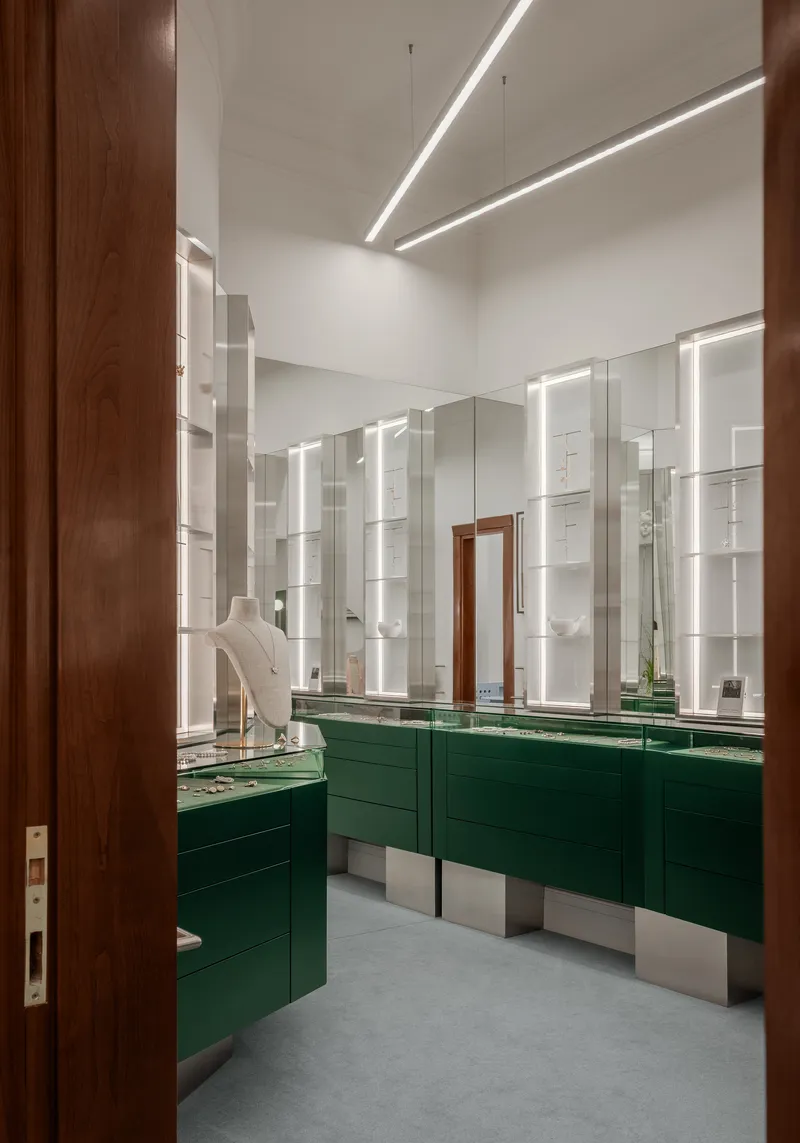

The existing mahogany cabinetry was too good to remove and too dense to leave unmodified. Temp Project's solution was surgical: strip out the interior shelves and replace them with slim metal structures that integrate lighting and glass back panels, converting heavy Victorian storage into illuminated vitrines. The effect in the jewellery hall is particularly striking, where green lacquered display cases sit inside the old frames and mirror panels multiply the depth of field. You read the mahogany as a frame and the metal-and-glass insert as a lens, each making the other legible.
In the main retail hall, ribbed metal display tables occupy the center of the room beneath coffered ceilings. Their industrial finish and repetitive geometry play against the ornate woodwork in a way that is tense but productive. The tables are clearly new, clearly utilitarian, and that honesty keeps the historic shell from tipping into nostalgia.
Clothing Hall and the Circular Motif
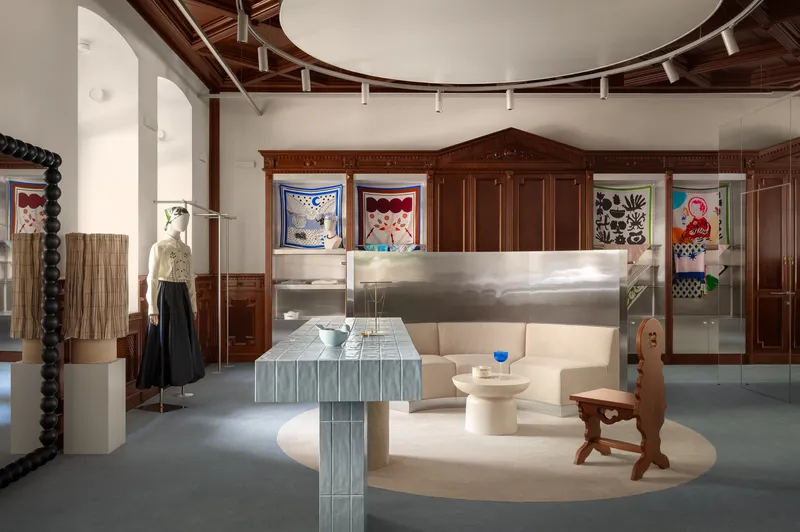


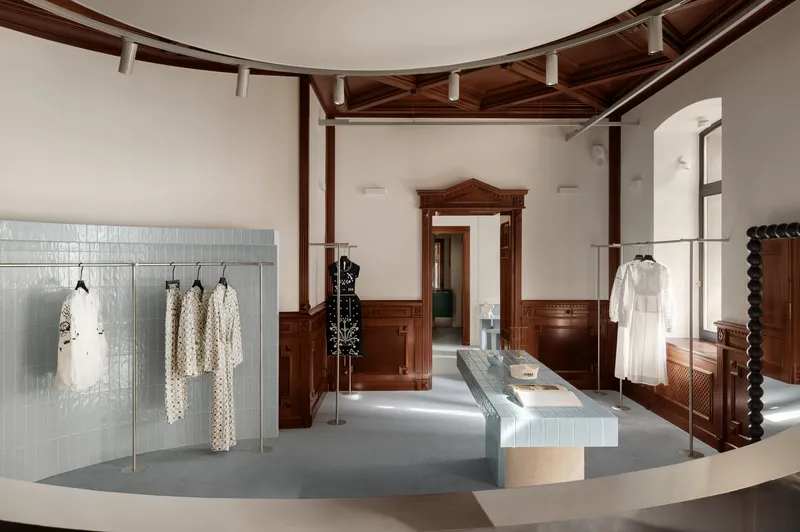
The clothing hall is organized around a circular carpet motif on the floor and a bespoke illuminated disc suspended from the coffered ceiling, establishing a vertical axis that gathers the room's energy to the center. It is a simple move, but it transforms a rectangular room with wood paneling into something closer to a salon. Garments hang on slim metal rails against pale blue ceramic tile, their patterned fabrics reading like small paintings against a monochromatic ground.
The suspended disc is visible through doorways from adjacent rooms, pulling you through the spatial sequence the way a lantern draws movement in a garden. That long view through multiple thresholds, each framed by timber or tile, is one of the showroom's quiet achievements. The plan is not open; it is a sequence of connected chambers, each with its own color identity and material logic, but linked by these carefully composed sightlines.
Lounge, Sculpture, and the Softer Registers

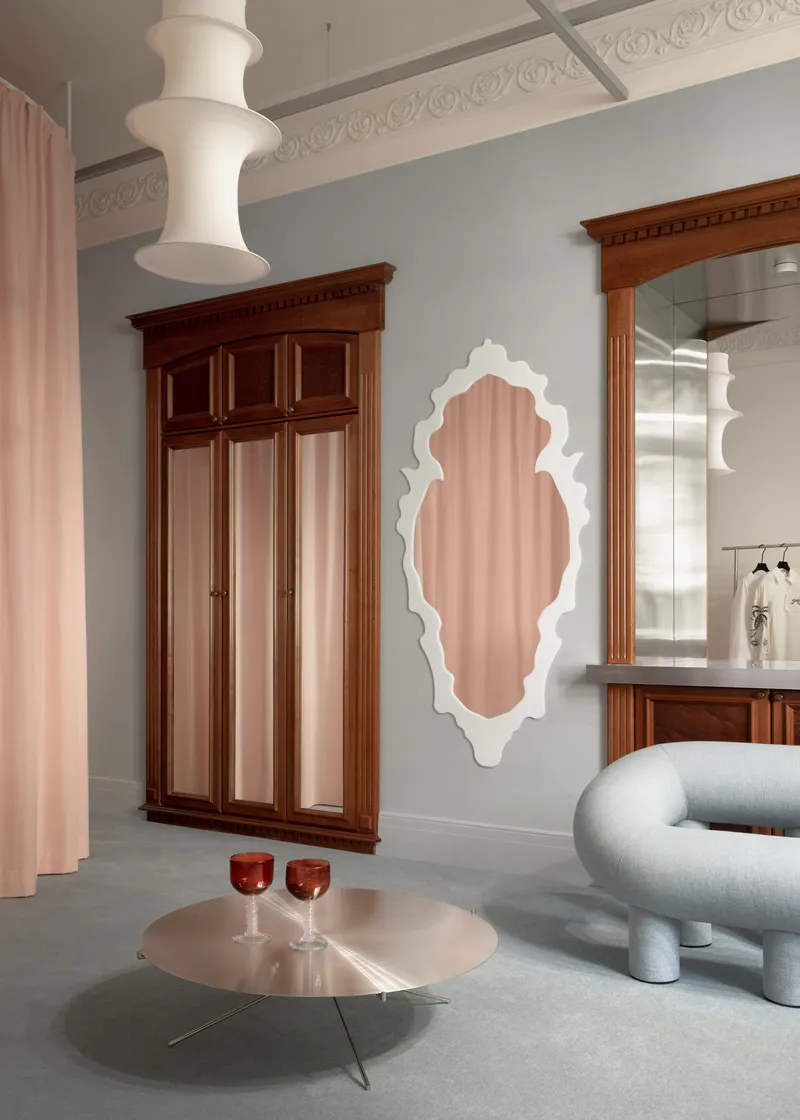
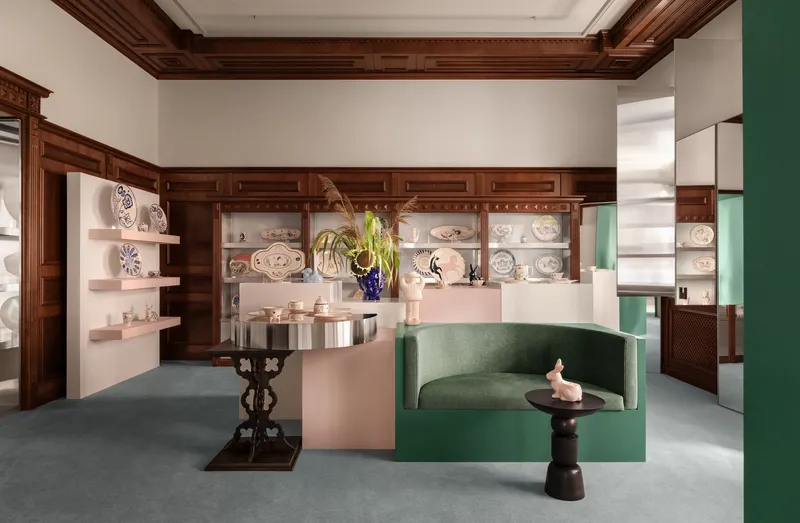
The lounge area reveals a different sensibility. A white sculptural column wrapped with flowing pink fabric sits beside a green upholstered sofa, an almost surreal composition that would not be out of place in a gallery installation. It is one of the few moments where the design openly courts strangeness, and it works because the surrounding context, the dark timber ceiling, the built-in shelving, the deep green seating, is grounded enough to absorb it.
Elsewhere, a vintage wooden wardrobe and an ornamental mirror sit against a grey wall beneath decorative ceiling molding, a vignette that collapses the distinction between the building's original furnishings and the design team's additions. The bespoke wooden pieces, a chair, a table, a large mirror frame, reference traditional Ukrainian woodcarving with enough abstraction to avoid the folkloric. They pay quiet homage to the Golden Gate nearby, the ancient entrance to Kyiv, and to a lineage of local craft that Gunia Project as a brand has always drawn on.
Plans and Drawings
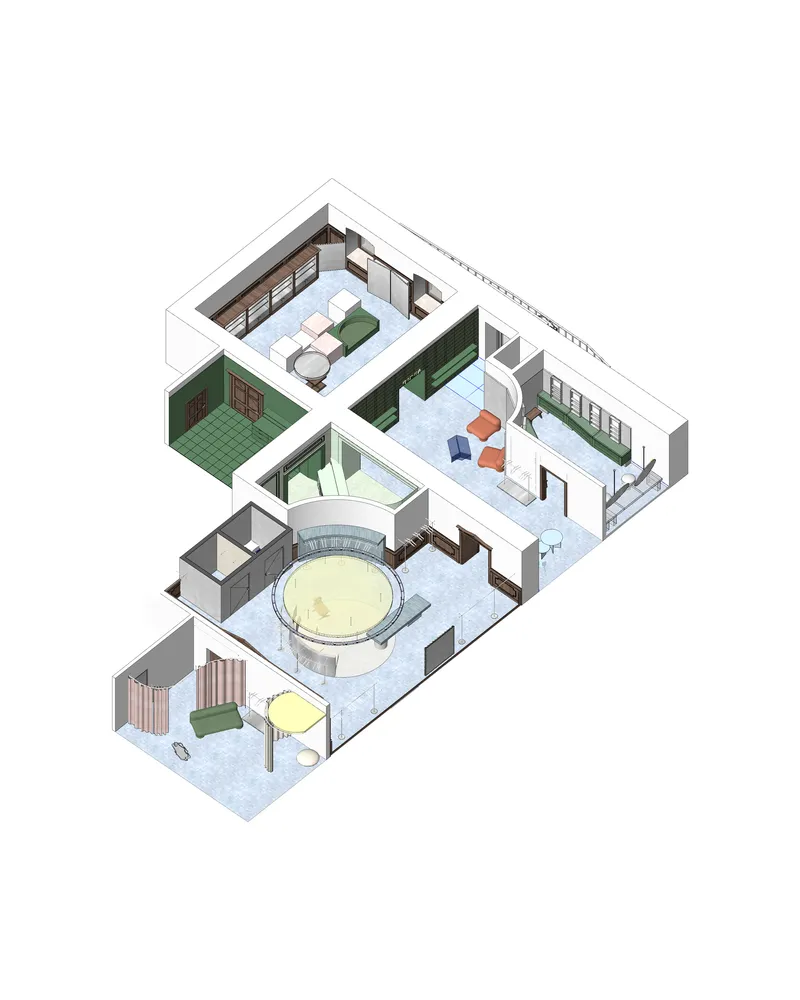

The axonometric drawing makes the spatial strategy legible in a way the photos cannot. Three distinct halls, ceramics, clothing, and jewellery, radiate from the central reception-lounge, with the green-tiled fitting room tucked to one side and a children's corner pushed to the rear. The floor plan confirms that the layout is not symmetrical but balanced, each room scaled to its program: the ceramics hall wide enough for a constellation of display plinths and a built-in sofa, the clothing hall centered on its circular carpet, the jewellery space narrower and more intimate. The hidden VIP passage through the mahogany cabinet is visible in the axonometric if you know where to look, threading between the lounge and fitting area like a secret stitch in the plan.
Why This Project Matters
Retail design in historic buildings tends to fall into two camps: the total white-box erasure that treats heritage as an inconvenience, or the reverential restoration that turns a shop into a museum diorama. Temp Project refuses both. By modifying the mahogany cabinets from the inside, laying hand-made ceramic tile against 19th-century plaster, and introducing furniture that translates Ukrainian carving traditions into contemporary form, the team treats the building as a collaborator rather than a backdrop. The space lacks natural light, a significant constraint, yet the combination of integrated cabinet lighting, suspended discs, and the reflective depth of glazed tile creates an atmosphere that feels intentional rather than compensatory.
The broader significance lies in what the project says about Ukrainian design culture right now. In a moment when national identity is both urgently felt and politically charged, Gunia Project and Temp Project choose subtlety over declaration. The references to Saint Sophia, to the Golden Gate, to pastoral color palettes and woodcarving traditions are woven into the material fabric of the space rather than pinned to its walls. That restraint, the confidence to let meaning accumulate through craft and spatial experience rather than signage, is what elevates the showroom from a good retail fit-out to a genuinely considered piece of architecture.
Gunia Project Showroom by Temp Project, lead architect Anastasiia Tempynska with design team Kirill Khivrich, Luba Andreeva, and Dana Artemenko. Kyiv, Ukraine. 180 m². Completed 2025. Photography by Yevhenii Avramenko.
About the Studio
Share Your Own Work on uni.xyz
If projects like this are the kind of work you want to make, uni.xyz is a place to publish your own, find collaborators, and enter design competitions.


Popular Articles
Popular articles from the community

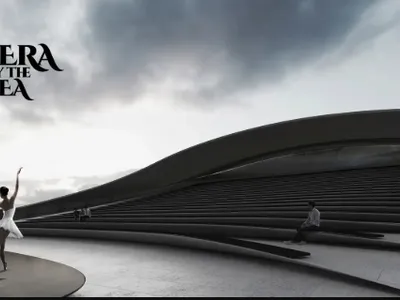
Opera by the Sea Estonia: Three Shells Dissolving Architecture into Tallinn's Coastline
A winning opera house proposal replaces monumental form with interconnected shells that blur the boundary between building, park and Baltic Sea.
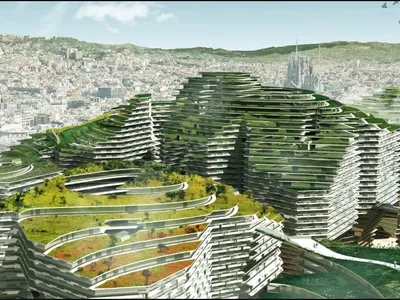
Manzana Morphosis: Stretching Barcelona's Grid into a Living Landscape for 2050
A radical reworking of the Eixample manzana turns density into a tool for generous public space, vertical ecology, and environmental performance.
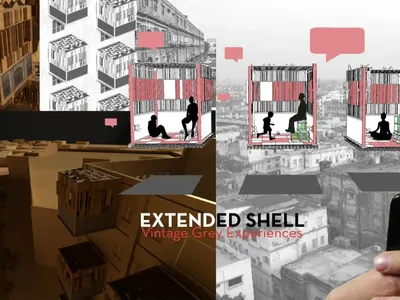
Extended Shell: Retrofitting Kolkata's Balconies as Living Urban Thresholds
A modular retrofit system recovers the social and environmental intelligence of Kolkata's historic verandas for contemporary Park Street residents.

Opera on the Sea: Driftwood Logic Shapes a Timber Opera House on Estonia's Coast
Trevor Orgill's opera house translates the entangled drift of floating timber into a civic building where wood, water, and music converge.

Similar Reads
You might also enjoy these articles

Pixel Gardens: One Repeated Module Stacked Into a Terraced Social Housing Tower for Famagusta
Salem Bader's shortlisted housing tower builds a vertical neighbourhood from one repeated module, offsetting units to carve terraces, light and air.

Bao Huynh Watercolor Atelier: A Serene Art Retreat in Hội An
Bao Huynh Watercolor Atelier in Hội An blends multifunctional art spaces, sustainable design, local materials, and family-friendly living in a serene environment.

Atelier Macri Concept Store Interior Design by CASE-REAL
Atelier Macri store features a "ko" counter, walnut wood details, cork displays, blending retail, gallery, and seamless customer experiences.

Manuel Vargas Izquierdo Stadium and High-Performance Sports Center: Architectural Excellence in Jalpa de Méndez
The Manuel Vargas Izquierdo Stadium blends sustainable design, inclusive sports facilities, and cultural-inspired architecture, revitalizing Jalpa de Méndez’s public spaces.


Comments (0)
Please login or sign up to add comments
No comments yet. Be the first to comment!