
Terra Capobianco and Galeria Arquitetos Suspend a São Paulo Home from Three Steel Trusses
In Alto de Pinheiros, a 464 m² house uses 15-meter spans and dry construction to open domestic life to the landscape.


Most residential projects in dense São Paulo neighborhoods accept structural compromise as a given: columns land where the program demands, walls thicken to carry loads, and the resulting interiors feel compartmentalized regardless of how open the plan pretends to be. Casa Treliça, designed by Terra Capobianco and Galeria Arquitetos under the direction of Ana Terra Capobianco and Fernanda Neiva, rejects that trade-off entirely. Three steel trusses, two longitudinal at 15 meters and one transverse at 14, carry the building's principal volume and liberate the social floor from any intermediate support.
What makes the project genuinely interesting is not just the structural ambition but the disciplined economy behind it. Every system is dry, fast, and dismountable: steel deck slabs, steel frame infill, autoclaved pine shutters, polycarbonate cladding. The house earned a Silver certificate from Green Building Council Brasil, integrates photovoltaic panels on both the main block and the shed, harvests rainwater for automated irrigation, and recycles greywater for toilets. On a 533 m² lot in Alto de Pinheiros, the architects managed to maximize occupation while keeping nearly four fifths of the upper floor envelope transparent or semi-transparent, a ratio that turns 3-meter ceilings into something that reads far more generous.
Structural Logic as Architecture
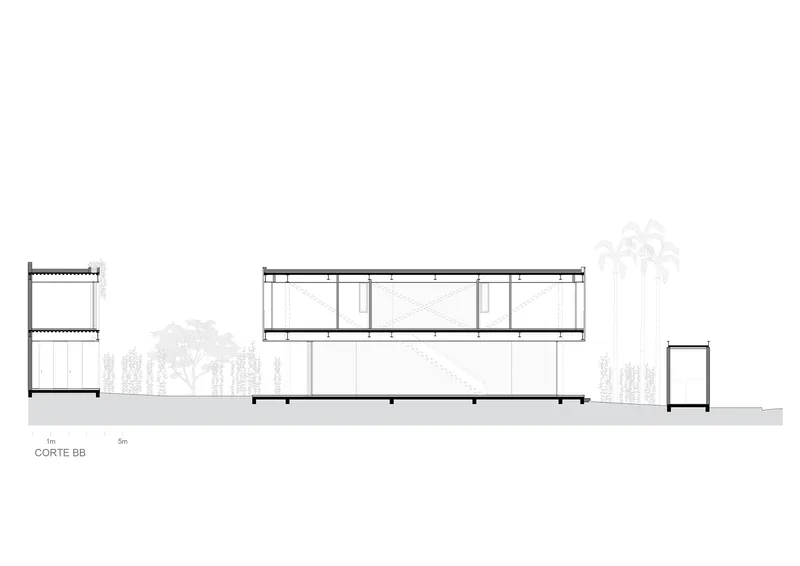

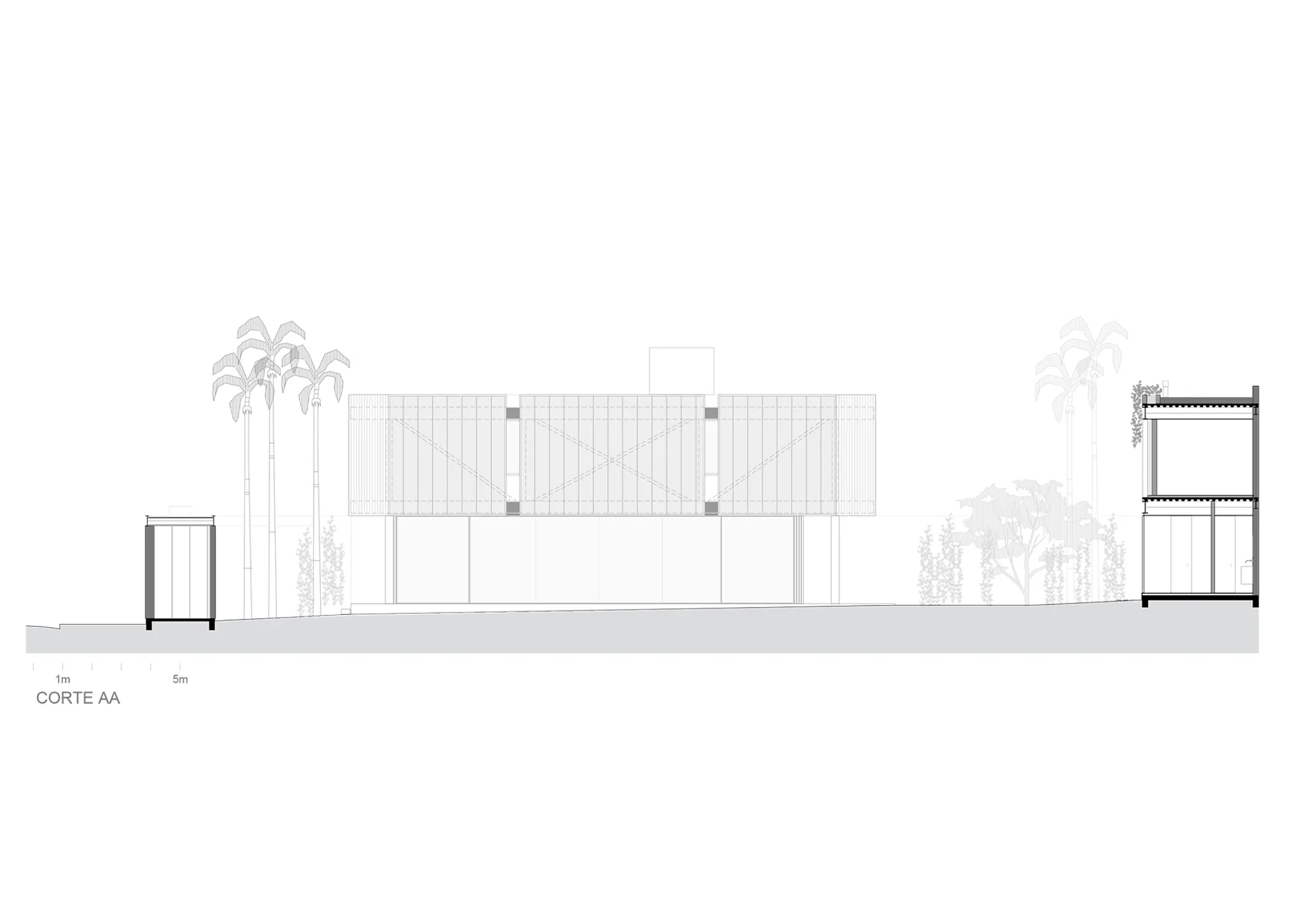
The section drawings reveal the house's real protagonist: the exposed metallic trusses that span the full width and length of the main volume without touching down inside the living areas. The transverse truss suspends the shed volume above, creating a clerestory condition that floods the interior with indirect light. It is a strategy borrowed from industrial construction, executed by Stec do Brasil, and deployed here with a lightness that belies its scale.
Exposing the structure rather than concealing it gives the house an honest legibility. You can trace the path of forces from roof to ground in a single glance, and the diagonal members of the trusses become a visual rhythm that organizes the facade as convincingly as any ornamental screen would. The sections also show how the two-story main block connects laterally to a lower annex housing a fitness room and guest suite, keeping the massing from overwhelming the residential street.
Facade and Climate Control
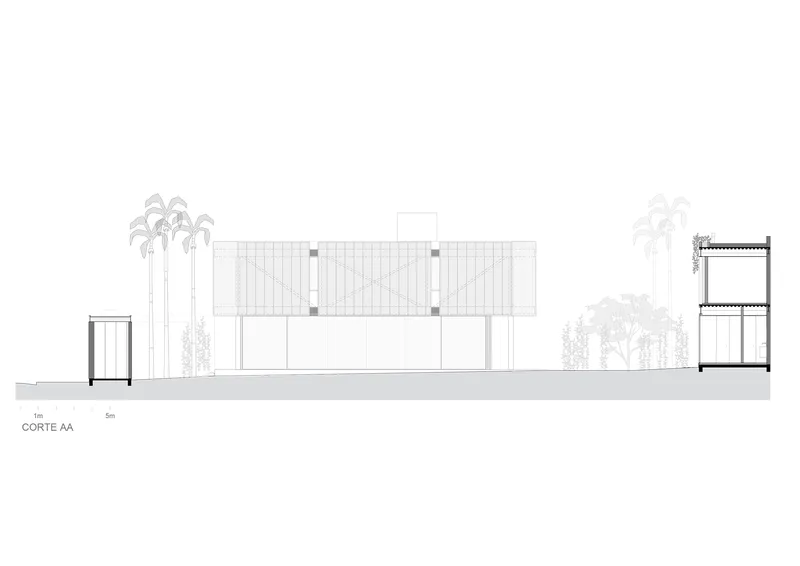
The vertical slatted shutters in carbonized pine form a double facade on the east and west elevations, where the bedrooms sit. The slats allow cross-ventilation while filtering direct sun, a passive strategy that reduces cooling loads without sealing the rooms behind glass. On the north facade, self-supporting polycarbonate panels (thermoclick) provide thermal resistance with translucency, keeping the interior luminous while managing heat gain.
The section drawing flanked by palm trees captures this layered envelope clearly: the slatted screen reads as a permeable veil set in front of the structural frame, and the clerestory windows above the truss line pull hot air up and out. Less than one fifth of the upper floor's perimeter is opaque, which means the house breathes in almost every direction. In a tropical climate, that porosity is not a luxury but a prerequisite for livability.
Domestic Program on a Tight Lot

The upper floor plan shows four suites distributed around a central metal staircase, with two of them designed as a flexible zone for the resident couple: two bathrooms, two closets, a bedroom, and an intimate room that can merge or separate depending on daily use. The plan is compact but never cramped, because the truss system below eliminates the need for load-bearing walls on this level, freeing the architects to partition space with lightweight, repositionable elements.
The attached service wing, visible in the plan drawing, consolidates utility functions away from the primary living and sleeping volumes. It is a straightforward organizational move, but on a lot of barely 533 m² in one of São Paulo's established residential districts, that clarity of zoning is what allows the social ground floor to remain entirely column-free and open to the garden, which was designed by Giardino Planejamento de Exteriores with an automated rainwater irrigation system.
Plans and Drawings
The full set of drawings lays bare the structural and spatial logic of the project. The two longitudinal sections trace how the steel trusses carry the main volume over the open social floor, while the transverse section shows the suspended shed and its clerestory gap. The floor plan confirms the economy of the layout: four suites, a central stair, and a service annex, all organized to extract maximum livable area from a modest urban lot.
Why This Project Matters
Casa Treliça demonstrates that residential architecture in dense urban contexts does not need to choose between structural performance and environmental responsibility. The dry construction system allowed for speed and precision, the exposed trusses eliminated wasteful interior columns, and the passive climate strategies, from the pine shutters to the polycarbonate north wall, reduce energy consumption without sacrificing openness. The Green Building Council Silver certification is a consequence of these decisions, not a bolt-on achievement.
For architects working on constrained urban lots in tropical climates, this project offers a useful model. Terra Capobianco and Galeria Arquitetos prove that industrial-grade steel construction can produce a house that feels light, breathable, and connected to its garden, rather than heavy and hermetic. The lesson is one of integration: when the structure is the architecture, when the envelope is the climate system, and when the plan is derived from the span rather than the other way around, 464 m² can feel genuinely generous.
Truss House (Casa Treliça) by Terra Capobianco and Galeria Arquitetos. Alto de Pinheiros, São Paulo, Brazil. 464 m². Completed 2020. Photography by Nelson Kon.
About the Studio
Share Your Own Work on uni.xyz
If projects like this are the kind of work you want to make, uni.xyz is a place to publish your own, find collaborators, and enter design competitions.



Popular Articles
Popular articles from the community

EW PARK: Sustainable Architecture Reimagines the Future of Urban Parking
EW PARK reimagines city parking as a modular wooden tower combining automation, solar energy, electric mobility, and adaptable urban design.

The Earth Pod: 3D Printed Homes for Resilient Refugee Communities
The Earth Pod reimagines refugee housing through 3D printed homes made from clay, combining resilience, self-sufficiency, and rapid shelter.

Conexión: Biophilic Design Reimagines High-Rise Living in Hong Kong
Conexión reimagines high-rise living in Hong Kong through biophilic design, green facades, shared spaces, daylight, water and nature within.

Riyadh For All: Intergenerational Urban Design for Active Aging in Rabat
Riyadh For All reimagines urban design in Rabat with intergenerational co-living, adaptive courtyards, and Moroccan cultural exchange today.


Similar Reads
You might also enjoy these articles

Bao Huynh Watercolor Atelier: A Serene Art Retreat in Hội An
Bao Huynh Watercolor Atelier in Hội An blends multifunctional art spaces, sustainable design, local materials, and family-friendly living in a serene environment.

Atelier Macri Concept Store Interior Design by CASE-REAL
Atelier Macri store features a "ko" counter, walnut wood details, cork displays, blending retail, gallery, and seamless customer experiences.

Manuel Vargas Izquierdo Stadium and High-Performance Sports Center: Architectural Excellence in Jalpa de Méndez
The Manuel Vargas Izquierdo Stadium blends sustainable design, inclusive sports facilities, and cultural-inspired architecture, revitalizing Jalpa de Méndez’s public spaces.

KAKR Buluh Awar Hall: Revitalizing Community and Ecology Through Bamboo Architecture
Community built bamboo hall revitalizes Buluh Awar village, empowering youth, restoring ecology, celebrating vernacular craftsmanship through sustainable architecture and culture.

Explore Residential Building Competitions
Discover active competitions in this discipline


Challenge to design mud housing for contemporary communities


Challenge to reimagine the Iron Throne


Photograph architecture without architects


Illustrate the lost glory of Angkor Wat - Render Challenge
Comments (0)
Please login or sign up to add comments
No comments yet. Be the first to comment!