
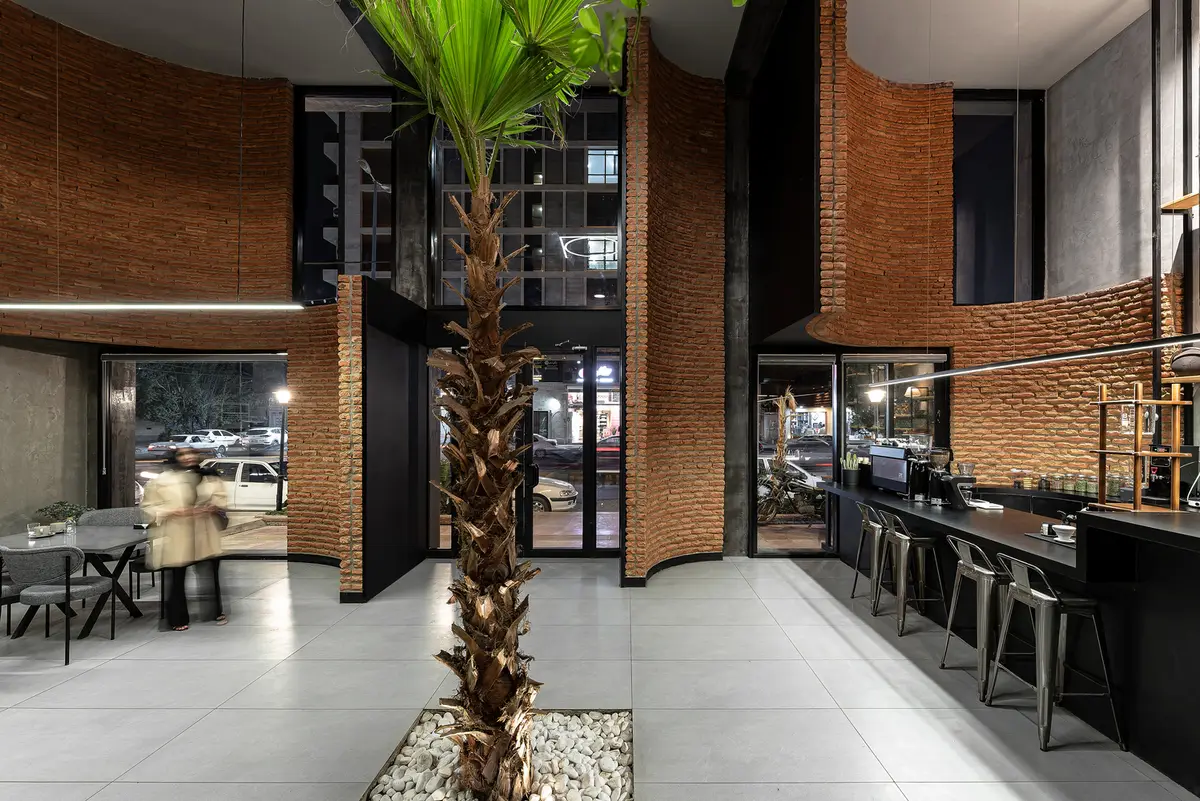
OJAN Design Studio Wraps an Ahvaz Food Hall in Handcrafted Curved Brick Walls
Tetra Food Hall replaces a blank stone facade with adzed brickwork and a central palm tree across three levels in southern Iran.


Ahvaz is a city built in brick. Its residential towers and commercial blocks line the streets in warm tones, forming a consistent but often unremarkable urban fabric. When OJAN Design Studio was asked to transform a nondescript three-story building on Kianabad Street into a food hall combining a café, restaurant, and pastry bakery, the firm recognized that the original flat stone facade contributed nothing to this context. Rather than simply re-cladding the building, the team stripped the facade entirely, retained the concrete structural grid behind it, and inserted a new language of curved brick walls that reach outward to the sidewalk like open arms.
What makes Tetra Food Hall worth studying is the specificity of its brick detailing. Every curved wall has a unique radius and angle calibrated to its role: one arc frames the entrance, another wraps a dining alcove, a third stands flat to separate program zones. The bricks themselves are adzed by hand, each one chipped to an irregular surface that catches light in unpredictable ways. At 600 square meters spread across two enclosed floors, a semi-open terrace, and a roof garden, the project is compact. But its material ambition operates at the scale of the city block, choosing a brick color deliberately tuned between its taller neighbors so the building reads as a continuation of the street rather than an interruption.
Stripping Back to the Grid
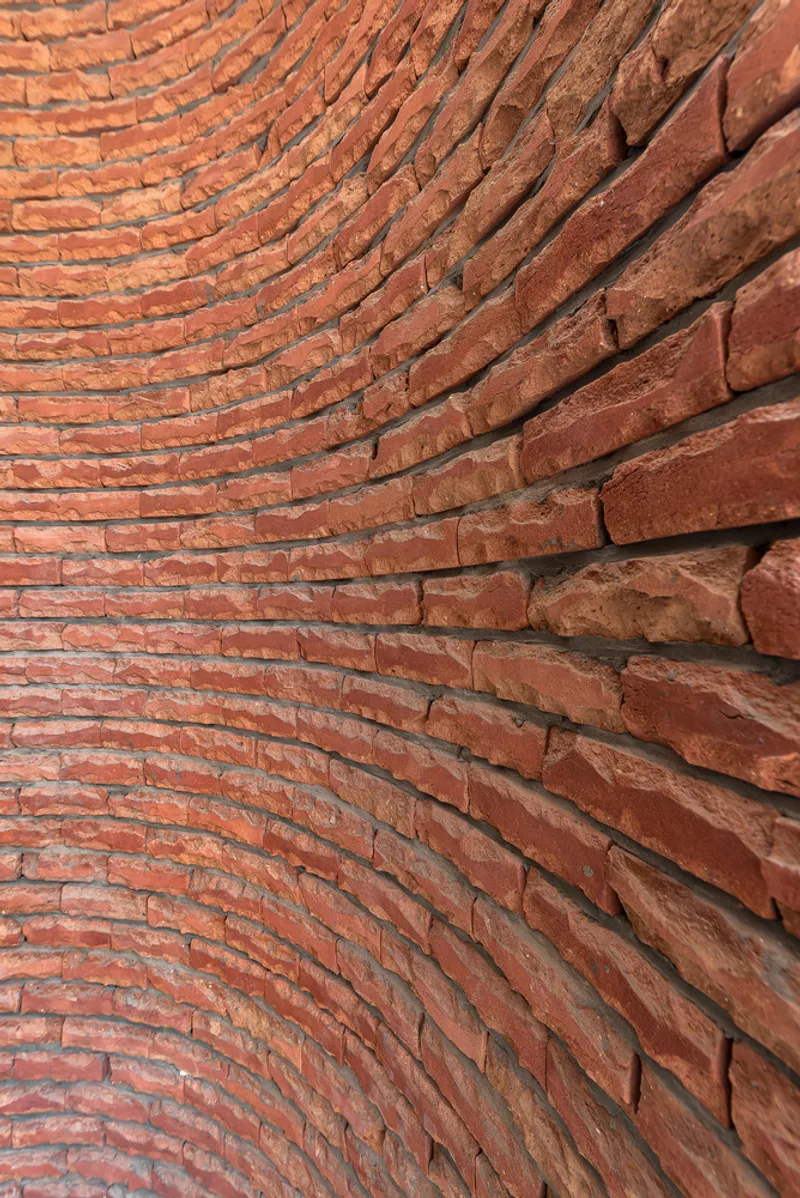
The original concrete frame was preserved as a modular scaffold into which the new curved walls could be placed. Each concrete cell acts as a bay, and the brick infill within it follows its own geometry. The decision to keep the structure visible, rather than conceal it, gives the facade an honest legibility: you can read the old building behind the new skin. The adzed bricks, partly shaped by hand, introduce a textural grain that flat machine-made units could never achieve. Under raking daylight the undulating surface throws soft shadows that shift throughout the day, giving the wall a quality closer to carved stone than stacked masonry.
A Palm Tree as Vertical Anchor
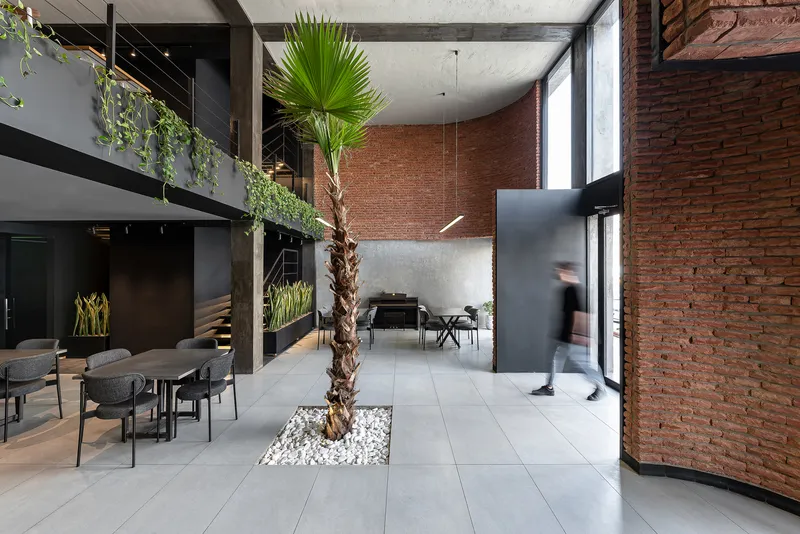
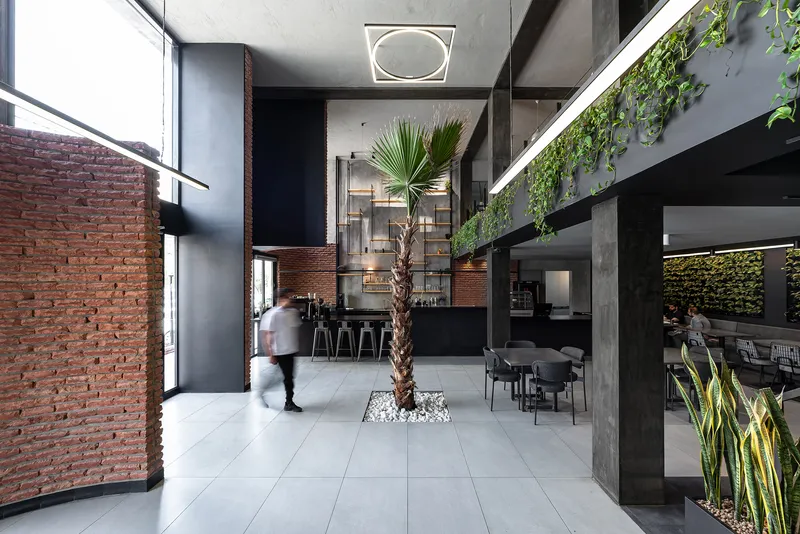
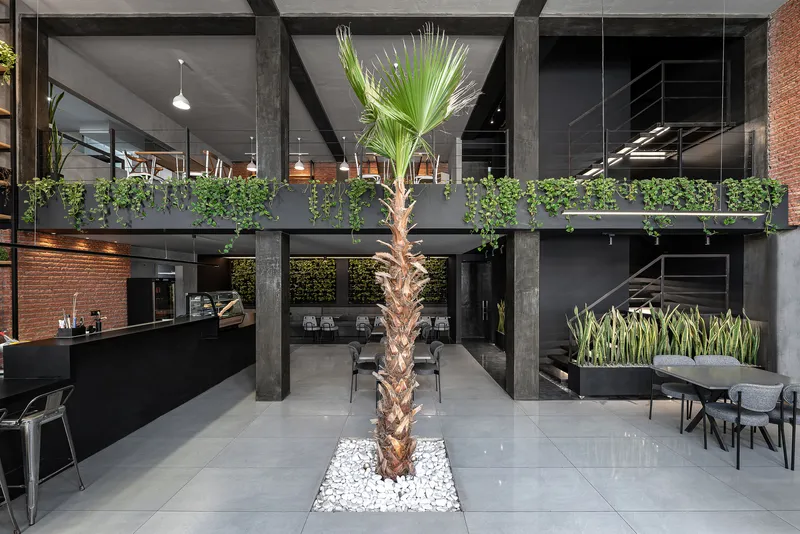
At the center of the double-height void, a tall palm tree rises from a white stone planter through the mezzanine level, anchoring the interior both spatially and symbolically. Ahvaz sits in the Khuzestan province, one of the hottest inhabited regions on Earth, and the date palm is as much an emblem of the local landscape as brick is of its architecture. Placing a living tree at the heart of a commercial interior is a bold commitment to maintenance, but it pays off by giving the food hall a vertical datum around which every other element orbits.
The planter sits below the mezzanine balcony, which is itself lined with greenery. From the ground floor you look up through fronds to a planted railing; from the mezzanine you look down past leaves to the bar counter. The palm turns a standard food-court section into something resembling a courtyard, collapsing the distinction between indoor dining and outdoor garden.
Raw Materials, Warm Atmosphere
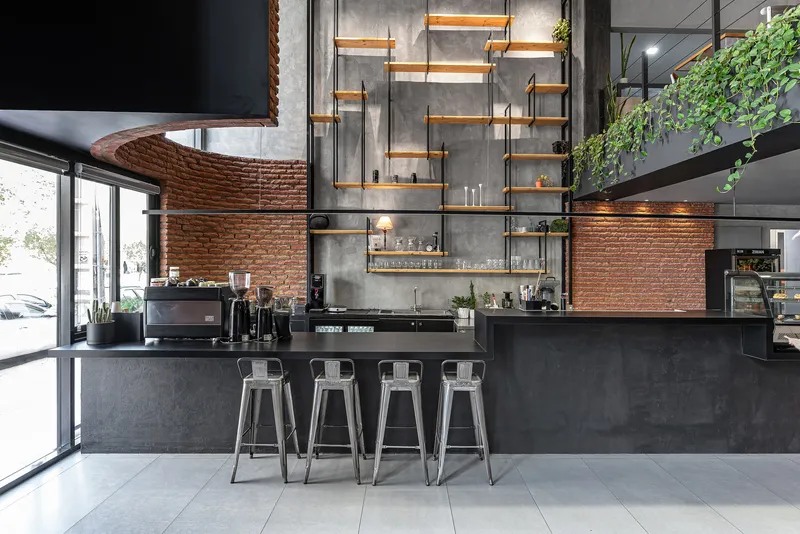
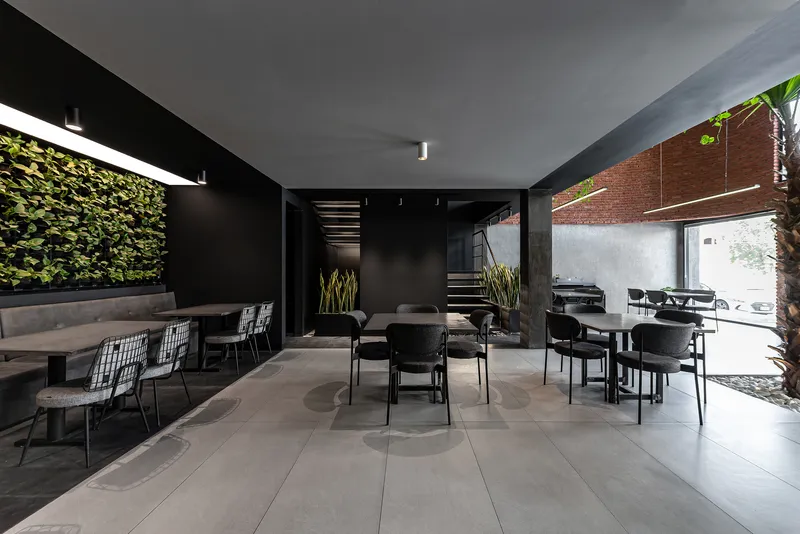
Inside, the palette stays deliberately restrained: exposed concrete ceilings, black metal fixtures, natural wood shelving, and the same brick that defines the facade. The cafe counter in particular demonstrates how these materials can work in concert. Steel-and-timber shelving is mounted directly onto the concrete and brick walls, while black metal stools line a timber counter. Nothing is clad or concealed. The result feels industrial without being cold, because the warm brick and wood tones counterbalance the rawness of concrete and steel.
A vertical green wall in the dining room adds a layer of biological texture that softens the hard surfaces. Through an opening beyond it, the brick courtyard and palm tree are visible, reinforcing the idea that greenery is not decoration here but a continuous spatial element threaded through every level.
Curved Walls and Directed Flow
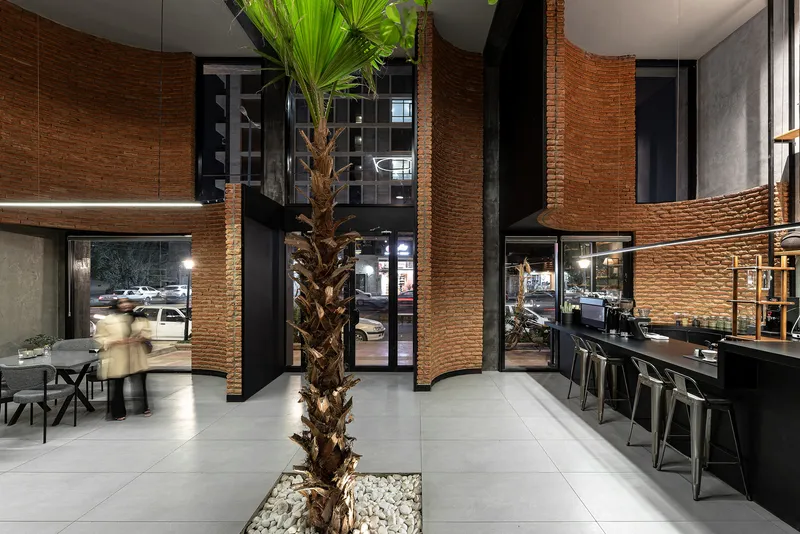
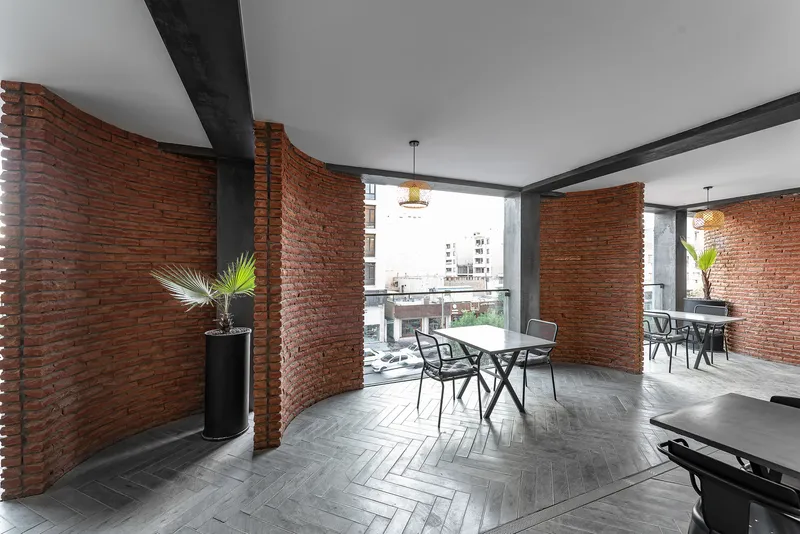
The curved brick partitions do real spatial work beyond aesthetics. On the terrace level, they carve the open floor plate into intimate dining zones without the rigidity of straight walls. A herringbone-patterned floor flows freely between these partitions, reinforcing the sense of continuous movement. Where a flat wall would create a dead end, a curved wall redirects your path and your gaze. At night, warm lighting washes across the concave surfaces and the double-height space reads almost like a brick canyon, its curves amplified by shadow.
Each partition has a different radius and sweep angle, so no two dining pockets feel identical. Some arcs are tight enough to create semi-enclosed booths; others are gentle enough to merely suggest a boundary. The variation keeps the 200-square-meter floor plate from feeling repetitive, a critical quality in a food hall that needs to accommodate a café, a sit-down restaurant, and a bakery counter within a compact site.
Why This Project Matters
Tetra Food Hall is a lesson in contextual ambition at a modest scale. On a site of just 200 square meters, OJAN Design Studio managed to produce a building that speaks to its neighborhood in material and color while introducing a formal language that is entirely its own. The handcrafted adzed bricks are the quiet hero: they push the project beyond the familiar territory of exposed-brick interiors into something genuinely tactile, where every surface rewards close inspection. In a market saturated with industrial-chic food halls that lean on the same palette of subway tile and Edison bulbs, that specificity matters.
More broadly, the project demonstrates that retaining an existing structure does not mean deferring to it. The old concrete grid is visible but subordinate; the new brick walls are the protagonists. Keeping the frame saved material and embodied energy, while the curved infill walls created spatial qualities that a demolish-and-rebuild approach would not have naturally produced. For architects working on commercial renovations in dense urban contexts, Tetra Food Hall offers a clear and replicable argument: strip back to what is structurally sound, then reimagine everything the public actually touches.
Tetra Food Hall by OJAN Design Studio. Located on Kianabad Street, Ahvaz, Iran. 600 m². Completed 2022. Photography by M.H.Hamzehlouei.
About the Studio
Share Your Own Work on uni.xyz
If projects like this are the kind of work you want to make, uni.xyz is a place to publish your own, find collaborators, and enter design competitions.


Popular Articles
Popular articles from the community


longwave studio Reorganizes a 112 m² Tainan Apartment Around the Daily Routines of a Family and Two Cats
In Tainan, Taiwan, birch plywood, rust-red furniture and a freestanding plaster wall link arrival, storage, work and family life in one apartment.

GROUP A Strips a 1969 Rotterdam Harbor Headquarters to Its Frame and Wraps It in Timber Louvers
In Rotterdam's M4H harbor district, Ferro Offices reuses a 1969 frame, adds one timber storey and reaches BREEAM-NL Outstanding.

Jaramillo Van Sluys Arquitectura and Urbanismo Turn a Demolished Registry Lot in Quito into an Orchard Plaza
In Quito's Centro Histórico, a 2,800 m² plaza exposes the San Agustín convent wall and redraws its lost Augustinian orchard in volcanic stone.

David Macias Steps a Doorless Stone and Plaster House Down a Tropical Colombian Hillside
In the humid hills of Colombia, Threshold House replaces the front door with an open void and terraces its 850 m² down the slope instead of fighting it.

Similar Reads
You might also enjoy these articles


Hodi-Mandai Geram
Project Function: Preservation and revitalization of the Intangible heritage and socio-spatial identity of the Hodi by Housing, Cultural Memory Center, Sacred Grove, landscape, local tourism economy


Olio Towers: A Mid-Rise for Performers That Fuses Housing, Rehearsal, and Stage
Located blocks from Houston's Theater District, this modular tower stacks living units around a central performance atrium.

Oasis: Modular Green Housing Carved into Dhaka's Urban Fabric
A shortlisted Plugin Housing entry reclaims unauthorized settlements in Dhaka with stepped concrete volumes, green roofs, and ventilation-driven design.

Black Hole: A Floating Megastructure for the Post-Physical Era
Emiliano Mazzarotto envisions a spherical, self-scaling arena where e-sports, digital hotels, and holographic stadiums replace traditional public space.

Explore Persian Architecture Competitions
Discover active competitions in this discipline

Challenge to reimagine the Iron Throne

Photograph architecture without architects

Illustrate the lost glory of Angkor Wat - Render Challenge

Design challenge to reuse E-waste
Comments (0)
Please login or sign up to add comments
No comments yet. Be the first to comment!