

allmannwappner and Menges Scheffler Wrap a University Building in Robotically Woven Fiber Tiles
The Texoversum Innovation Center in Reutlingen is the first permanent building clad in robotically wound carbon and glass fiber panels.


A building about textiles should, in theory, feel like a textile. The Texoversum Innovation Center at Reutlingen University of Applied Sciences takes that logic literally. Designed by allmannwappner and Menges Scheffler Architekten, the 4,110 m² facility wraps itself in roughly 2,000 square meters of robotically wound carbon and glass fiber panels, a material system that had previously only been tested in temporary pavilions. This is the first permanent building to use Robotic Coreless Filament Winding at an architectural scale, and it manages to do so without looking like a tech demo. Donated to the university by Südwesttextil, the regional textile trade federation, the center cost 18.5 million euros to build, and every cent appears to have gone toward proving that fiber composites belong in the vocabulary of permanent construction.
What makes the project genuinely compelling is how it collapses the gap between subject matter and envelope. The building teaches and researches textile technology; its skin is textile technology. White glass fibers overlaid with black carbon fibers are embedded in aliphatic polyurethane resin, then wound by robots between rotating scaffolds with no mold, no core, and, crucially, no production waste. The resulting triangular tiles, approximately four meters wide and a meter and a half tall, are self-supporting. They need no secondary load-bearing frame. This is not ornamentation applied to a concrete box. It is structure, sun protection, and architectural identity collapsed into a single system.
A Facade That Works for Its Keep
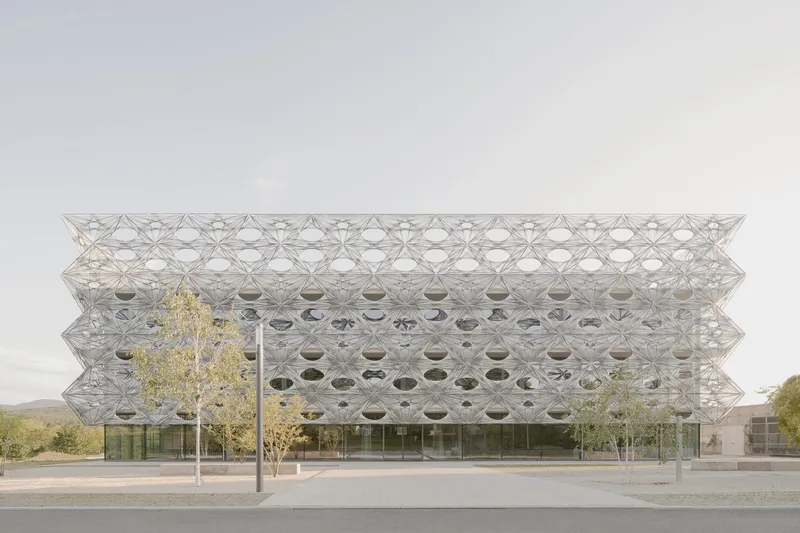
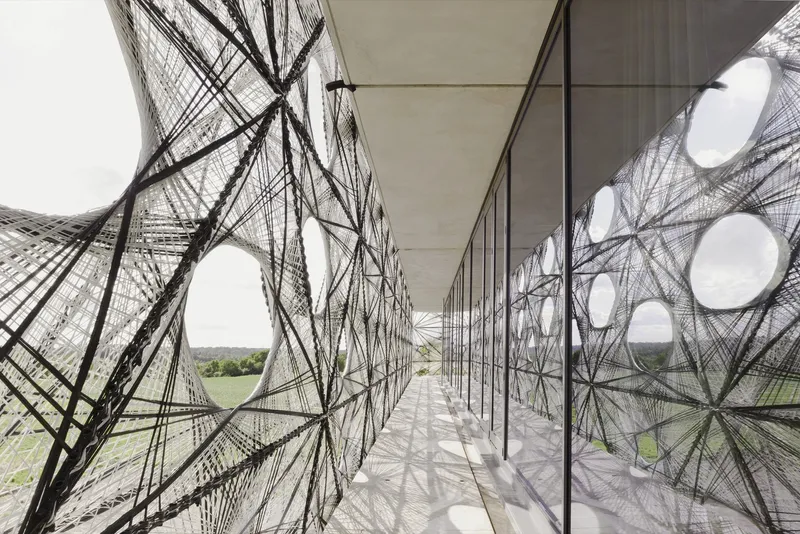
Five distinct triangular tile types compose the facade, and their arrangement follows the path of the sun across the building's envelope. This is not a pattern exercise. The staggered configuration provides graduated shading: enough to block direct solar radiation, open enough to preserve views out. Where the weave loosens, circular apertures punch through the skin, framing fragments of the campus and the surrounding landscape like portholes in a ship's hull. These cutouts double as ventilation pathways and light wells, turning the entire envelope into a passive environmental filter.
The tiles were manufactured by FibR GmbH using a winding process developed at the University of Stuttgart, the same institution whose biomimetic research pavilions at the Bundesgartenschau horticultural show served as prototypes. Scaling that technology from exhibition structure to occupied building required eliminating tolerances, proving fire safety, and ensuring long-term UV stability in the resin system. The fact that it arrived at a campus building rather than a corporate headquarters or museum speaks well of the client's ambition and the architects' willingness to accept risk.
Split Levels, Woven Together
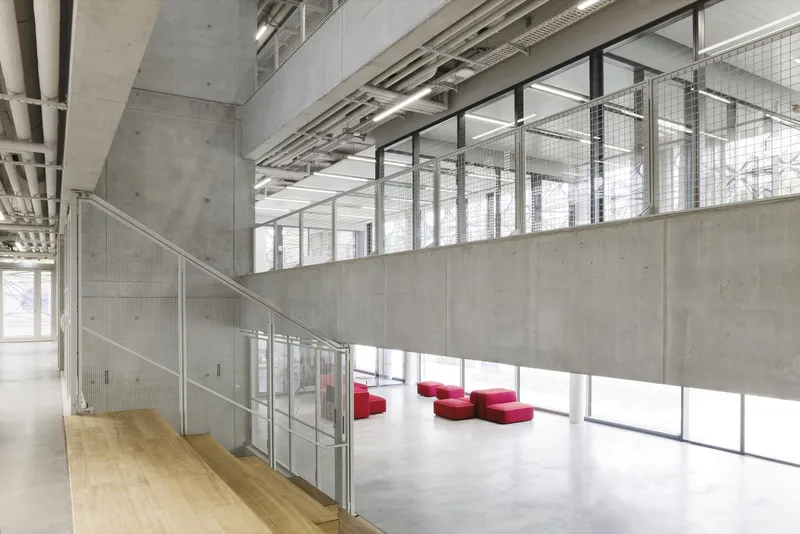
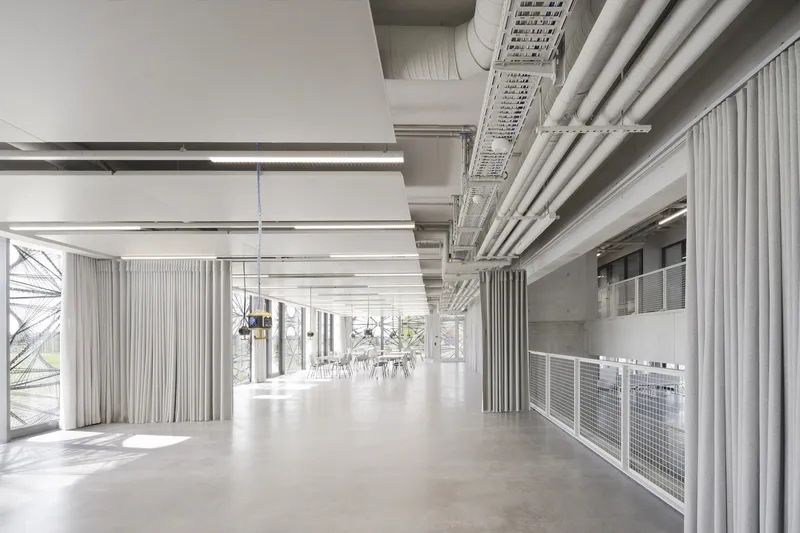
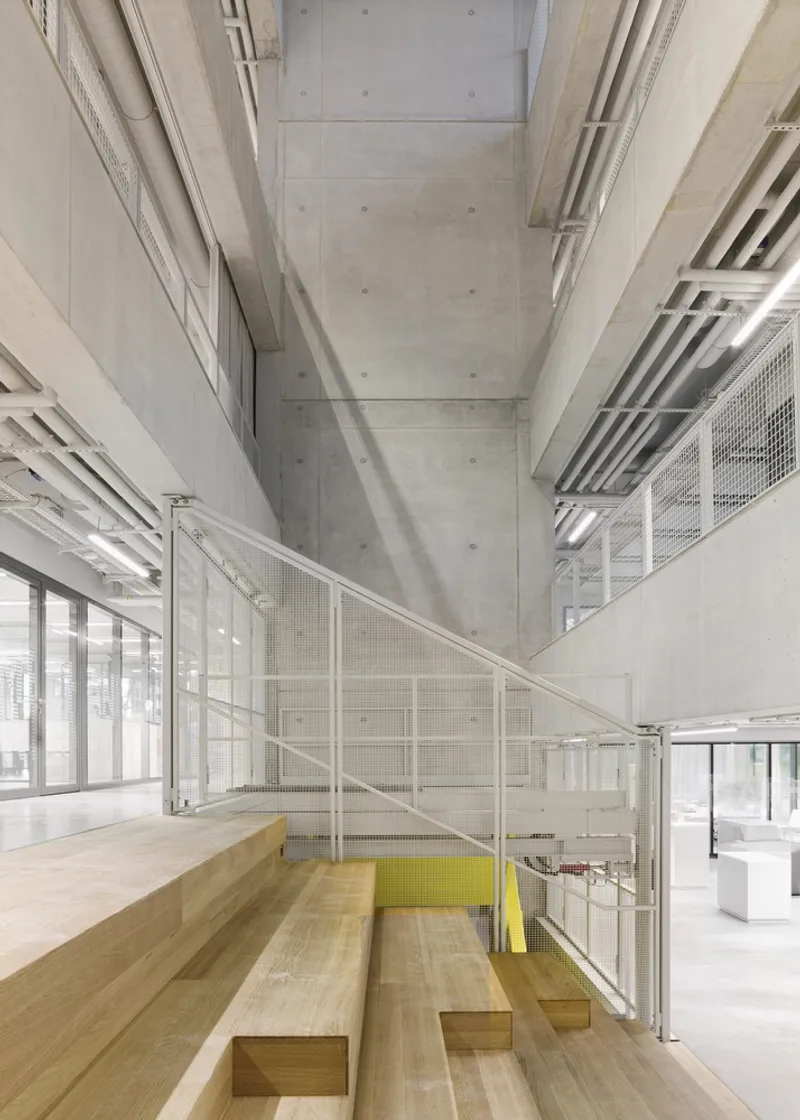
Internally, the building splits into two halves separated by a central atrium. Each half is offset by a half-story, so the floors step up and down in a continuous zigzag that keeps every level visually connected to at least two others. The metaphor of weaving is deliberate: disciplines, user groups, and sight lines interlace vertically the way fibers interlace on the facade. Tiered seating platforms bridge between the staggered floors, creating informal gathering zones where the building's population can collide without scheduling a meeting.
The program is dense. Offices, workshops, classrooms, laboratories, a CNC robot workspace, a university store, and an internationally recognized collection of historical textile samples all fit within nearly 3,000 square meters of usable space. The open-plan layout absorbs this variety by relying on fabric dividers rather than fixed partitions, a detail that keeps the textile narrative going right down to the interior fittings.
Concrete and Curtains
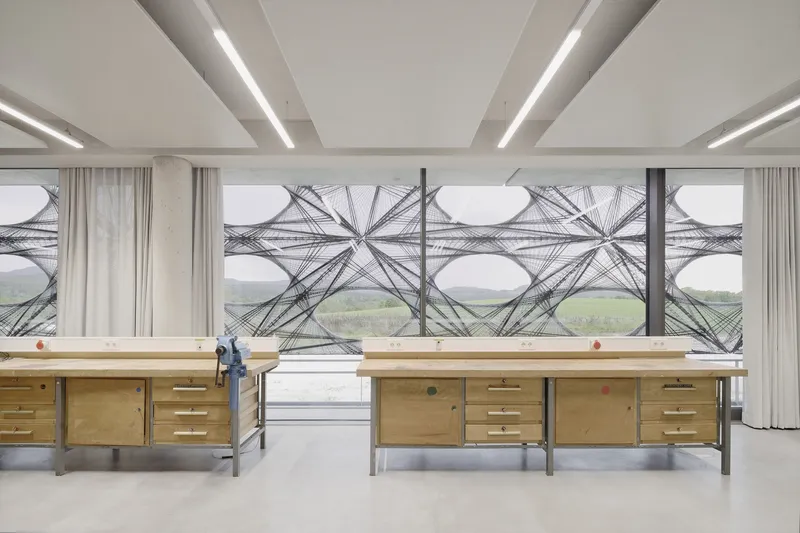
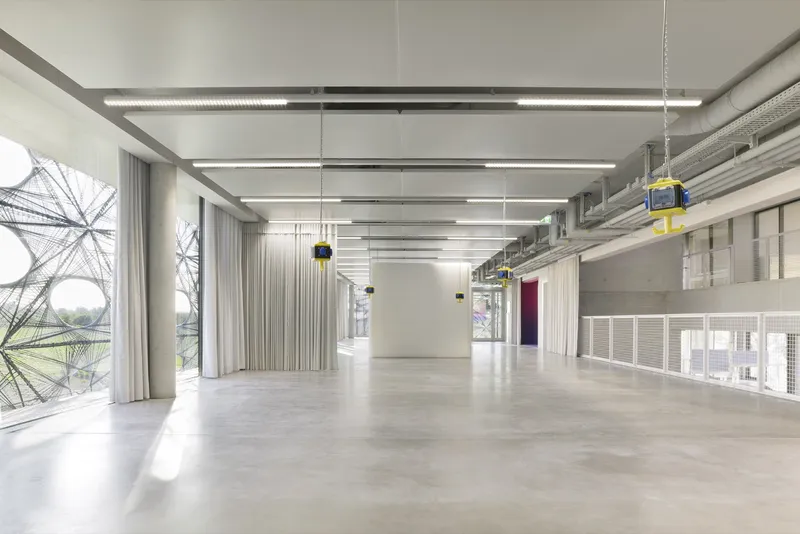
The interior palette is deliberately raw. Exposed concrete ceilings, visible ductwork, hard-wearing screed, and polished concrete floors establish an industrial baseline that lets the program and the people provide the visual activity. Pleated curtains hang floor to ceiling along the glazed perimeter walls, softening the threshold between the fiber facade and the workspace behind it. There is something satisfying about using fabric as the primary interior modulation device in a building devoted to fabric science.
Plywood desks line the perimeter workspaces, facing outward toward the patterned shadows cast by the woven skin. Natural light arrives filtered and fragmented, shifting throughout the day as the sun moves across the tile array. The effect is closer to working beneath a canopy than behind a curtain wall, which is exactly the kind of spatial quality that fiber composites can deliver and glass cannot.
Color as Connective Tissue
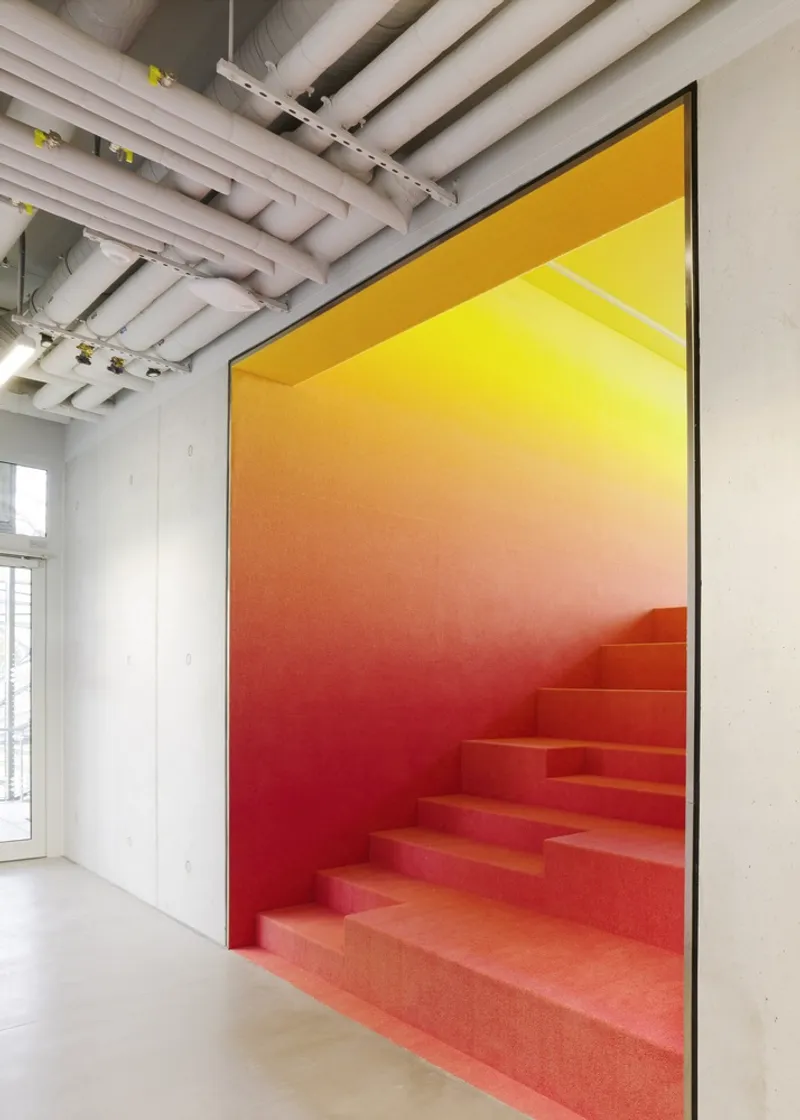
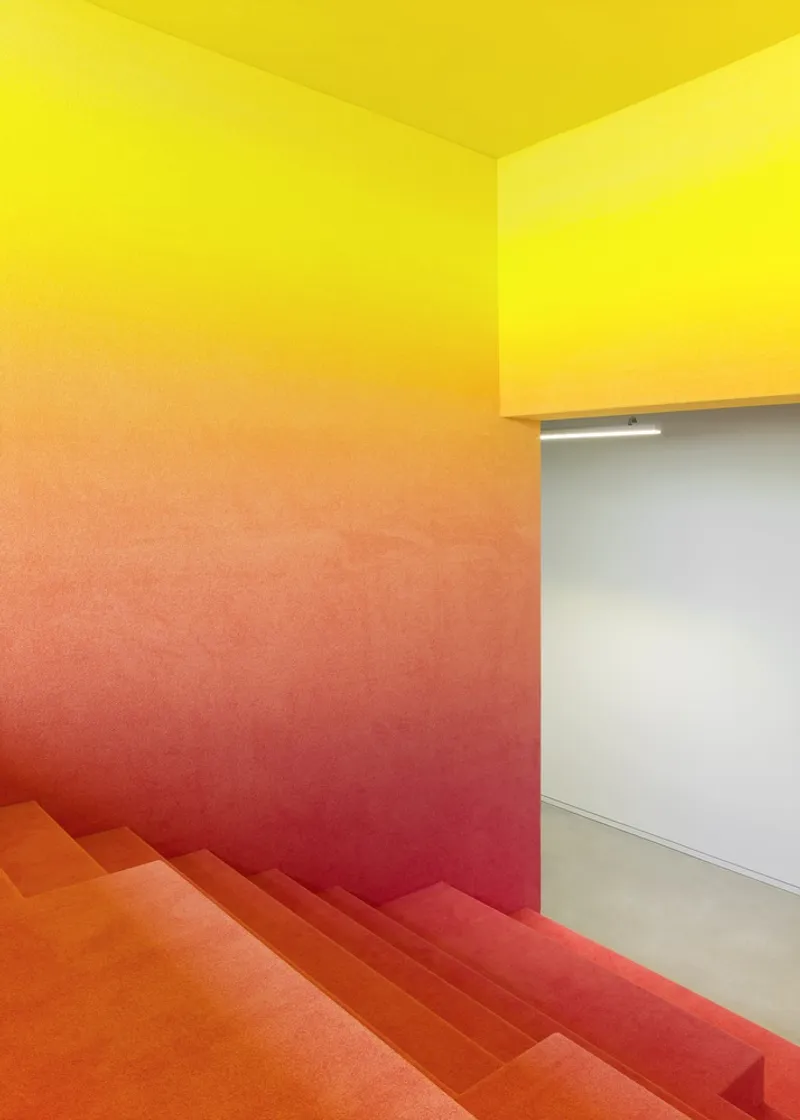
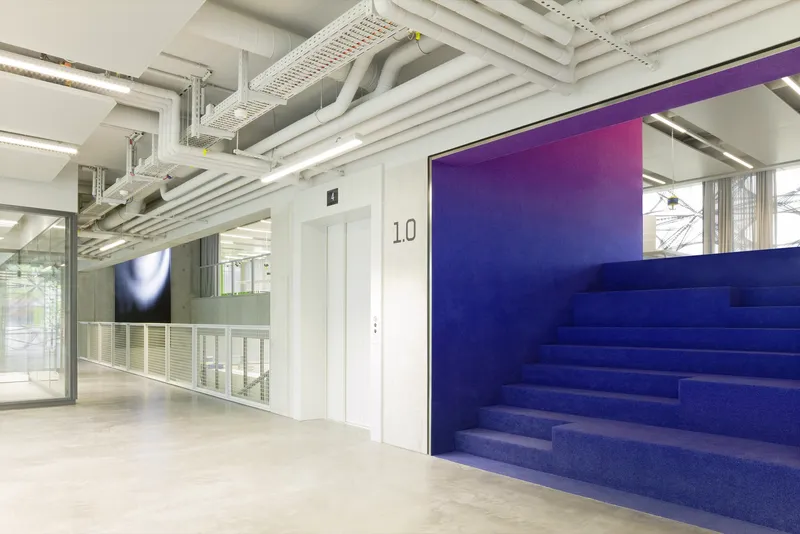
A continuous color gradient runs through the building's circulation zones, transitioning from yellow to orange to deep red. The reference is twofold: Gobelin tapestries, with their slow tonal shifts woven into wool, and the emerging technology of color-printed textiles. Carpet, wall panels, and upholstered seating all participate in the gradient, so moving vertically through the building registers as a chromatic journey as much as a spatial one. The color accentuates the half-level offsets, making each landing feel like a distinct moment even as the palette insists on continuity.
Against the neutral concrete and exposed steel of the structure, the gradient reads as warm and assertive without becoming overwhelming. It also serves a practical wayfinding function. When every floor is offset and every sightline crosses multiple levels, color gives users an intuitive sense of where they are in the section. It is ornament doing real work, which is a principle the textile industry has understood for centuries.
The Atrium as Engine
The central atrium is the organizational spine that makes the split-level scheme legible. Double-height volumes open up where the staggered floors pull apart, creating pockets of generous vertical space that would be absent in a conventional floor plate. Mesh balustrades and white wire railings maintain transparency across the void, so the eye travels freely between the timber bleacher seating on one side and the workshop zones on the other. Red upholstered seating clusters at the atrium's base, marking it as the building's social heart.
This spatial engine culminates at the roof terrace, where the half-level stagger resolves into a single plane open to the sky. It is a satisfying conclusion: the building's interior complexity unwinds into a simple outdoor room that gives the campus a new elevated gathering space.
Why This Project Matters
The Texoversum Innovation Center matters because it takes a fabrication technology out of the research pavilion and puts it to work in a real building with real occupants, fire codes, and a budget. Robotic Coreless Filament Winding produced zero material waste in the facade's manufacture, a claim that almost no other cladding system can make. The self-supporting tiles eliminated an entire layer of substructure, reducing embodied material and simplifying construction logic. These are not marginal improvements. They represent a fundamentally different relationship between material, labor, and form.
Beyond the technical achievement, allmannwappner and Menges Scheffler Architekten have designed a building that is genuinely pleasant to be in. The split-level atrium, the color gradient, the shadow play of the woven facade: these are spatial qualities, not engineering talking points. The best buildings about a technology do not just demonstrate it. They make you believe in it. Texoversum does both.
Texoversum Innovation Center, designed by allmannwappner and Menges Scheffler Architekten. Reutlingen, Baden-Württemberg, Germany. 4,110 m². Completed 2023. Photography by Brigida González.
About the Studio
Share Your Own Work on uni.xyz
If projects like this are the kind of work you want to make, uni.xyz is a place to publish your own, find collaborators, and enter design competitions.


Popular Articles
Popular articles from the community


Manzana Morphosis: Stretching Barcelona's Grid into a Living Landscape for 2050
A radical reworking of the Eixample manzana turns density into a tool for generous public space, vertical ecology, and environmental performance.

Extended Shell: Retrofitting Kolkata's Balconies as Living Urban Thresholds
A modular retrofit system recovers the social and environmental intelligence of Kolkata's historic verandas for contemporary Park Street residents.

Cloaked Colonization: A Mobile Underwater Habitat That Moves Like a Fish
Micah Abaya's shortlisted EHC Pacific entry reimagines ocean settlement as a dispersed network of self-sustaining architectural organisms.

Singing Woman: Contemporary Architecture Inspired by Estonia’s Voice and the Sea
Singing Woman turns Estonia’s song culture into flowing opera house architecture, blending public life, landscape, sea, and national memory.

Similar Reads
You might also enjoy these articles


Hodi-Mandai Geram
Project Function: Preservation and revitalization of the Intangible heritage and socio-spatial identity of the Hodi by Housing, Cultural Memory Center, Sacred Grove, landscape, local tourism economy


Olio Towers: A Mid-Rise for Performers That Fuses Housing, Rehearsal, and Stage
Located blocks from Houston's Theater District, this modular tower stacks living units around a central performance atrium.

Oasis: Modular Green Housing Carved into Dhaka's Urban Fabric
A shortlisted Plugin Housing entry reclaims unauthorized settlements in Dhaka with stepped concrete volumes, green roofs, and ventilation-driven design.

Black Hole: A Floating Megastructure for the Post-Physical Era
Emiliano Mazzarotto envisions a spherical, self-scaling arena where e-sports, digital hotels, and holographic stadiums replace traditional public space.

Explore Recycled Textile Wall Panels Competitions
Discover active competitions in this discipline

Challenge to reimagine the Iron Throne

Photograph architecture without architects

Illustrate the lost glory of Angkor Wat - Render Challenge

Design challenge to reuse E-waste
Comments (0)
Please login or sign up to add comments
No comments yet. Be the first to comment!