

THE AESTHESIS
This project is a set of units for educational and social purposes for women in Nigeria, intertwined with nature and strengthened with sensory areas.

PURPOSE
The goal is to make sure that you to provide sensory spaces for women when creating skills development workshops and classrooms for women. Sensory sensation was wanted to be emphasized thanks to the pools and flower gardens. Women have the chance to experience the spaces while moving between units. It has been designed so that women can be educated, have economic power and at the same time meet their spiritual needs.

CONTEXT
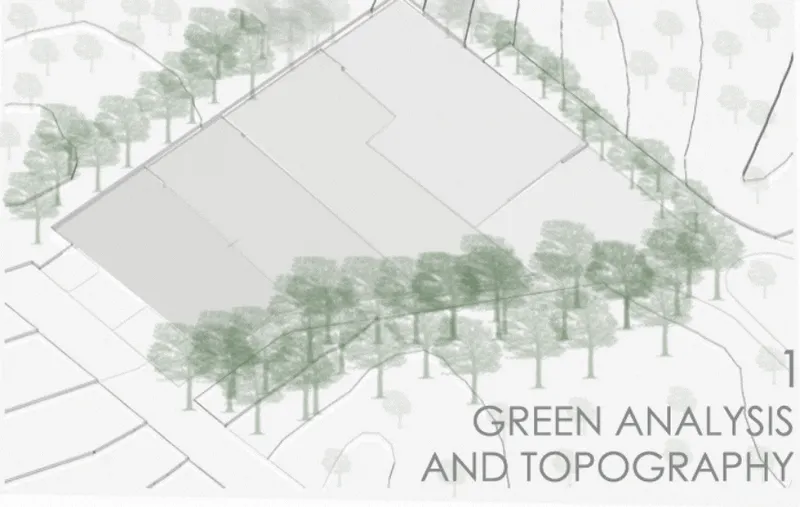
Nigeria has a dry climate of 6 months and 6 months of rain. Design was made taking into account the climatic conditions. Solution to problem such as safety were sought in the land located in the industrial zone. The design is intended to consist of units instead of a single monolithic mass, so that it can provide more natural ventilation and enlightenment surface against Nigeria's warm climate. The image of the city was provided by seeking order in the irregularity, sparseness and soullessness of the surrounding buildings. The existing slope of the land was used and each unit was placed on the elevations. Transition integrity is ensured with ramps between the units placed in accordance with the slope.
CONCEPT
In the Kado region of Abuja, Nigeria, places where women can socialize, receive education and also provide a financial resource have been set up. Since the land is located in an industrial area away from residential areas, there are structural problems in the area. Along with their daily lives, workshops and basic training units are designed where women can receive vocational training so that they can take their financial freedom into their hands. In addition to providing economic support, sensory space fiction for women is based. In the constructed pools, this sensory space
serves. Women in Nigeria are quite deficient and unconscious about health, and units for health education and controls have been set up here. The concept has a flexible design setup that can host multiple events together.

DESIGN PROCESS
In line with the climate and terrain conditions, the most suitable design form for Nigerian culture has been selected. The design includes courtyards serving each unit and agricultural areas where different aromatic plants are grown. Indoor and outdoor fiction is based on ensuring that women move freely.
PROGRAM
Green axes were created by taking reference from the trees around the land. Water axes are placed in the opposite direction to the green axes and in the direction of the slope. Building units are placed at the intersection points of these axes. With the arrival of the building units, the pool and agricultural axes were disintegrated and worked as separate units. Each unit opens onto water and agricultural areas. A circulation network has been created connecting the units on the ground floor. In this circulation, the transition between the ramps and the levels is provided. On the upper floor, the bridges connect the spaces and integrity is achieved. The top of the single-storey units was used as an open terrace. The tops of the terraces are covered with colorful fabrics specific to Nigerian culture, thus creating shaded areas. Furnishings specific to Nigerian culture are used in the spaces and open courtyards. In addition, a dance and music area was designed for women.
Aromatic plants grown in Nigeria were selected by commenting on agricultural areas. A sensory space is designed with local, colorful and fragrant flower gardens. At the same time, it is aimed to provide economic support to women by using flowers in aroma-therapy education and soap-oil production. According to the color of the flower in front of each unit, a wall on the façade is painted the same color as the flower, ensuring integrity.
While a fluid interior design is achieved with the folding wall setup, it is aimed to provide easy access to the courtyards. With the bamboo sunshades used on the folding walls, the African sun was filtered into the space. In order to solve the security problem highlighted in the program, protective brick walls were designed outside. This wall is designed as hollow, and the gaps start larger from the outside and get smaller towards the inside. It is inaccessible from the outside and helps to get the sun level to the interior.
For efficient use of water, gray water treatment systems are designed. The problem was solved with a single clean water well thanks to the system that allows the treatment and reuse of natural rainwater, dirty water formed in the structures and the waters in the pools. Water Treatment tanks are located in the basement. Glass floors are used in the spaces so that the flow of water that continues under the building can be seen. These glass floors are used as tools to support the desired sensuality. Roof slopes of the units are unidirectional and different from each other. It was intended to provide urban image with the design of roof directions.

MATERIAL
The selection of materials has been taken into account the local production materials of Nigeria. A wooden system was built in the structure. Rosewood, which is very abundant in the region, was used. Laterite brick filling was used between the wooden structures on the façade. Natural air and sunlight are provided by using bamboo on the raised roof. At the same time, a double layer of bamboo was used on the roof for its water-resistant gutter. The carriers of the glass floors in the sections where the water enters the units are constructed as steel.
EXPANSION PLAN
Problems with women have been going on for centuries. Design is an exemplary project in many parts of the world in order to develop women, make them realize their inner strength, meet their daily needs easily and provide economic support. With unitary editing, the potential for expansion is quite easy. In addition to façade setup, the water system can be used and improved according to the need.




Popular Articles
Popular articles from the community


Co-Life: Senior Housing Design That Reconnects Older Adults With the City
Co-Life reimagines senior housing design through healing gardens, shared streets, workshops, and a sustainable community across generations.

Play: Fragments of Their World
Familiar architecture becomes modular playground design, creating safe spaces where displaced children can learn, connect, imagine and play.

Co-life: Sustainable Architecture for Age-Friendly Community Living
Co-life reimagines sustainable architecture for seniors through courtyards, rammed earth, shared gardens, and spaces designed for belonging.

Lunar Spiral: Space Architecture Shaped by the Mathematics of the Universe
Lunar Spiral reimagines space architecture through Fibonacci geometry, lunar regolith, levitating habitats, and self-sustaining Moon living.
Similar Reads
You might also enjoy these articles

Day and Night Park: A Time-Based Urban Newsstand in Beijing
A temporary urban newsstand in Beijing blending travel, light, and reading through poetic colors, compact form, and community-focused design.

Modernist Patio Renovation in El Masnou, Barcelona by Oliver Segura Arquitectura + Cebrià Arquitectura
Modernist patio renovation blending tradition and innovation with a movable pool, leveled floors, and Catalan materials in El Masnou.

Alto Residencial Coop: Cooperative Housing Development in Santiago de Compostela by Carbajo Barrios Arquitectos
A linear cooperative housing complex blending white volumes and perforated metal façades, enhancing community living, natural light, privacy, and urban integration.

Vil Genis School by BPA ARCHITECTURE – Massy, France
Vil Genis School in Massy, France, features sustainable design, south-facing classrooms, community integration, accessible spaces, and modern educational architecture.





Comments (1)
Please login or sign up to add comments
Such a nice project. The concept of the project -senses- is well thought and organized. Congrats to the group memebers.