

The Aqueous: A Pixelated Tower That Flows Like the Hudson River
Modular residential units twist and stack into a fluid waterfront tower in Manhattan's Community District 7, blurring the line between pixel and wave.


What happens when you treat a housing unit like a pixel and a skyscraper like a body of water? You get a tower that rotates floor by floor, stacking prefabricated living modules into a form that mimics the fluid motion of the Hudson River right beside it. The Aqueous takes modular construction beyond its usual reputation for utilitarian efficiency and pushes it into something expressive: a spiraling residential tower where every slight rotation generates shared terraces, uninterrupted skyline views, and a silhouette that refuses to sit still.
Designed by Anshika and shortlisted in the Plugin Housing Challenge 2020, the project is sited along the Hudson River in Manhattan's Community District 7, within walking distance of Central Park and Lincoln Center. The neighborhood offers strong public transit connectivity, high educational attainment among residents, and a mix of commercial and residential uses. It is precisely this dense, culturally rich context that gives The Aqueous its programmatic ambition: housing for individuals and families alike, layered with retail, hospitality, and a direct pedestrian link from street to waterfront.
Reading the Waterfront: Site and Urban Strategy
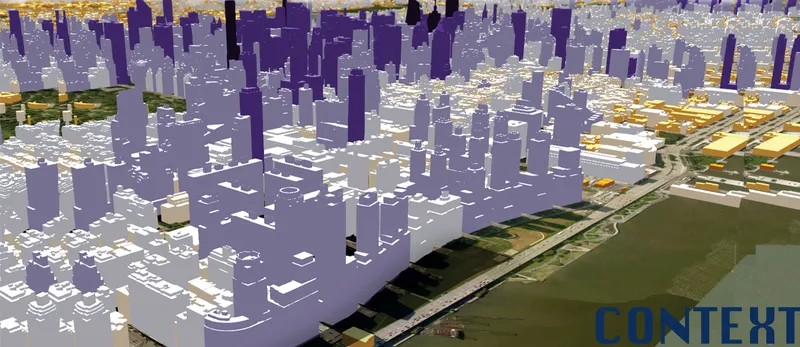
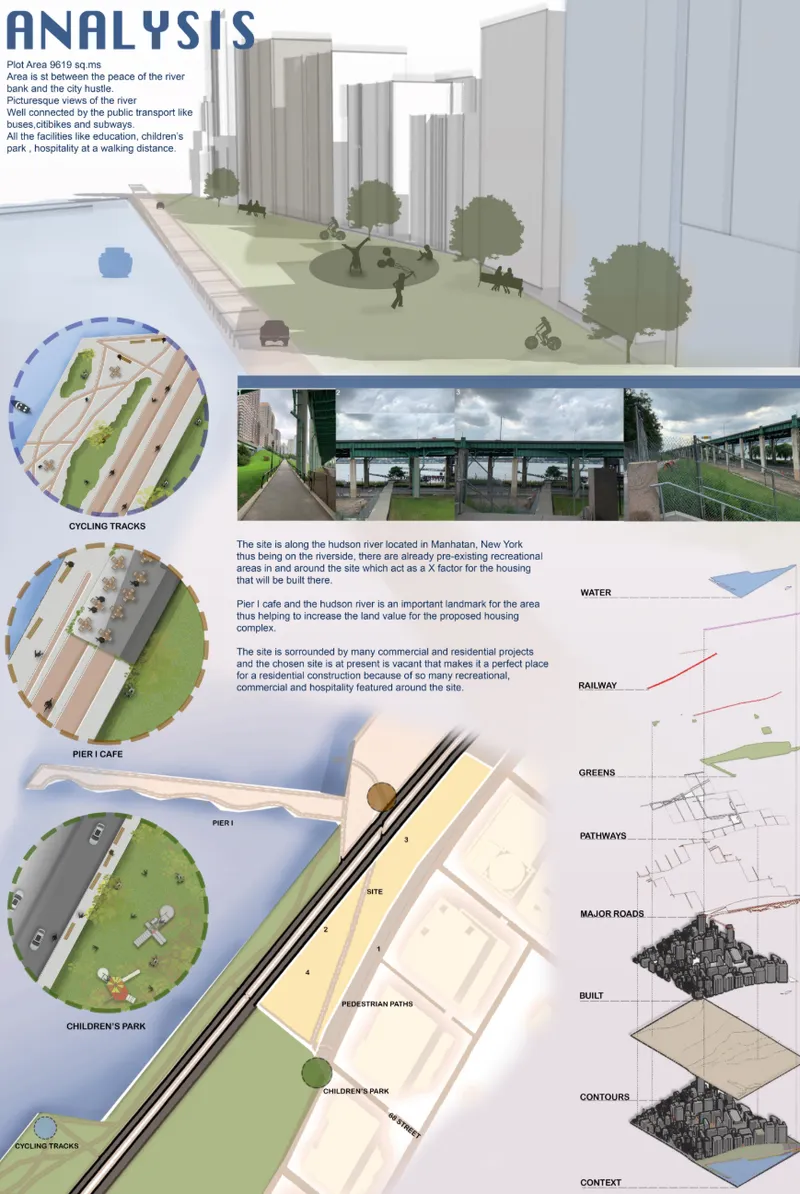
The axonometric site drawing immediately tells you where The Aqueous sits in the urban grain. Dense Manhattan blocks stretch inland while the proposed development, highlighted in golden tones, claims the waterfront edge. The accompanying analysis board breaks this context down further: pedestrian plaza renderings, elevated railway photographs, programmatic site plans, and movement diagrams lay out the argument for why this particular parcel demands both density and public generosity. Data on sun paths, wind direction, and seasonal shadows directly inform the tower's orientation, with balconies and open spaces facing southwest to capture optimal winter sunlight.
What stands out is the deliberate threading of public space through the building's footprint. The lower levels are dedicated to retail and hospitality, activating the ground plane and ensuring the tower doesn't become a gated residential silo. A continuous pedestrian route from the street to the river's edge transforms the site into a permeable threshold rather than a wall along the waterfront.
Pixels as Architecture: The Modular Unit System
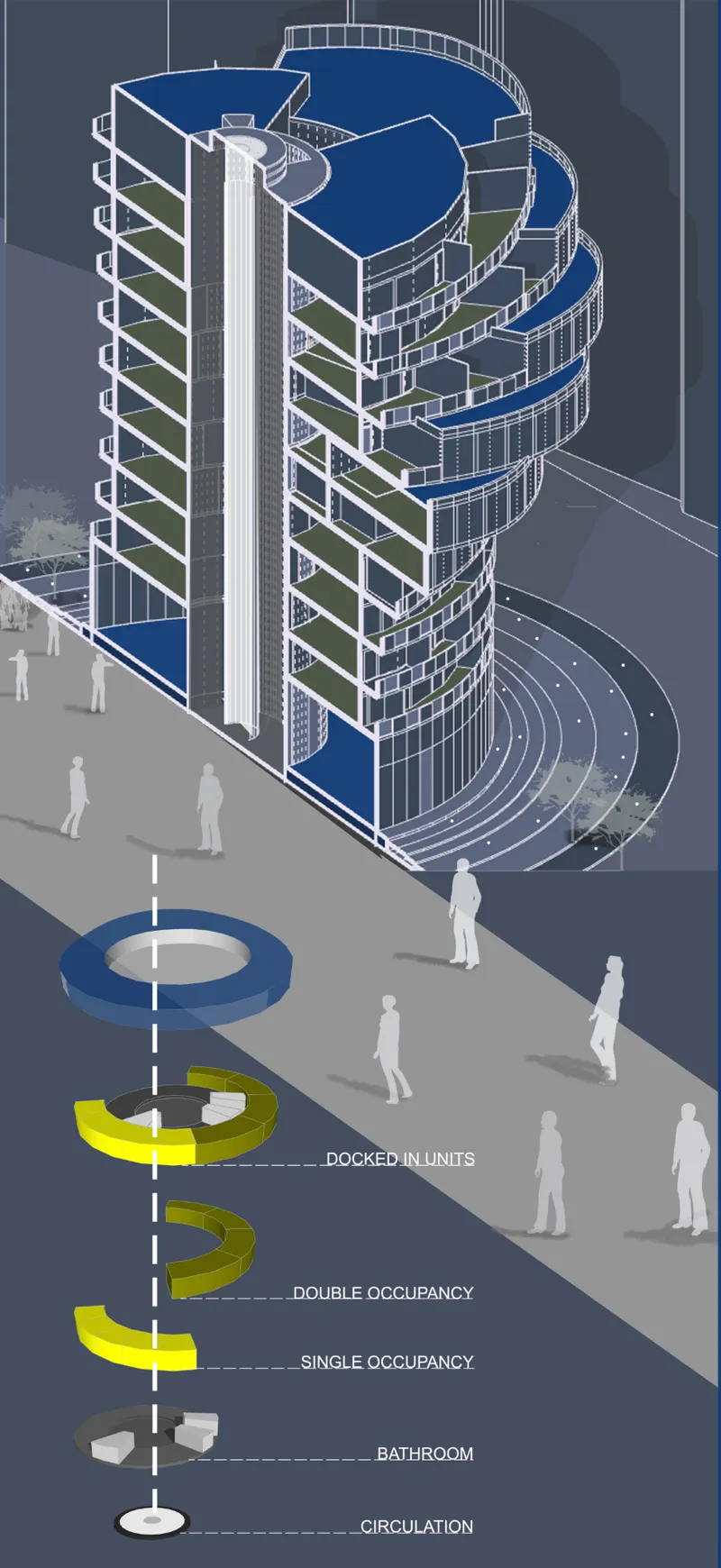
The isometric section drawing reveals the tower's real engine: a pixelated modular system built from three distinct unit types. Restroom pixels, sleep pixels, and multipurpose pixels combine in different configurations to produce single or double occupancy residential units. The circulation core sits at the center, with living modules radiating outward toward the building's curvilinear perimeter and its generous balconies. Common areas and services are centrally aligned for accessibility, while each unit allows for personalization and reconfiguration as residents' needs evolve.
The slight rotation of each floor plate is the move that turns a conventional stacking exercise into something spatial. That twist generates the shared terraces visible between floor plates, creating outdoor social space without sacrificing interior floor area. The drawing clearly shows how the rotation compounds vertically, producing the tower's spiraling silhouette while ensuring every unit gets a distinct view angle toward the river or the skyline.
Curvilinear Skin: Where the Tower Meets the Water
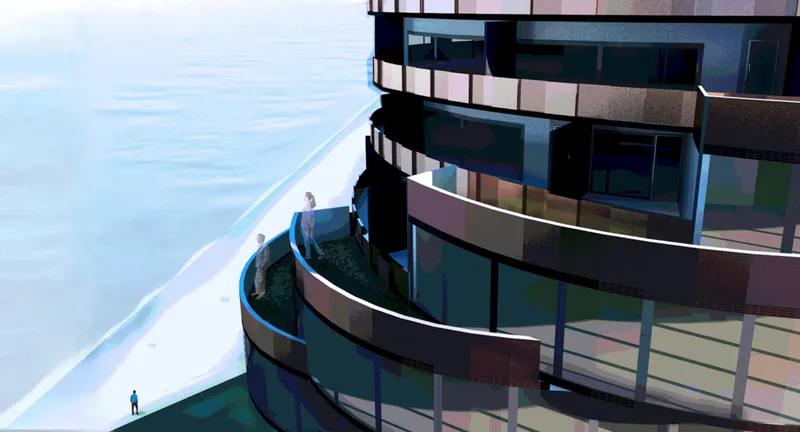
The dusk rendering offers the most visceral reading of the design concept. Curved balconies wrapped in glass railings extend from the tower's facade, their sweeping geometry reflected in the still water below. The building and the river begin to echo each other, and the organic, curvilinear language feels earned rather than decorative. These are not token balconies: they are the spatial byproduct of rotated floor plates, wide enough to function as genuine outdoor rooms. The warm interior light filtering through the glass suggests habitation and activity at every level, reinforcing the idea that this is a vertical community, not just a stack of apartments.
Stacking the Program: From Services to Rooftop Commons
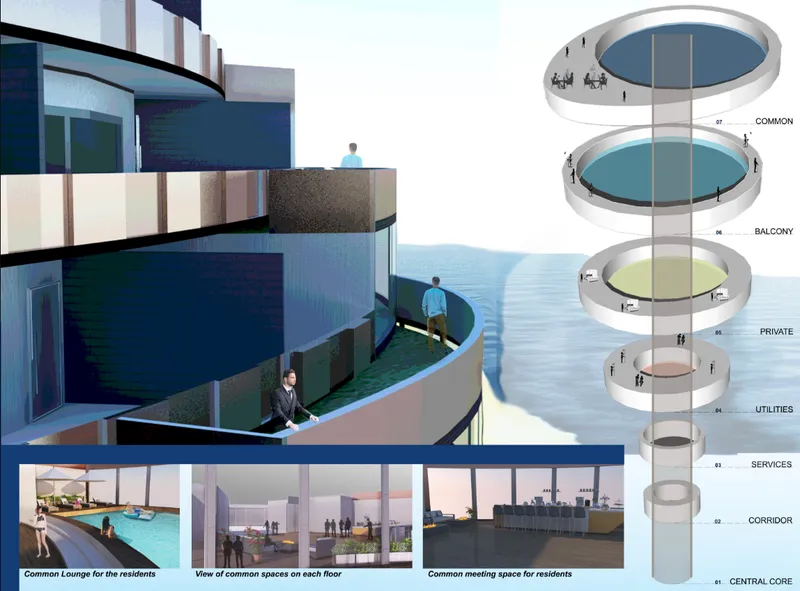
The exploded axonometric diagram pulls the tower apart to show how program is distributed vertically. Circular floor plates are stacked from services and retail at the base through residential levels to a rooftop common space at the crown. Each plate is legible as a discrete structural and programmatic layer, and the diagram reveals the massing strategy that reduces heat loss while maintaining the spiraling aesthetic. Prefabricated BCORE units are the construction method of choice, promising speed, reduced material waste, and a lower environmental footprint compared to conventional site-built construction.
Every floor integrates shared spaces designed to encourage interaction and social engagement among residents. The rooftop common space, visible as the topmost plate in the diagram, caps the building with a collective amenity rather than a private penthouse, a deliberate signal about the project's community-centric values.
Why This Project Matters
Modular housing projects often trade formal ambition for constructability, producing buildings that feel efficient but inert. The Aqueous argues that this trade-off is false. By treating each prefabricated unit as a pixel in a larger compositional field, and by rotating floor plates to generate communal outdoor space, the design achieves both systemic rigor and spatial generosity. The climate-responsive orientation, the pedestrian waterfront link, and the ground-level retail programming show a project that thinks beyond the unit to address the neighborhood.
For a competition entry by a young designer, the level of site analysis and programmatic specificity here is notable. Anshika's proposal doesn't just drop a tower on a waterfront parcel; it reads the demographic, infrastructural, and environmental data of Community District 7 and responds with a building form shaped by those forces. As cities confront the dual pressures of density and livability, projects like The Aqueous offer a persuasive model: architecture that is simultaneously adaptable, contextual, and unapologetically expressive.
View the Full Project
About the Designers
Designer: Anshika
Enter a Design Competition on uni.xyz
uni.xyz runs architecture and design competitions year-round that reward proposals with spatial conviction and real site intelligence.
Project credits: The Aqueous by Anshika Plugin Housing Challenge 2020 (uni.xyz).


Popular Articles
Popular articles from the community


Cloaked Colonization: A Mobile Underwater Habitat That Moves Like a Fish
Micah Abaya's shortlisted EHC Pacific entry reimagines ocean settlement as a dispersed network of self-sustaining architectural organisms.
Faces of the Soviet Avant-Garde: Turning Moscow's Street Names into an Open-Air Museum
A network of sculptural installations across a Moscow residential district transforms forgotten architect names into spatial encounters with cultural memor

The Amber Palace Opera: A Geological Fiction Surfaces on Tallinn's Baltic Waterfront
Pierre Brillard reimagines a Baltic legend as a public landscape, opera house, and waterfront promenade rooted in Tallinn's coastal identity.
Opera by the Sea Estonia: Three Shells Dissolving Architecture into Tallinn's Coastline
A winning opera house proposal replaces monumental form with interconnected shells that blur the boundary between building, park and Baltic Sea.

Similar Reads
You might also enjoy these articles

Day and Night Park: A Time-Based Urban Newsstand in Beijing
A temporary urban newsstand in Beijing blending travel, light, and reading through poetic colors, compact form, and community-focused design.

Modernist Patio Renovation in El Masnou, Barcelona by Oliver Segura Arquitectura + Cebrià Arquitectura
Modernist patio renovation blending tradition and innovation with a movable pool, leveled floors, and Catalan materials in El Masnou.

Alto Residencial Coop: Cooperative Housing Development in Santiago de Compostela by Carbajo Barrios Arquitectos
A linear cooperative housing complex blending white volumes and perforated metal façades, enhancing community living, natural light, privacy, and urban integration.
Vil Genis School by BPA ARCHITECTURE – Massy, France
Vil Genis School in Massy, France, features sustainable design, south-facing classrooms, community integration, accessible spaces, and modern educational architecture.

Comments (0)
Please login or sign up to add comments
No comments yet. Be the first to comment!