

Gálvez & Márton Drape a Metal Roof Over the Brazilian Hillside to Frame the Sunset
MDG Baroneza House uses concrete, steel, and topography to split 1,360 square meters of living across two sloping lots in Brazil.


A house that works with the ground rather than against it is rarer than it should be. MDG Baroneza House, completed in 2021 by São Paulo firm Gálvez & Márton Arquitetura, sits across two gently sloping lots somewhere in the Brazilian interior, and its 1,360 square meters of program are organized almost entirely by the terrain itself. The ground floor extends forward and, as the slope drops, a lower level emerges beneath it without any major excavation. The result is a two-level residence where the upper social zones and lower private quarters have independent access, a move that keeps guests and residents on separate circuits without the usual corridor gymnastics.
What makes the project genuinely interesting is the tension between its heavyweight materials and the lightness of its profile. Reinforced concrete walls and stone block surfaces anchor the building to its hillside, but a large metal roof floats above them, casting deep overhangs that shade terraces, walkways, and internal gardens alike. The roof does more than keep rain out: it is the organizing element that separates social living from service and private zones, creating a clear spatial hierarchy under a single, commanding plane. It is decisive architecture, not decorative, and the landscape it frames, particularly the panoramic sunset view from a set of stone bleachers at the property's edge, becomes as much a part of the program as any room.
Terrain as Organizer

The house reads as a low, horizontal line pressed into the hillside. Terraced lawns step down in front of the building, their brick edges creating a geometric rhythm that echoes the straight datum of the roof. The strategy is clear: rather than building up, the architects build along the slope, distributing the program proportionally across the site and leaving generous pockets for gardens, a sports court, and stone bleachers that double as outdoor seating.
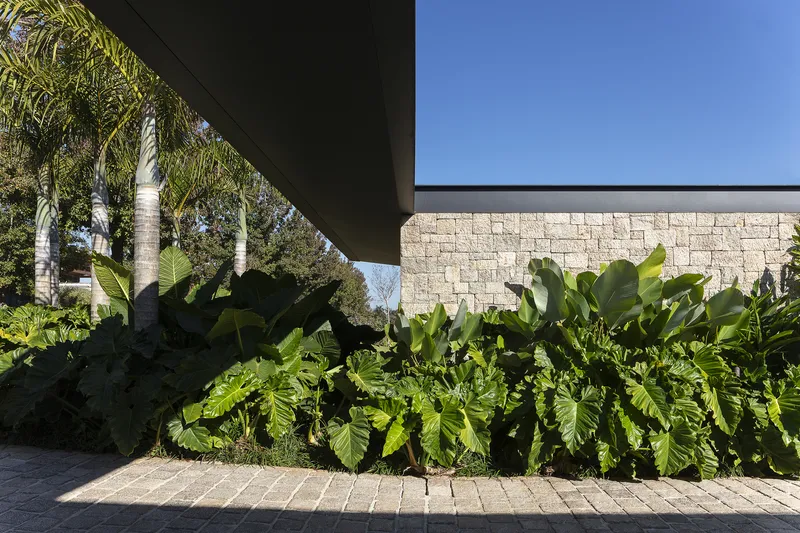
Beneath the deep overhang, stone block walls and planted beds of tropical foliage create a transitional zone between the shaded interior and the open landscape. There is no hard boundary, just a gradient from built to natural that lets the terrain do the spatial work. The absence of extensive earthmoving is not just an environmental gesture; it is what gives the building its low, respectful posture.
The Overhang and the Horizon

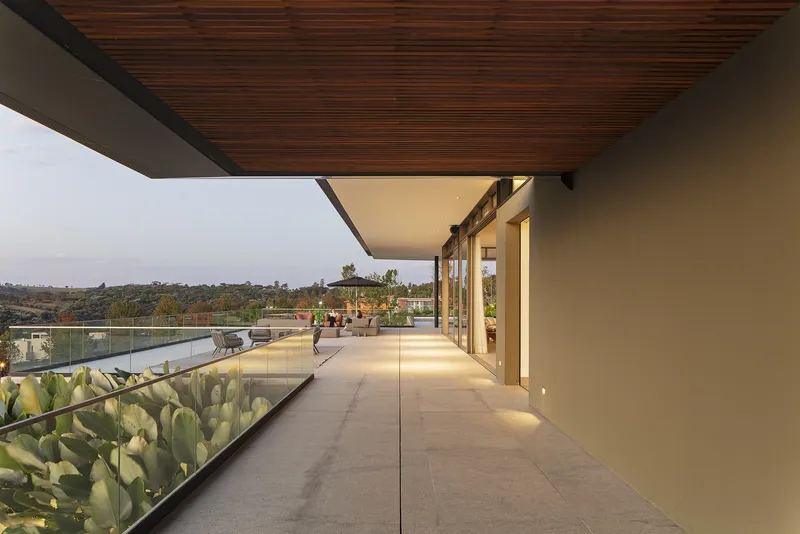
A black cylindrical column at the terrace edge frames the view like a theatrical proscenium: the pool in the middle ground, a glass balustrade at its edge, and the valley rolling out beyond. It is a composed shot that the architects clearly intended. The metal roof extends well past the building envelope, turning the entire perimeter into a covered outdoor room. At dusk, the timber-clad ceiling of these walkways glows warm against the cooling blue of the sky, and the planted terrace beds soften the concrete geometry.
The overhang is doing serious climatic work, too. In the Brazilian interior, deep shade is not a luxury but a necessity, and the metal roof's projection shields the glass walls from direct solar gain during the hottest hours. The architects do not rely on shutters or screens; they rely on geometry.
Internal Gardens and Borrowed Light

The internal courtyard, visible through floor-to-ceiling glazing, is planted with banana trees and populated with oversized ceramic pots. It functions as a light well, a thermal buffer, and a visual anchor that orients you as you move through the house. From the living spaces, the courtyard draws the eye inward before the panoramic landscape pulls it back out again. The push and pull between these two focal points keeps the interior from feeling like a single, relentless view corridor.
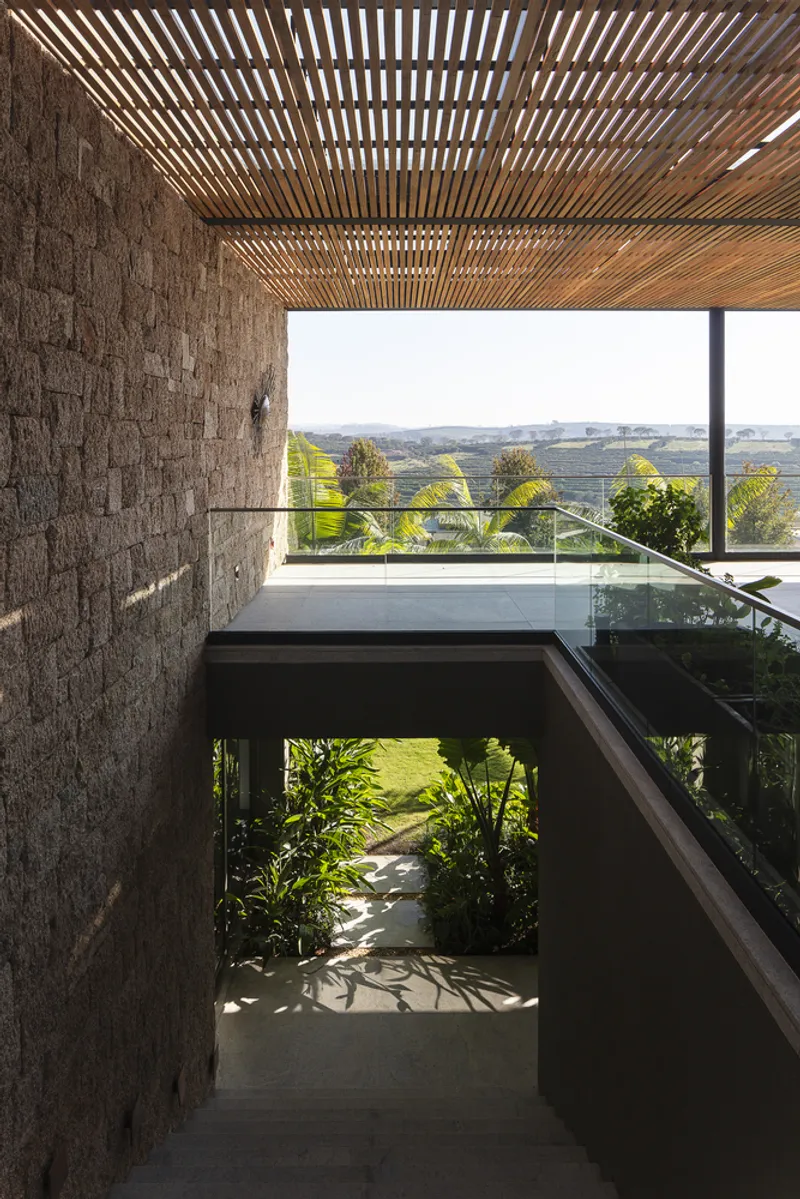
A stairwell nearby uses a timber slatted ceiling and a textured stone wall to compress the space as you descend to the lower level, where another planted courtyard opens up at the bottom. The transition from social to intimate zones is marked not by doors or corridors but by changes in light, material, and ceiling height. It is a sectional sequence that rewards the body more than the eye.
Living Open to the Landscape

The main living space is essentially a single room dissolved into glass. A timber beam spans overhead, and the floor-to-ceiling openings retract to merge the room with the pool terrace. There is no threshold to negotiate; the polished floor simply gives way to the paving outside. It is a well-executed version of a move that Brazilian modernism pioneered decades ago, but the material palette here, with its darker timbers and raw concrete, trades the white lightness of that tradition for something more grounded.
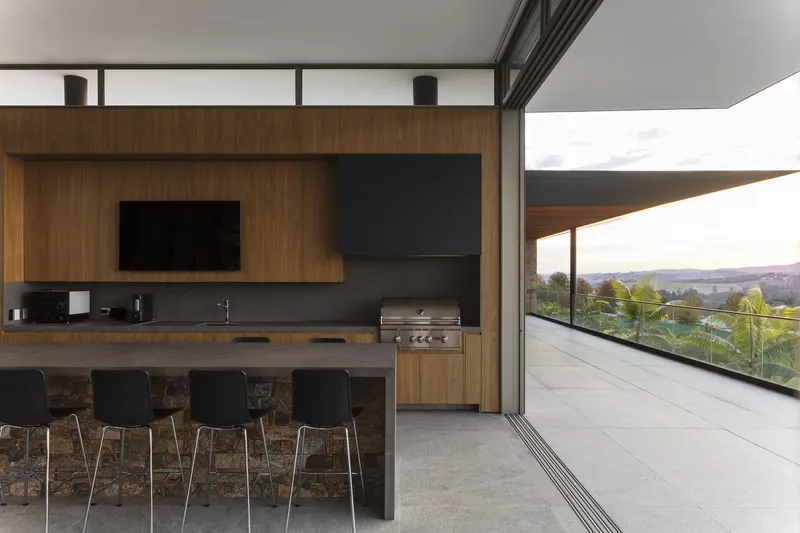
The kitchen follows the same logic: timber cabinetry, an island counter oriented toward the terrace, and glass doors that make cooking an outdoor activity by proxy. What makes these spaces work is their restraint. The finishes are warm but not precious, durable but not industrial. Gálvez & Márton specified market-grade components throughout, a practical decision that prioritizes longevity and low maintenance over bespoke detailing. The house is meant to age well, not to be preserved under glass.
Why This Project Matters
MDG Baroneza House is not trying to reinvent the Brazilian country house. It is trying to build one that actually works: structurally, climatically, and programmatically. The decision to let the terrain organize the section, rather than flatten it and build on a slab, produces a residence where every level has its own relationship to the ground and to the view. The lower floor is not a basement; it is a separate world with its own access and its own garden. That kind of spatial generosity does not come from square meters alone. It comes from reading the site correctly.
The project also demonstrates that material austerity and sensory richness are not opposed. Concrete, steel, stone, and timber are deployed with precision but without preciousness. The metal roof is the single boldest gesture, and it earns its prominence by doing real work: shading, organizing, and defining the silhouette of a house that otherwise dissolves into its hillside. Gálvez & Márton have built something that feels inevitable, which is the hardest quality to achieve in architecture.
MDG Baroneza House by Gálvez & Márton Arquitetura. Lead architects: Márton Gyuricza, Lina Maeoca, Bianca Dall'Ovo. Located in Brazil. 1,360 m². Completed 2021. Photographs by Leonardo Finotti.
About the Studio
Share Your Own Work on uni.xyz
If projects like this are the kind of work you want to make, uni.xyz is a place to publish your own, find collaborators, and enter design competitions.




Popular Articles
Popular articles from the community


EW PARK: Sustainable Architecture Reimagines the Future of Urban Parking
EW PARK reimagines city parking as a modular wooden tower combining automation, solar energy, electric mobility, and adaptable urban design.

Hill & Cross Opera: Sculptural Opera House Architecture Shaped by Tallinn’s Landscape and Identity
Hill & Cross Opera reimagines opera house architecture in Tallinn through its sculptural hill, civic plaza, glass wave and a luminous cross.

Conexión: Biophilic Design Reimagines High-Rise Living in Hong Kong
Conexión reimagines high-rise living in Hong Kong through biophilic design, green facades, shared spaces, daylight, water and nature within.

Co-Life: Senior Housing Design That Reconnects Older Adults With the City
Co-Life reimagines senior housing design through healing gardens, shared streets, workshops, and a sustainable community across generations.


Similar Reads
You might also enjoy these articles


Hodi-Mandai Geram
Project Function: Preservation and revitalization of the Intangible heritage and socio-spatial identity of the Hodi by Housing, Cultural Memory Center, Sacred Grove, landscape, local tourism economy


Olio Towers: A Mid-Rise for Performers That Fuses Housing, Rehearsal, and Stage
Located blocks from Houston's Theater District, this modular tower stacks living units around a central performance atrium.

Oasis: Modular Green Housing Carved into Dhaka's Urban Fabric
A shortlisted Plugin Housing entry reclaims unauthorized settlements in Dhaka with stepped concrete volumes, green roofs, and ventilation-driven design.

Black Hole: A Floating Megastructure for the Post-Physical Era
Emiliano Mazzarotto envisions a spherical, self-scaling arena where e-sports, digital hotels, and holographic stadiums replace traditional public space.


Explore Architecture Competitions
Discover active competitions in this discipline



Challenge to reimagine the Iron Throne


Photograph architecture without architects


Illustrate the lost glory of Angkor Wat - Render Challenge


Design challenge to reuse E-waste
Comments (0)
Please login or sign up to add comments
No comments yet. Be the first to comment!