
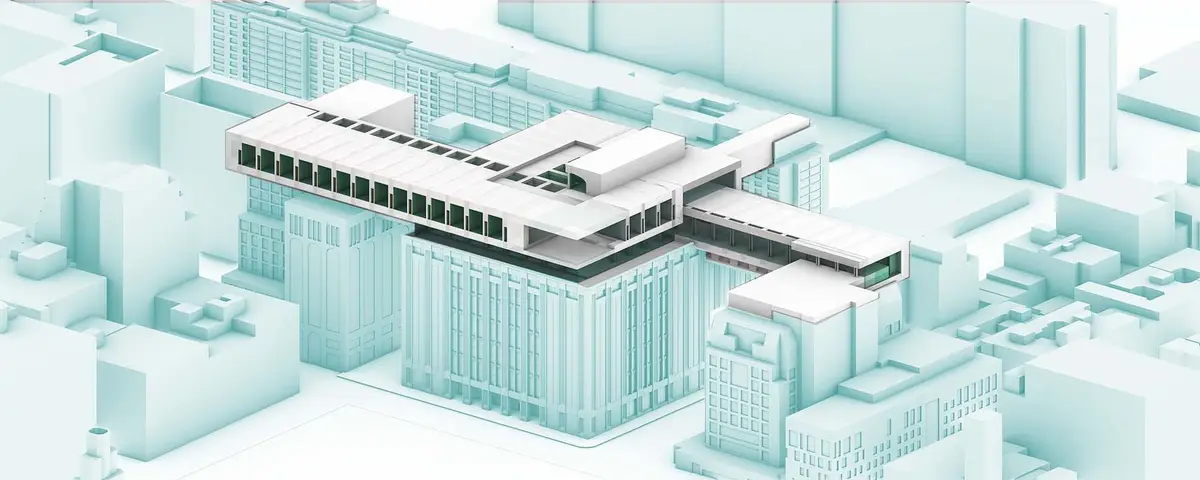
The Bauhaus, Elevated: A School of Architecture Suspended Above Washington Square Park
An elevated network of skybridges and studios perched atop NYU's Bobst Library reimagines how design education occupies the city.


What happens when you place an entire school of architecture on top of a Philip Johnson landmark? Tyler Rodgers answers that question by proposing an elevated campus that sits above NYU's Bobst Library and extends outward through a network of skybridges connecting surrounding buildings. The premise is provocative: rather than carving out a new footprint on Manhattan's impossibly dense ground plane, the project lifts the entire programme into the air, preserving street life below while generating a new layer of public and academic activity overhead.
Shortlisted in the Bauhaus Neue competition, the project takes Bauhaus principles of functionality, simplicity, and the integration of art with technology and transplants them into an aggressively urban context: Washington Square Park and the surrounding NYU campus in Greenwich Village. The result is not a single building but a connective tissue of bridges, studios, and fabrication labs that turns the gap between existing structures into occupied, programmed space.
A White Volume Over the Library
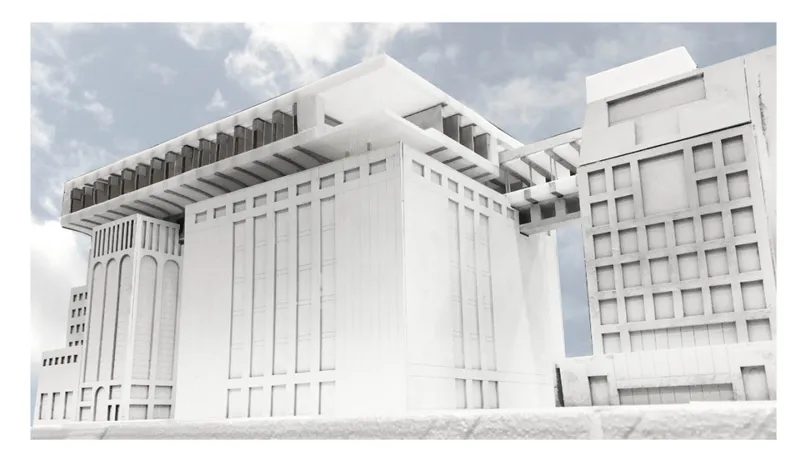
The physical model reveals the project's formal language: a clean white facade composed of vertical panels, capped by an overhanging pergola structure that filters light into the spaces below. It reads as a deliberate counterpoint to the heavy masonry and red sandstone of Johnson's Bobst Library. The vertical articulation gives the facade rhythm without ornament, a move that nods to Bauhaus restraint while asserting a contemporary material sensibility. The pergola, open to the sky, suggests that the roof itself is a usable landscape rather than a sealed envelope.
Bridges as Programme, Not Just Circulation
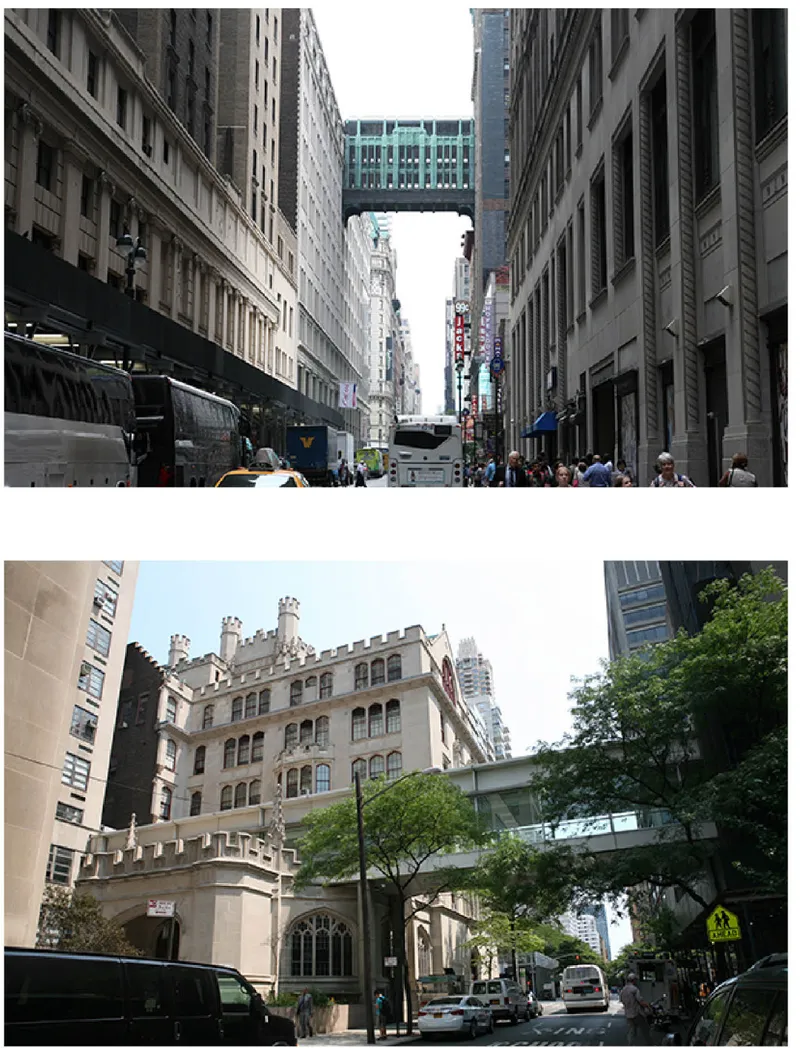
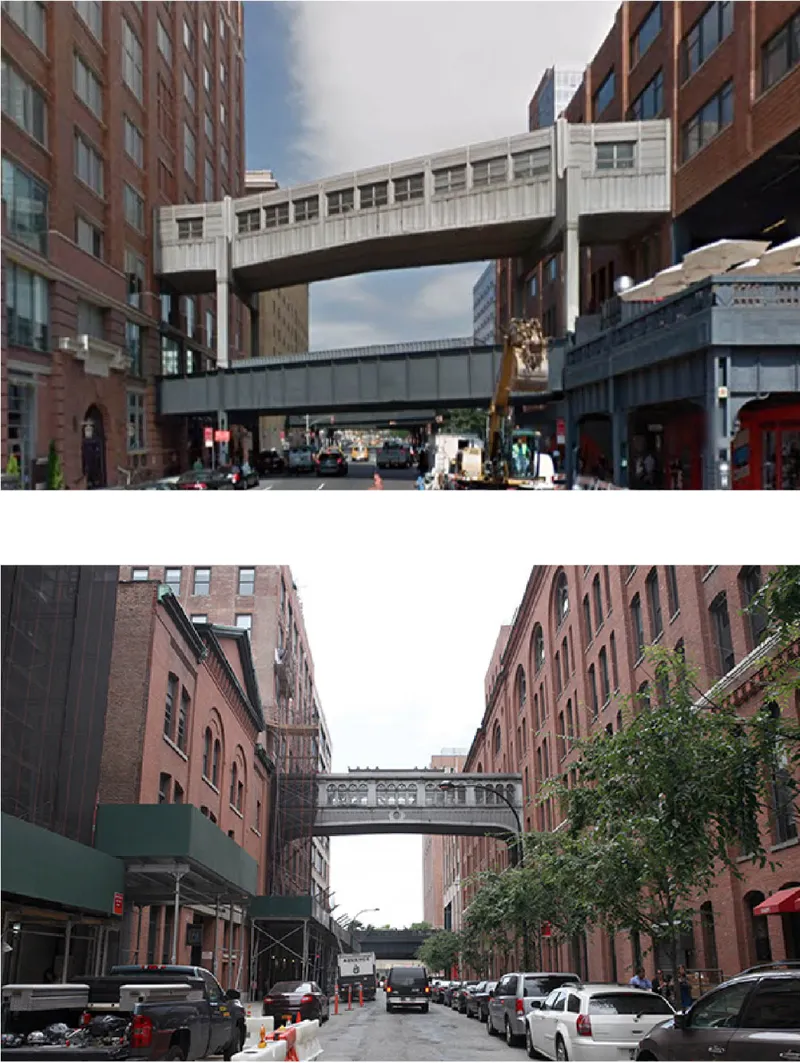
The concept hinges on skybridges that do far more than move people from point A to point B. These elevated structures span streets between existing masonry buildings, crossing above traffic and preserving the ground-level urban condition entirely. In the photographs that inform the design's visual vocabulary, we see the reality of bridge architecture in dense neighborhoods: enclosed walkways connecting brick residential buildings, their presence both assertive and oddly familiar against fire escapes and parked cars.
Rodgers reinterprets these utilitarian precedents as collaborative zones. The skybridges are designed to function as shared environments where open-studio work, spontaneous critique, and social interaction happen in transit. The bridge is no longer a corridor; it is a room with a view of Washington Square Park.
Learning from the Existing Urban Fabric
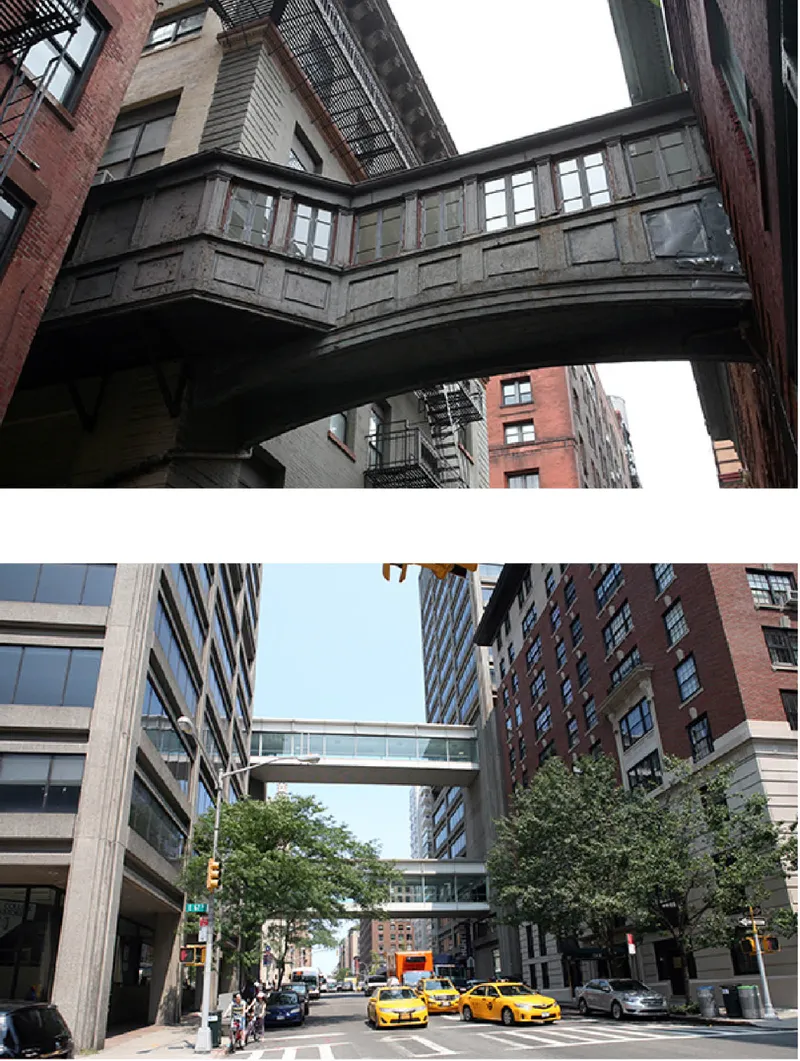
One image in particular grounds the project in its site reality: a weathered enclosed pedestrian bridge with paneled walls spanning between brick buildings. It is a reminder that this kind of elevated connectivity already exists in New York, often in unglamorous, purely functional form. The project's ambition is to elevate this typology, literally and figuratively, into something that serves design education. By building above rather than beside existing structures, the scheme preserves the historical integrity of the Bobst Library and the surrounding streetscape while adding density where it is least disruptive.
Section Logic and Vertical Circulation
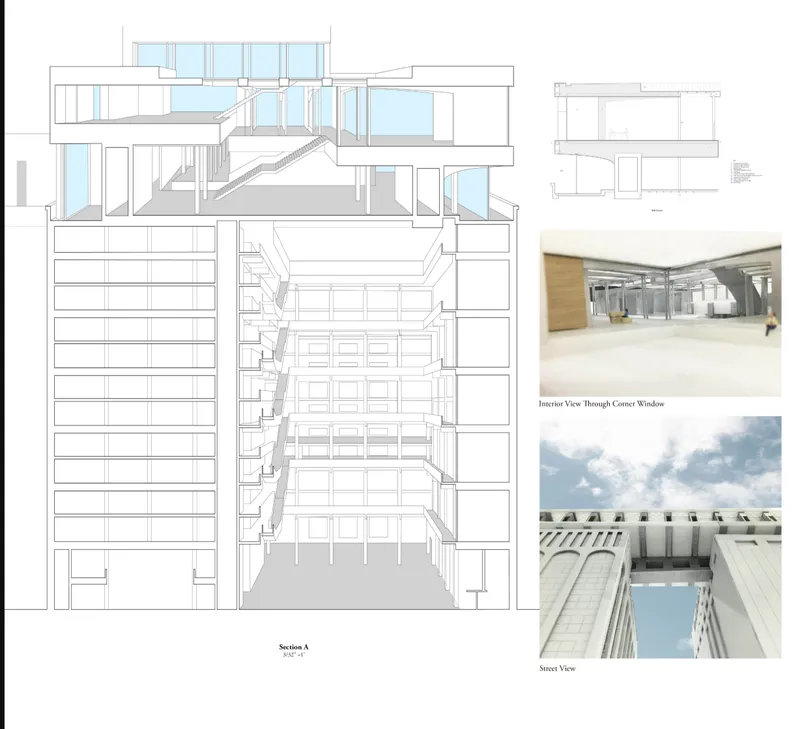
The section drawing lays bare the project's structural ambition. Vertical circulation cores anchor the elevated volumes to the buildings below, while bridge connections at multiple levels knit the campus together. Interior perspectives embedded in the section show the spatial variety on offer: double-height studio spaces, fabrication labs equipped for CNC machining, laser cutting, and 3D printing, alongside public gallery rooms and reading areas. The section also makes clear that street-level activity remains untouched, with vehicles and pedestrians moving freely beneath the new campus layer.
Massing as Campus Strategy
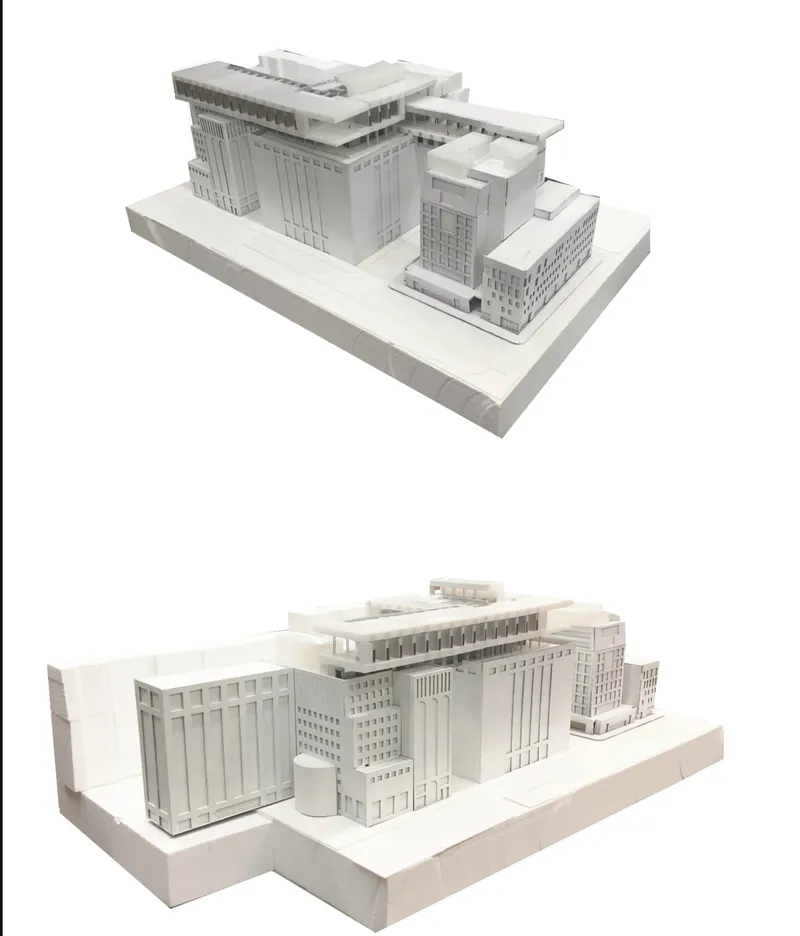
A second physical model pulls back to show the full massing of the interconnected campus. Multiple volumes with consistent vertical facade articulation are linked by the bridge network, creating a legible architectural ensemble above the existing roofline. What stands out is the project's refusal to be a singular icon. Instead, the massing reads as a distributed system, a campus in the truest sense, where the connections between buildings matter as much as the buildings themselves. Networking hubs and public engagement spaces are distributed across this system so that no single node monopolizes activity.
Why This Project Matters
Schools of architecture tend to occupy repurposed warehouses or purpose-built boxes at the edge of campus. Rodgers rejects both conventions by placing the school at the geographic and symbolic center of NYU, suspended in the air above one of the university's most significant buildings. The decision to build up rather than out is not merely pragmatic; it is a statement about how design education should sit within the life of a city, visible, connected, and impossible to ignore.
The project also offers a useful provocation about adaptive reuse at an urban scale. Rather than retrofitting a single building, the proposal treats an entire cluster of existing structures as a foundation for new programme. The skybridges become the architecture's defining gesture: spaces where disciplines collide, where architecture meets urban planning meets landscape design, all framed by views of Washington Square Park. It is a compelling model for how universities in constrained urban sites might grow without consuming more ground.
View the Full Project
About the Designers
Designer: Tyler Rodgers
Enter a Design Competition on uni.xyz
uni.xyz runs architecture and design competitions year-round that reward proposals with spatial conviction and real site intelligence.
Project credits: The Bauhaus Elevated by Tyler Rodgers Bauhaus Neue (uni.xyz).


Popular Articles
Popular articles from the community


Manzana Morphosis: Stretching Barcelona's Grid into a Living Landscape for 2050
A radical reworking of the Eixample manzana turns density into a tool for generous public space, vertical ecology, and environmental performance.


Cube Design Draws an Ecological Corridor Between Two Shenzhen Hills with the Nankai Building
Beside Shenzhen's container docks, the Nankai Building pairs stacked balconies with a climbing green screen to connect two hillsides across its height.

The Amber Palace Opera: A Geological Fiction Surfaces on Tallinn's Baltic Waterfront
Pierre Brillard reimagines a Baltic legend as a public landscape, opera house, and waterfront promenade rooted in Tallinn's coastal identity.

graciastudio Turns a Viewless Tijuana Lot Inward Around a Courtyard of Concrete, Timber and Trees
In Tijuana, Jorge Gracia's GA2 House stacks a timber-clad private floor over exposed concrete and replaces a missing view with a planted interior patio.

Similar Reads
You might also enjoy these articles

Vereda Arquitetos Renovates a 40-Square-Meter Apartment Inside Niemeyer's Copan Building
A compact unit in São Paulo's most iconic residential tower gets a material overhaul that pairs exposed concrete with bold blue Formica.

Shakur's House: Exposed Brick as an Interior Organiser in a 168 m² Mashhad Residence
Brick moves indoors in this Mashhad residence, where masonry walls, glass partitions and teal planes sequence a compact home without closing it off.

Day and Night Park: A Time-Based Urban Newsstand in Beijing
A temporary urban newsstand in Beijing blending travel, light, and reading through poetic colors, compact form, and community-focused design.

Modernist Patio Renovation in El Masnou, Barcelona by Oliver Segura Arquitectura + Cebrià Arquitectura
Modernist patio renovation blending tradition and innovation with a movable pool, leveled floors, and Catalan materials in El Masnou.

Explore New Bauhaus Competitions
Discover active competitions in this discipline

Challenge to design public laboratory

Challenge to reimagine the Iron Throne

Photograph architecture without architects

Illustrate the lost glory of Angkor Wat - Render Challenge
Comments (0)
Please login or sign up to add comments
No comments yet. Be the first to comment!