

The Black Taj: Completing Shah Jahan's Cosmic Pair Across the Yamuna
A shortlisted entry reimagines the mythic Black Taj as a sacred frame of red sandstone and pointed arches opposite the white marble original.


What if the Taj Mahal was never meant to stand alone? The legend of a Black Taj, a mirror monument on the opposite bank of the Yamuna River, has persisted for centuries. Manish takes that myth seriously, proposing a structure that does not compete with the Taj Mahal but instead frames it. The act of framing turns the white marble mausoleum from a solitary object into one half of a cosmic pair, completing a narrative of love, loss, and reunion left unfinished since the 17th century.
Shortlisted in the The Black Taj competition on uni.xyz, the project draws on a quote attributed to the designer's concept: "Mum-Taj is incomplete without her Master's Soul." Positioned on the opposite bank of the Yamuna, the design establishes a visual and metaphysical dialogue between the two structures. The alignment is geographic, yes, but also deeply symbolic: light and shadow, purity and depth, the feminine and the masculine, each reflected across a river that becomes, in this reading, a threshold between the earthly and the divine.
A Turquoise Dome Anchors the Central Courtyard
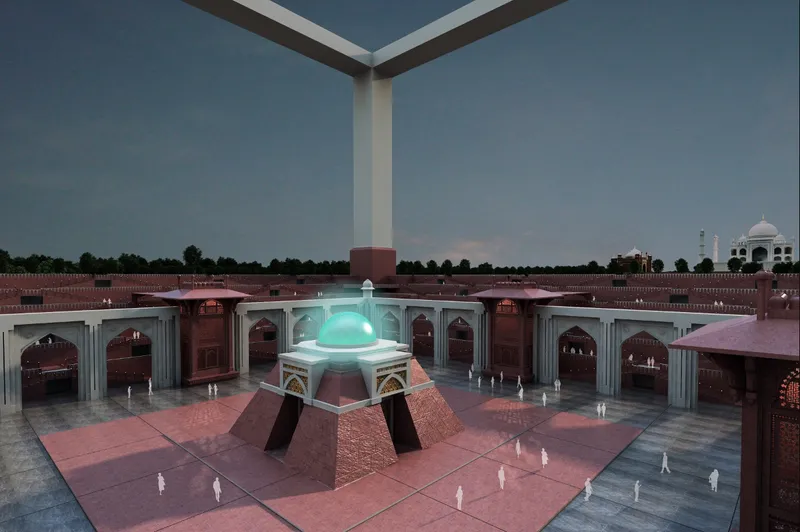
Seen from above at dusk, the central courtyard reveals the project's rigorous geometry. A hexagonal pavilion sits at the heart of the composition, crowned by a glowing turquoise dome that bathes its interior in soft illumination. The plan follows the axial symmetry characteristic of Mughal architecture: balanced courtyards, proportionate scaling, and a central tomb meant to evoke transcendence. Stairs descend rhythmically into the earth around it, echoing what the designer describes as the descent of the emperor's soul. The aerial perspective makes clear that this is not a single building but a spatial sequence, a layered procession of courtyards and voids that guide the visitor toward a symbolic center.
Pointed Arches and Carved Timber: Mughal Vocabulary Reinterpreted
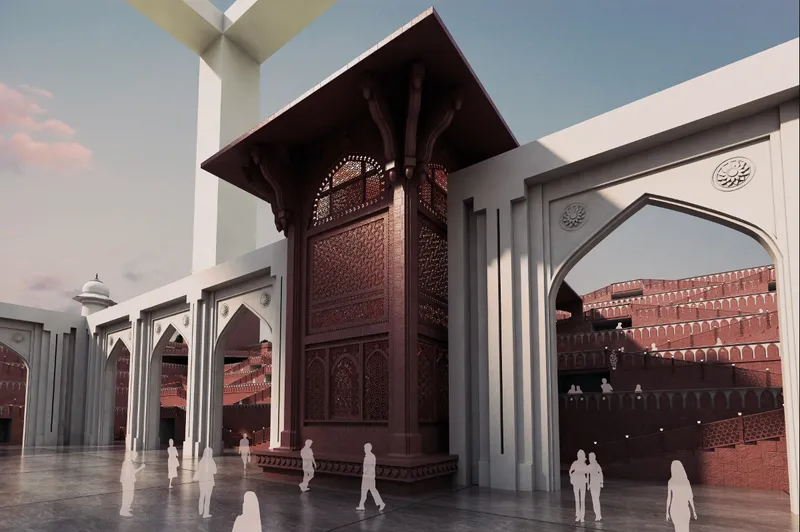
Step inside the covered colonnade, and the project's relationship with traditional Mughal vocabulary becomes tangible. Pointed arches define the rhythm of the space, framing a carved timber minbar beneath a cantilevered roof. The arches and jaali screens recall the ornamental language of Fatehpur Sikri and the Red Fort, yet their treatment here leans contemporary: cleaner lines, monumental voids, structural honesty. The cantilevered roof introduces a sense of tension that pure historical recreation would avoid. What emerges is an architecture that reads as both ancient and decisively present, rooted in tradition without being trapped by it.
The designer references Howard Hodgkin's idea about framing: "They are where the picture stops and the world begins." That sensibility is visible here. Each arch does not merely support a roof; it frames a view, directing the eye toward carved detail, filtered light, or the landscape beyond. The colonnade becomes a series of deliberate apertures through which the narrative of the monument unfolds.
Red Sandstone Walls Meet White Colonnades Along the River Edge
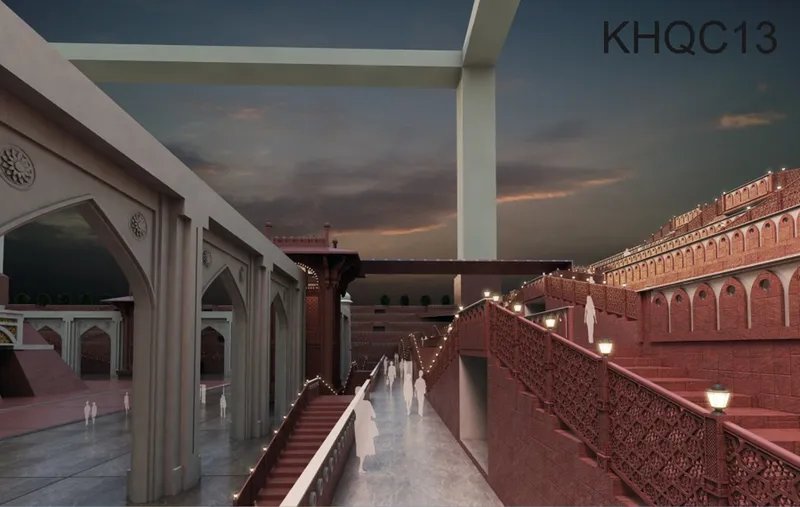
The elevated walkway captures the material duality at the core of the project. Red sandstone walls rise on one side, heavy and earthbound. White colonnades open on the other, filtering twilight into the corridor. The interplay of these two materials, red sandstone and soft white plaster, establishes a contrast that resonates with the project's thematic concerns: Shah Jahan and Mumtaz, black and white, earth and heaven. These elevated corridors open toward the river, connecting the sacred interior of the monument to the landscape and, by extension, to the Taj Mahal on the far bank.
The walkway also reveals the project's sectional ambition. Rather than sitting flat on the ground, the architecture steps up and down, creating elevated promenades and sunken courts that shape the visitor's experience through vertical movement. The descent into the earth and the rise toward the river are not incidental; they are the spatial language through which the project narrates reunion and transcendence.
Why This Project Matters
The Black Taj legend is one of architecture's most persistent myths, and most responses to it risk either pastiche or spectacle. What makes Manish's entry compelling is its restraint. The project does not try to out-dazzle the Taj Mahal. It frames it. By positioning the new structure as a complement rather than a competitor, the design transforms absence into presence and gives architectural form to a story of incompleteness. The Mughal vocabulary of arches, jaalis, and axial symmetry is handled with enough contemporary confidence to feel like interpretation rather than imitation.
At a moment when heritage discourse often gets stuck between preservation and spectacle, this shortlisted entry offers a third path: architectural imagination rooted in historical empathy. The Black Taj proposed here is not a monument to ego but a monument to dialogue, a place where geometry, shadow, and devotion converge to complete a love story four centuries in the making.
View the Full Project
About the Designers
Designer: Manish
Enter a Design Competition on uni.xyz
uni.xyz runs architecture and design competitions year-round that reward proposals with spatial conviction and real site intelligence.
Project credits: The Black Taj – KHQC13 by Manish The Black Taj (uni.xyz).




Popular Articles
Popular articles from the community


Play: Fragments of Their World
Familiar architecture becomes modular playground design, creating safe spaces where displaced children can learn, connect, imagine and play.

Co-life: Sustainable Architecture for Age-Friendly Community Living
Co-life reimagines sustainable architecture for seniors through courtyards, rammed earth, shared gardens, and spaces designed for belonging.

Co-Life: Senior Housing Design That Reconnects Older Adults With the City
Co-Life reimagines senior housing design through healing gardens, shared streets, workshops, and a sustainable community across generations.

The Ocean Hive: Sustainable Architecture for a Self-Sufficient Civilization at Sea
The Ocean Hive imagines sustainable architecture at sea, where modular habitats, algae, wave power and ocean waste sustain a growing colony.


Similar Reads
You might also enjoy these articles

Lunar Spiral: Space Architecture Shaped by the Mathematics of the Universe
Lunar Spiral reimagines space architecture through Fibonacci geometry, lunar regolith, levitating habitats, and self-sustaining Moon living.
The Main Dream: Modular Architecture for Play, Learning, and Community
A modular playground turns recycled plastic into adaptable spaces where refugee children can play, build, learn, and reconnect.
Play: Fragments of Their World
Familiar architecture becomes modular playground design, creating safe spaces where displaced children can learn, connect, imagine and play.

Wadi Rum Observatory: Desert Architecture Designed for the Night Sky
Wadi Rum Observatory turns desert architecture into a quiet instrument for astronomy, hiding research spaces under Jordan's starlit terrain.


Explore The Black Taj Competitions
Discover active competitions in this discipline



Challenge to reimagine the Iron Throne


Photograph architecture without architects


Illustrate the lost glory of Angkor Wat - Render Challenge


Design challenge to reuse E-waste
Comments (0)
Please login or sign up to add comments
No comments yet. Be the first to comment!