
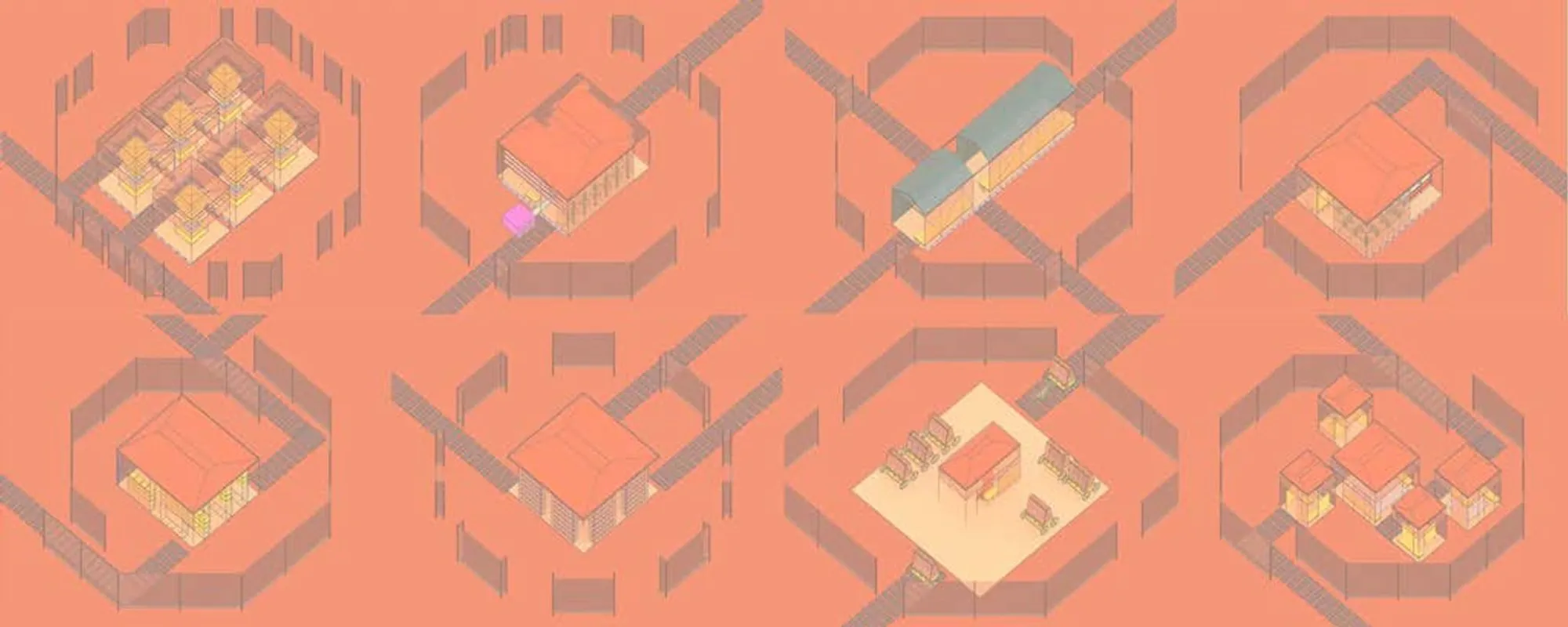
Lal Dera: Water Pavilions That Revive Mughal Hydraulic Wisdom in Agra
A shortlisted Black Taj entry reimagines the Charbagh as a modular water treatment landscape of perforated steel, wetland flora, and public gathering.


What if the most advanced water infrastructure we could build already existed five centuries ago? Along the banks of the Yamuna in Agra, where Mughal engineers once designed intricate hydraulic networks of channels, tanks, and stepwells to sustain imperial gardens and cities, a new proposal asks us to look backward in order to move forward. Lal Dera: Ek Pani Ki Katha, which translates to "A Tale of Water," replaces the monumental gesture with a system of modular water treatment pavilions that filter, aerate, store, and teach. The architecture is lightweight and transportable, yet its ambition is enormous: to restore the ecological consciousness already embedded in historic Mughal design and make it publicly legible.
Designed by Kruti and Sebastian, this shortlisted entry in The Black Taj competition takes its name from the Mughal "Lal Dera," the red pavilion that historically served as the center stage of royal courts. Here that pavilion is recast as a regenerative landscape: part water treatment plant, part public commons, part living ecology lab. The project's title is a statement of intent: architecture as narrative, infrastructure as cultural continuity.
A Reinterpreted Charbagh Organized Around Water's Journey
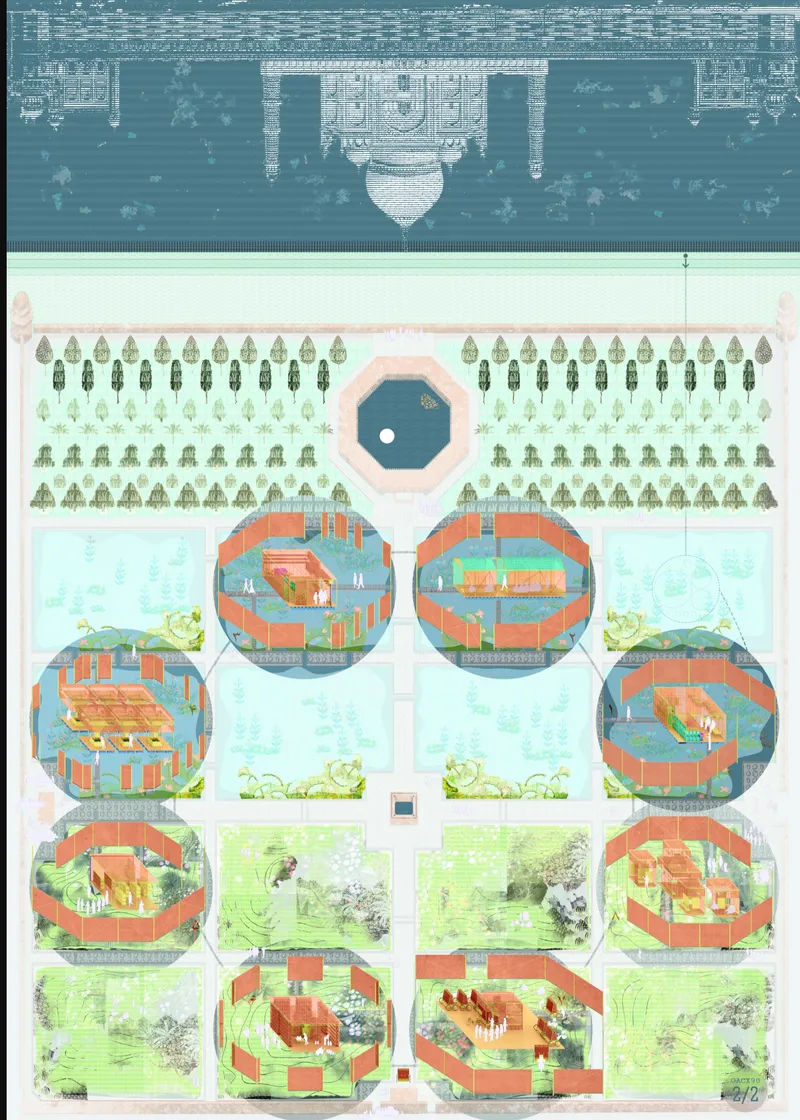
The site plan reveals how thoroughly the Mughal Charbagh geometry has been absorbed and reworked. Circular pavilions sit in a disciplined grid around a central octagonal pool, their positions dictated not by arbitrary formalism but by the sequential stages of water purification. Eight interconnected zones host distinct pavilions: an Absorption Pavilion for natural filtration, Primary and Secondary Treatment Pavilions where layers of clay, gravel, and vegetation clean and oxygenate the flow, a Storage Pavilion for processed water reuse, a Participation Pavilion for workshops and public engagement, and a Testing Pavilion where data collection meets physical design. The tree-lined plaza between them reads as both civic space and ecological buffer.
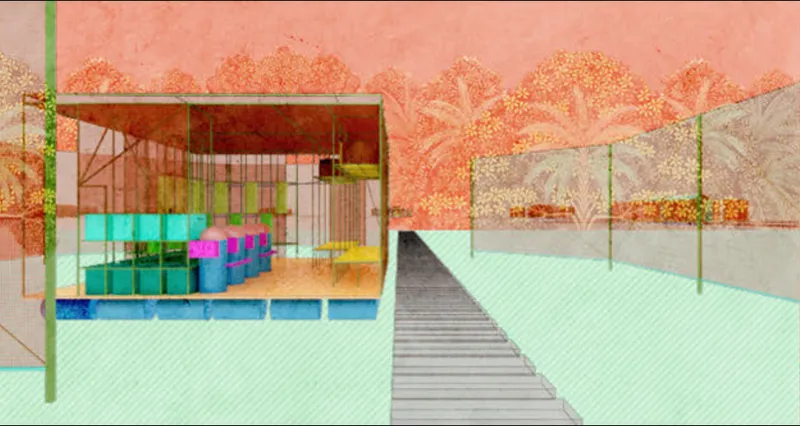
The rendered perspective confirms that the pavilions are not sealed objects but open, glass-walled structures connected by wooden boardwalks that thread through planted landscape. The flat roofs sit low, avoiding any competition with the Taj Mahal's silhouette on the horizon. Instead of monumental permanence, everything is calibrated toward porosity: views pass through, air circulates, and the water itself remains visible at every stage of its transformation.
Modular Pavilions Between Craft and Computation
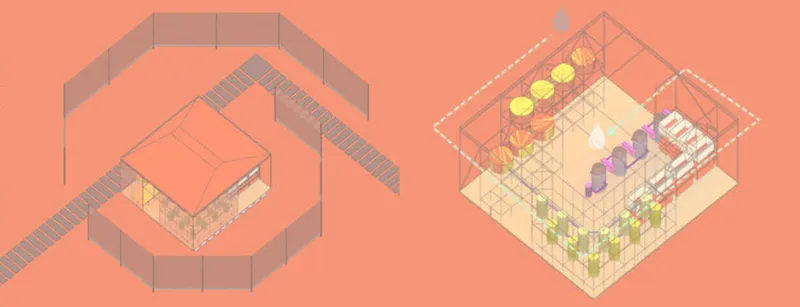
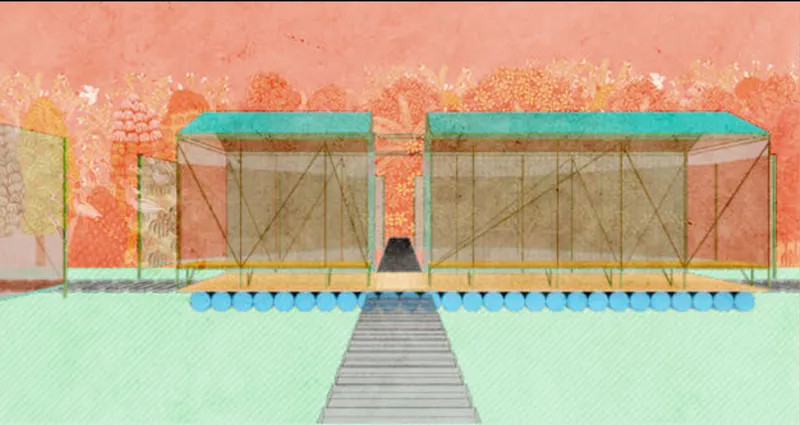
The axonometric drawings dissect the pavilion typology with precision. One structure shows enclosed walls housing the water treatment equipment; its neighbor peels back to reveal interior furnishings oriented toward education and public use. The twin pavilions in elevation float on blue cylindrical supports beneath turquoise roofs, their glass walls making the interior process entirely transparent to passersby. The material palette speaks directly to the Mughal dialogue the designers are after: perforated steel, woven screens, and terracotta tones create a vocabulary that sits between handcraft and computational pattern-making.
The raised condition is strategic. Elevating the pavilions above the landscape accommodates seasonal flooding from the Yamuna, protects the treatment systems, and creates shaded ground-level space where wetland flora can do its infrastructural work. Species like Typha Latifolia, Acorus Calamus, and Papyrus are planted not as ornament but as active participants in pollutant filtration and biodiversity restoration, turning the ground plane into a living laboratory.
Barrel Vaults and Yellow Glass: An Architecture of Transparency
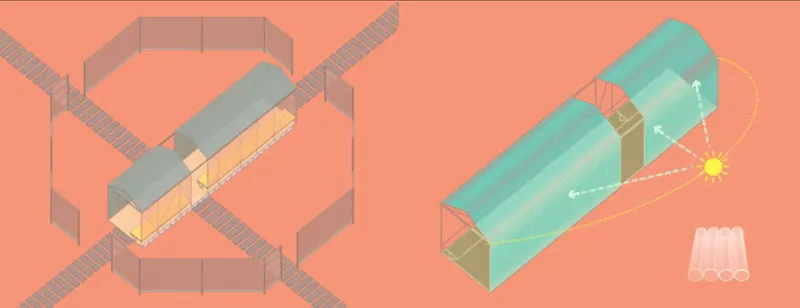
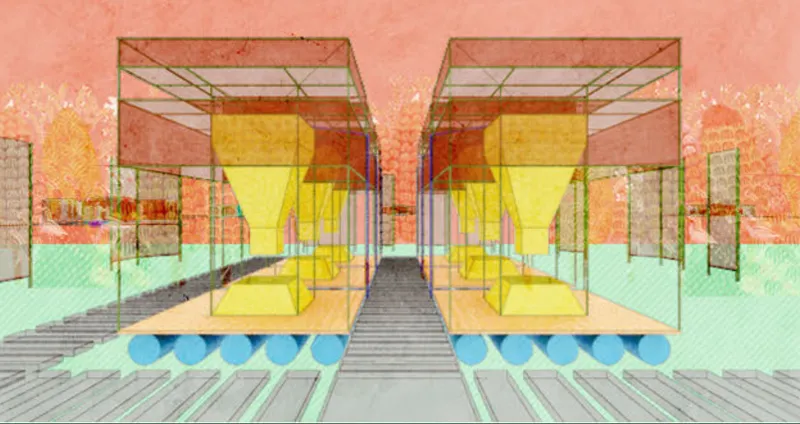
A second pavilion type introduces barrel-vaulted roofs over translucent enclosures, their linear volumes stretched along the water channel. The axonometric view exposes the structural logic: lightweight, repetitive, and fundamentally modular, these units could be transported, reconfigured, or multiplied as the system grows. The perspective rendering through paired pavilions with yellow glass volumes flanking a central boardwalk over water is the project's most evocative image. Walking through this corridor, a visitor would be surrounded by the filtered glow of treated water on both sides, the process made sensory rather than abstract.
The yellow glass is a deliberate chromatic choice that recalls the warm stone and gilt detailing of Mughal architecture while signaling something unmistakably contemporary. It transforms sunlight into a material presence within the pavilion, shifting the experience from utilitarian infrastructure to contemplative public space. The boardwalk, suspended over water, reinforces the project's central argument: that proximity to ecological process generates civic awareness.
Red Screens and the Public Threshold
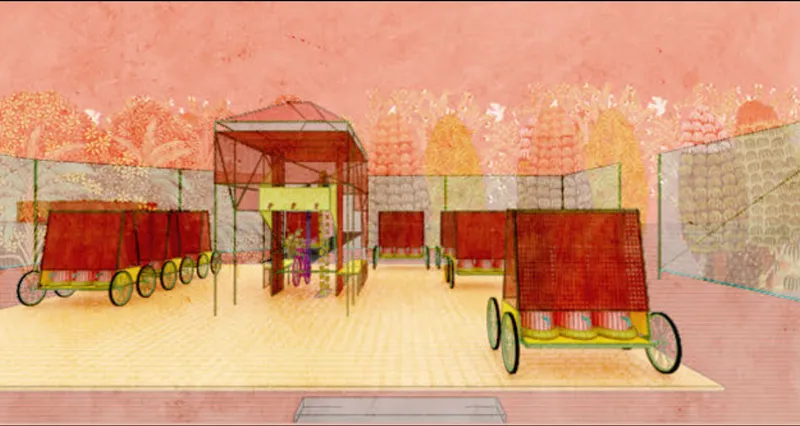
The entry pavilion anchors the public face of the project. A canopy extends over a paved plaza where red woven screens filter light and frame views into the treatment landscape beyond. Yellow bicycles parked on the plaza signal the intended accessibility: this is infrastructure designed to be arrived at casually, by local residents and visitors alike, not gated behind institutional barriers. The red screens are a direct reference to the Lal Dera itself, the red pavilion reimagined as a threshold between city and water, between contemporary life and inherited ecological knowledge.
Why This Project Matters
Lal Dera refuses the false choice between heritage conservation and environmental action. By grounding its water treatment program in the spatial logic of the Charbagh and the material traditions of Mughal craft, Kruti and Sebastian demonstrate that sustainability is not a rupture from history but a continuation of it. The proposal's insistence on modularity, transportability, and public participation pushes against the tendency to treat infrastructure as invisible and permanent, arguing instead for systems that are legible, adaptable, and communal.
In a competition that asks designers to complete an unfinished memory on the banks of the Yamuna, this entry shifts the question entirely. Rather than speculating on what was never built, it proposes what urgently needs to be built now: architecture that treats water not as a backdrop for monuments but as a living system deserving its own pavilion, its own public, its own story.
View the Full Project
About the Designers
Enter a Design Competition on uni.xyz
uni.xyz runs architecture and design competitions year-round that reward proposals with spatial conviction and real site intelligence.
Project credits: the black Taj , Lal Dera: Ek Pani Ki Katha by Kruti, Sebastian The Black Taj (uni.xyz).




Popular Articles
Popular articles from the community


The Earth Pod: 3D Printed Homes for Resilient Refugee Communities
The Earth Pod reimagines refugee housing through 3D printed homes made from clay, combining resilience, self-sufficiency, and rapid shelter.

Riyadh For All: Intergenerational Urban Design for Active Aging in Rabat
Riyadh For All reimagines urban design in Rabat with intergenerational co-living, adaptive courtyards, and Moroccan cultural exchange today.

The Musturak Paradise: Senior Living Architecture for a Connected Future in Temara, Morocco
The Musturak Paradise reimagines senior living architecture in Temara via private homes, social spaces, culture, community, and shared care.

Play: Fragments of Their World
Familiar architecture becomes modular playground design, creating safe spaces where displaced children can learn, connect, imagine and play.

Similar Reads
You might also enjoy these articles

Lunar Spiral: Space Architecture Shaped by the Mathematics of the Universe
Lunar Spiral reimagines space architecture through Fibonacci geometry, lunar regolith, levitating habitats, and self-sustaining Moon living.
The Main Dream: Modular Architecture for Play, Learning, and Community
A modular playground turns recycled plastic into adaptable spaces where refugee children can play, build, learn, and reconnect.
Play: Fragments of Their World
Familiar architecture becomes modular playground design, creating safe spaces where displaced children can learn, connect, imagine and play.

Wadi Rum Observatory: Desert Architecture Designed for the Night Sky
Wadi Rum Observatory turns desert architecture into a quiet instrument for astronomy, hiding research spaces under Jordan's starlit terrain.


Explore The Black Taj Competitions
Discover active competitions in this discipline



Challenge to reimagine the Iron Throne


Photograph architecture without architects


Illustrate the lost glory of Angkor Wat - Render Challenge


Bring back Drive In's
Comments (0)
Please login or sign up to add comments
No comments yet. Be the first to comment!