
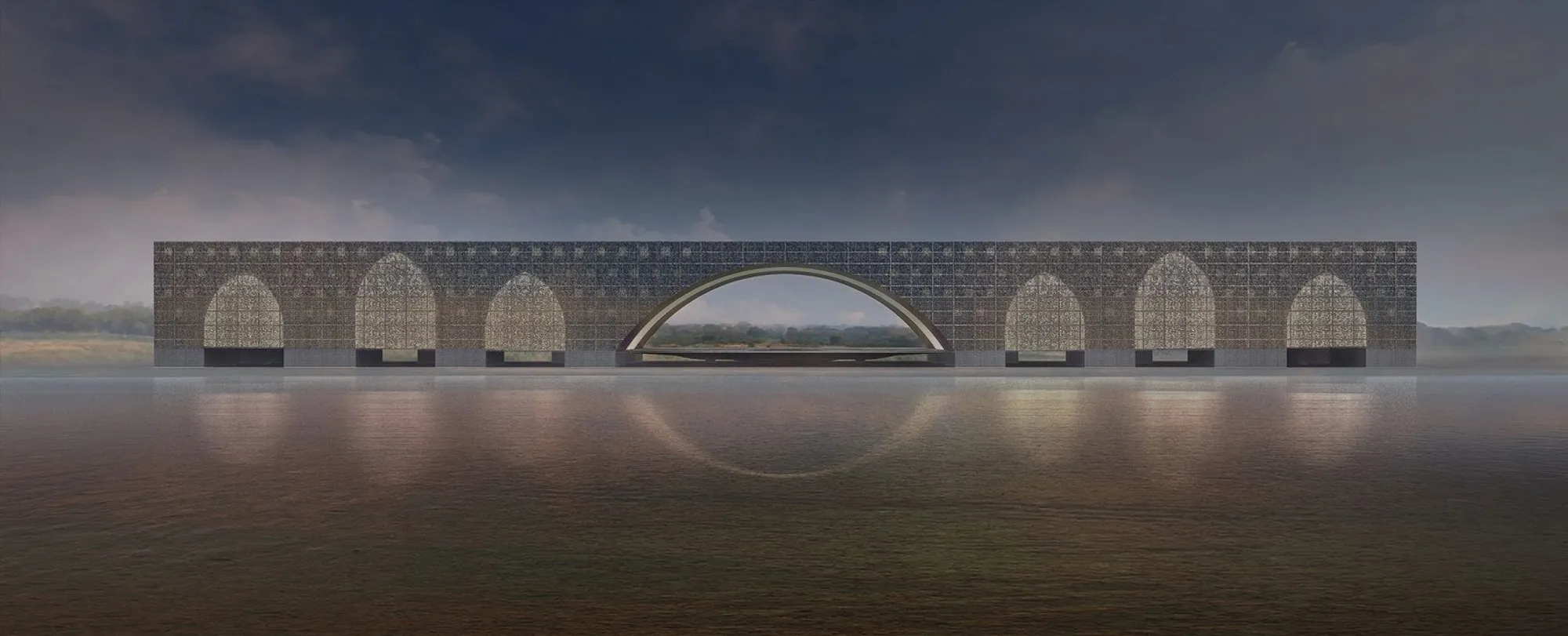
Mirage Gate: A Porous Monument to the Legend of the Black Taj
A massive gabion archway on the Yamuna River reinterprets Mughal symmetry through earth masonry, water purification, and phenomenal light.


Shah Jahan's rumored Black Taj Mahal has persisted as one of architecture's most seductive ghost stories: a dark twin mausoleum, never built, forever imagined on the opposite bank of the Yamuna. Mirage Gate takes that absence seriously. Rather than reconstructing the myth as a literal mirror, the project proposes a colossal arched gateway of earth masonry that filters light, wind, and river water through its porous walls. The result is architecture that behaves like a mirage itself, shifting with time and atmospheric condition, never resolving into a single fixed image.
Designed by Ikeda, Takayuki Kanno, Tetsukawa, and Mikiko Yamane, Mirage Gate was shortlisted in The Black Taj competition on uni.xyz. Sited across the Yamuna from the Taj Mahal, the project aligns itself on the Taj's central axis, establishing a direct visual and symbolic dialogue with the monument it honors. The proposal functions simultaneously as museum, public space, and water purification landscape, weaving ecological infrastructure into an immersive cultural narrative about love, loss, and the passing of time.
A Gateway That Breathes with the Landscape
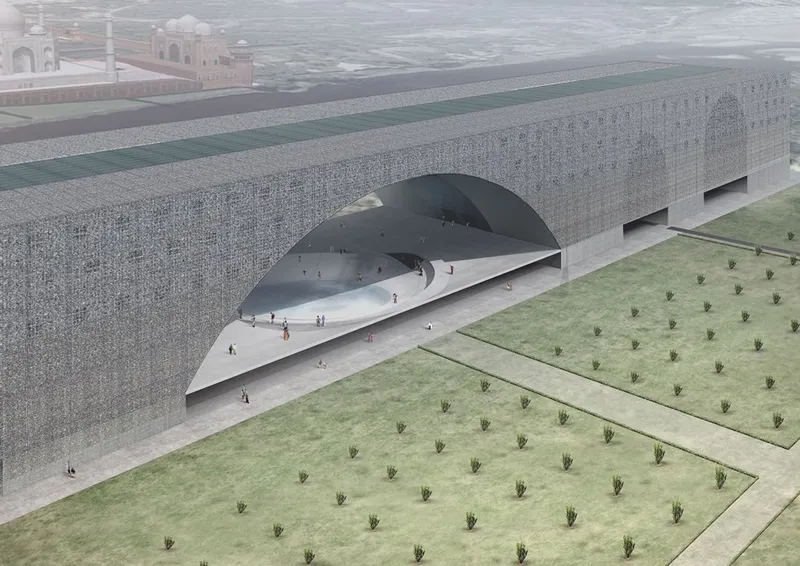
Seen from above, Mirage Gate reads as a monolithic wall pierced by a single massive arch, its scale calibrated to frame the Taj Mahal on the far riverbank. The facade's gabion-like texture is not decorative; each modular block acts as both structural brick and environmental filter, allowing light and wind to pass through. The planted lawn surrounding the structure softens the transition between monument and terrain, while visitors visible in the aerial view offer a sense of the archway's enormous proportions. The geometry echoes Mughal symmetry, but the rough, porous materiality pushes the language somewhere entirely new.
What makes the approach compelling is its refusal to compete with the Taj's polished marble perfection. Where the Taj is smooth, reflective, and white, Mirage Gate is textured, absorptive, and earthen. The contrast is the point. The project positions itself as the Taj's shadow, not its copy, and the resulting tension between permanence and permeability gives the structure a restless, alive quality that marble alone could never achieve.
Light Filtered Through Stone: The Entry Passage
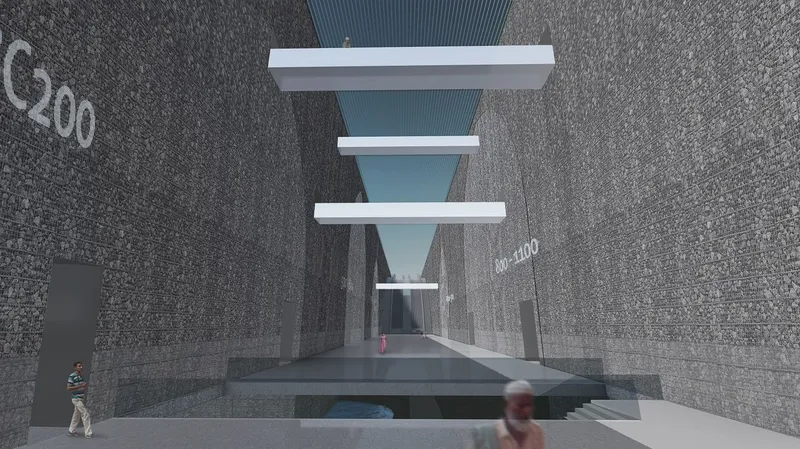
The interior of the passage reveals how the modular earth masonry system performs at close range. Suspended horizontal skylights slice light into controlled bands that play across the rough stone walls, creating a choreography of shadow that shifts throughout the day. The spatial sequence draws from Mughal architectural tradition: a deliberate movement from light to shadow, solid to void, designed to evoke a spiritual transition. Here, that journey begins with compression. The walls press inward, the ceiling hovers, and the filtered daylight gives the space a hushed, almost subaqueous quality.
The designers describe their approach as "phenomenal architecture," spaces that never remain static but transform with time and atmospheric condition. In Agra, where morning mist and afternoon heat constantly alter the perception of the Taj, the interior of Mirage Gate captures that same instability. Visitors moving through the passage experience the structure as a threshold between memory and imagination, a place where the tangible meets the intangible.
Depth and Porosity Along the Yamuna
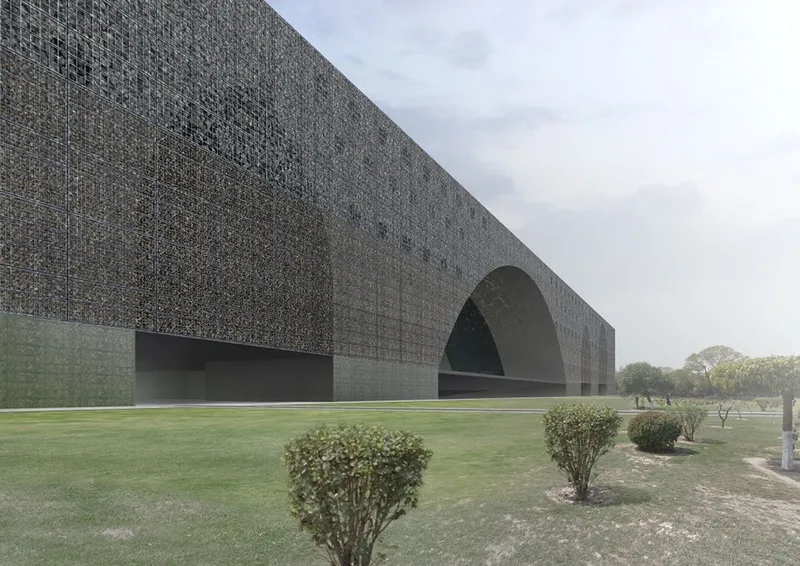
The long elevation view exposes the full depth of the perforated facade and the scale of the arched entry. From this angle, the structure appears almost geological, a cliff face eroded by wind and water into a cavernous opening. Scattered shrubs in the foreground ground the composition in Agra's dry, semi-arid landscape, while the layered depth of the masonry wall reveals corridors and voids within the structure itself. The project operates on the principle that repetition is not monotony but memory: every brick, every shadow cast upon the water, records the passage of time.
The earth-based material palette carries both ecological and symbolic weight. By using locally sourced, sustainable masonry, the designers tie the monument to its site physically and spiritually, echoing the Mughal tradition of drawing building materials from the immediate geography. The modular system also serves a functional purpose, enabling the structure to participate in natural water filtration, a quiet but critical piece of the project's environmental strategy for revitalizing the Yamuna's degraded ecology.
Reflective Pools and the Interior Water Courtyard
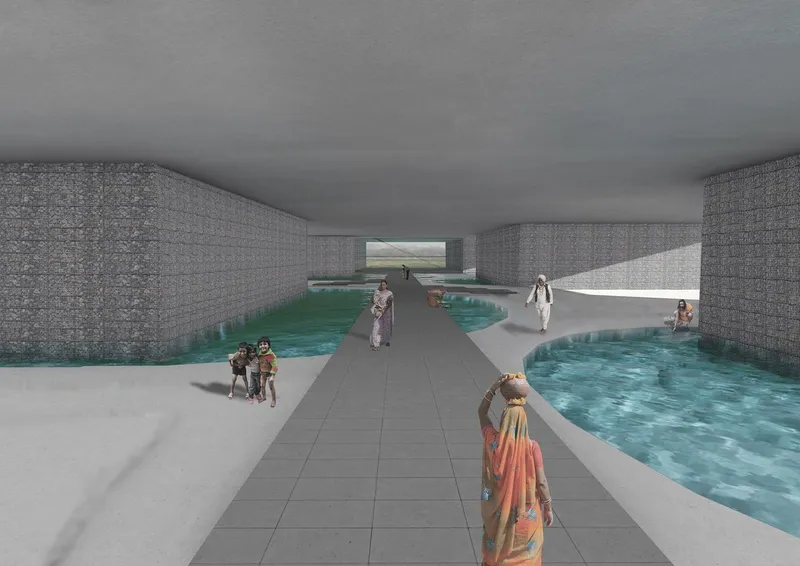
Beneath the archway, shallow pools flank a central walkway in what the designers describe as a water courtyard. The pools serve a dual function: they create reflective surfaces that frame the Taj Mahal in the distance, and they form part of the natural water purification system that draws river water through filtration landscapes before returning it to the Yamuna. Visitors walk between these still planes of water, their movement mirrored below, in an experience that collapses the distinction between architecture and landscape. The Mughal garden tradition of harmonizing utility with aesthetics finds a contemporary expression here.
The tactile presence of flowing water throughout the lower corridors gives the interior spaces a sensory richness that goes beyond the visual. Sound, temperature, and humidity all shift as visitors move deeper into the structure, reinforcing the project's central ambition: to make the environment itself an active participant in storytelling. Upper decks offer panoramic views of the Taj, completing a spatial sequence that moves from enclosed meditation to open revelation.
Why This Project Matters
Mirage Gate succeeds because it resists the obvious temptation. Faced with one of architecture's most famous myths, a dark mirror of the world's most celebrated monument, the designers chose not to build a twin but to build a threshold. The project understands that the Black Taj's power lies in its absence, and the architecture responds with porosity, impermanence, and atmospheric instability. It is a building that exists to make visitors aware of what is missing, and that paradox of presence and absence gives the work genuine conceptual depth.
Equally important is the project's environmental ambition. By integrating water purification infrastructure into the monumental program, the team positions cultural preservation and ecological restoration as inseparable goals. The Yamuna River, degraded and neglected, becomes a site of renewal rather than decay. In a competition field crowded with symbolic gestures, Mirage Gate stands out for grounding its myth in material, hydrology, and landscape, treating the legend of the Black Taj not as a spectacle to be recreated but as a story the site itself can tell.
View the Full Project
About the Designers
Designers: Ikeda, Takayuki Kann, Tetsukawa, Mikiko Yamane
Enter a Design Competition on uni.xyz
uni.xyz runs architecture and design competitions year-round that reward proposals with spatial conviction and real site intelligence.
Project credits: The Black Taj - Mirage Gate - EAYE23 by Ikeda, Takayuki Kann, Tetsukawa, Mikiko Yamane The Black Taj (uni.xyz).




Popular Articles
Popular articles from the community


The Ocean Hive: Sustainable Architecture for a Self-Sufficient Civilization at Sea
The Ocean Hive imagines sustainable architecture at sea, where modular habitats, algae, wave power and ocean waste sustain a growing colony.

Riyadh For All: Intergenerational Urban Design for Active Aging in Rabat
Riyadh For All reimagines urban design in Rabat with intergenerational co-living, adaptive courtyards, and Moroccan cultural exchange today.

Play: Fragments of Their World
Familiar architecture becomes modular playground design, creating safe spaces where displaced children can learn, connect, imagine and play.

The Earth Pod: 3D Printed Homes for Resilient Refugee Communities
The Earth Pod reimagines refugee housing through 3D printed homes made from clay, combining resilience, self-sufficiency, and rapid shelter.


Similar Reads
You might also enjoy these articles

Lunar Spiral: Space Architecture Shaped by the Mathematics of the Universe
Lunar Spiral reimagines space architecture through Fibonacci geometry, lunar regolith, levitating habitats, and self-sustaining Moon living.
The Main Dream: Modular Architecture for Play, Learning, and Community
A modular playground turns recycled plastic into adaptable spaces where refugee children can play, build, learn, and reconnect.
Play: Fragments of Their World
Familiar architecture becomes modular playground design, creating safe spaces where displaced children can learn, connect, imagine and play.

Wadi Rum Observatory: Desert Architecture Designed for the Night Sky
Wadi Rum Observatory turns desert architecture into a quiet instrument for astronomy, hiding research spaces under Jordan's starlit terrain.

Explore The Black Taj Competitions
Discover active competitions in this discipline



Challenge to reimagine the Iron Throne


Photograph architecture without architects


Illustrate the lost glory of Angkor Wat - Render Challenge


Bring back Drive In's
Comments (0)
Please login or sign up to add comments
No comments yet. Be the first to comment!