

The Moonlight Garden: Rebuilding the Black Taj as Pure Perception
Ornruja Boonyasit reimagines Shah Jahan's mythic counterpart to the Taj Mahal as a choreography of light, water, and spatial silence.


What if the Black Taj Mahal was never meant to be built in stone at all? Across the Yamuna River from the world's most celebrated tomb, the Moonlight Garden has long occupied a strange liminal space between historical site and architectural myth. Ornruja Boonyasit seizes on that ambiguity and turns it inside out, proposing a structure that abandons material permanence in favor of something harder to pin down: the felt experience of moving through space shaped by light, reflection, and calibrated silence.
Shortlisted in The Black Taj competition on uni.xyz, Boonyasit's entry reframes the legend of Shah Jahan's imagined twin monument not as a dark mirror of the Taj Mahal but as something altogether different in kind. Where the Taj immortalized love through carved marble, the Moonlight Garden constructs legacy through perception itself, offering a sequence of twelve choreographed spatial encounters that guide visitors from entrance platform to a central quasi-sphere. The result is less a building and more an emotional script written in architecture.
A Map of Twelve Encounters
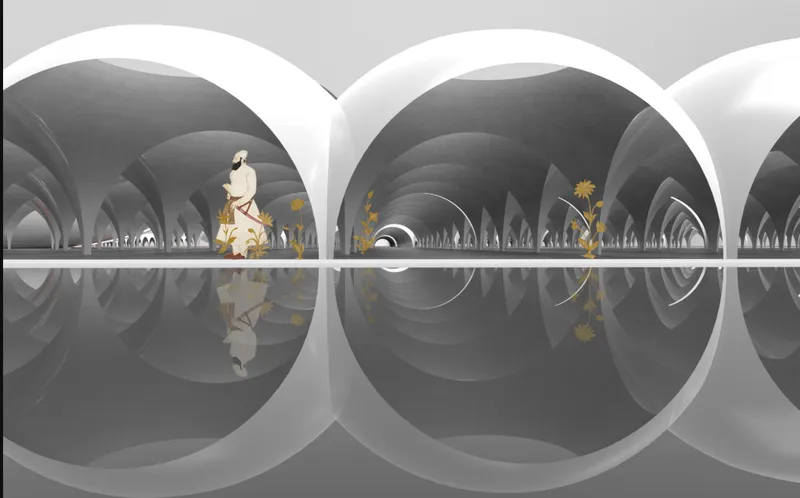

The project is organized around what Boonyasit calls a Map of Experiences: a deliberate procession through twelve spatial and sensory frames. Upon entering, visitors encounter minimal light filtering through repeating arched vaults, their polished marble surfaces mirroring both human presence and celestial glow. The rhythm is slow and deliberate. Each archway reveals another fragment of the garden's interior, as if peeling back layers of historical memory one step at a time. In the image above, the repeating vaults double themselves in a still water pool, collapsing the distance between structure and reflection, earth and sky.
The sectional perspective reveals how the sequence builds vertical complexity. Stepped platforms create moments for pause between perforated white canopy structures, suggesting that the architecture is as much about sitting and observing as it is about moving forward. Boonyasit treats the visitor's body as an instrument of the design; the building does not perform without someone inside it.
Vaulted Corridors That Breathe Like Thought
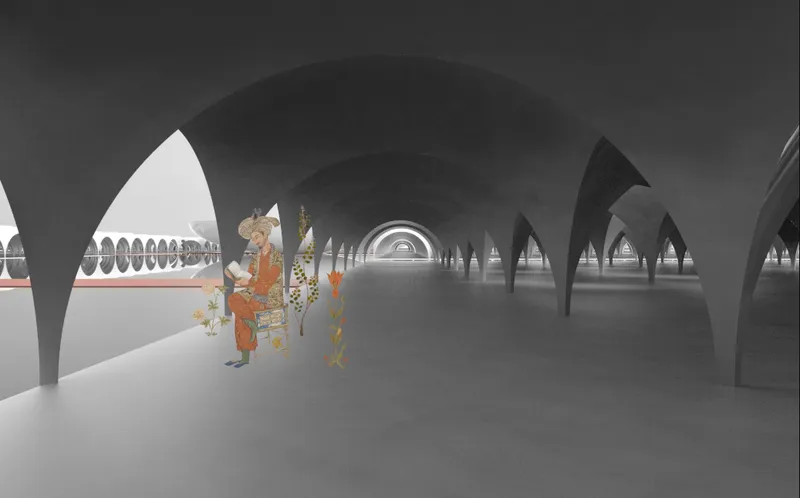

Boonyasit draws from the philosophical foundation of Mughal architecture, its harmony of proportion and spiritual illumination, but the interpretation is sharply modern. Ornate decoration is stripped away entirely, replaced by the purity of pointed arches and the play of brightness against deep shadow. The vaulted corridor shown here frames a solitary figure near an opening that gives onto courtyard views beyond, a composition that makes the passage between interior and exterior feel like a threshold between states of mind rather than simply rooms.
Across the reflecting pool, the repeating vaulted spaces take on a quality of infinite recession. Small plants punctuate the water's edge, grounding the abstraction in something living. The controlled shift in light intensity along the garden's axial pathways captures what Boonyasit describes as the ebb and flow of emotion. Shadow becomes a material in its own right: an echo of Mughal artistry expressed through minimalist abstraction.
The Long Axis: Terracotta, Water, and Directed Movement
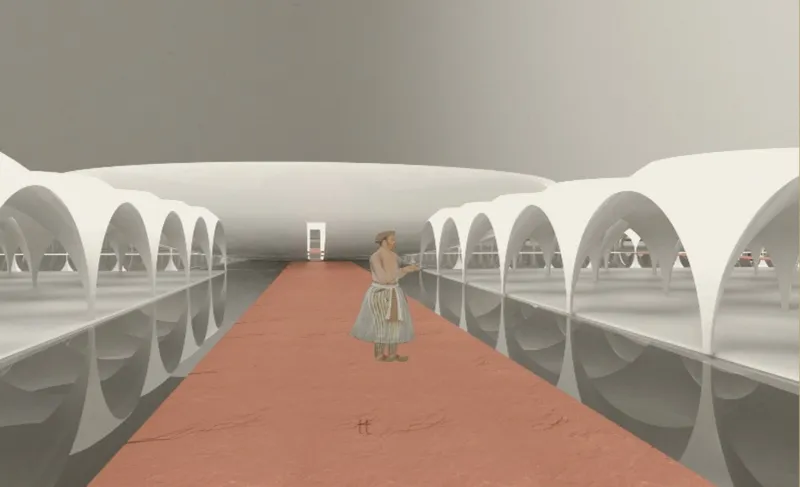
One of the project's most compelling images shows a long corridor flanked by arched openings and narrow reflecting pools, with terracotta flooring establishing a warm material counterpoint to the surrounding white surfaces. A single figure walks the axis, and the composition makes viscerally clear how the architecture works as a choreography of brightness and darkness. Light enters from both sides through the arched openings, creating a rhythmic alternation that accelerates and decelerates depending on the viewer's pace. The corridor is not a passage to somewhere; it is the experience itself.
The Quasi-Sphere: Wholeness at the Garden's Heart

At the center of the Moonlight Garden lies the quasi-sphere, a monumental form representing cosmic unity and the cyclical relationship between life and death, day and night, memory and oblivion. Boonyasit conceives it not as a static monument but as an evolving theatre of reflections. The interior image reveals pleated white surfaces connecting different levels, with two figures occupying separate landings. The effect is of being held inside a form that is simultaneously enclosing and open, its translucent shell immersing visitors in shifting patterns of light and movement.
The quasi-sphere symbolizes rebirth: the architectural embodiment of Shah Jahan's imagined other Taj, built not in marble alone but in meaning. It is the culmination of the twelve-frame sequence, the point where the Map of Experiences converges into a single, encompassing spatial event. Visitors move beneath its shell and find that the building has been preparing them, through rhythm and silence and graduated illumination, for this moment of arrival.
Why This Project Matters
The Black Taj legend is one of architecture's most seductive what-ifs, and it tends to invite responses that default to formal mirroring: dark stone opposite white, negative to positive. Boonyasit sidesteps that impulse entirely. By proposing the Moonlight Garden as a sequence of perceptual events rather than a monumental object, the project argues that architectural legacy is constructed through human experience, not material permanence. It is a monument not for one emperor but for the collective memory of a civilization that understood beauty as devotion.
What elevates the work beyond conceptual exercise is its spatial specificity. The twelve encounters are not abstract ideas; they are rendered as corridors, pools, stepped platforms, and a culminating quasi-sphere, each with clear material and luminous character. Boonyasit demonstrates that experiential architecture does not mean vague architecture. Precision in the choreography of light, proportion, and movement is what allows the Moonlight Garden to function as a meditative instrument, one that bridges the Yamuna, and the centuries, through the most ancient architectural medium of all: the human body moving through shaped space.
View the Full Project
About the Designers
Designer: Ornruja Boonyasit
Enter a Design Competition on uni.xyz
uni.xyz runs architecture and design competitions year-round that reward proposals with spatial conviction and real site intelligence.
Project credits: The Black Taj-The Moonlight Garden by Ornruja Boonyasit The Black Taj (uni.xyz).


Popular Articles
Popular articles from the community

Extended Shell: Retrofitting Kolkata's Balconies as Living Urban Thresholds
A modular retrofit system recovers the social and environmental intelligence of Kolkata's historic verandas for contemporary Park Street residents.

The Amber Palace Opera: A Geological Fiction Surfaces on Tallinn's Baltic Waterfront
Pierre Brillard reimagines a Baltic legend as a public landscape, opera house, and waterfront promenade rooted in Tallinn's coastal identity.

Singing Woman: An Opera House That Performs Before the Curtain Rises
Ovidiu Cristian Pavel's conceptual opera house translates Estonia's choral identity into a sculpted waterfront landmark facing the Baltic Sea.
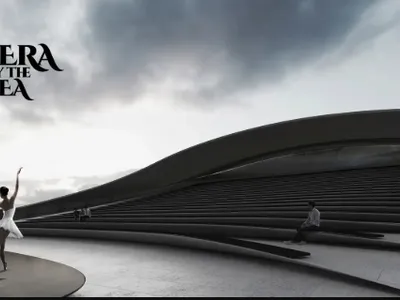
Opera by the Sea Estonia: Three Shells Dissolving Architecture into Tallinn's Coastline
A winning opera house proposal replaces monumental form with interconnected shells that blur the boundary between building, park and Baltic Sea.

Similar Reads
You might also enjoy these articles

Play: Fragments of Their World: Remembered Architecture Rebuilt as a Modular Playground for Refugee Camps
Tom Gardner abstracts domes, arches and towers from the homelands of displaced families into a kit of child-scaled play parts for camp settlements.
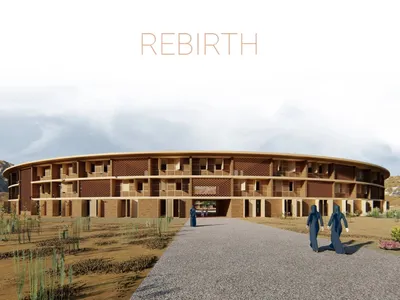
REBIRTH: A Circular Settlement Where Afghan Widows and Their Children Rebuild Life Together
A shortlisted Resile entry turns the circle into a protective ring of timber and brick, gathering homes, classrooms and gardens around a shared landscape.
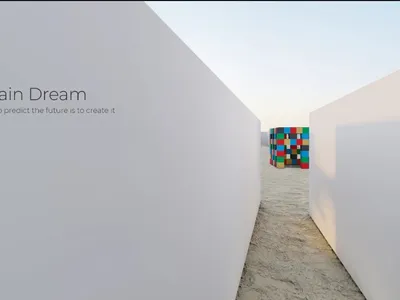
The Main Dream: A Recycled Plastic Kit That Lets Refugee Children Build Their Own Playground
Thirty-centimetre interlocking cubes that connect on three axes turn play into construction, letting children author the spaces they occupy.

Lunar Spiral: A Fibonacci-Driven Moon Settlement Rising from Shackleton Crater
Golden-spiral geometry organises buried infrastructure and orbiting habitable spheres into a lunar base designed to grow as life on the Moon expands.

Explore The Black Taj Competitions
Discover active competitions in this discipline

Challenge to reimagine the Iron Throne

Photograph architecture without architects

Illustrate the lost glory of Angkor Wat - Render Challenge

Design challenge to reuse E-waste
Comments (0)
Please login or sign up to add comments
No comments yet. Be the first to comment!