

The Breathing Quadrant: A Courtyard House in India
PMA Madhushala designed a multi-generational courtyard house in Maharashtra using brick, concrete, and timber with passive cooling and Vastu principles.


In a dense neighbourhood in Maharashtra, a brick house rises above the older low-rise fabric. The Breathing Quadrant, designed by PMA Madhushala, is a multi-generational house built around a central courtyard that pulls light and air through three floors. The name describes the strategy: four quadrants of programme arranged around a breathing void that ventilates the entire section.
The project is one of three experimental houses by PMA Madhushala that reinterpret the traditional Indian courtyard house for contemporary urban conditions. The brief called for shared and private spaces across three generations, adherence to Vastu principles, passive cooling in a hot climate, and the use of local materials. The result is a house that is simultaneously raw, warm, and open to the sky.
Street and Context
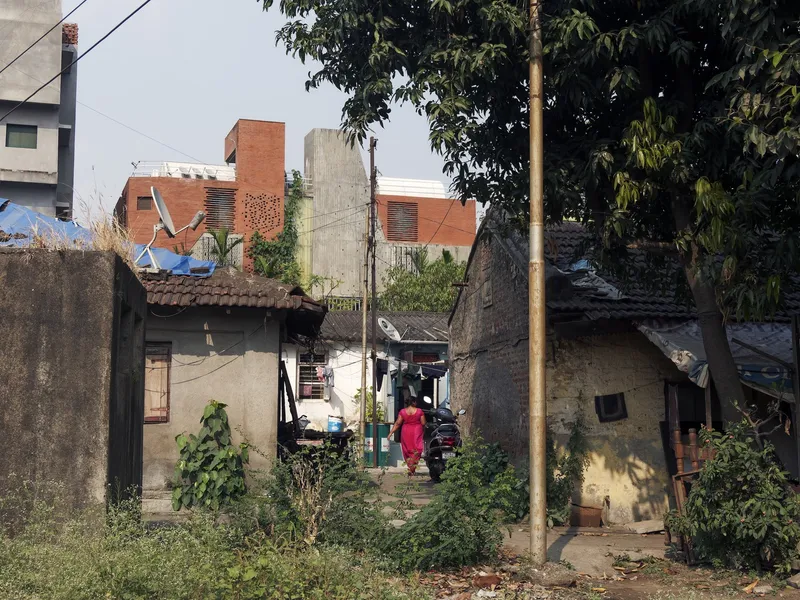

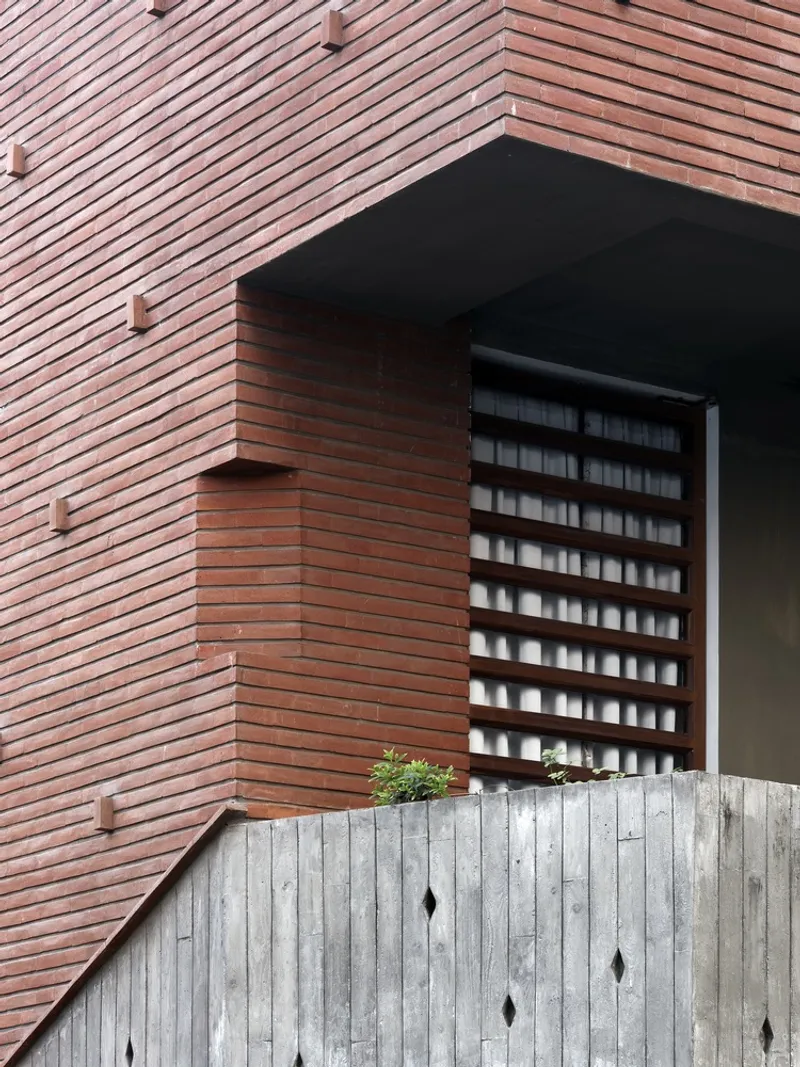
From the street, the house announces itself through its materials. Brick in horizontal coursing, board-formed concrete portal frames, and timber screens are visible above the compound wall. The entry path passes through a sequence of concrete frames with potted plants and planted garden beds on either side. A figure walks toward the door. The scale is domestic, but the material weight is civic. This house takes its street presence seriously.
The Courtyard: Light, Air, and Stone
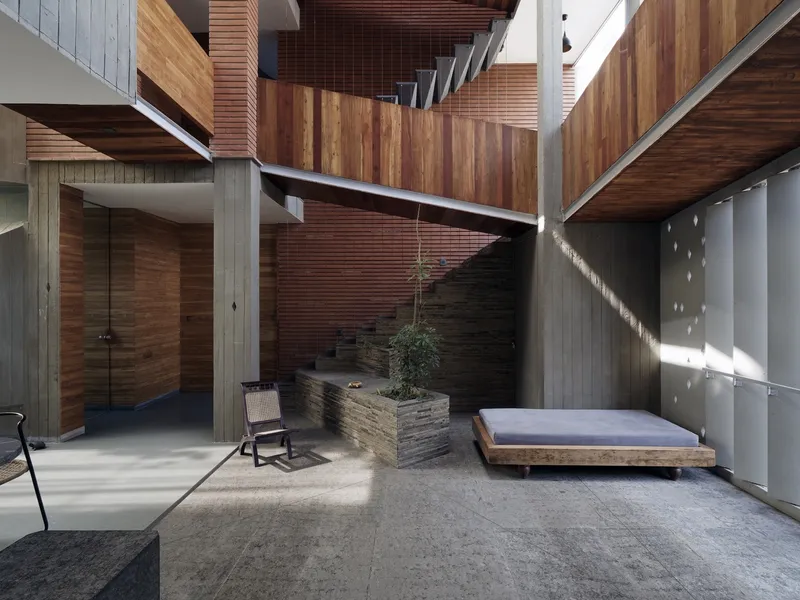
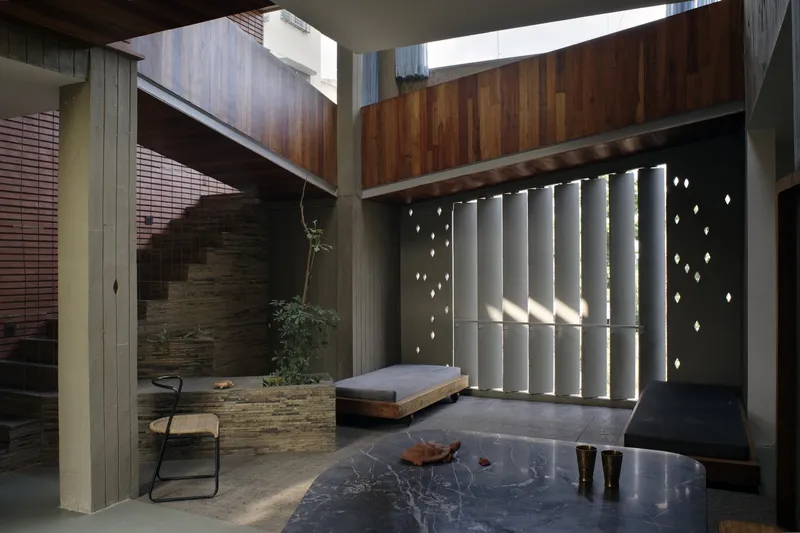
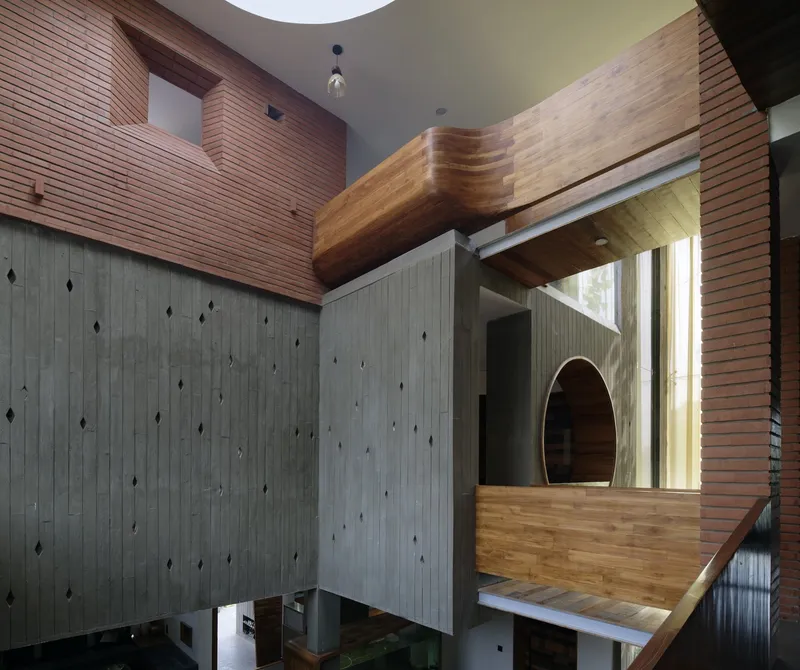
The central courtyard is the heart of the house. It is open to the sky, bounded by brick walls, concrete columns, and timber screens. A rough stone staircase runs along one side. A timber daybed and a chair sit on the polished stone floor. The courtyard is not decorative. It is the primary climate device: hot air rises and exits through the open top, pulling cooler air through the ground floor rooms. Stack ventilation, achieved through geometry rather than machinery.
The perforated concrete screen on one wall casts scattered circular light dots across the floor and the daybed. The pattern changes through the day as the sun moves. In the morning, the dots are sharp. By afternoon, they stretch and soften. The screen is both enclosure and ornament, both privacy and light.
The Barrel Openings
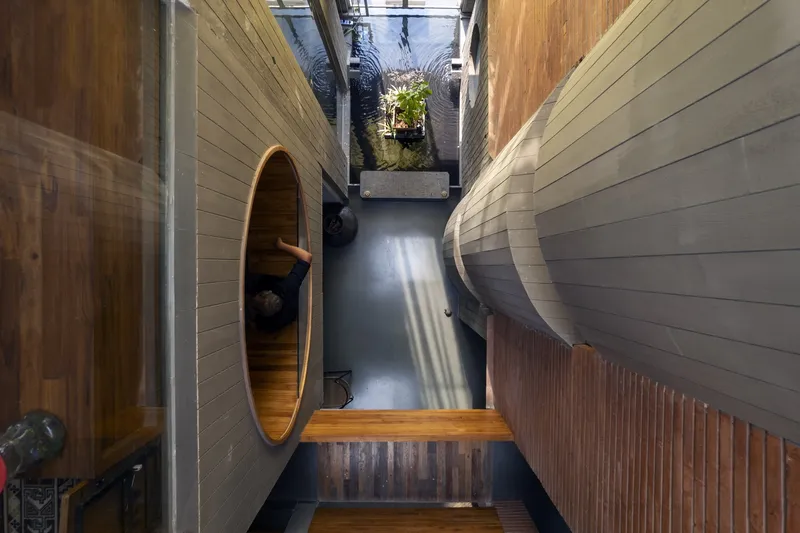
One of the most striking elements is a pair of large circular timber-lined barrel openings set into a narrow side corridor. The barrels are large enough to sit inside. They connect rooms across the section, creating visual links and cross-ventilation paths. The corrugated metal walls of the corridor contrast with the warm timber lining of the barrels. This is a detail that could only exist in a house designed around airflow: the openings are simultaneously windows, passages, and ventilation channels.
Living Spaces: Stone, Timber, and Concrete
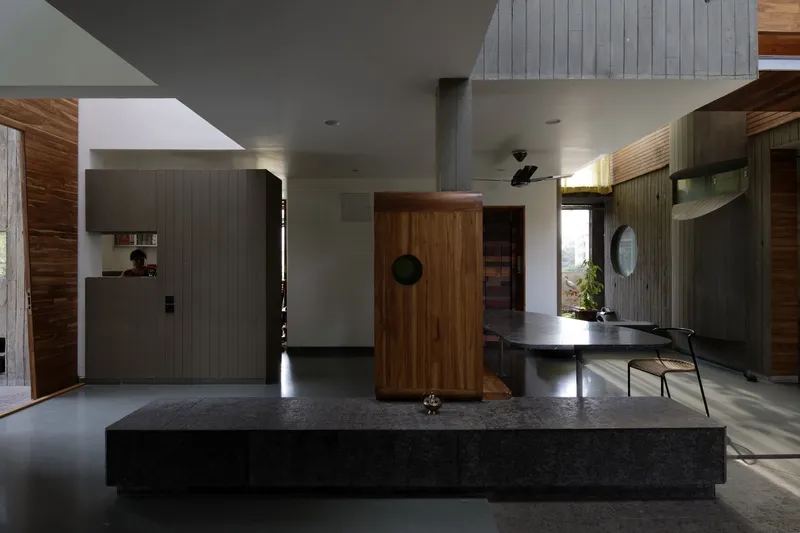
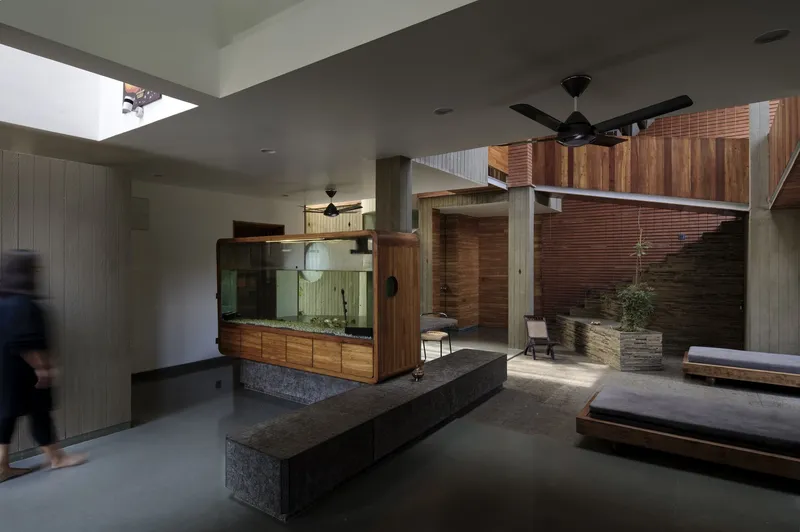
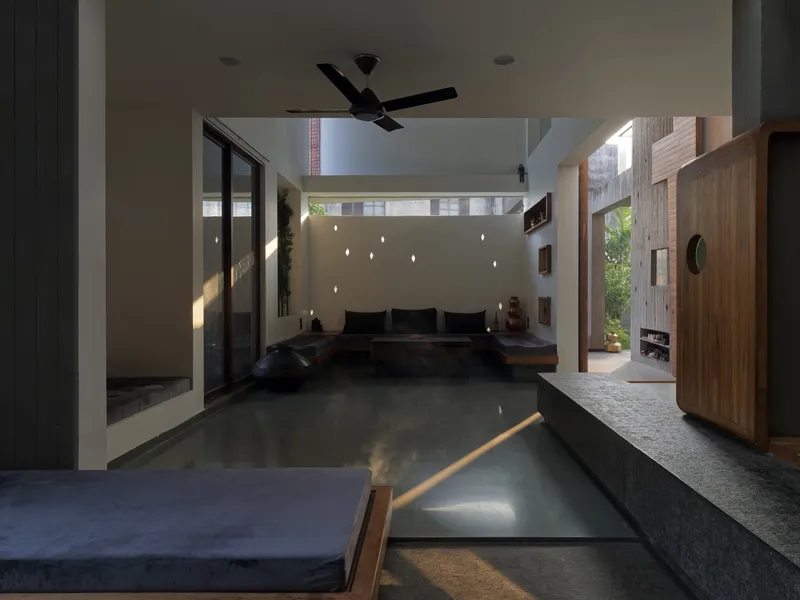
The living areas are split across levels. The kitchen has a dark polished stone counter, a timber cabinet with a large circular pull handle, and a vaulted white ceiling. The main living area has a large glass aquarium on a stone plinth, concrete bench seating, and views through to the brick staircase. The sitting room on another level has a dark polished stone floor, black cushioned seating, and the perforated wall casting its light dots across the room.
The material palette is consistent: board-formed concrete, brick, polished dark stone, and timber. No surface is painted or clad. Every material is structural or functional. The concrete shows its formwork grain. The brick shows its coursing. The timber shows its joint. The house is honest about how it was made.
Bedroom: Canopy and Vault

The bedroom is the quietest room. A four-poster bed with a sheer patterned canopy sits under a vaulted ceiling. Timber wardrobes line one wall. A louvred window filters light from the courtyard. The ceiling fan is the only mechanical element. The room relies entirely on the courtyard for ventilation: air enters through the louvres, moves across the bed, and exits through the void above. This is passive cooling designed at the room scale, not the building scale.
Upper Levels and Bridges
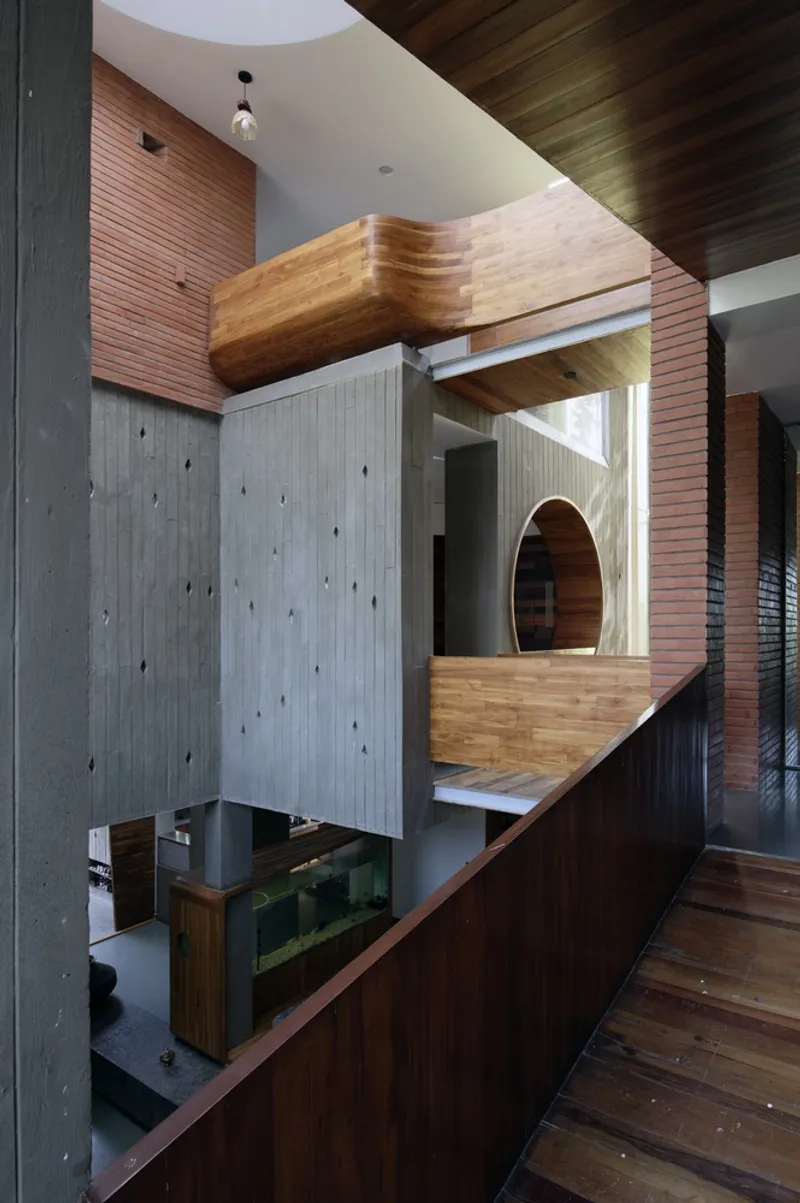
The upper levels are connected by timber bridges and balconies that overhang the courtyard. A concrete column rises through the section. An arched timber opening on one level frames a view down to the courtyard below. The circulation is vertical and visual: you are always aware of where you are in the section, and you can always see or hear the other floors. This is the spatial quality of a multi-generational house. Privacy exists, but isolation does not.
Site Model
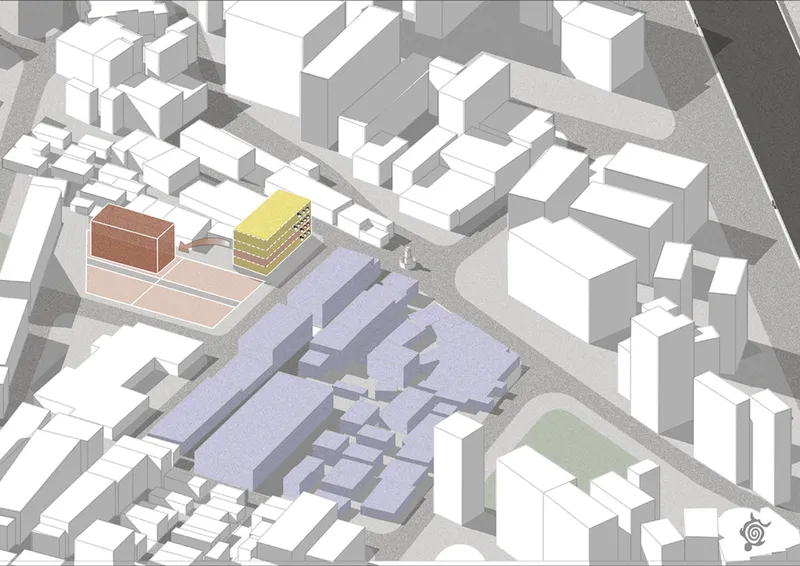
The 3D site model shows the house in its urban block context. The brick and yellow volumes of the house sit within a dense neighbourhood of white block forms. The purple ground plane marks the surrounding plot boundaries. The house occupies a mid-block plot, surrounded on three sides by neighbours. The courtyard strategy makes sense in this context: it brings light and air to the centre of a plot that cannot rely on its perimeter.
Why This Project Matters
The Indian courtyard house is thousands of years old. What PMA Madhushala has done with The Breathing Quadrant is not reinvent the type but re-engineer it for a contemporary multi-generational family. The courtyard provides ventilation. The perforated screens provide privacy and light. The barrel openings provide cross-ventilation. The Vastu-aligned plan provides cultural continuity. Every element has a job.
If you are designing a house in a hot climate, on a dense urban plot, or for a multi-generational family, this project is worth studying for how courtyard geometry, material honesty, and passive cooling can replace mechanical systems without sacrificing comfort or beauty.
About the Studio
Share Your Own Work on uni.xyz
If you are working on courtyard houses, climate-responsive architecture, or multi-generational housing, uni.xyz is a place to publish your work and connect with a global design community.
Project credits: The Breathing Quadrant by PMA Madhushala. Maharashtra, India. Photographs: Hemant Patil.


Popular Articles
Popular articles from the community


David Ortega Stacks a Two-Story Mexico City Penthouse Around a Steel Stair and a Pergola-Shaded Roof Terrace
In Colonia Roma, a 300 m² penthouse uses oak joinery, a planted steel stair and a slatted roof pergola to make a new-build apartment feel like a house.


Aquadapt: An Underwater Habitat That Rewrites Its Rooms by the Hour
Curved modules ring the seabed while one shell shifts from breakfast room to cinema, farm and football pitch as residents' needs change.

ETEH Reworks the Shared Spaces of São Domingos School in Brazil Around Timber, Color and Hanging Plants
At São Domingos School in Brazil, 436 m² of hall, refectory and library are recast with timber joinery, a yellow and blue code and trailing greenery.

FCC Arquitectura Expands a Portuguese Granite House with a Board-Marked Concrete Wing
In Portugal, JV House pairs a cleaned-up whitewashed and granite dwelling with a timber-shuttered concrete extension, courtyards and a garden pool.

Similar Reads
You might also enjoy these articles


Hodi-Mandai Geram
Project Function: Preservation and revitalization of the Intangible heritage and socio-spatial identity of the Hodi by Housing, Cultural Memory Center, Sacred Grove, landscape, local tourism economy


Olio Towers: A Mid-Rise for Performers That Fuses Housing, Rehearsal, and Stage
Located blocks from Houston's Theater District, this modular tower stacks living units around a central performance atrium.

Oasis: Modular Green Housing Carved into Dhaka's Urban Fabric
A shortlisted Plugin Housing entry reclaims unauthorized settlements in Dhaka with stepped concrete volumes, green roofs, and ventilation-driven design.

Black Hole: A Floating Megastructure for the Post-Physical Era
Emiliano Mazzarotto envisions a spherical, self-scaling arena where e-sports, digital hotels, and holographic stadiums replace traditional public space.

Explore M Square Architectural Design Competitions
Discover active competitions in this discipline

Challenge to reimagine the Iron Throne

Photograph architecture without architects

Illustrate the lost glory of Angkor Wat - Render Challenge

Design challenge to reuse E-waste
Comments (0)
Please login or sign up to add comments
No comments yet. Be the first to comment!