
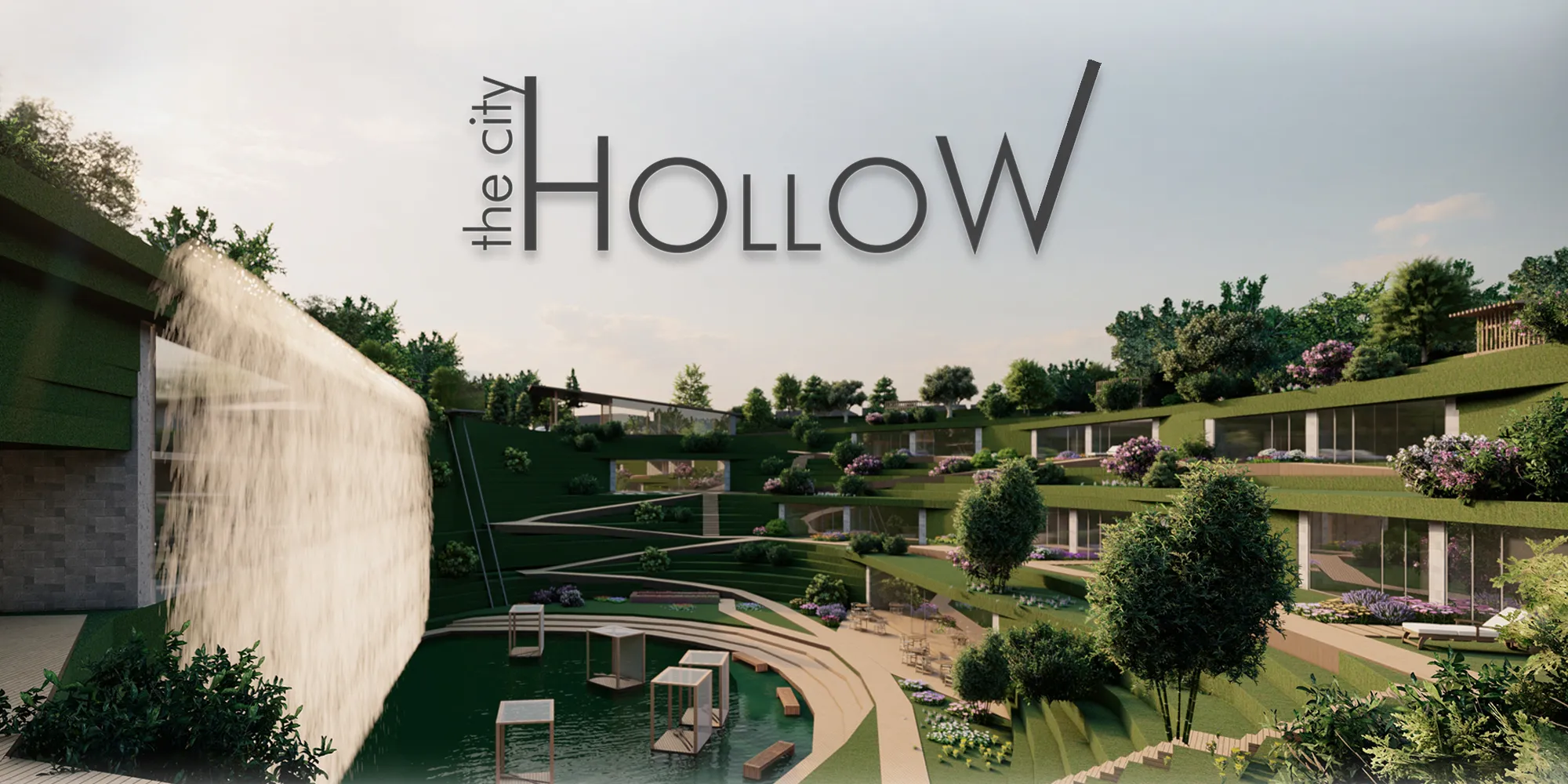
The City Hollow
Wellness Center based on biophilic design principles
Today, the increasing stress level of people who get away from nature and get lost among buildings has increased psychological and physical disorders. Therefore, the main idea is to design a center intertwined with nature for those who want to get away from the stress of the city and heal.
In addition to residences around the site, there are car parking spaces and an airport nearby. These car parks, airports and roads create noise. In addition, it is seen in the analyzes that the rate of precipitation and temperature is high. According to these environmental data, the general layout and design was constructed.
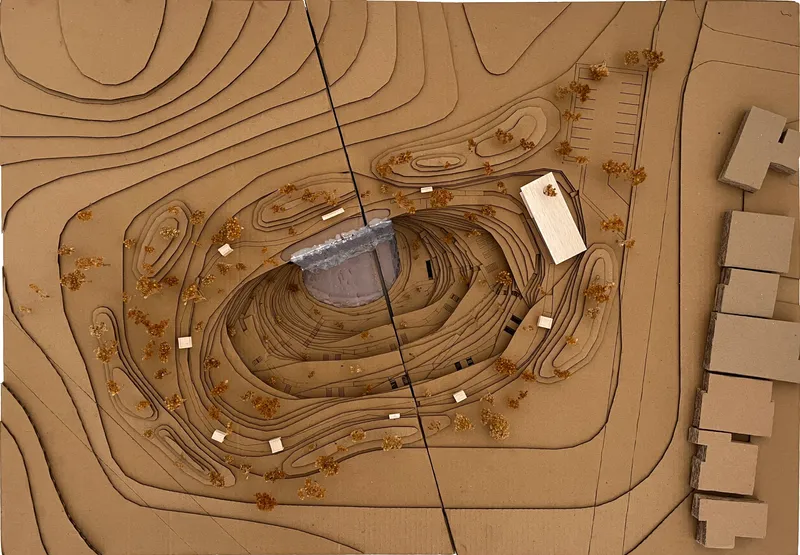
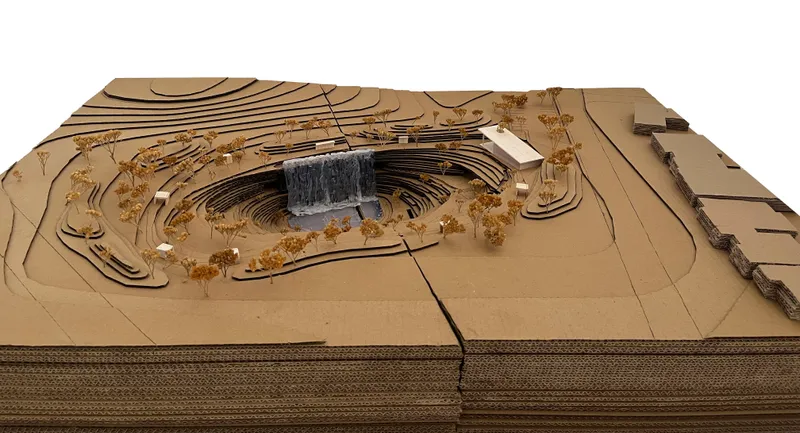
The existing slope of the land was increased, as it was desired to break the visual and auditory connection with the city and to heal the people by relieving them of their stress with the nature created entirely inside. A waterfall was positioned on the slope to use the healing power of the water. Units are placed on the slope with a view of the waterfall. Thus, the design was turned into a city hollow where people come to get rid of stress, just like the tree hollows that animals use for shelter. Inspired by the tree hollow, the project was named The City Hollow.
People who want to get away from the crowded city life come to The City Hollow and get in touch with nature here. They can listen to the calming sound of the waterfall and interact with the water from various points around the biological pond and on the platforms above it. In addition, they can get away from their stress by doing various activities such as art and sports, which also have therapeutic properties.
Biophilic design principles, which are the expectation of the competition, were used in many points in the design. The principle of establishing a visual connection with nature was used in every aspect of the design. The buildings are positioned in such a way that they do not cut this bond and strengthen this bond when viewed from the interior. According to the presence of water principle, water was used in the Project. The principle of non-visual connection with nature was achieved by the sound of the water and the surrounding trees, the scent of flowers, and the users touching the water in the shallow area created on the lake shore. The sound of waterfalls was used for non-rhythmic sensory stimuli. The risk principle was applied on the platforms above the water, and the mystery principle was applied in the meditation area, which is completely underground, and in the healing space behind the waterfall. The principle of material connection with nature was achieved by using natural and local materials. In order to ensure the principle of biomorphic forms&patterns, natural lines were used as much as possible while shaping the land.
In order to meet the 30-person expectation of the competition, the accommodation was designed as 15 units with double person capacity. Bluestone, which is the local stone of Australia, was used as the building material in the buildings. Reflective glass were used to ensure privacy. In this way, nature was reflected and its effect was strengthened. Wood was used in structures, pergolas, stairs, ramps and floors.
The existing slope of the land was increased in order to minimize the noise caused by the presence of the airport and car parks nearby, and the settlement was built within this slope. A noise barrier was provided by placing the structures below the ground level. In addition to these, the environment of the hollow is covered with dense tree texture, increasing the comfort of the users both visually and acoustically.
In the design, elevation differences were created between the buildings in order to provide a fluid circulation in nature. Circulation was provided between the buildings by ramps and stairs. A walking area with a pergola was also designed at the top level. A horizontal elevator descending from this upper level to the water level was designed.
The City Hollow is entered from the road where the residences are located. The parking lot was placed outside the main spaces. The entrance building, has a reception area, administrative and service units. After passing through the welcome structure at the entrance, the accommodation units are reached by ramps. Access to the sports and art workshop is provided by ramps from the accommodation.
Just behind the waterfall, a healing space with a sauna, pool, massage and treatment areas has been designed. In addition to offering the opportunity to heal with nature, it also contributes to this healing process with a yoga/exercise workshop and an art workshop. The restaurant area and the amphitheater are built on the ground level. Floating platforms are designed for users to meditate on the water. At the ground level, a recreation area has been created where users can spend time together with a waterfall, biological pond, restaurant, amphitheater, walking path and sitting areas. In addition, a mystical meditation area has been designed below the ground level, overlooking the water from the lower level.
It has been a priority for the users to benefit from the maximum nature view in their accommodation units. Nature was carried indoors by creating green spaces in the meditation, yoga/exercise workshop and restaurant area.
The green roof system is used in the buildings constructed under the ground. In the site analysis, it was observed that the precipitation rate was high. The water needed by waterfalls, ponds, irrigation and structures is obtained by collecting rain water. Rain collected through green roofs is collected in tanks. The water needed is used after being purified from the tanks. Thus, a sustainable system was designed.
During the preparation process for the competition, there were discussions about what the competition wanted and the requirements of the program. The potentials and problems of the land were analyzed. Many form and layout experiments were carried out within the framework of a basic concept. This process was supported by a 1/200 scale model.


Popular Articles
Popular articles from the community


Co-life: Sustainable Architecture for Age-Friendly Community Living
Co-life reimagines sustainable architecture for seniors through courtyards, rammed earth, shared gardens, and spaces designed for belonging.

Co-Life: Senior Housing Design That Reconnects Older Adults With the City
Co-Life reimagines senior housing design through healing gardens, shared streets, workshops, and a sustainable community across generations.

The Ocean Hive: Sustainable Architecture for a Self-Sufficient Civilization at Sea
The Ocean Hive imagines sustainable architecture at sea, where modular habitats, algae, wave power and ocean waste sustain a growing colony.

The Musturak Paradise: Senior Living Architecture for a Connected Future in Temara, Morocco
The Musturak Paradise reimagines senior living architecture in Temara via private homes, social spaces, culture, community, and shared care.
Similar Reads
You might also enjoy these articles
The Rhythm of Seasons
A Farmers' Market Connecting Nature and the City

More Than a Building-Designing a Living System
More Than a Building-Designing a Living System
Base Beyond
DESERT COMPOUND ARID: TOURISM OF ABSENCE AND ABUNDANCE

Explore Biophilic Competitions
Discover active competitions in this discipline




Challenge to reimagine the Iron Throne


Photograph architecture without architects


Illustrate the lost glory of Angkor Wat - Render Challenge


Design challenge to reuse E-waste
Comments (0)
Please login or sign up to add comments
No comments yet. Be the first to comment!