
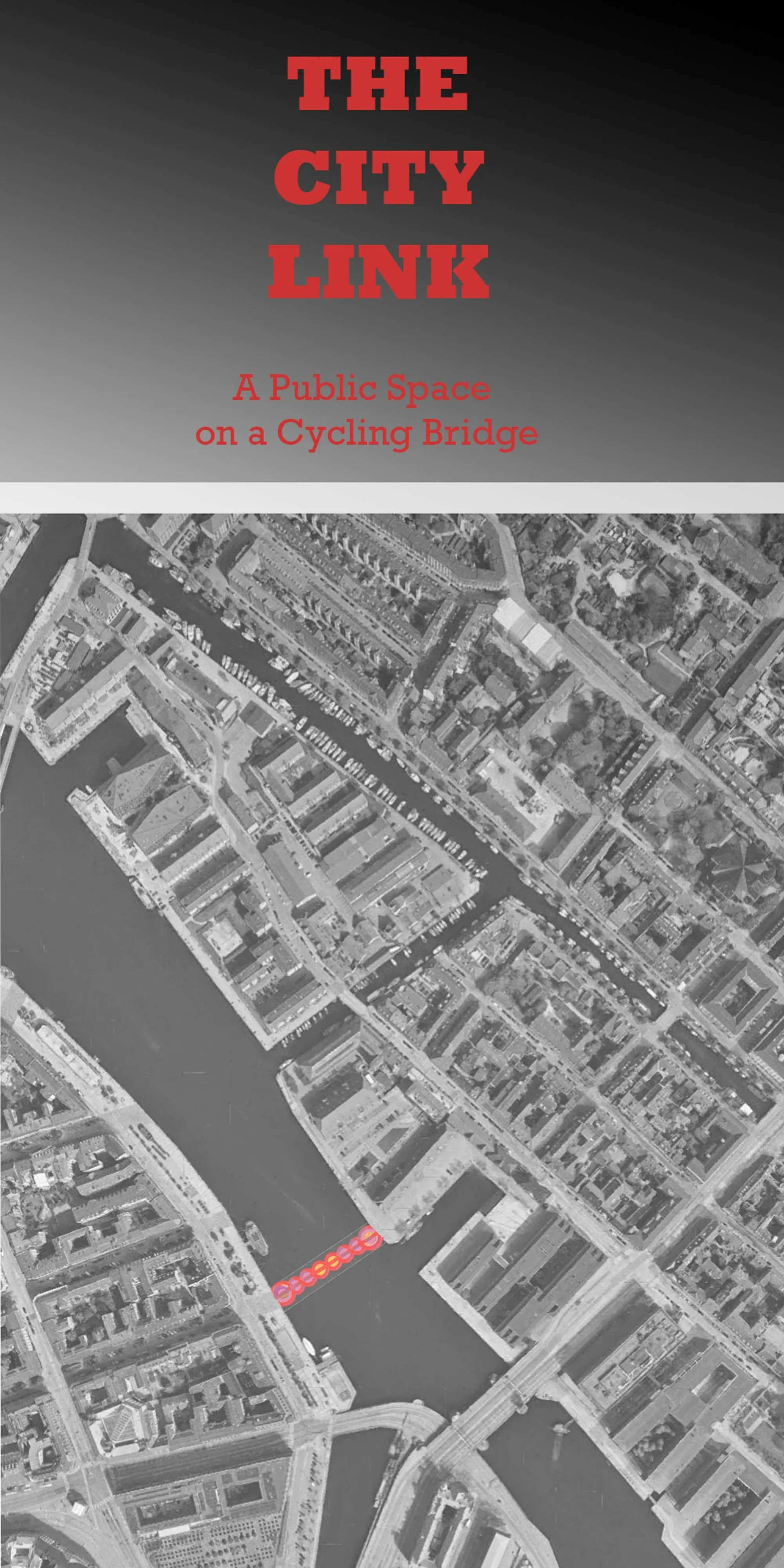
The City Link: A Landmark in Sustainable Urban Design
A visionary sustainable urban design that transforms a cycling bridge into a vibrant public landmark for movement, leisure and city life now


In the evolving discourse of sustainable urban design, infrastructure is no longer conceived as a purely functional connector. Instead, it becomes an active civic space: an environment that shapes movement, interaction, and environmental responsibility. The City Link, a visionary project by Melika Nateghian, reimagines the traditional bridge as a multi-layered public realm that integrates mobility, commerce, recreation, and ecological sensitivity into one cohesive architectural gesture.
Inspired by the geometry of bicycle wheels, the project transforms circular repetition into a powerful spatial language. The design links two sides of the city while simultaneously creating a destination in its own right, establishing a new model for pedestrian bridge architecture rooted in sustainable urban principles.
Concept: Circular Geometry as Urban Strategy
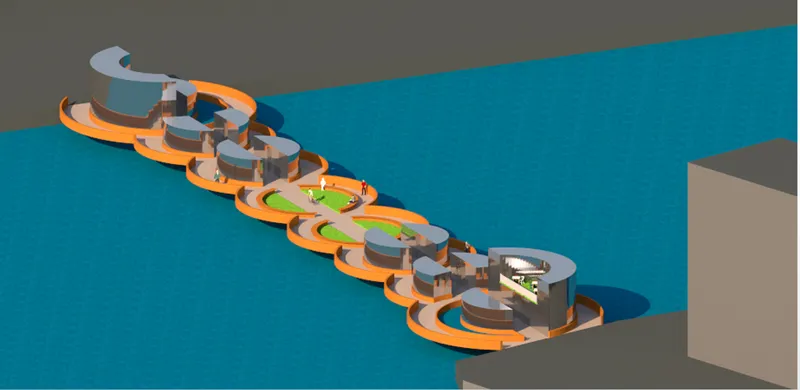
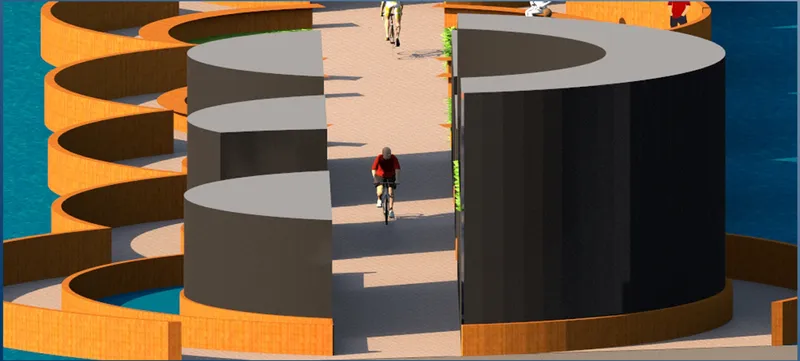
The architectural concept originates from the symbolism and structure of bicycle wheels. Circular forms repeat rhythmically along the length of the bridge, forming interconnected spatial nodes. Two larger circular volumes mark the entrance and exit, functioning as gateways that announce the bridge as a civic landmark.
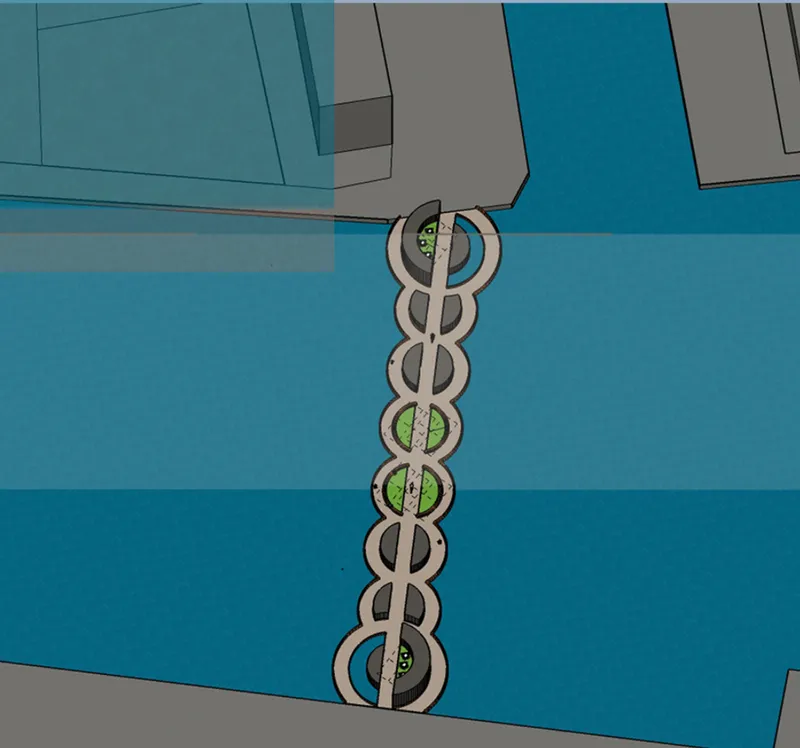
Where the curved outlines meet, a straight, efficient path is generated, specifically designed for cyclists. This direct route accommodates rapid transportation needs, reinforcing the project’s commitment to sustainable mobility. Meanwhile, the outer curved circulation path encourages pedestrians to slow down, linger, and engage with the surrounding water and urban skyline.
Through this dual-system circulation strategy, the bridge demonstrates how sustainable urban design can balance efficiency with experience.
A Multi-Purpose Urban Bridge
Unlike conventional bridges that serve merely as transitional infrastructure, The City Link operates as a multi-purpose urban ecosystem. Each circular node houses distinct functions, creating a layered programmatic experience:
- Bicycle parking and rental facilities to encourage green commuting
- Retail stores that activate the public realm
- Public washrooms for convenience and accessibility
- Office spaces with staff facilities and services
- Cafés with green balconies at both entrance and exit points
- Information center and tourism guide hub
- Lounges and grass-covered gathering areas in the central zones
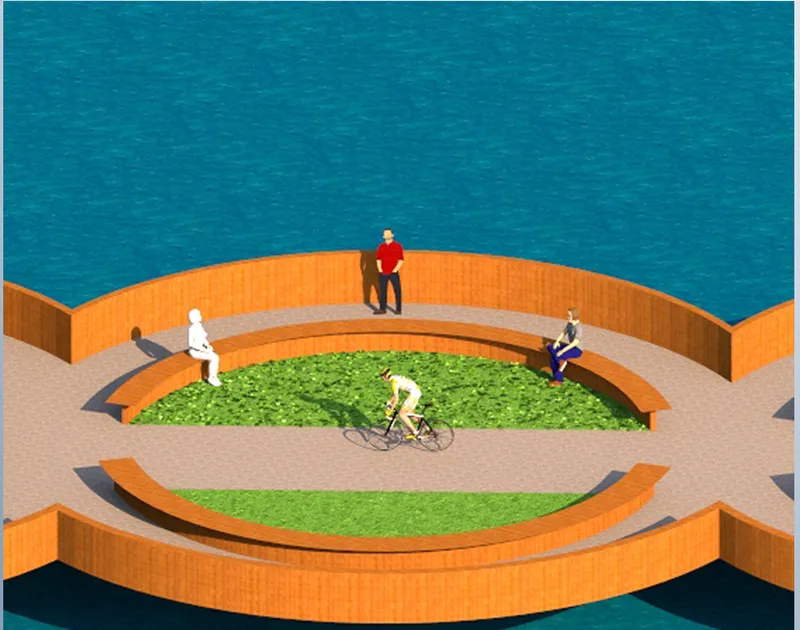
The curved lounges in the middle of the bridge are specifically designed to foster social interaction. By integrating seating, landscaping, and open views to the water, these areas function as micro public squares suspended above the urban landscape.
This integration of commercial, civic, and recreational functions reinforces the project’s role as a social condenser, an essential goal of contemporary sustainable urban design.
Material Strategy and Environmental Responsiveness
Material selection plays a crucial role in the bridge’s identity. The building volumes are constructed primarily in glass, allowing transparency and visual permeability across the water. The structural framework is designed with stone, providing durability and mass, while the bridge barriers are clad in wood, adding warmth and tactile comfort to the pedestrian experience.
Green balconies and landscaped central zones introduce vegetation into the urban crossing, mitigating heat and enhancing microclimatic comfort. By combining natural materials with transparent surfaces, the bridge achieves both visual lightness and structural solidity.
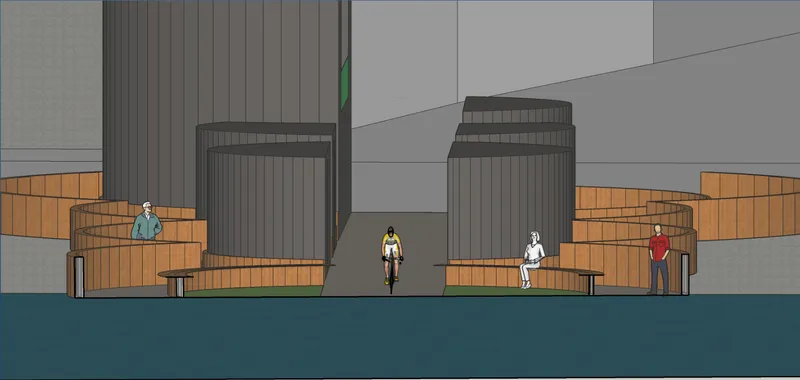
Movement Hierarchy: Cyclists and Pedestrians in Harmony
A defining feature of the project is its clear hierarchy of movement. The straight internal path ensures uninterrupted, rapid transit for cyclists. In contrast, the longer curved pedestrian path encourages slower movement and experiential engagement.
This separation avoids conflict between fast and slow users while promoting inclusive accessibility. The design demonstrates how pedestrian bridge architecture can successfully integrate different modes of movement without compromising safety or spatial quality.
Adaptive Functionality: An Openable Mechanism
The mid-section of the bridge incorporates a vertical opening mechanism, allowing water vehicles to pass through. This dynamic feature ensures that the bridge respects the existing aquatic circulation network while maintaining its role as a primary urban connector.
By merging adaptability with permanence, the project strengthens its identity as resilient urban infrastructure.
From Infrastructure to Landmark
The City Link distinguishes itself through its sculptural curvature. Unlike rigid linear bridges, its flowing circular geometry subconsciously invites relaxation and visual exploration. The design shifts perception, from crossing a barrier to inhabiting a space.
As the first bridge in the city conceived as a place to spend time rather than merely commute, it establishes a new typology within sustainable urban design. Cyclists are drawn to its direct path; pedestrians are invited to pause, socialize, and engage with the city from a new vantage point.
Its distinct form, programmatic richness, and environmental integration position The City Link as both infrastructure and icon.
Sustainable Urban Design for the Future
In the context of global climate challenges and the urgent need for environmentally responsible cities, projects like The City Link exemplify how architecture can foster sustainable transportation habits. By prioritizing cycling, enhancing pedestrian comfort, and integrating mixed-use functions, the bridge becomes a catalyst for greener urban living.
Melika Nateghian’s vision demonstrates that sustainable urban design is not limited to ecological metrics: it is equally about social vitality, experiential richness, and long-term adaptability.
The City Link stands as a model for future urban bridge architecture: a structure that connects more than land: it connects people, movement, environment, and community into a singular civic experience.



Popular Articles
Popular articles from the community


Play: Fragments of Their World
Familiar architecture becomes modular playground design, creating safe spaces where displaced children can learn, connect, imagine and play.

Conexión: Biophilic Design Reimagines High-Rise Living in Hong Kong
Conexión reimagines high-rise living in Hong Kong through biophilic design, green facades, shared spaces, daylight, water and nature within.

The Ocean Hive: Sustainable Architecture for a Self-Sufficient Civilization at Sea
The Ocean Hive imagines sustainable architecture at sea, where modular habitats, algae, wave power and ocean waste sustain a growing colony.

The Earth Pod: 3D Printed Homes for Resilient Refugee Communities
The Earth Pod reimagines refugee housing through 3D printed homes made from clay, combining resilience, self-sufficiency, and rapid shelter.


Similar Reads
You might also enjoy these articles

Eco Chapel: A Green Architecture Pavilion Designed in Symbiosis with the Forest
Eco Chapel uses green architecture to weave prayer, learning and reuse into a forest pavilion shaped by modular hexagonal canopies for life.
Kaffeebühnen: Coffee Shop Architecture Designed as a Civic Stage Between Vienna’s City and Park
Kaffeebühnen turns coffee shop architecture into a civic stage, linking Vienna’s park edge, urban life, warm timber yards, and coffee craft.
Healing Façade: Sustainable Architecture for Reforestation, Community, and Sacred Ecology in Ethiopia
Healing Façade reimagines sustainable architecture as a living wall that restores soil, catches water and renews Ethiopia's forest churches.


Urban Forest: A Vertical Ecosystem for 5,000 Workers in Singapore's Changi Business Park
Radially stacked pods and layered green decks turn a 7-acre plot into 47 acres of ecological workspace projected for 2040.


Comments (0)
Please login or sign up to add comments
No comments yet. Be the first to comment!