

The City Link: A Landmark of Sustainable Bridge Architecture
A transformative example of sustainable bridge architecture where infrastructure, public space, and urban culture merge above water.


Bridges have long been among the most powerful symbols in architecture. From ancient civilizations to contemporary cities, they represent transition, connection, and progress. Yet in modern design discourse, bridge architecture is no longer just about movement: it is about experience, identity, and cultural space.
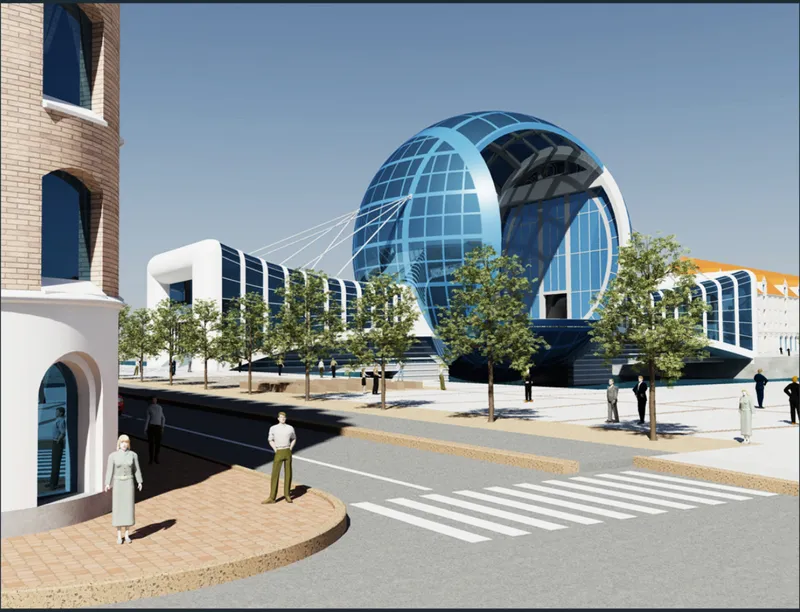
The City Link, a visionary project by Leonid Emdin, redefines sustainable bridge architecture by transforming a technical structure into a dynamic urban destination. Rather than serving merely as infrastructure, the bridge becomes an inhabitable world, an architectural organism suspended above water.


A Bridge as a Cultural Connector
Historically, bridges connected territories. In mythology, they connected worlds. In cities, they connect communities. The City Link builds upon this layered symbolism and translates it into contemporary architectural language.
Positioned within a dense urban waterfront, the bridge is conceived not only as a transit corridor but as a public platform that organizes cultural space. It links promenades, activates riverbanks, and creates a new civic landmark that reshapes the city skyline.
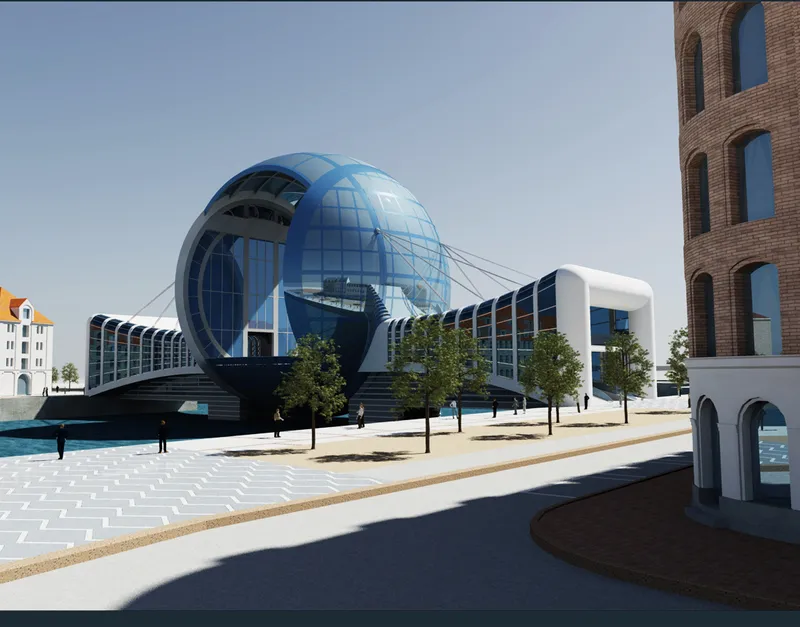
At its core lies a monumental circular volume: a transparent architectural ring that houses viewing platforms, recreational areas, and public programs. This iconic form transforms the bridge into a destination rather than a passage.
Innovative Movable Bridge Engineering
One of the defining features of this sustainable bridge architecture is its advanced lifting mechanism. The structure consists of two support rings placed 25 meters apart, allowing free passage of ships.
Inside the rings, a rotary mechanism raises the central portion of the bridge using a counterweight system. When elevated, the middle segment reaches a height of 35 meters above water level, enabling uninterrupted maritime traffic. During this transformation, the bridge becomes a spectacular kinetic landmark, its movement turning infrastructure into urban theater.
Unlike traditional drawbridges, The City Link integrates its mechanical function into the architectural narrative. The act of lifting is not hidden; it is celebrated.
Architecture Beyond Circulation
The City Link challenges the conventional separation between infrastructure and public life. Instead of a narrow pedestrian crossing, it offers layered spatial experiences distributed across multiple levels:
- Ground-level promenade with retail stores, bicycle repair services, and public amenities
- Second-floor cafés, offices, and commercial spaces
- Elevated viewing platforms within the support rings
- Gathering spaces and amphitheater-style seating at the entrances
- Staff facilities, information centers, and support areas
At the heart of the circular structure, the transparent floor platform creates a dramatic gathering space overlooking the river. When raised, this central deck becomes an observation platform, offering panoramic city views from 35 meters above the water.
The Ferris Wheel Experience
Embedded within one of the structural rings is a Ferris wheel-like system that connects the bridge level to the elevated viewing platform. In normal mode, it functions as an urban attraction. When ships pass and the central span lifts, it continues operating, ensuring accessibility while reinforcing the bridge’s identity as a dynamic architectural object.
This integration of leisure, engineering, and circulation exemplifies the project’s commitment to experiential infrastructure.
Sustainable Bridge Architecture and Urban Integration
Beyond its striking form, The City Link demonstrates principles of sustainable bridge architecture through:
- Multi-functional spatial programming
- Integration with pedestrian promenades
- Encouragement of cycling and public transportation
- Activation of underutilized waterfront zones
- Creation of climate-responsive shaded public spaces
The transparent canopy over the central portion allows natural light to flood the interior, reducing reliance on artificial lighting during the day. Its elevated design promotes airflow and enhances microclimatic comfort.
Rather than occupying the river as an obstruction, the bridge enhances its presence: framing views, reflecting light, and strengthening the relationship between water and city.
Structural Expression as Urban Identity
The circular form, bold yet elegant, becomes a new urban icon. Seen from above, it reads as a geometric intervention in the city grid. From the river, it appears as a portal. From within, it functions as a social condenser.
The bridge’s structural system is openly expressed. Tension cables, rings, and mechanical cores are not concealed but integrated into the architectural language. This honesty reinforces the project’s identity as both infrastructure and sculpture.
The Bridge as a World of Its Own
As the original concept suggests, bridges have always symbolized transition between worlds. In The City Link, the bridge itself becomes a world: containing movement, leisure, commerce, and spectacle within a single infrastructural framework.
By merging engineering precision with architectural ambition, Leonid Emdin’s project expands the possibilities of contemporary bridge architecture. It demonstrates that sustainable bridge design can be more than functional, it can be transformative.
The City Link is not simply a crossing over water. It is an urban event, a kinetic landmark, and a new typology for infrastructure in the 21st century.



Popular Articles
Popular articles from the community


Conexión: Biophilic Design Reimagines High-Rise Living in Hong Kong
Conexión reimagines high-rise living in Hong Kong through biophilic design, green facades, shared spaces, daylight, water and nature within.

Riyadh For All: Intergenerational Urban Design for Active Aging in Rabat
Riyadh For All reimagines urban design in Rabat with intergenerational co-living, adaptive courtyards, and Moroccan cultural exchange today.

Hill & Cross Opera: Sculptural Opera House Architecture Shaped by Tallinn’s Landscape and Identity
Hill & Cross Opera reimagines opera house architecture in Tallinn through its sculptural hill, civic plaza, glass wave and a luminous cross.

The Musturak Paradise: Senior Living Architecture for a Connected Future in Temara, Morocco
The Musturak Paradise reimagines senior living architecture in Temara via private homes, social spaces, culture, community, and shared care.

Similar Reads
You might also enjoy these articles

Eco Chapel: A Green Architecture Pavilion Designed in Symbiosis with the Forest
Eco Chapel uses green architecture to weave prayer, learning and reuse into a forest pavilion shaped by modular hexagonal canopies for life.
Kaffeebühnen: Coffee Shop Architecture Designed as a Civic Stage Between Vienna’s City and Park
Kaffeebühnen turns coffee shop architecture into a civic stage, linking Vienna’s park edge, urban life, warm timber yards, and coffee craft.
Healing Façade: Sustainable Architecture for Reforestation, Community, and Sacred Ecology in Ethiopia
Healing Façade reimagines sustainable architecture as a living wall that restores soil, catches water and renews Ethiopia's forest churches.


Urban Forest: A Vertical Ecosystem for 5,000 Workers in Singapore's Changi Business Park
Radially stacked pods and layered green decks turn a 7-acre plot into 47 acres of ecological workspace projected for 2040.


Comments (0)
Please login or sign up to add comments
No comments yet. Be the first to comment!