
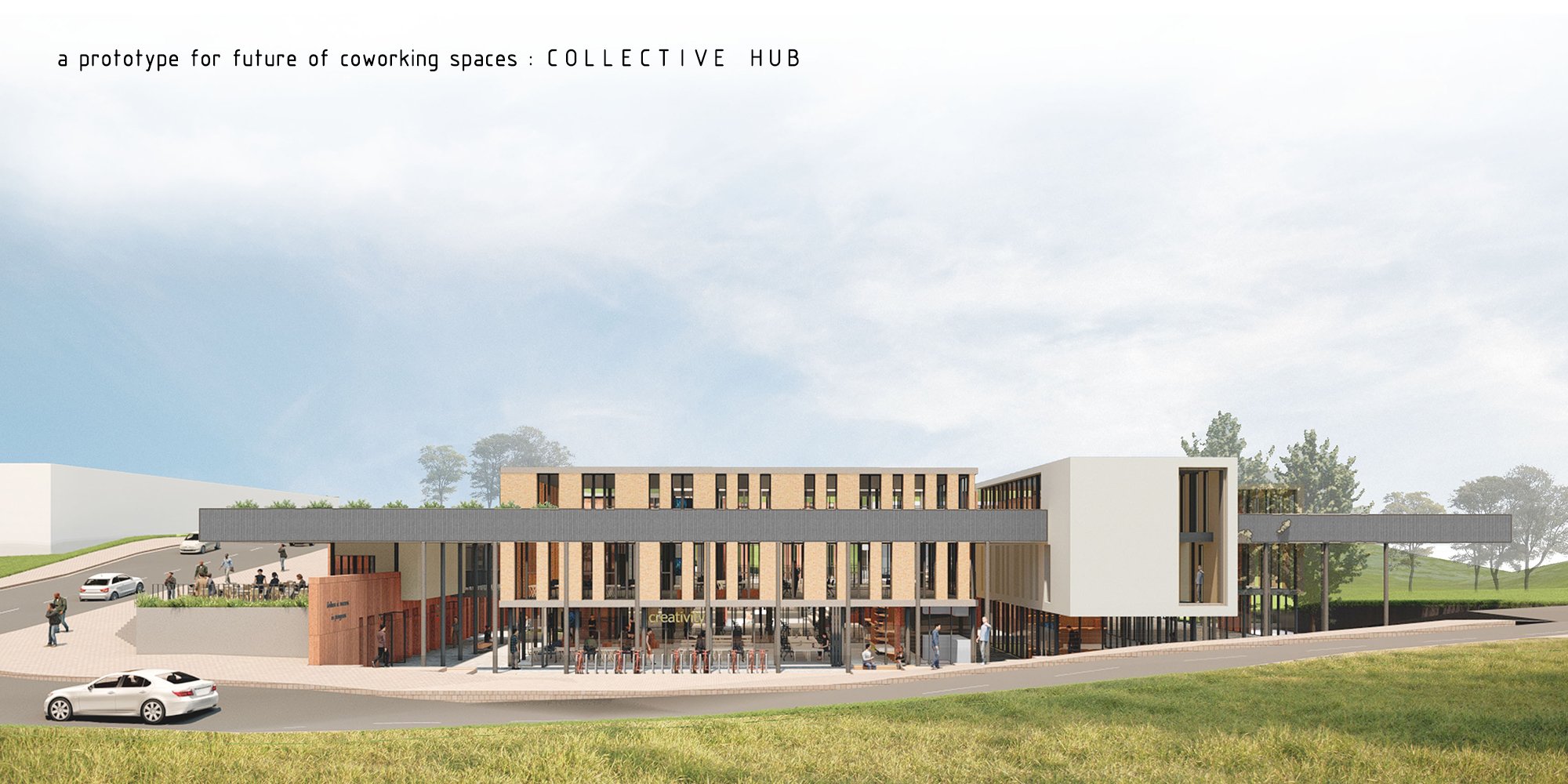
THE COLLECTIVE HUB
A prototype for future coworking space
“Can we design a coworking office by working in coworking spaces and non-coworking office" is our starting point when we took first concept of the competition brief as three employees in same architectural Office.
Can we launch out a new empathy-oriented working system by experiencing different places?
As the new method in new normal: empathetic design
Our centerline was how the architecture that we know evolved in the new oandemic era during the project research period. We extended our research in these topics: contemporary office design, spaces that trigger creativity, flexible space, architecture in the post-pandemic period, social distance and space. We have interiorized design through experience as a method for co-working Office design which is unheard-of circumstance in new normal. In this context, we spent time in our process of research, discussion and project develelopment looking for clues to the new normal co-working office in places like the corporate office where we have to breathe the same air with hundreds of people, the co-working office we share with people from different sectors, the libraries where we have to be quiet, the cafes only we work and everyone else socialize, and the foodcoart everyone eats and we work.
A Prototype: Future of Co-working Office
We thought that the risk level of the spaces shared with hundreds of people in gigantic square meters was old-fashioned for the design of new normal office because of the feedback which is given to us by working in different places. In this context, we focused on a new plan typology which the same air does not circulate and the spaces where fresh air reaches are convenient to access. The low density of start-ups as a co-working Office user has been supportive for our disruptive plan setup. With this project, the purpose is meeting the expectations of different users by producing 4 types of modules 3 metre and over with taking as referance the 1.80 metre social distance which is announced by the health organizations. it is determined that the service and meeting areas In the traditional office setup increases the contact and risks of contagious diseases. From this point of view, essential service areas are planned for ensuring self-sufficiency to 4 different modules.
Context: In between Housing & Industry
The city of Scranton is an important industrial city which is based on important geographical position and localed at the intersection of railways under favour of its coal and mineral reserves. Once upon a time, the city satisfy the needs of the eastern side of USA, but the city lost its importance because of the initiation of diesel locomotives after the World Wars. The area of project is located in the transporatation center of the multicenter city which expands on the North-east and South-east. In this multi-level city, the functions have a gridal urban plan with clear lines. The railway and its area where are located in this gridal plan expand over time and evolves into a strong public sphere between residential and industrial areas. An extroverted, open space setup has been adopted to inspire people with an entrepreneurial spirit at the intersection of these public areas. In this buffer zone between the residential fabric and the industrial fabric, it is aimed to establish a common language with the small-scale structure of the vernacular architecture of the residential area by referring to the project as a layer the footprint of mega-scale industrial buildings in search of typological language. In this context, “collective roof” is not only a common typological language, but also intermediate spaces that endure encounters by constructing different modules on a common denominator are proposed. It is observed that the brick material came into prominence when the texture of the city of Scranton was examined. In addition to that, corten rusted steel and concrete, used together with brick material, in order to emphasize this identity of this city, whose industrial image stands out, reflected the industrial identity of the city to the project. on the parcel with a height difference of 6 meters, a maximum height of 9 meters, a mass proposal has been developed that spreads over 3 layers In order to meet the demand for square meters. In this open-plan coworking office setup, inviting people into the structure from 3 different levels, directing them to the common areas and offices supports the fluid space setup that we imagine. These three different inviting entrances are built on a rational network of plans connected by reference to topography. In the area at the center that we can define as the heart of the coworking office, an amphitheater that allows for different activities, daily rest and encounters has been proposed. it is aimed to connect the spaces with functions on different floors with a common circulation network by placing social areas around this amphitheater. The fragmented flexible office modules which was developed as prototypes in new normal are planned with the principle of making maximum use of daylight, taking into account social distance. Each office unit has independent entrances within the plan setup organized at 3 different levels.
Flexible Office Module
After working on many different versions, we produced 4 different types -18X6 9X12 9X24 21X18- referenced by 1.8m social distance and sizes are designed 3 metres and its multiples. Service modules (wc, kitchen, furniture unit) were placed in each independent office unit and this allowed it to be self-sufficient. This also provides flexibility and infrastructure for different spatial functions while minimizing contact in the new normal. The determining factor in the interior design was the flexible furniture that can be rearranged according to different spatial needs. These furniture offer solutions to different spatial needs with table and seating combinations.


Popular Articles
Popular articles from the community

BAST Slots a Four-Story Glass House into a Narrow Gap Between Toulouse Townhouses
In the dense Bonnefoy district, a stepped infill building merges home and office while preserving a majestic hackberry tree.
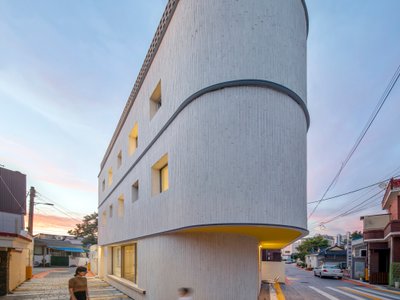
YOAP Architects Round a Corner in Yeongcheon with a Cylindrical Community Hub
A 197-square-meter brick and ribbed-clad tower turns a forgotten alley corner in South Korea into a public garden with a low threshold.
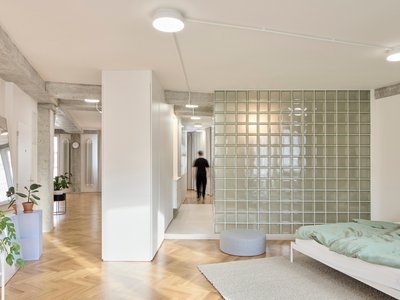
RDTH architekti Rips Out Nearly Every Wall in a Prague Apartment and Replaces Them with Furniture
A 101-square-meter post-war flat in Prague trades rigid partitions for a single rotated furniture block, curtains, and glass concrete.
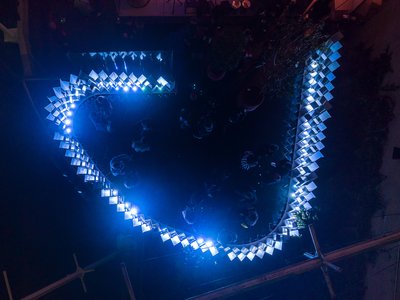
Rojkind Arquitectos and Think Parametric Build a Glueless Pavilion from 67 Interlocking Panels
A serpentine fiber-cement installation in Chapultepec Park celebrates a decade of architectural media in Mexico City.

Similar Reads
You might also enjoy these articles

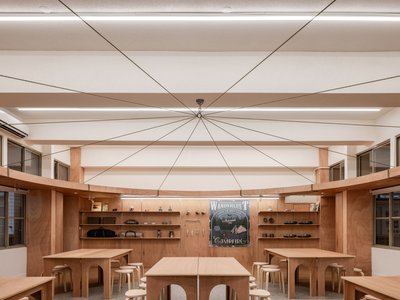
317studio Turns an 87 m² Classroom into a Forest Clearing for Scouts in New Taipei City
A rope canopy, student-made specimens, and campfire geometry replace rows of desks in this Scouting classroom in Xizhi District.
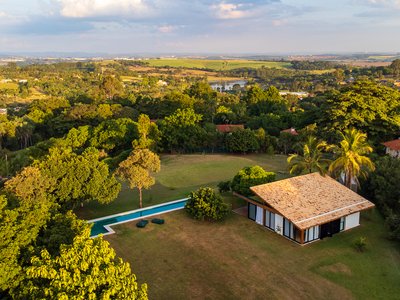
24 7 Arquitetura Builds a Timber Pavilion as a Family's First Act on a 5,000 m² Brazilian Plot
In Jaguariúna, a prefabricated glulam house nestles among mature trees as the opening move of a larger residential masterplan.
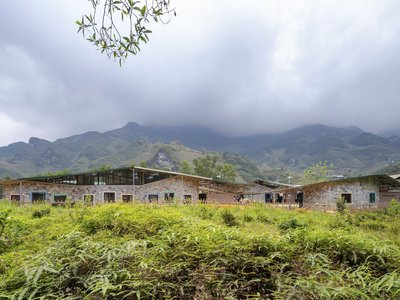
1+1>2 Architects Build a School from 900 Blocks of Hmong Stone on Vietnam's Rocky Plateau
On a barren valley in Ha Giang province, a community quarried its own stone to raise a kindergarten and primary school rooted in Hmong identity.
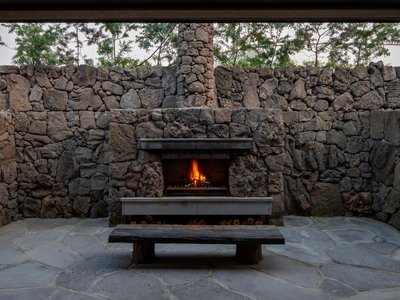
100A Associates Builds a Volcanic Stone Retreat on Jeju Island Rooted in Ritual and Restraint
Watarstay [Wa:Tar] in Bongseong-ri channels Jeju's basalt, reed, and hemp into a 150 m² hospitality space shaped by contemplation.

Explore Prototyping Competitions
Discover active competitions in this discipline




The Global Benchmark for Architecture Dissertation Awards

Packaging challenge - Design meets sustainability
Comments (0)
Please login or sign up to add comments
No comments yet. Be the first to comment!