

The Communal Lightbox: A Timber Market That Gives Mangaluru's Street Vendors a Roof and a Place
A thesis proposal for Hampankatta that folds informal vendors, daylight, waste cycles and aquifer recharge into one porous civic market.


Most market redevelopments in Indian cities start by clearing the street. The Communal Lightbox starts by admitting that the street is the market. Instead of pushing hawkers to the margins so a cleaner formal building can rise, the project treats the informal vendor as essential urban infrastructure and builds a daylit timber framework around the life that already exists. The result is a market designed as a civic bridge. It reads less as a building to be visited and more as a connector that the city passes through.
Developed as a thesis project by Neethi Acharya, the proposal sits in Hampankatta, the historic commercial centre of Mangaluru, Karnataka. Its focus is the Central Market, formerly known as Webster Market, where formal shops and street vendors have long operated side by side. The vendors have done so without spatial recognition or infrastructural support. Acharya's argument is direct: harassment, poor facilities, waste mismanagement and ecological stress are design failures as much as policy ones. Architecture can do something about them.
A Monsoon Street That Already Works as a Market

The opening image is the project's real brief. Fruit vendors work a rain-slicked road, an auto-rickshaw is parked against stained walls, and the monsoon presses down on everything. This is Market Road. The site acts as a connective spine between Mangaluru's old and new quarters, and the area around it is dense and continuously active: narrow lanes, hawkers, meat markets, vegetable stalls and heavy foot traffic.
Acharya mapped this activity across morning, afternoon and evening, and the conclusion shapes everything that follows. The proposal does not drop a new object into the district. It stitches into the existing fabric, sharpening movement and spatial clarity rather than replacing them. The photograph also shows exactly what is missing: shelter, drainage, dignity. These are the things the building sets out to supply.
Zoning Fruit, Fish, Vegetables and Meat Without Building Walls Between Them
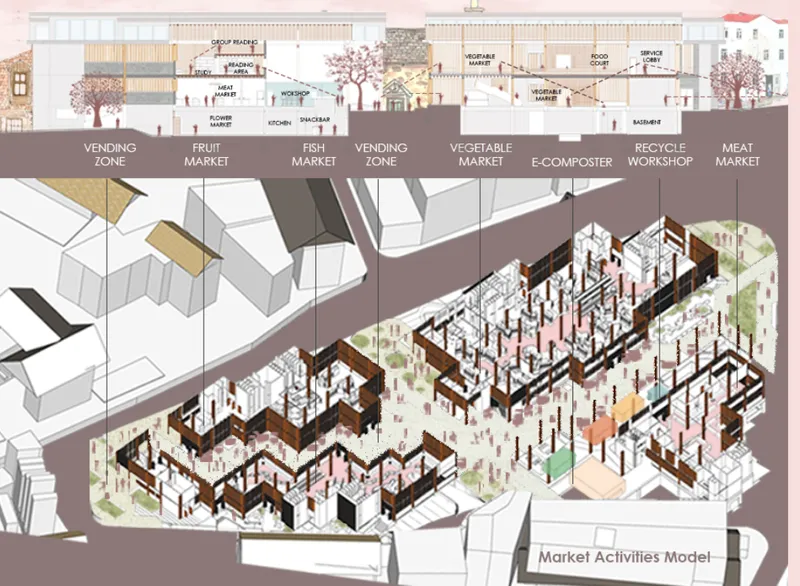
The axonometric and sections make the porosity legible. The fruit, fish, vegetable and meat markets are laid out as distinct zones, but the drawing places them inside the surrounding street buildings rather than behind a perimeter. The project describes these as layered spatial zones, a way of organising trade without separating informal vendors from the formal market. That distinction matters. Many market projects formalise vendors by enclosing them. Here, the vendors become part of a continuous ground plane that the public crosses freely.
The sections also reveal the environmental logic. South-facing skylights and an exterior louver system were tuned through sun path studies at the solstices and equinoxes. The aim is to cut heat gain while bringing in diffused daylight, which gives the project its name. Natural ventilation reduces reliance on mechanical systems, a sensible move for a building that handles fish and meat in a hot, humid coastal climate.
A Timber Mezzanine That Turns Shopping Into Watching
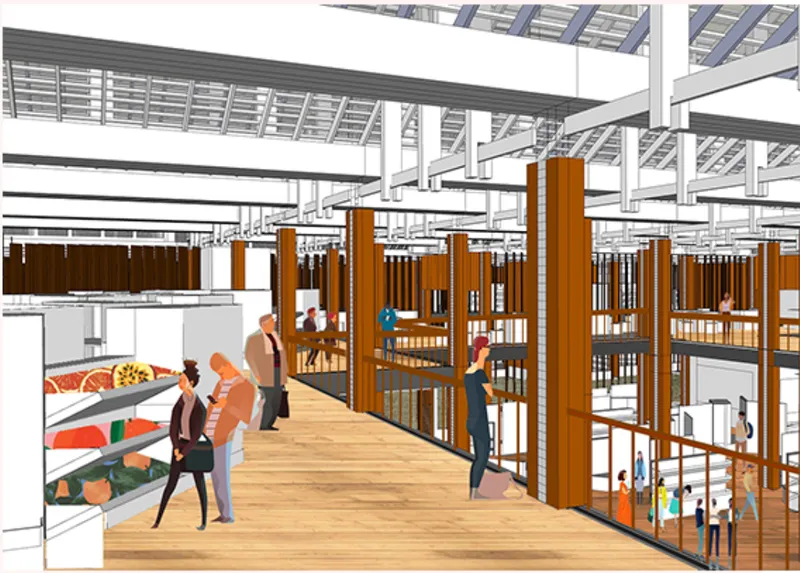
The interior perspective is where the proposal feels most convincing. A timber-floored mezzanine walkway runs between wood columns, fruit displays line the edge, and a trussed roof spans overhead. The upper level reads as one of the project's viewing decks. From there, shoppers can look down over the trading floor instead of being funnelled past it. The market becomes a place to linger as well as a place to buy.
The material choice carries an argument of its own. Acharya selects wood partly because it lowers lifecycle carbon emissions compared with steel and concrete. Locally available materials and debris reuse strategies reinforce that position. In a monsoon city, timber needs careful detailing to survive. Still, the warmth it gives this interior is a deliberate counterpoint to the concrete shopping blocks that so often replace traditional markets.
A Screened Edge, a Planted Plaza and a Ground That Gives Back
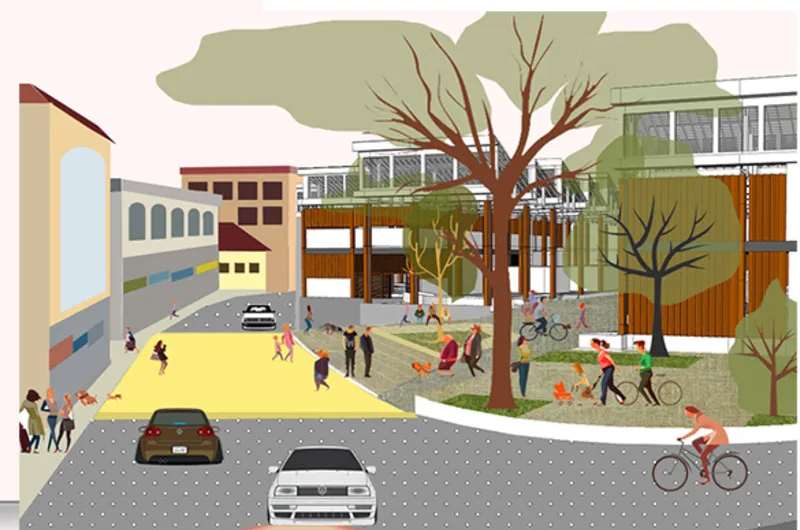
From the street, the building shows a timber-screened facade next to a planted plaza. A large tree shades cyclists, pedestrians and parked cars. The louvers filter sun and soften the building's presence on Market Road, while the plaza does the civic work. It extends the central spine that Acharya describes as changing over the course of the day. Temporary urban furniture, seating terraces and shaded boulevards let the same ground serve trade, rest, community events and chance encounters.
Much of the project's ambition sits out of sight, below this plaza. Despite heavy rainfall, Mangaluru suffers from groundwater depletion, so the proposal introduces aquifer recharge systems and underground storage chambers. Waste gets the same systemic treatment: the market's food waste is processed within 24 hours and converted into manure. That closes a loop that usually ends in a landfill, and it generates revenue for the market itself.
Why This Project Matters
The Communal Lightbox is valuable because it refuses the usual trade-off between order and informality. Indian cities depend on street vendors for employment, yet public projects routinely treat them as clutter to be controlled. Acharya inverts that premise. The vendor sits at the centre of the brief, and the architecture, from daylit roofs to manure cycles, is built to support that economy rather than discipline it.
Some ideas would need testing beyond a thesis, including the durability of timber in a coastal monsoon setting and the management model behind on-site waste processing. The direction is still the right one. By pairing climate-responsive design, circular systems and water resilience with a genuinely porous plan, the project shows how a market can again become what it once was in Hampankatta: a social condenser where the city meets itself.
View the Full Project
About the Designers
Designer: Neethi Acharya
Enter a Design Competition on uni.xyz
uni.xyz runs architecture and design competitions year-round that reward proposals with spatial conviction and real site intelligence.
Project credits: The Communal Lightbox by Neethi Acharya.


Popular Articles
Popular articles from the community


Juan García Correa, John González and Claudia Rueda Sink a Circular Amphitheater into a Manizales Engineering Building
On the La Nubia campus in Manizales, Colombia, the S1 Building folds labs and offices into a hillside of ramped lawns that double as a campus route.

David Macias Steps a Doorless Stone and Plaster House Down a Tropical Colombian Hillside
In the humid hills of Colombia, Threshold House replaces the front door with an open void and terraces its 850 m² down the slope instead of fighting it.

Architekt Andreas Gruber Scatters 23 Dark Timber Chalets Across a South Tyrolean Forest Edge
In Molini di Tures, Amonti Chalets breaks a resort into a hamlet of gabled timber houses, with parking, storage and services pushed into the slope.

Cube Design Draws an Ecological Corridor Between Two Shenzhen Hills with the Nankai Building
Beside Shenzhen's container docks, the Nankai Building pairs stacked balconies with a climbing green screen to connect two hillsides across its height.

Similar Reads
You might also enjoy these articles
Healing Façade: A Modular Chapel System That Restores Ethiopia's Sacred Forests
Winner of the Eco-Chapel competition, this circular timber façade collects water from air to rebuild soil and reforest degraded Ethiopian landscapes.
Kaffeebühnen: Where Coffee Shop Architecture Becomes a Civic Stage in Vienna
A linear sequence of timber boxes, transparent shells, and open yards turns the Viennese café tradition into a public performance space.
Eco Chapel: A Modular Forest Pavilion That Grows Like the Landscape It Protects
Hexagonal timber modules weave through existing trees, turning a chapel into a living system for prayer, education, and reforestation.


Urban Forest: A Vertical Ecosystem for 5,000 Workers in Singapore's Changi Business Park
Radially stacked pods and layered green decks turn a 7-acre plot into 47 acres of ecological workspace projected for 2040.

Explore Architecture Competitions
Discover active competitions in this discipline

Challenge to reimagine the Iron Throne

Photograph architecture without architects

Illustrate the lost glory of Angkor Wat - Render Challenge

Design challenge to reuse E-waste
Comments (0)
Please login or sign up to add comments
No comments yet. Be the first to comment!