
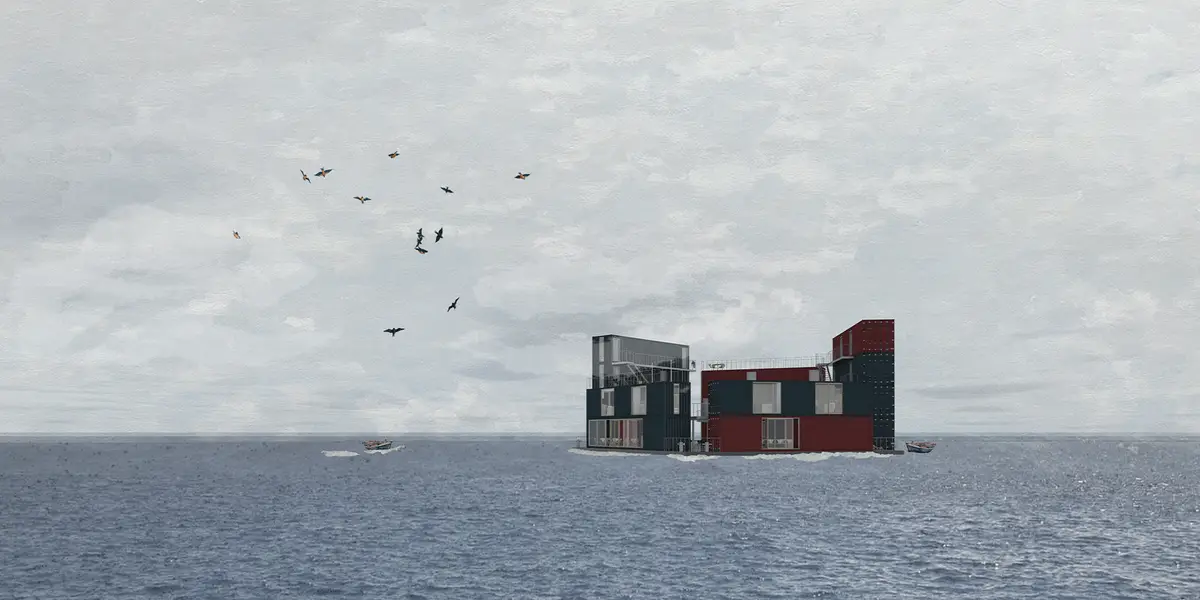
The Floating Neighborhood
A community overseas.

Nowadays, the construction of housing in our cities is taking steps towards a modular basis, planned so that it has the lowest possible cost and the greatest use of the minimum stipulated area, to fulfill both the necessities of growth as well as the lives and needs of the inhabitants.
A shipping container can be a generator for new avenues of thought and creative dwelling. Thinking the container as a housing unit, a generator of common space, when it no longer serves its purpose, proposes a great challenge for architects. Reflecting on how to design a minimum area having in consideration space optimization and efficiency, while providing comfort and quality of life.
The design process began with a simple model where different configurations on how to display fifteen containers, this exercise led us to the establishment of principles for our proposal: the design should be clear in its geometry and organization. The main idea was too lean on the concept of a neighborhood and transport it to a floating community; therefore, the containers are organized around a void on a regular base, a pentagon. This circular arrangement of the shipping containers parallel to the sides of the pentagonal base allows for a diverse use of the plaza while leaving the corners free in order to create five possible entrances, underlining this idea of radial configuration.
With water as our site, the idea was that The Floating Neighborhood could sail across the oceans creating a community. The design allows for different configurations on how dock in different places around the globe and also permits that another floating groups could attach together and navigate the world simultaneously.
The spatial and programmatic organization maintains the clear initial logic of the design and the definition of its limits. The central square of the pentagonal base is for all students to use. The ground floor containers make the most public areas of the residence: a coffee bar run by the students, a bigger kitchen with an eating room, a convenience store, a library and an open space for study or activities. The containers above the ground floor containers are student rooms, which are open towards the sea and more closed to the square to maintain privacy. In order to enforce the idea of connection to this wide open space the metal staircases and galleries are facing it and introduce an element of movement and diversity. This way when docked the square can become a public space while on sea can be enjoyed by students.
One of our concerns was that each student could feel that they had a space that was their own and each had their intimacy in spite of the connecting galleries to central square. There is a clear notion and limite of what is collective and what is individual, private or public. We believe this is extremely important today because of the way in which we want the space to be used and the comfort we wanted to generate, the architectural elements that separate both dimensions are the root of the symbiotic relationship between open space and private space.
To ensure this difference between the exterior and interior dimension, it seemed to us that the choice of the materials would have to be a different. While on the exterior more robust materials such as metal and iron are used to create the connection between containers, the interior of room is constructed with wood and plaster for a more comfortable and inviting feeling in this way abandoning the expression of the container on the inside. Each container fits two students rooms, both with a private bathroom and kitchenette, the concern of how to design in a narrow space led to the proposal where multiple wood cabinets and doors have multi-pupuse and store the bed that can be closed when not being used. This design of module cabinet allows for individualized way of living.
The Floating Neighborhood is designed as a student living concept that encompasses change and diverse use at its root. Our proposal stands from the belief that a place like this one is conceivable, specially nowadays where a transition to a more virtual way of living is happening and becoming more and more possible. We witness the rising of movements such as nomad and tiny and minimal living, this idea of freedom of location not restrained by boundaries is relevant to our concept. The introduction of architectural elements and urban principles to this pentagonal base made of re-used shipping containers, we strongly believe creates a neighborhood or a community that appeals to students and designs for the future with an emerging way of life.

Popular Articles
Popular articles from the community


Manzana Morphosis: Stretching Barcelona's Grid into a Living Landscape for 2050
A radical reworking of the Eixample manzana turns density into a tool for generous public space, vertical ecology, and environmental performance.

The Amber Palace Opera: A Geological Fiction Surfaces on Tallinn's Baltic Waterfront
Pierre Brillard reimagines a Baltic legend as a public landscape, opera house, and waterfront promenade rooted in Tallinn's coastal identity.

Opera by the Sea Estonia: Three Shells Dissolving Architecture into Tallinn's Coastline
A winning opera house proposal replaces monumental form with interconnected shells that blur the boundary between building, park and Baltic Sea.

Faces of the Soviet Avant-Garde: Turning Moscow's Street Names into an Open-Air Museum
A network of sculptural installations across a Moscow residential district transforms forgotten architect names into spatial encounters with cultural memor

Similar Reads
You might also enjoy these articles

The Rhythm of Seasons
A Farmers' Market Connecting Nature and the City

More Than a Building-Designing a Living System
More Than a Building-Designing a Living System
Base Beyond
DESERT COMPOUND ARID: TOURISM OF ABSENCE AND ABUNDANCE

Comments (0)
Please login or sign up to add comments
No comments yet. Be the first to comment!