
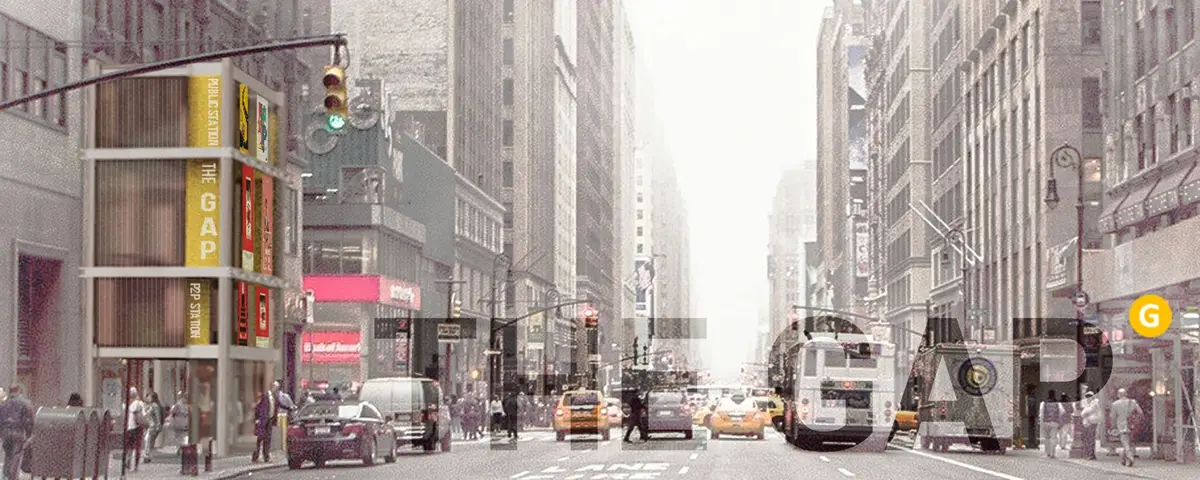
The Gap: Reclaiming Public Space from the Digital Landscape
A network of modular urban stations transforms overlooked city gaps into interactive hubs for community, commerce, and culture.


As cities invest heavily in smart infrastructure, something ironic is happening: the physical public spaces that once defined urban life are becoming dead zones. Mobile devices have turned citizens into nodes on a digital network, and the sidewalks, plazas, and street corners between those nodes are being left behind. The Gap asks a pointed question: what if we could plug public space back into the city's operating system?
Developed by Wenpeng Bi and Yi Zhong, this concept was recognized as an Editor's Choice entry in Elevate 2019. The project proposes a city-wide system of modular, interactive public stations that serve as help stations, community interaction zones, and trade or exhibition spaces. Branded as "G THE GAP," the system integrates with a mobile application to enable real-time information sharing and data-driven urban renewal, ensuring that physical public spaces remain relevant as the digital landscape evolves.
Reading the Gaps in the Urban Grid
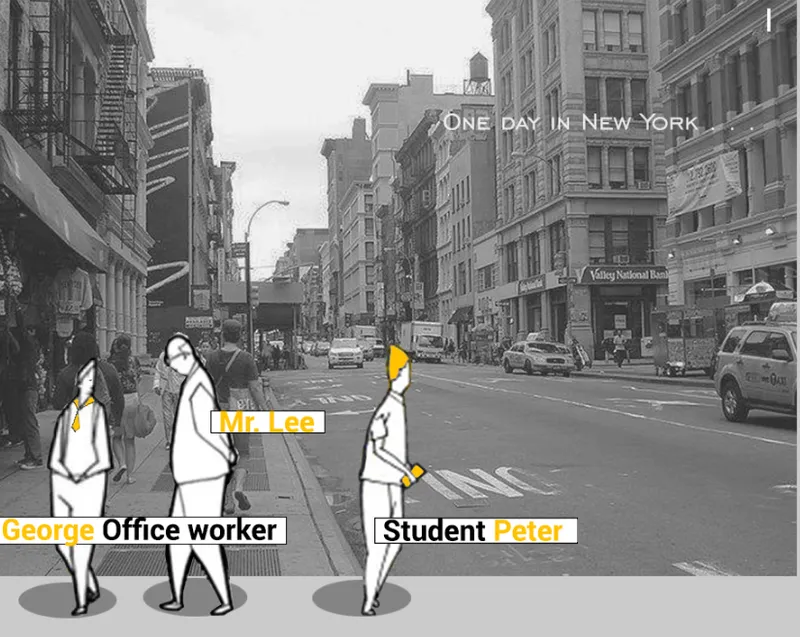

The project begins with an honest look at existing street conditions. Dense masonry blocks, heavy pedestrian crossings, and predictable movement corridors define the urban fabric under study. The axonometric analysis maps these pedestrian flow patterns against the built environment, identifying the residual spaces where foot traffic thins and public engagement drops off. These are the "gaps" that the project targets: underperforming corners, leftover sidewalk widths, and transitional zones between buildings where no one pauses.
Street-Level Context: Where Neglect Meets Opportunity
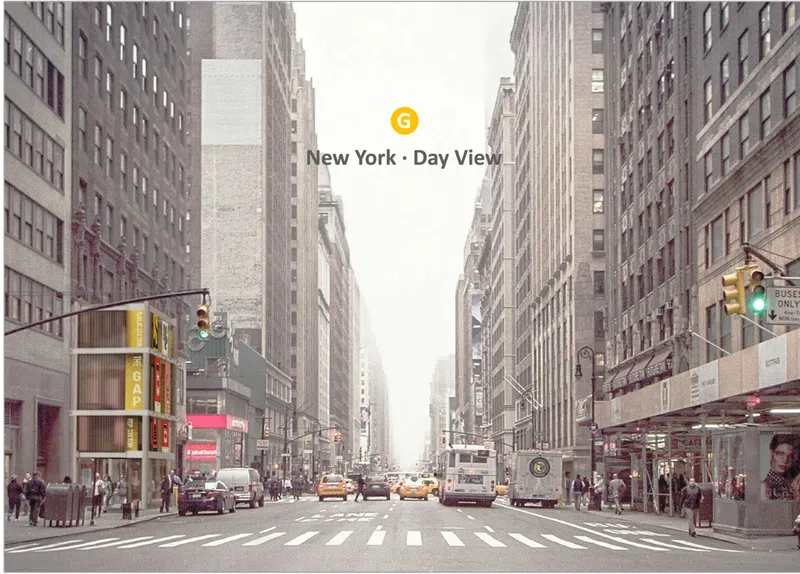


The designers ground their proposal in real streetscape conditions. Avenue views between brick facades, yellow cabs rolling under hazy daylight, and storefronts that glow at dusk reveal the kind of urban corridors where public life currently defaults to passing through rather than staying. A diagrammatic study of outdoor seating, cafe tables, trees, and pedestrian flow shows how even small interventions can redirect attention and encourage people to linger. The contrast between a bustling intersection and a quiet dusk scene reinforces the argument: these spaces have latent social energy that goes untapped without a catalyst.
A Modular Kiosk at the Sidewalk Corner


The core architectural unit of The Gap system is a modular kiosk designed to occupy sidewalk corners, precisely the spots the site analysis identified as underused. The isometric drawing presents a compact structure scaled to the pedestrian realm, sitting alongside yellow cars and foot traffic without overwhelming the streetscape. A more developed three-story iteration, clad in corrugated metal with prominent signage, demonstrates how the module can scale vertically when program demands it. The material language is deliberately urban and industrial, designed to read as infrastructure rather than ornament.
Stacked Programs: Display, Retail, and Workspace


Cutaway axonometric and section drawings reveal the interior logic of the stations. The two-level configuration dedicates space to display areas where local culture and commerce can be exhibited, while figures on both levels suggest active use rather than passive observation. The more complex variant introduces stacked retail and workspace modules held within a yellow structural frame, making the adaptability of the system visible. These are not fixed buildings; they are configurable containers whose program can shift based on user demand and data feedback from the mobile application.
The structural honesty is worth noting. By exposing the yellow frame and making the modular assembly legible from the outside, the designers communicate the system's core promise: that these stations can be reconfigured, relocated, or expanded as neighborhoods change. Architecture here becomes a physical API, offering public space as a service.
Why This Project Matters
The Gap tackles a paradox that most smart city proposals ignore. The more connected a city becomes digitally, the more its physical public realm risks irrelevance. Rather than accepting that trade-off, Bi and Zhong propose a hybrid system where architecture and app work together, using data to keep physical spaces responsive and programmatically alive. The modular approach avoids the trap of grand master plans that take decades to realize, offering instead a distributed, incremental strategy that can adapt to real conditions in real time.
What makes the proposal compelling is its refusal to treat public space as a nostalgia project. The designers do not argue for a return to pre-digital plazas; they argue for a new kind of public infrastructure that is as networked and responsive as the phones in people's pockets. The gap between digital and physical urban life is real, and closing it requires exactly this kind of thinking: systematic, modular, and grounded in how streets actually work.
View the Full Project
About the Designers
Designers: Wenpeng Bi, Yi Zhong
Enter a Design Competition on uni.xyz
uni.xyz runs architecture and design competitions year-round that reward proposals with spatial conviction and real site intelligence.
Project credits: THE GAP City APP for the public by Wenpeng Bi, Yi Zhong Elevate 2019 (uni.xyz).


Popular Articles
Popular articles from the community

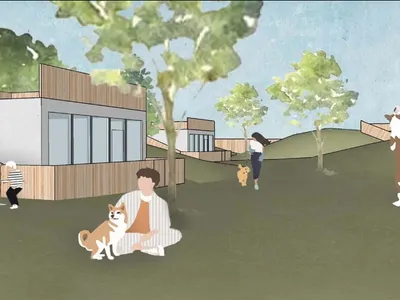
Temporary Home for Dogs: A Reversed Zoo Rethinks Animal Shelter Architecture
In Bucharest, a sinuous corridor and freed landscape flip the logic of containment, designing a shelter that works to make itself unnecessary.

Manzana Morphosis: Stretching Barcelona's Grid into a Living Landscape for 2050
A radical reworking of the Eixample manzana turns density into a tool for generous public space, vertical ecology, and environmental performance.

Singing Woman: Contemporary Architecture Inspired by Estonia’s Voice and the Sea
Singing Woman turns Estonia’s song culture into flowing opera house architecture, blending public life, landscape, sea, and national memory.
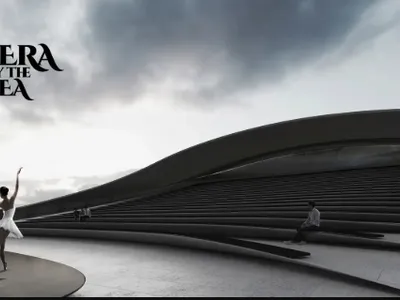
Opera by the Sea Estonia: Three Shells Dissolving Architecture into Tallinn's Coastline
A winning opera house proposal replaces monumental form with interconnected shells that blur the boundary between building, park and Baltic Sea.

Similar Reads
You might also enjoy these articles

Day and Night Park: A Time-Based Urban Newsstand in Beijing
A temporary urban newsstand in Beijing blending travel, light, and reading through poetic colors, compact form, and community-focused design.

Modernist Patio Renovation in El Masnou, Barcelona by Oliver Segura Arquitectura + Cebrià Arquitectura
Modernist patio renovation blending tradition and innovation with a movable pool, leveled floors, and Catalan materials in El Masnou.

Alto Residencial Coop: Cooperative Housing Development in Santiago de Compostela by Carbajo Barrios Arquitectos
A linear cooperative housing complex blending white volumes and perforated metal façades, enhancing community living, natural light, privacy, and urban integration.
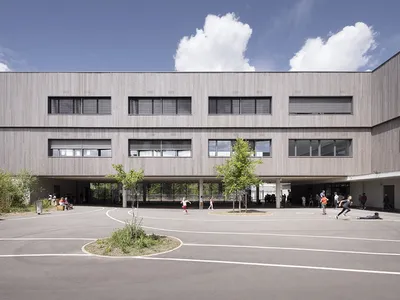
Vil Genis School by BPA ARCHITECTURE – Massy, France
Vil Genis School in Massy, France, features sustainable design, south-facing classrooms, community integration, accessible spaces, and modern educational architecture.

Explore Smart City Competitions
Discover active competitions in this discipline

Challenge to design locus for the upliftment of human rights

Design challenge to reuse E-waste
Comments (0)
Please login or sign up to add comments
No comments yet. Be the first to comment!