

The Green Eye of Sahara: Engineering Oases as Prototypes for Desert Cities
A phased regeneration strategy transforms barren Saharan terrain into self-sustaining urban ecosystems through buried water networks and circular growth ba


What if the logic of a flowerpot could scale to the size of a city? That is the provocation at the center of The Green Eye of Sahara, a speculative proposal that treats the world's largest hot desert not as a void to be endured but as a substrate to be cultivated. The design imagines circular planting basins, buried irrigation grids, and seawater desalination infrastructure working together to trigger ecological recovery, layer by layer, until the terrain can support permanent human settlement. It is landscape architecture reframed as long-term urban planning, stretched across an 80-year timeline from first pipe to replicable prototype.
Developed by Zhichen Liu and Yuhan Shen, the project takes the Saharan oasis as both precedent and blueprint. Surveys of existing settlements around the Sahara show communities still relying on oases for water, microclimates, food, and shade. Rather than treating these as isolated natural anomalies, the designers read them as bioclimatic systems: self-regulating loops of moisture retention, temperature moderation, and soil stabilization. The Green Eye of Sahara asks what happens when you engineer those loops from scratch and then let biology take over.
A Water Network Buried Beneath the Sand
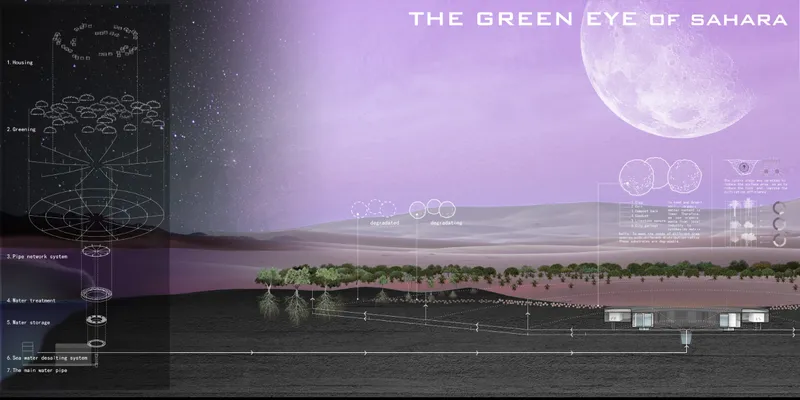
The section drawing reveals the project's hidden infrastructure: a subterranean system of pipes, filtration networks, and storage tanks that channels desalinated seawater to the root zones of desert-hardy species. Everything above ground looks organic, almost inevitable, but beneath the surface lies a carefully calibrated delivery system designed to encourage deep rooting. The irrigation grids are buried to minimize evaporation losses, a critical strategy where surface temperatures can make conventional watering futile. Pipe networks, filtration systems, and controlled irrigation grids form the backbone of the future oasis, all installed in a first phase the designers target for 2020.
The planted trees along the desert horizon in this drawing are not ornamental. They represent the second phase, beginning around 2030, when substrate-filled basins receive Phoenix, Acacia, and Borassus palms selected for their ability to stabilize soil and lower surface temperatures. The purple sky above is a stark reminder of the extreme conditions these systems must survive: punishing solar radiation, vast diurnal temperature swings, and wind-driven sand erosion. The infrastructure must work before the ecology can begin.
From Oasis to Settlement: Life Among the Palms
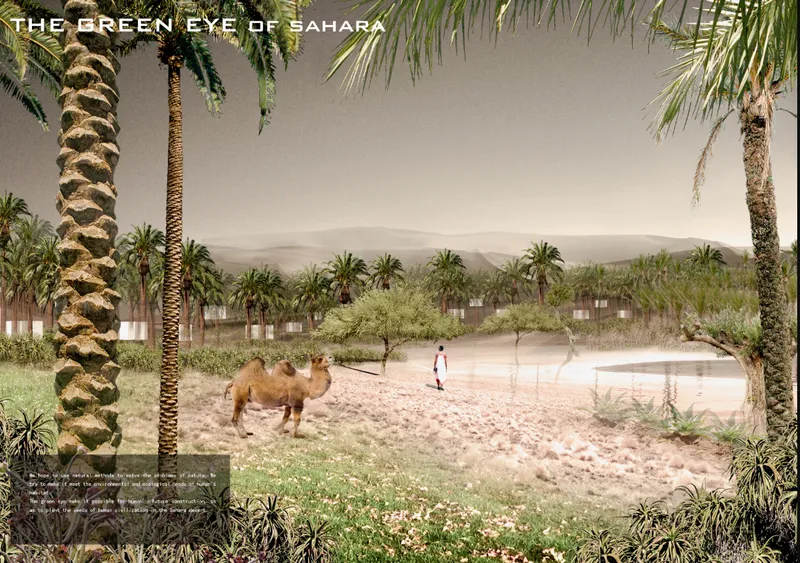
By the time the rendering's courtyard scene becomes reality, decades of ecological groundwork have already occurred. The visualization shows what the designers envision for 2060 and beyond: scattered pavilions nestled among mature palm groves, a camel moving through the sandy terrain, and mountains framing the backdrop. The architecture here is deliberately modest, water-efficient building clusters arranged in circular community layouts that mirror oasis morphology. There are no towers, no spectacle. The settlement defers to the landscape it has helped create.
The spatial logic is significant. Buildings cluster around shade and water, not roads or property lines. Renewable energy systems supplement the desalination and irrigation infrastructure already in place. The circular layout is not aesthetic whimsy; it follows the outward expansion pattern of the vegetation itself, which grows from its initial basins "like ripples in a pond," as the designers describe it. Human habitation arrives only after the microclimate has matured enough to sustain it, an inversion of the typical development sequence where construction precedes ecology.
Flowerpot Logic at an Urban Scale
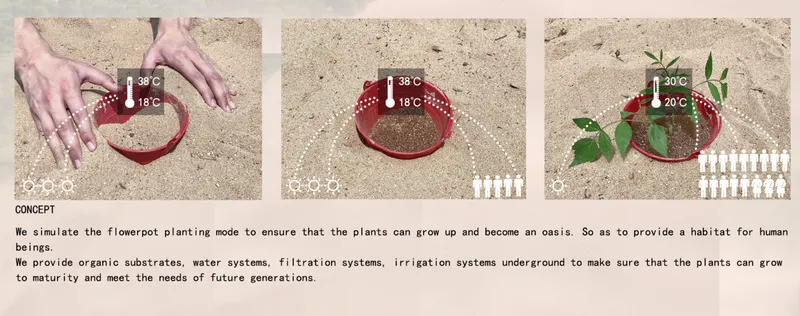
The three-panel diagram strips the concept down to its most elemental gesture: hands placing plants into containers set on sand, with temperature indicators tracking the thermal environment as vegetation grows. It is a deliberate analogy. The designers describe their core idea as recreating "the self-contained logic of a flowerpot at an urban scale." Each circular growth basin acts as a controlled cell: organic substrates nourish early-stage planting, moisture is retained through engineered soil profiles, and adaptive temperature control mitigates the worst of the desert climate. As each basin matures, it stabilizes enough surrounding terrain to allow the next ring of planting to begin.
The temperature indicators in the diagram are not decorative. They track the measurable shift from hostile to habitable: as canopy cover increases, ground-level temperatures drop, evaporation slows, and a feedback loop takes hold where healthier soil retains more water, supporting denser vegetation. By 2040, the designers project that continuous care will produce a self-reinforcing microclimate. By 2100, the mature oasis becomes a repeatable prototype, capable of being reproduced across the Sahara as interconnected "green islands." The ambition is vast, but the method is incremental, rooted in the patient logic of cultivation rather than the speed of construction.
Why This Project Matters
The Green Eye of Sahara is not a building. It is a timeline. Its most provocative contribution is the argument that architecture in extreme environments should not begin with structures but with soil, water, and roots. By sequencing ecological restoration before human settlement, Liu and Shen challenge a development paradigm that treats landscape as a backdrop rather than a prerequisite. The four-stage roadmap, stretching from infrastructure to replication, positions architecture as stewardship: a discipline measured in decades of canopy growth, not months of construction.
As habitable land shrinks and desert boundaries expand, proposals like this gain urgency beyond the speculative. The project's strength lies in its refusal to treat the Sahara as a blank canvas for futuristic imagery. Instead, it reads existing oasis settlements as proven technology and asks how that technology can be systematically replicated. Whether or not an 80-year plan survives contact with political and economic reality, the framework it establishes, ecology first, settlement second, replication third, offers a credible counter-narrative to extractive development models in arid regions worldwide.
View the Full Project
About the Designers
Designers: zhichen liu, yuhan shen
Enter a Design Competition on uni.xyz
uni.xyz runs architecture and design competitions year-round that reward proposals with spatial conviction and real site intelligence.
Project credits: The Green Eye of Sahara by zhichen liu, yuhan shen.




Popular Articles
Popular articles from the community

AL-JANNAH: Sustainable Architecture and Permaculture for Afghan Widows
AL-JANNAH uses sustainable architecture and permaculture to create resilient oasis of housing, learning, work and renewal for Afghan widows.

Co-life: Sustainable Architecture for Age-Friendly Community Living
Co-life reimagines sustainable architecture for seniors through courtyards, rammed earth, shared gardens, and spaces designed for belonging.

The Earth Pod: 3D Printed Homes for Resilient Refugee Communities
The Earth Pod reimagines refugee housing through 3D printed homes made from clay, combining resilience, self-sufficiency, and rapid shelter.

The Musturak Paradise: Senior Living Architecture for a Connected Future in Temara, Morocco
The Musturak Paradise reimagines senior living architecture in Temara via private homes, social spaces, culture, community, and shared care.

Similar Reads
You might also enjoy these articles
The Musturak Paradise: Senior Living Architecture for a Connected Future in Temara, Morocco
The Musturak Paradise reimagines senior living architecture in Temara via private homes, social spaces, culture, community, and shared care.

The Leaf Center: Cultural Center Architecture for Social Integration in Amsterdam
Cultural center architecture becomes a bridge at The Leaf Center, connecting international students with Amsterdam through art and exchange.

Conexión: Biophilic Design Reimagines High-Rise Living in Hong Kong
Conexión reimagines high-rise living in Hong Kong through biophilic design, green facades, shared spaces, daylight, water and nature within.

Wander to Wonder: Modular Playground Design for Children in Kutupalong Refugee Camp
Wander to Wonder uses modular playground design to create flexible, imaginative play spaces for children in Kutupalong refugee camp.


Explore Desert Design Competitions
Discover active competitions in this discipline



Challenge to reimagine the Iron Throne


Photograph architecture without architects


Illustrate the lost glory of Angkor Wat - Render Challenge


Design challenge to reuse E-waste
Comments (0)
Please login or sign up to add comments
No comments yet. Be the first to comment!