

The Healing Crack
Time will dilute the scars of history and move towards the future with vitality

Article of the project
War is a chessboard game between political giants with innocent people as pawns and great rivers and mountains as bets. No matter who wins or loses in this game, the result must be that great rivers and mountains and natural environment are damaged at the expense of ordinary people.
The war in Syria lasted for ten years. As a result of this war, the whole national structure collapsed, civilization regressed, and the world cultural heritage with a long history was destroyed by artillery fire. So far, more than 4 million Syrians have fled their hometowns, and even the elderly and newborn babies have been forced to embark on the road of escape......
Question
What was the concept behind the project?
The long river of history is always rushing, and this long road is always bumpy and full of thorns. War has traumatized it. Maybe tears and blood will dry up slowly with time, but this scar will always exist. With it, there are a series of tragedies that constantly overflow from these scars and cracks. Can these scars full of grief and anger in history sound the alarm for us living in today's world? Can we disagree with the meaning of existence, and then lead to a deeper discussion of the inner law of the world?
Therefore, the purpose of this programme is to design an archaeological park for Aleppo Castle with the theme of "The Healing Crack". We hope that the cracks and scars of history can be presented to the audience in the form of exhibitions, so that the audience can immerse themselves in these historical traces and think deeply about them, thus forming their own brand-new cognition of the current life and situation.
What was the intent behind the organization of elements across various levels (Architectural, Site, Urban)?
This project is a comprehensive space with architecture as the main part and landscape as the auxiliary part.
How many iterations were tried to arrive at the final outcome?
We tried three iterations, first of all, we take the concept of "gap" as the starting point and depict the general shape of the building. Secondly, we add the concept of "time" to the design, which adds narrative expression to the architecture. Finally, we also add the elements of "historical environment" in the design, and at the same time, adjust and deepen the lighting, material and comprehensive performance of the space.
Which methods of design investigation?
Early on in the project, we investigated the Aleppo Basin in northwest Syria. Specifically, We investigated the local geographical environment through Google Maps, We used Google Browser to collect local climate and environment, folk culture, religious beliefs, war traces and other relevant data. Then, we searched relevant historical photos on Pinterest and learned about their architectural features. Finally, we summarized these data and information and completed the preliminary research work.
How was the programme condensed into final?
After planning the initial shape of the project, we simplified its shape in order to show the purity of the building and the solemnity and heaviness of the "stone tablet". In the design language, we uphold the principle of "majority unity and local change", and shape the space calmly but with ups and downs (waves). In the aspect of outdoor design, we simplify the outdoor installation and highlight the building itself, so as to make the design scheme more pure and simple.
What/How were the materials chosen?
In the application of materials, we use concrete and natural stone to combine, and apply some special materials locally, such as burned stone, translucent gray glass, etc.......
As for the outdoor layout and design, we strive to perfectly integrate the existing materials with the natural environment, and create a more interesting outdoor environment by adopting the contrast technique of sand and gravel and green plants.
How was a specific objective attempted to be met?
For example, in term of the meditation space design, we intend to insert the whole space obliquely into the building, which not only ensures its integrity, but also makes the whole streamline design achieve the best visual effect. At the same time, this design brings a strong sense of impact to people. For another example, in the design of reading area, we adopted the design method of "sinking", which divided an independent semi-closed area on the basis of the original open space, providing readers with a quiet and comfortable reading environment.
What is the expansion plan of the project?
This programme reserves scalable free space for future functional requirements. We designed a slotted space under the raised ramp, where some functional partitions can be stored, and its existence will not affect the dominant position of the building, because it is hidden underground, which greatly improves the space utilization and flexibility.
How will the project transform with the passing time? etc.
We plan to plant plants that can grow freely beside the building. As time goes by, these plants will grow up gradually, and eventually they will grow enough to wrap some cracks in the building. This form means that "time will dilute the scars of history and move towards the future with vitality." I really hope we can witness the changes over time together!

Popular Articles
Popular articles from the community

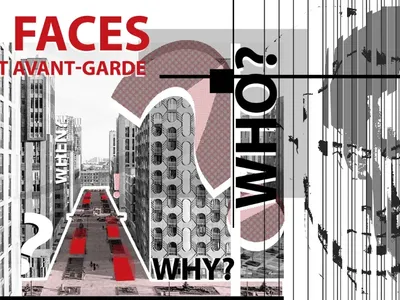
Faces of the Soviet Avant-Garde: Turning Moscow's Street Names into an Open-Air Museum
A network of sculptural installations across a Moscow residential district transforms forgotten architect names into spatial encounters with cultural memor

Opera by the Sea Estonia: Three Shells Dissolving Architecture into Tallinn's Coastline
A winning opera house proposal replaces monumental form with interconnected shells that blur the boundary between building, park and Baltic Sea.

Opera on the Sea: Driftwood Logic Shapes a Timber Opera House on Estonia's Coast
Trevor Orgill's opera house translates the entangled drift of floating timber into a civic building where wood, water, and music converge.

Temporary Home for Dogs: A Reversed Zoo Rethinks Animal Shelter Architecture
In Bucharest, a sinuous corridor and freed landscape flip the logic of containment, designing a shelter that works to make itself unnecessary.

Similar Reads
You might also enjoy these articles

Shakur's House: Exposed Brick as an Interior Organiser in a 168 m² Mashhad Residence
Brick moves indoors in this Mashhad residence, where masonry walls, glass partitions and teal planes sequence a compact home without closing it off.

Day and Night Park: A Time-Based Urban Newsstand in Beijing
A temporary urban newsstand in Beijing blending travel, light, and reading through poetic colors, compact form, and community-focused design.

Modernist Patio Renovation in El Masnou, Barcelona by Oliver Segura Arquitectura + Cebrià Arquitectura
Modernist patio renovation blending tradition and innovation with a movable pool, leveled floors, and Catalan materials in El Masnou.

Alto Residencial Coop: Cooperative Housing Development in Santiago de Compostela by Carbajo Barrios Arquitectos
A linear cooperative housing complex blending white volumes and perforated metal façades, enhancing community living, natural light, privacy, and urban integration.

Explore Cultural Architecture Competitions
Discover active competitions in this discipline


Challenge to reimagine the Iron Throne

Photograph architecture without architects

Illustrate the lost glory of Angkor Wat - Render Challenge

Bring back Drive In's
Comments (0)
Please login or sign up to add comments
No comments yet. Be the first to comment!