

The High-Rise Life
Hybridization- the new age architecture


Context
City skylines are being rewritten, with international design firms like Foster+Partners and BIG coming up with sky-high solutions to corporate and residential ails every other day. Instead of being an aesthetic, voluntary choice (as it seems), going tall is becoming the necessary decision in the world of infrastructure. With growing populations and decreasing availability of land, skyscrapers provide one of the best ways to house a large number of residents in small ground coverage. In metropolitan cities like New York and Hong Kong, High-Rise life has already been adopted as the way of life for all citizens. Offices, residences, and commercial centres — all can be accommodated within the confines of a tall box. The popularity of skyscrapers has now reached developing cities as well, with public and private bodies both opting for modern glass-covered metal containers as the architecture of today.
Background
Skyscrapers have a long history, beginning from 10 stories tall and now breaking limits in both virtual and physical realms. More than the defining point of modern architecture, skyscrapers are functional and effective in today’s scenario. There are limitations to innovating with materials and façade designing, but at the same time, we have that much freedom to design and plan the internal functioning of the towers. Coupled with progressive technologies, city infrastructure is experiencing a major revamp. Barring the common typologies we see being followed today, there is a lot of scope for future internal development, with regards to hybrid typologies. A new trend in urban planning is to integrate different spaces corroborating to different usage into one building or one neighbourhood. For example, vertical architecture has a set number of floors dedicated to the commercial, official, and residential space respectively, or some permutation of either. However, these examples fall under the ‘mixed-use category of infrastructure — in which building blocks catering to varied functions are placed together yet do not encourage integration and interaction.
The concept of Hybrid
 As designers, it is our thinking that sets us apart — the thought of bringing something new and innovative to the table. We have to focus on the past, present, and future at the same time to create designs that speak to the humans of now and of the coming generations. The concept of hybridization considers taking the mixed-use typology to the next level. Architect Steven Holl rightly explains the concept in his book ‘This is Hybrid’ — “The hybrid building is a specimen of opportunity which has the mixed-use gene in its gene code. It turns against the combination of the usual programs and bases its whole raison d’etre on the unexpected mixing of functions. The hybrid is the consequence of a rant against tradition, giving typology the one-finger salute. It is an opportunist building, which makes the most out of its multiple skills, a key player which revitalizes the urban scene and saves space.”

This concept differs from the mixed-use category in a manner of design — there are no singular blocks, rather a ‘hybrid’ building which consists of social blocks, integrating different use spaces through open and public plazas. Vertical buildings, even with their mixed-use typology, are unable to create interaction between all kinds of end-users. Hybridization gives us more freedom to ideate — that is, creating a building in which different use spaces seem open and connect through public platforms. With this freedom in hand, we can take hybridization of spaces to the next level — say, seamlessly integrating corporate typologies with travel ports through small commercial plazas that act as co-working spaces as well, or commercial hubs blending with transportation parks, integrated through ‘resting’ lounges open to the public, all in one high-rise tower.
 Conclusion
The challenge, ‘Hybrid Futures: Work x Fly’ poses this thought to students and professionals, providing them with the freedom of choosing the future they would like to design. The competition revolves around coalescing workspaces with a flying hub (small airport), either public and/or private, fit into a skyscraper, designed exclusively for the future as we imagine it to be.
The hybridization of spaces is not a standardized concept. It is a design theory, arising due to changing demands of the present urban civilizations. Exploration of this theory through the combination of the logic of technology and the fantasy of our imagination can help us create spaces that will revolutionize the way we live in the future.
To register, visit http://hybridfutures.uni.xyz/


Popular Articles
Popular articles from the community


Opera by the Sea Estonia: Three Shells Dissolving Architecture into Tallinn's Coastline
A winning opera house proposal replaces monumental form with interconnected shells that blur the boundary between building, park and Baltic Sea.

Opera on the Sea: Driftwood Logic Shapes a Timber Opera House on Estonia's Coast
Trevor Orgill's opera house translates the entangled drift of floating timber into a civic building where wood, water, and music converge.
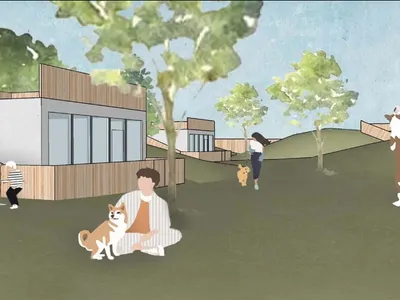
Temporary Home for Dogs: A Reversed Zoo Rethinks Animal Shelter Architecture
In Bucharest, a sinuous corridor and freed landscape flip the logic of containment, designing a shelter that works to make itself unnecessary.

Faces of the Soviet Avant-Garde: Turning Moscow's Street Names into an Open-Air Museum
A network of sculptural installations across a Moscow residential district transforms forgotten architect names into spatial encounters with cultural memor

Similar Reads
You might also enjoy these articles

Day and Night Park: A Time-Based Urban Newsstand in Beijing
A temporary urban newsstand in Beijing blending travel, light, and reading through poetic colors, compact form, and community-focused design.

Modernist Patio Renovation in El Masnou, Barcelona by Oliver Segura Arquitectura + Cebrià Arquitectura
Modernist patio renovation blending tradition and innovation with a movable pool, leveled floors, and Catalan materials in El Masnou.

Alto Residencial Coop: Cooperative Housing Development in Santiago de Compostela by Carbajo Barrios Arquitectos
A linear cooperative housing complex blending white volumes and perforated metal façades, enhancing community living, natural light, privacy, and urban integration.
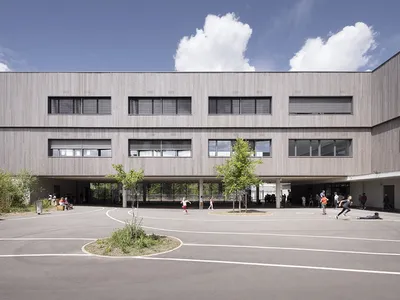
Vil Genis School by BPA ARCHITECTURE – Massy, France
Vil Genis School in Massy, France, features sustainable design, south-facing classrooms, community integration, accessible spaces, and modern educational architecture.

Comments (0)
Please login or sign up to add comments
No comments yet. Be the first to comment!