

The House of Parallel Walls by PVDRS: A Contemporary Joint-Family Residence in Ahmedabad
A climate-responsive family home in Ahmedabad featuring parallel walls, double-height living, verandahs, and seamless indoor-outdoor spaces inspired by traditional courtyards.


The House of Parallel Walls by PVDRS in Ahmedabad, India, redefines modern joint-family living through architecture that balances privacy, openness, and climate-responsive design. Completed in 2025, this residential project celebrates community living, spatial fluidity, and biophilic connections, while responding thoughtfully to Ahmedabad’s hot climate.

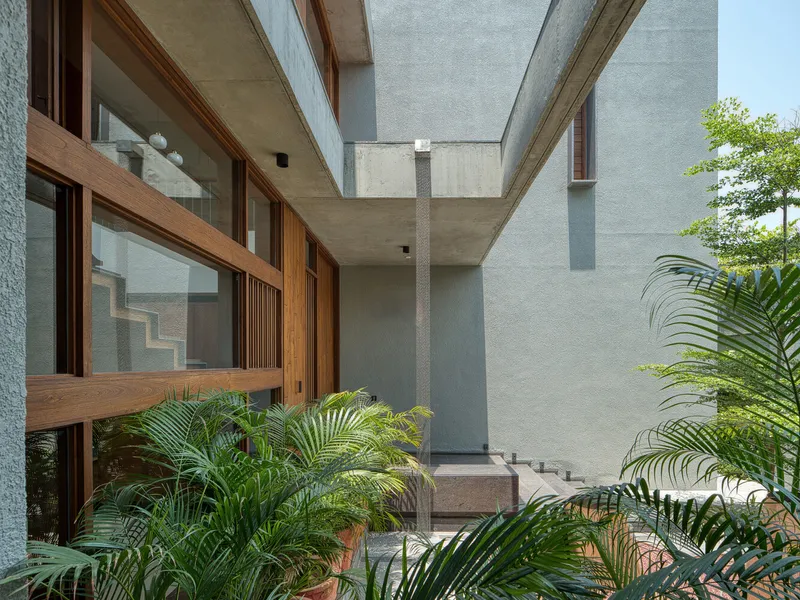
Designed by lead architects Keyur Vadodaria and Megha Patel-Vadodaria, the home is conceived as a sanctuary where multiple generations coexist harmoniously. The structure’s defining feature—two solid parallel walls aligned north-south—creates a protective architectural envelope, shielding interiors from the intense east and west sun while framing flexible living zones that expand into the outdoors.


Central Double-Height Living Space
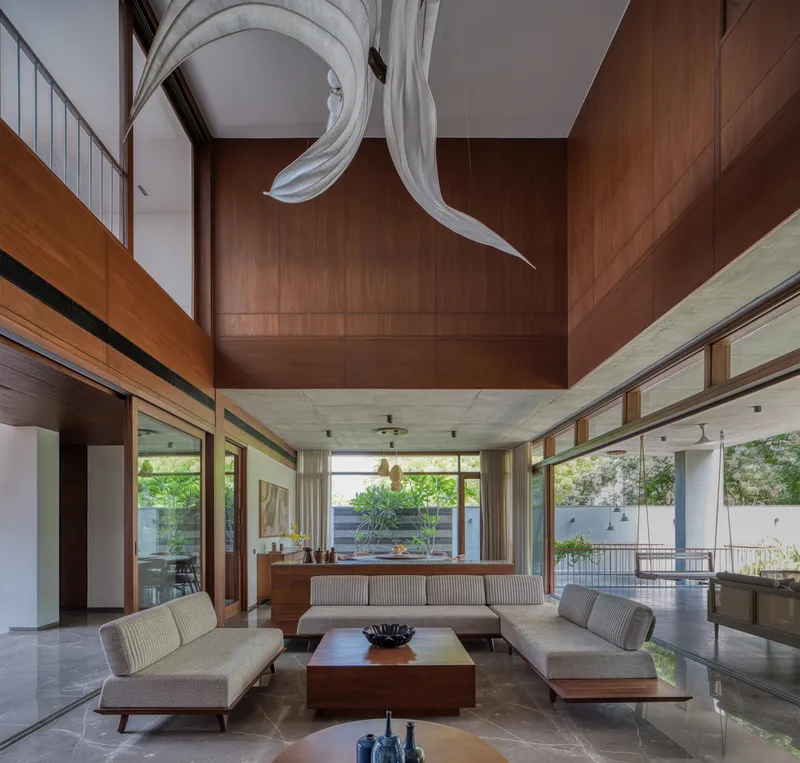
At the heart of the home lies a dramatic double-height living room, envisioned as the communal hub for family interactions. This core volume anchors the spatial layout, connecting formal and informal spaces visually and physically. Circulation, verandah, and living functions merge seamlessly here, eliminating rigid boundaries and fostering family bonding.
Natural light, ventilation, and shadow play animate the interiors, creating an environment that adapts to daily rhythms and seasonal transitions.

Climate-Responsive Architecture and Passive Design
In response to Ahmedabad’s climate, the design employs passive cooling strategies:
- Thick, parallel walls act as thermal buffers
- North- and south-facing openings maximize diffused daylight and cooling winds
- Sliding-folding screens and verandahs modulate airflow, privacy, and sunlight
- Rear garden placement leverages south-westerly winds for natural ventilation
By inverting the typical garden placement—situating it at the rear—the architects created a private outdoor living area that remains shielded from street noise while enhancing cross-breeze and family leisure space.


Courtyard Influence and Vernacular Inspiration
Inspired by traditional Ahmedabad khadkis and chowks, the home reinterprets historic spatial experiences. The passage from the street introduces guests through dynamic shadow patterns into a tranquil arrival court, echoing the gradual thresholds of old city homes.

Spatial Flow and Vertical Connectivity
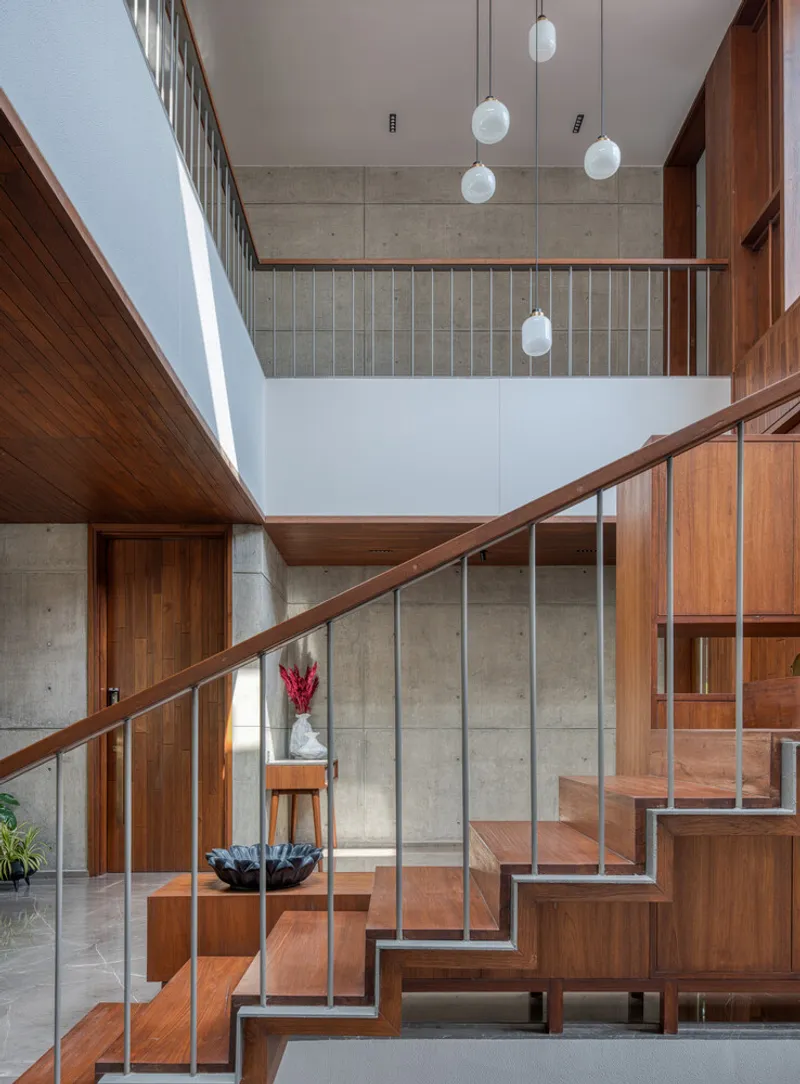
Entry into the double-height vestibule reveals a sculptural staircase washed in natural light. An internal bridge above connects private zones on the upper level while visually linking the foyer to the central living room. Bedrooms occupy four corners around the core, ensuring privacy while maintaining connection to the communal heart.
The verandah serves as an outdoor living room, linking the master suite and basement lounge, reinforcing the indoor-outdoor living experience.
Material Palette and Craftsmanship
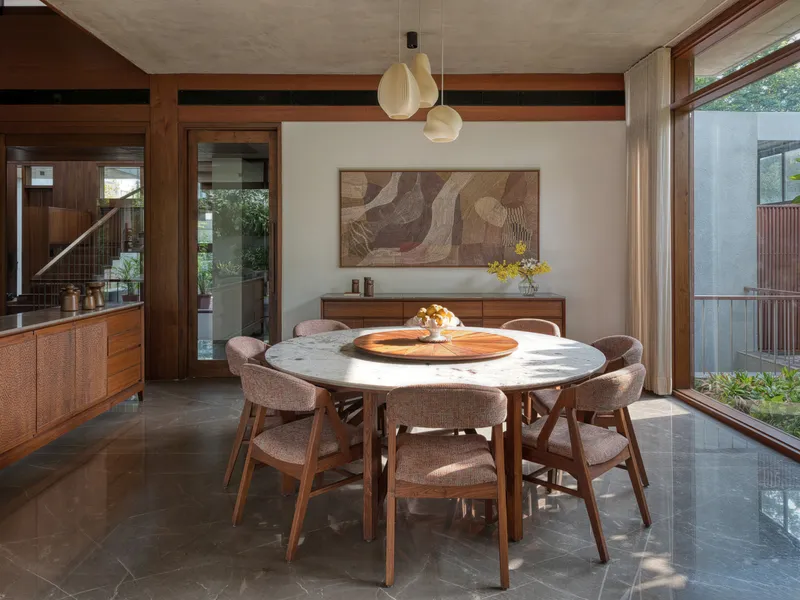
The architecture embraces a refined material palette echoing Gujarat’s craftsmanship:
- Grey plastered and exposed concrete walls
- Teakwood doors and windows
- Wooden ceilings and paneling
- Grey Italian marble flooring
These materials create a calm and contemporary atmosphere, enriched by natural textures and regional influences. Furnishings and finishes from Jaipur Rugs, OBEETEE, Dtale Modern, and Tectona Grandis add warmth and artisanal character.
The House of Parallel Walls stands as a compelling model for modern Indian joint-family living, merging climate-sensitive strategies with spatial harmony and timeless materials. Rooted in Ahmedabad’s architectural heritage yet distinctly contemporary, the home by PVDRS offers a sophisticated balance between privacy, openness, and environmental responsiveness.

All photographs are works of Umang Shah




Popular Articles
Popular articles from the community

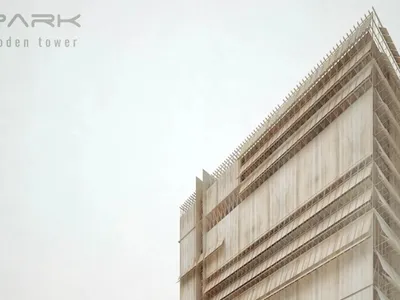
EW PARK: Sustainable Architecture Reimagines the Future of Urban Parking
EW PARK reimagines city parking as a modular wooden tower combining automation, solar energy, electric mobility, and adaptable urban design.

Hill & Cross Opera: Sculptural Opera House Architecture Shaped by Tallinn’s Landscape and Identity
Hill & Cross Opera reimagines opera house architecture in Tallinn through its sculptural hill, civic plaza, glass wave and a luminous cross.

The Earth Pod: 3D Printed Homes for Resilient Refugee Communities
The Earth Pod reimagines refugee housing through 3D printed homes made from clay, combining resilience, self-sufficiency, and rapid shelter.

Riyadh For All: Intergenerational Urban Design for Active Aging in Rabat
Riyadh For All reimagines urban design in Rabat with intergenerational co-living, adaptive courtyards, and Moroccan cultural exchange today.


Similar Reads
You might also enjoy these articles


Hodi-Mandai Geram
Project Function: Preservation and revitalization of the Intangible heritage and socio-spatial identity of the Hodi by Housing, Cultural Memory Center, Sacred Grove, landscape, local tourism economy


Olio Towers: A Mid-Rise for Performers That Fuses Housing, Rehearsal, and Stage
Located blocks from Houston's Theater District, this modular tower stacks living units around a central performance atrium.

Oasis: Modular Green Housing Carved into Dhaka's Urban Fabric
A shortlisted Plugin Housing entry reclaims unauthorized settlements in Dhaka with stepped concrete volumes, green roofs, and ventilation-driven design.

Black Hole: A Floating Megastructure for the Post-Physical Era
Emiliano Mazzarotto envisions a spherical, self-scaling arena where e-sports, digital hotels, and holographic stadiums replace traditional public space.


Explore Residential Building Competitions
Discover active competitions in this discipline


Challenge to design mud housing for contemporary communities


Challenge to reimagine the Iron Throne


Photograph architecture without architects


Illustrate the lost glory of Angkor Wat - Render Challenge
Comments (0)
Please login or sign up to add comments
No comments yet. Be the first to comment!