

The Living Hill: A Stadium Buried in Landscape at Staydium 2020
An artificial hill integrates a multifunctional stadium into green urban infrastructure, rooting public sport in ecological design.


What if a stadium didn't sit on the landscape but became part of it? The Living Hill proposes an artificial topography that absorbs a full sports venue into a continuous green surface, turning the boundary between architecture and ground into something genuinely ambiguous. Rather than the usual object-building dropped onto a cleared site, the design treats the stadium as infrastructure hidden beneath planted berms, sunken walkways, and public plazas, making the surrounding orchards and green space the primary experience for anyone approaching.
Shortlisted at Staydium 2020, the project was developed by Adina Elena, Cosmin Păduraru, Andra Panait, and Brînzucă Andrei. The team drew on research published in the Proceedings of the National Academy of Sciences linking green urban infrastructure to measurable improvements in public health: reduced noise and air pollution, increased social interaction, and more physical activity. Their response was to refuse the false choice between civic spectacle and ecological responsibility, folding both into a single landform.
A Stadium Bowl Suspended Under a Radial Canopy
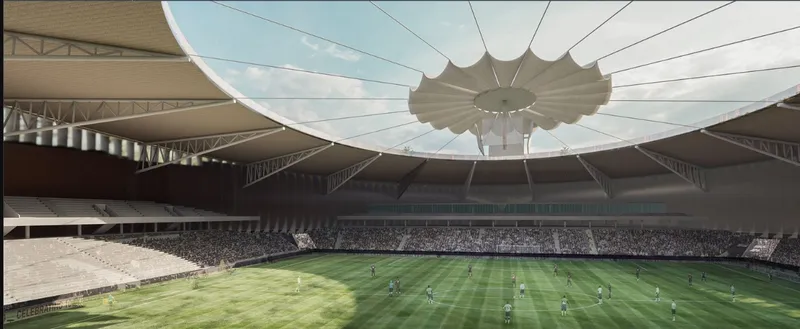
Inside the hill, the architecture reveals itself. The interior bowl opens to a radial cable roof structure that spans the playing field and seating tiers without heavy columns obstructing sightlines. The lightweight tension system keeps the roof visually thin, letting daylight filter through while sheltering spectators. It is a confident structural move: the same design that buries itself modestly into the earth overhead asserts real engineering ambition in the span of its canopy.
Planted Approaches That Dissolve the Building's Edge
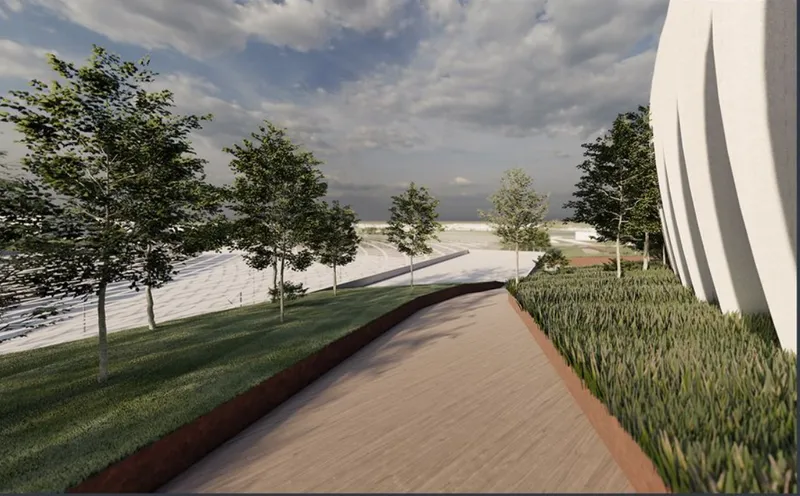
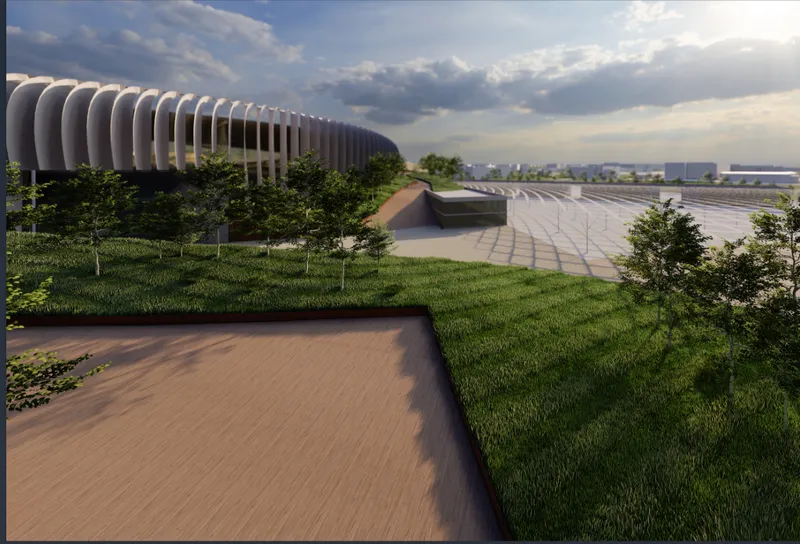
The journey toward the stadium matters as much as arrival. A paved pathway lined with lawn and planted beds leads visitors through what reads as a park, not a precinct. The landscaped plaza surrounding the ribbed stadium volume is carved with sunken walkways and grassed berms that absorb pedestrian circulation into the topography. These are not decorative gestures; they are the primary organizational strategy, channeling crowds while keeping the green surface continuous. Inspired by the surrounding orchards of the site, the planting reinforces the ecological narrative the designers set out to build.
The afternoon light in the plaza view reveals how the ribbed facade reads as a texture within the landscape rather than a standalone monument. By pushing the building mass partially below grade and wrapping it in earth, the team achieved something rare for a stadium: a perimeter that invites lingering rather than simply processing people through turnstiles.
A Vertical Ribbed Facade Framing the Entry Threshold
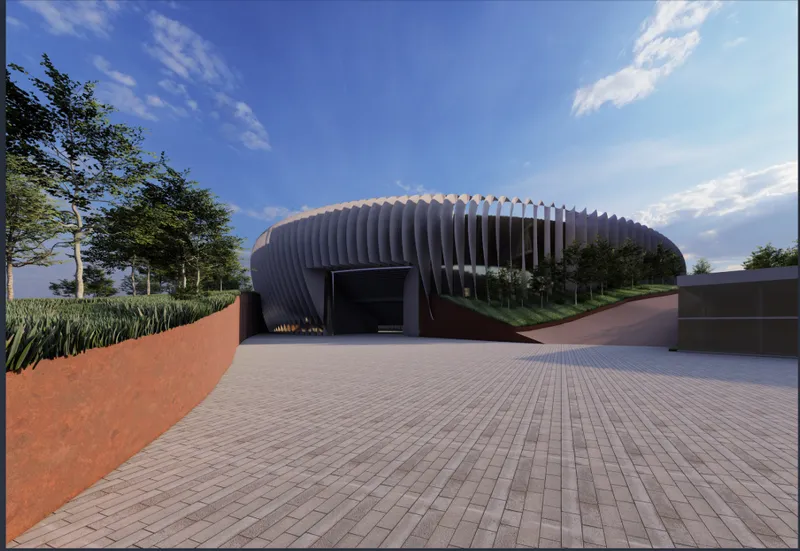
Where the building does surface, it does so with deliberate restraint. The entry plaza presents a vertical ribbed facade rising from a broad paved forecourt, establishing a clear threshold between the open landscape and the enclosed bowl. The ribs provide rhythm and shadow depth without relying on heavy cladding, and they echo the linear planting patterns visible across the wider site. It is a facade that works hardest as a gateway, compressing the approach into a moment of entry before the bowl opens up beyond.
Section: Reading the Buried Program
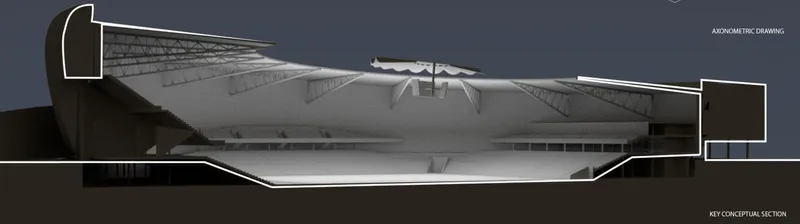
The sectional drawing reveals the full ambition of the scheme. Seating tiers step down from the planted surface, the roof structure arcs overhead, and underground levels accommodate the support programme that any stadium of this scale requires. Cutting through the hill shows how the designers stacked public, spectator, and service zones vertically, using the artificial topography to separate functions that would otherwise sprawl horizontally. The section is the project's clearest argument: burying the stadium is not a formal conceit but a spatial strategy that compresses infrastructure and liberates the ground plane for public life.
Why This Project Matters
Stadiums are among the most land-hungry building types in any city. They consume hectares of surface, generate dead zones on non-event days, and rarely give anything back to the neighborhoods around them. The Living Hill challenges that pattern by treating the stadium as a piece of landscape infrastructure, one that reduces air and noise pollution, promotes daily physical activity on its planted surfaces, and fosters the kind of social interaction that only generous public green space can sustain.
For a student team, the integration of ecological research, structural ambition, and urban design thinking is impressive. Elena, Păduraru, Panait, and Andrei did not simply green-wash a conventional venue; they restructured the relationship between building and ground. In a competition field full of expressive forms, this entry earned its shortlist position by asking a harder question: what if the best thing a stadium could do for a city is disappear into the landscape it occupies?
View the Full Project
About the Designers
Designers: Adina Elena, Cosmin Păduraru, Andra Panait, Brînzucă Andrei
Enter a Design Competition on uni.xyz
uni.xyz runs architecture and design competitions year-round that reward proposals with spatial conviction and real site intelligence.
Project credits: THE LIVING HILL by Adina Elena, Cosmin Păduraru, Andra Panait, Brînzucă Andrei Staydium 2020 (uni.xyz).


Popular Articles
Popular articles from the community


Faces of the Soviet Avant-Garde: Turning Moscow's Street Names into an Open-Air Museum
A network of sculptural installations across a Moscow residential district transforms forgotten architect names into spatial encounters with cultural memor
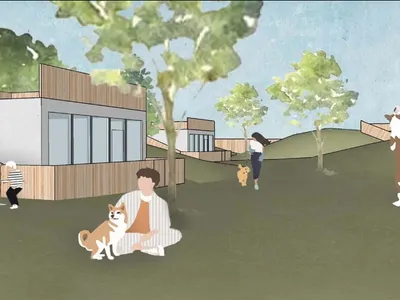
Temporary Home for Dogs: A Reversed Zoo Rethinks Animal Shelter Architecture
In Bucharest, a sinuous corridor and freed landscape flip the logic of containment, designing a shelter that works to make itself unnecessary.

Opera on the Sea: Driftwood Logic Shapes a Timber Opera House on Estonia's Coast
Trevor Orgill's opera house translates the entangled drift of floating timber into a civic building where wood, water, and music converge.

Cloaked Colonization: A Mobile Underwater Habitat That Moves Like a Fish
Micah Abaya's shortlisted EHC Pacific entry reimagines ocean settlement as a dispersed network of self-sustaining architectural organisms.

Similar Reads
You might also enjoy these articles

Play: Fragments of Their World: Remembered Architecture Rebuilt as a Modular Playground for Refugee Camps
Tom Gardner abstracts domes, arches and towers from the homelands of displaced families into a kit of child-scaled play parts for camp settlements.
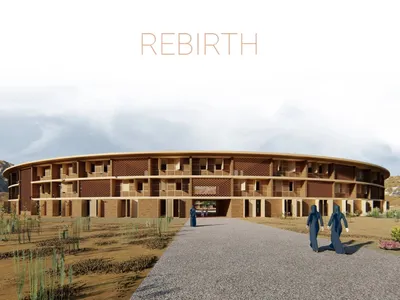
REBIRTH: A Circular Settlement Where Afghan Widows and Their Children Rebuild Life Together
A shortlisted Resile entry turns the circle into a protective ring of timber and brick, gathering homes, classrooms and gardens around a shared landscape.
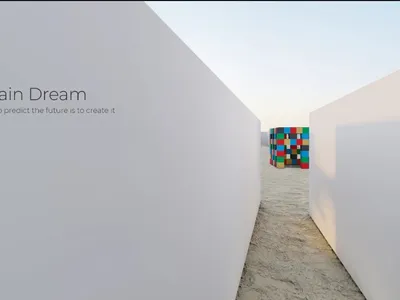
The Main Dream: A Recycled Plastic Kit That Lets Refugee Children Build Their Own Playground
Thirty-centimetre interlocking cubes that connect on three axes turn play into construction, letting children author the spaces they occupy.

Lunar Spiral: A Fibonacci-Driven Moon Settlement Rising from Shackleton Crater
Golden-spiral geometry organises buried infrastructure and orbiting habitable spheres into a lunar base designed to grow as life on the Moon expands.

Explore Green Architecture Competitions
Discover active competitions in this discipline

Challenge to design a barrier free sports center

Challenge to design an outdoor ice-rink and park
Comments (0)
Please login or sign up to add comments
No comments yet. Be the first to comment!