

The Loop: A 150-Meter Ramp That Stitches Generations Together in a Treehouse for All
A circular, modular pavilion uses continuous ramped circulation and embedded playfulness to dissolve age-based segregation in public parks.


What if a public building could feel like a treehouse and function like a community center? The Loop answers that question with a 150-meter continuous ramp that winds through a circular, elevated timber pavilion, connecting ground-level workshops, a first-floor library, and a rooftop terrace without a single staircase. The building is designed to make seniors, children, and everyone in between visible to one another, physically and socially, turning a public park into a genuine intergenerational commons.
Designed by Bettina Werner, Michela Nota, and Lars Grenaker, The Loop was shortlisted in HUDDLE, a competition focused on designing spaces that foster human connection. The team started from a clear premise: urban environments routinely fail seniors by offering them little beyond benches and passive observation. Their response is a modular structure that can host arts and crafts sessions, animal interaction zones, seasonal celebrations, and shared meals, all within a single form that adapts to different sites and community needs.
A Circular Footprint That Keeps Everyone in Sight
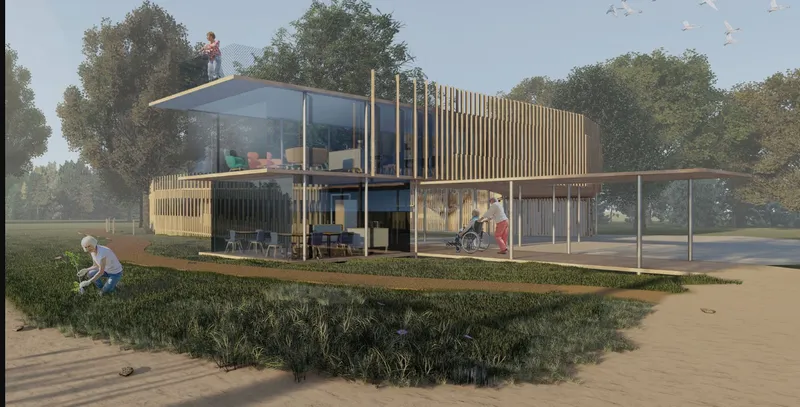
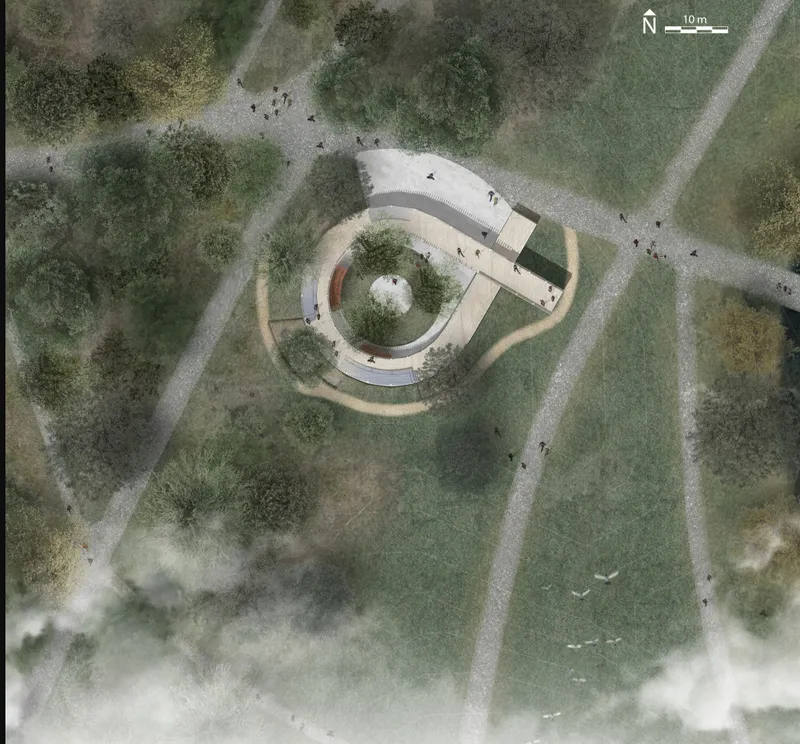
The aerial view reveals the logic of the plan: a circular building wraps around a central courtyard garden, ensuring that activity on one side of the loop is always visible from the other. Vertical timber screening and glazed walls define the perimeter, allowing filtered views both inward and outward. Mature trees and planted beds surround the structure, embedding it in the existing park landscape rather than imposing on it. The circular form is not decorative. It creates a continuous social surface where chance encounters between age groups become inevitable.
The modular nature of the design means the footprint can scale up or down depending on the site. The designers envision The Loop functioning as a library in one community, a café and farm hub in another, or a flexible event venue elsewhere. The program follows the people, not the other way around.
Timber Screens, String Lights, and the Courtyard as Living Room
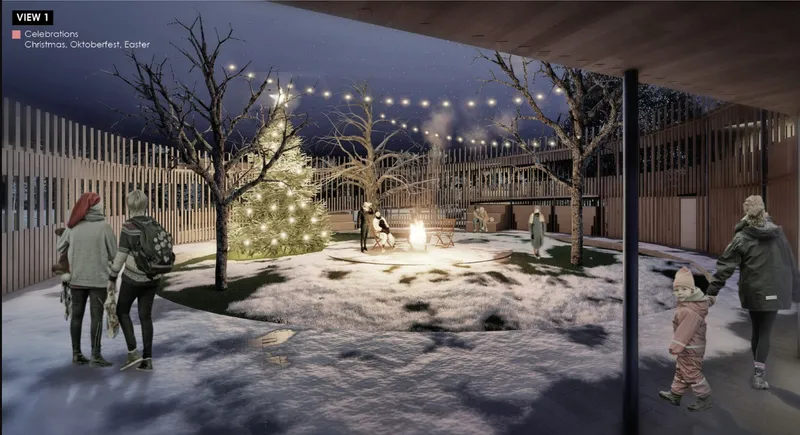
The covered courtyard operates as the building's social heart. Vertical timber slat screens filter light during the day and frame the glow of string lights at evening, creating an atmosphere that is sheltered without feeling enclosed. Even in winter, with snow dusting the ground, the space reads as warm and inhabited. Ground-level programming here includes workshop and exhibition areas, a café, animal shelters, and small-scale farm zones, giving visitors tangible reasons to linger and return.
Dappled Light and Dignity Along the Ramp

The 150-meter ramp is marked at regular intervals to encourage physical activity, doubling as a mobility training path for seniors and a playful running track for children. Vertical timber screens cast dappled shadows across pale flooring, creating a sensory rhythm as visitors move through the building. The ramp eliminates staircases entirely, ensuring that access to every level is available regardless of physical, cognitive, or sensory ability. This is not a secondary route or an afterthought: it is the primary circulation, the architectural backbone that makes the treehouse metaphor real for a wheelchair user as much as for a five-year-old.
Full-Height Glazing Turns the Upper Level Into a Canopy

On the first floor, a lounge space lined with full-height glazing and a warm timber ceiling brings the surrounding greenery directly into view. Colorful seating clusters encourage informal gathering, reading, or simply watching the park below. The designers placed the library and flexible programming spaces on this level, along with resting and viewing platforms. The roof terrace above adds moveable seating, scenic viewpoints, and relaxation zones, completing a vertical sequence that rewards the climb with openness and calm.
The program benefits the designers outline are deliberately holistic. Physical activity comes from the ramp and farm zones. Social connection comes from shared meals, artistic collaboration, and intergenerational events. Psychological well-being comes from reduced isolation, confidence-building, and a renewed sense of purpose. The architecture does not prescribe any single use; it creates conditions where all three dimensions of health can overlap.
Why This Project Matters
Most public spaces designed for seniors default to passive amenities: a shaded bench, a paved path, maybe a chess table. The Loop rejects that template by making physical movement, sensory engagement, and intergenerational contact the structural premise of the building itself. The continuous ramp is not just accessible infrastructure; it is a social device that forces different age groups to share the same route, the same views, the same moments of pause.
Werner, Nota, and Grenaker demonstrate that inclusive architecture does not have to look clinical or institutional. By borrowing the language of the treehouse, by wrapping the program in timber and filtered light, and by centering the design on a courtyard that feels like a communal living room, they propose a model that communities might actually want to adopt. That combination of ambition and warmth is what earned The Loop its place on the HUDDLE shortlist, and it is what makes the project worth studying beyond the competition.
View the Full Project
About the Designers
Designers: Bettina Werner, Michela Nota, Lars Grenaker
Enter a Design Competition on uni.xyz
uni.xyz runs architecture and design competitions year-round that reward proposals with spatial conviction and real site intelligence.
Project credits: The Loop" by Bettina Werner, Michela Nota, Lars Grenaker HUDDLE (uni.xyz).


Popular Articles
Popular articles from the community


Cube Design Draws an Ecological Corridor Between Two Shenzhen Hills with the Nankai Building
Beside Shenzhen's container docks, the Nankai Building pairs stacked balconies with a climbing green screen to connect two hillsides across its height.

U.GA Architects Wraps an Oval Rooftop Pool in Curved Board-Formed Concrete on Busan's Jeollidan-gil
In Busan's Jeonpo-dong, a 454 m² mixed-use block stacks a neighborhood facility, guest rooms and an oval rooftop pool inside spiraling concrete walls.

LT2A and OPEN Architectes Thread a Brick and Glass High School Through a Wooded Belgian Campus
In Braine-l'Alleud, a 3,000 m² wing for Collège Cardinal Mercier pairs pale brick with a glazed colonnade, deferring to a small chapel and a dense wood.

David Ortega Stacks a Two-Story Mexico City Penthouse Around a Steel Stair and a Pergola-Shaded Roof Terrace
In Colonia Roma, a 300 m² penthouse uses oak joinery, a planted steel stair and a slatted roof pergola to make a new-build apartment feel like a house.

Similar Reads
You might also enjoy these articles


Vereda Arquitetos Renovates a 40-Square-Meter Apartment Inside Niemeyer's Copan Building
A compact unit in São Paulo's most iconic residential tower gets a material overhaul that pairs exposed concrete with bold blue Formica.

Shakur's House: Exposed Brick as an Interior Organiser in a 168 m² Mashhad Residence
Brick moves indoors in this Mashhad residence, where masonry walls, glass partitions and teal planes sequence a compact home without closing it off.

Day and Night Park: A Time-Based Urban Newsstand in Beijing
A temporary urban newsstand in Beijing blending travel, light, and reading through poetic colors, compact form, and community-focused design.

Modernist Patio Renovation in El Masnou, Barcelona by Oliver Segura Arquitectura + Cebrià Arquitectura
Modernist patio renovation blending tradition and innovation with a movable pool, leveled floors, and Catalan materials in El Masnou.

Explore Inclusive Spaces Competitions
Discover active competitions in this discipline

Comments (0)
Please login or sign up to add comments
No comments yet. Be the first to comment!