

THE OASIS INSIDE THE OASIS
Cultural Center Of Marrakech, Morocco
When we read the presentation of the competition and we looked at the pictures of the references and of the site, we did not think to a possible project but to a possible experience: the experience of visiting the Oasis Cultural Center.
We wrote down a short story about what should have happened to a possible visitor in terms of emotions and perceptions. We read it in our meeting room and at the end of the reading, after a long moment of silence, we decided to try the competition
Here is the short story:
Our visitor gets in an oasis inside the oasis, a cozy and welcoming place, where wondering around is pleasant, where is nice to come back, where one can find different ways of enjoying the moments spent there, but, above all, a magical place, where time and space flows differently than in the outer world, in some ways a mysterious, fantastical and charming place.
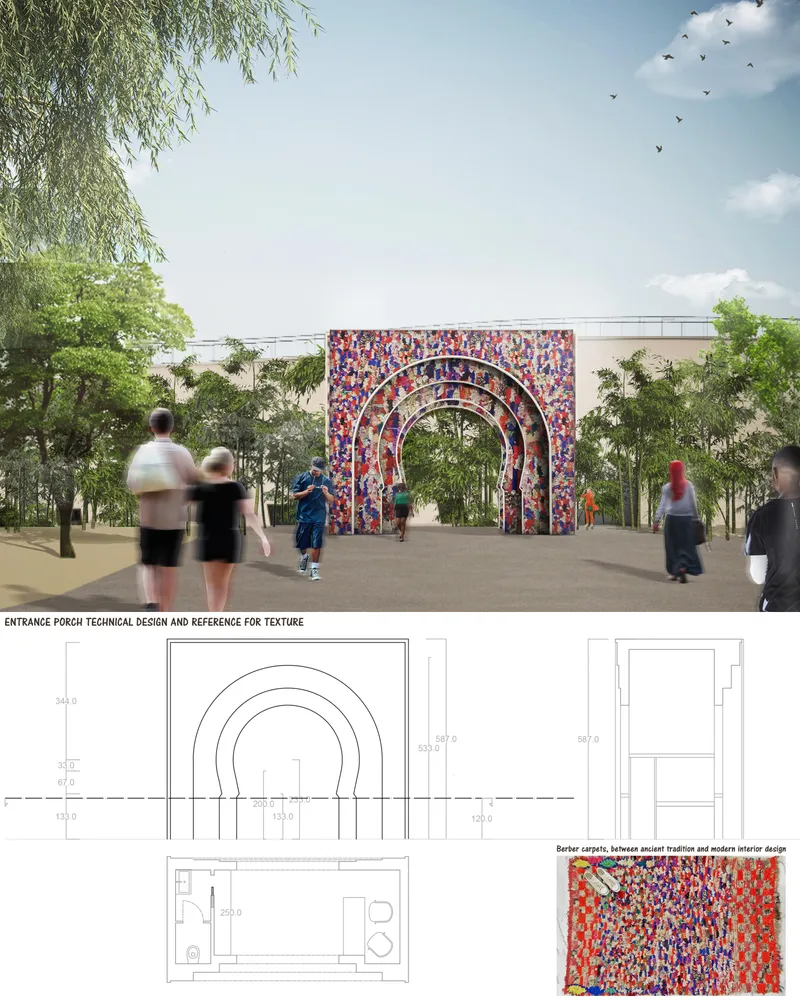
At the end of the road that leads to the Center our visitor finds a portal (the entrance porch), whose shape reminds of the medieval doors of the ancient Marrakech and whose colors reminds of Berber decorations, bright colors that give a feeling of levity and smoothness and cover a structure that gives an idea of solidity, and whose shape attracts our visitor inside. The architectural idea is a contemporary reinterpretation of the past but most important are the feelings that arise while coming across it.
At the sides of the portal there is a Bamboo forest almost three meter high, where it is difficult to get in and that hides any view.
Our visitor gets in the portal, crosses the entrance porch and finds himself in a small terrace that is enclosed by the Bamboo forest. Close views are hidden here too, but above the plants he can see the upper part of a strange shape, a sort of dune of the same color of the desert sand with people walking on its very top. Among the Bamboos he can hear the sound of flowing water. He wants to find out what is down there. On the right of the terrace he sees a small paved road among the Bamboos and he starts walking down.
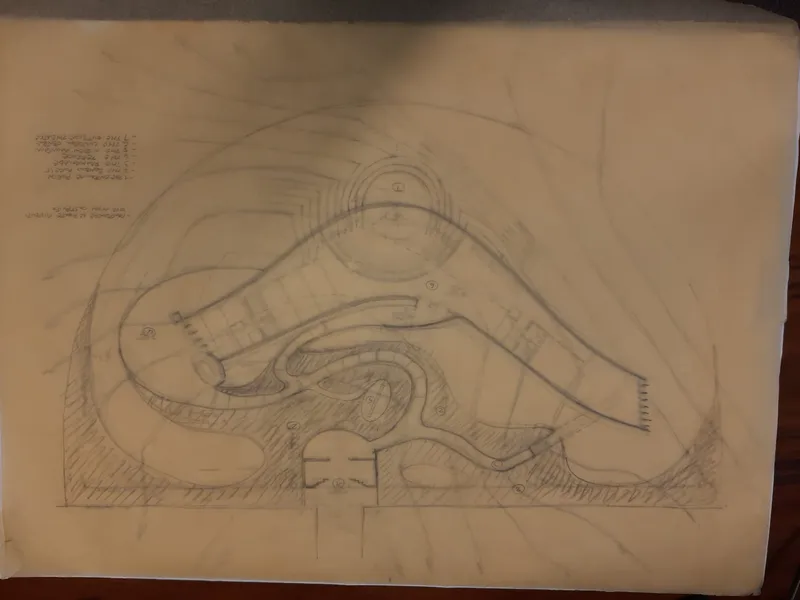
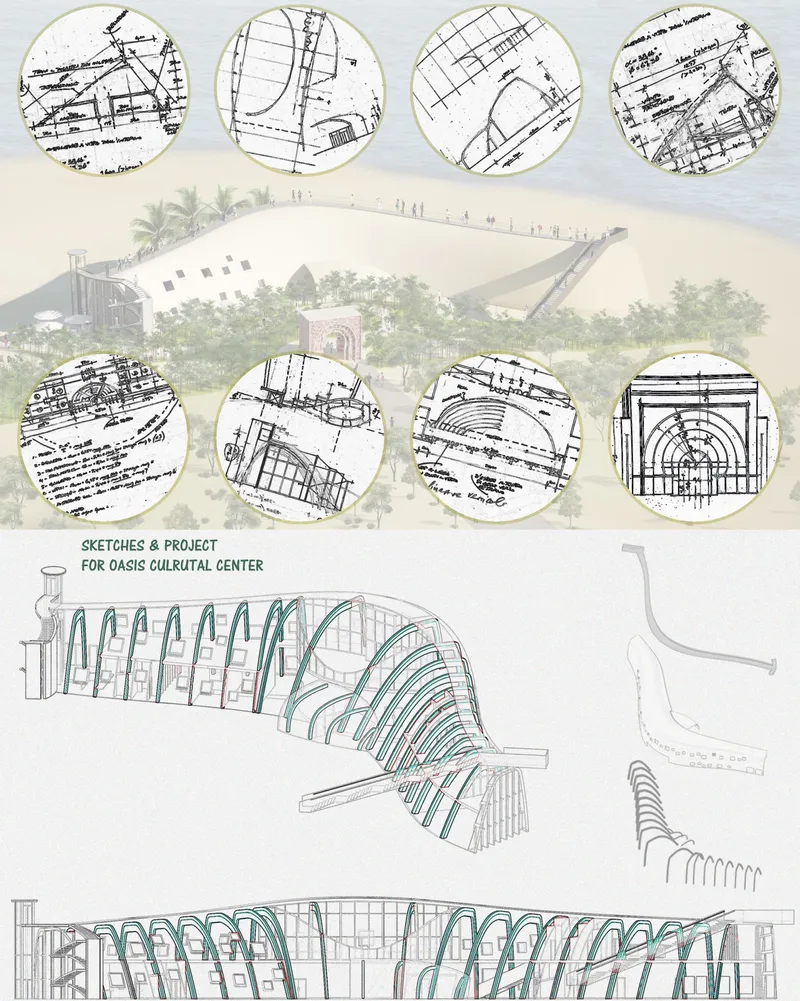
The entire building appears only when our visitor is very close to it. The dimension of the building that suddenly shows up strikes him. The first impression is strong, estranging and disorienting, the building looks like a huge dune with a sort of mouth that invites him to get in.
As he gets in, he can see the inside countertop of the building shape and the exposed structural ribbing and he feels like being inside the body of a big animal that welcomes and protects him, while big shaded openings creates a strong relationship with outside nature.
Internal partitions are light and give the idea that they can be moved in relation to the different uses of the internal space, in opposition to the solidity and stability over time of the main structure.
Then the design process started and many more ideas aroused with the aim to keep effective the emotional experience of the visitors as much as possible. In our idea, visiting the Cultural Center has to become such a pleasant and unique experience that any visitor would like to come back many and many times.
Here below our design basic concepts
The Entrance Porch is the portal that separates the outer world from the area of the Cultural Centre. Here a visitor feels that he is getting into a different space, a mysterious, fantastical and charming place, THE OASIS IN THE OASIS. When he approaches the portal it is important that he couldn’t see anything else. At the sides of the portal there is the Bamboo Forest with plants almost three meter high, where it is difficult to get in and that hides any view.
As this is a crossing point, here the necessary reference is what is consolidated in the collective architectural memory. Our main reference for the portal is Marrakech Bab Agnaou, that has a typical shape that invites to get in and actually welcomes people in what is still considered a “magical place”. We modified its façade to adapt it to the scale of our project. As the main goal of the Entrance Porch is creating a perceptive detachment from what is around it, we designed a skin whose reference are Berberian decorations, colorful and bright, and that gives a feeling of levity and smoothness while covering a structure that gives an idea of solidity. The Entrance Porch architectural concept is a contemporary reinterpretation of the architecture of the past but most important are the feelings that arise while going through it.
The Entrance Porch hosts the ticket office, a first InfoPoint and a toilet for personnel.
As a visitor goes through the Entrance Porch, he finds himself in the Entry Terrace, a small terrace that is enclosed by the Bamboo Forest. Close views are hidden by the Bamboos, but above them one can see the upper part of the main building, a sort of dune with people walking on its very top. Among the Bamboos one can hear the sound of hidden flowing water, like in a mysterious garden. This terrace is encircled by a low brick wall where people can sit. It is not conceived as a resting place but as an intriguing spot that arouses people’s curiosity.
On the right side of the Entry Terrace starts a small paved road. The path to the main building gently slope among the Bamboo Forest, plants hide any view while unseen water keeps running. Even this approaching path keeps people’s curiosity alive until the Cultural Centre main building suddenly appears. The Bamboo Forest does not house only Bamboos plants but pre-existing trees too.
Before the slope to the main building begins, one can take a right at the first fork and go to the Promenade. This starts with a long staircase that climbs to the very top of the main building. The path to the Promenade runs in the Bamboo Forest, that hides any view, but as soon as one begins climbing the stairs, the building and the whole Bamboo Forest appear. We liked the idea of climbing over the building, like on dunes or like on the back of a big animal. The staircase and the path over the building create a unique architectural promenade whose views wander from the building to the lake and the oasis. The very top of the building becomes a vantage point with astonishing views. Only visitors to the Cultural Center will have the opportunity of enjoying such views and this can be a strong cause of interest and one more reason to visit the Centre.
Looking at the building from the sky, the “dolphin smile” of the dark Promenade paving makes it a highly recognizable element in the landscape of the whole oasis area.
The Promenade main staircase ends over the south side of the building, people can walk to its north side on a slightly downhill slope and take another staircase or a lift down to the Restaurant Terrace. From here even disabled people can get to the top and to the Promenade by using the lift.
We consider the Restaurant and Cafeteria Area another point of attraction even for the most distracted visitor. As to get out of this area one has to go through the main building, on the way back everybody will have the opportunity to see the many features of the Cultural Centre once more.
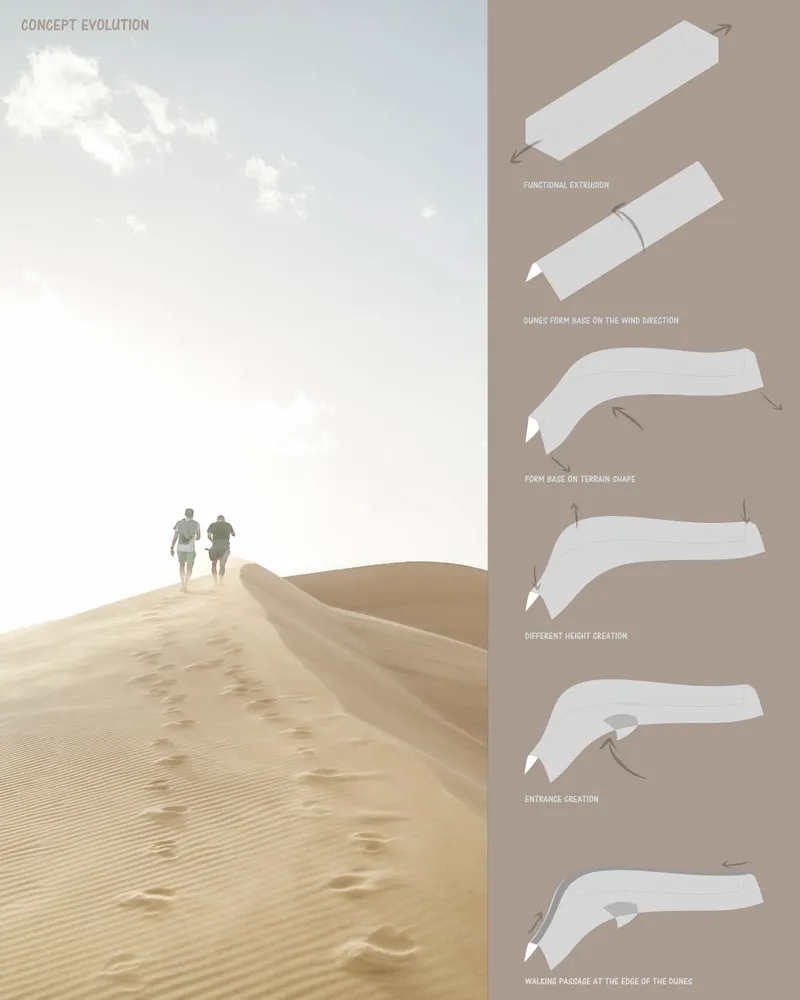
The shape of dunes was our reference for the Cultural Center Main Building. A dune is a wave of sand that is shaped by wind, a natural shape that keeps changing but that is as old as the Earth itself. No age, no culture, no human footprint can change its nature: the ideal shape for a place whose aim is making people travel through different ages and cultures.
Looking from the lake the building becomes a sand wave over the lake, a strong reference point easily recognizable from the whole oasis area.
The organic shape of the building changes to adapt to the landscape, to the prevailing winds, to the orientation in respect to the sun … Like any dune, or any wave when the wind blows hard, its windward side has a gentle slope while its leeward side is steep.
The Main Entrance comes out of the “dune” as a sheltering open mouth that invites the visitor inside the building. Once in the Entrance Hall, one finds himself in an enveloping, ample and very high space, where he can see the inside countertop of the building shape with the exposed structural ribbing, so that he feels like being inside the body of a big animal that welcomes and protects him. Big windows frame the view of the lake. The round wall of the theatre is full of pictures that introduce the main features of the Centre. The InfoPoint welcomes the visitor. One can rest on big sofas. The Entrance Hall is barycentric in the building and from here one can reach all the different inner spaces of the Centre on the ground floor or can take a lift or a panoramic staircase to get to the first floor.
The Theatre is the pivot of the lay-out of the building, an amphitheater with terraced seats sloping down to the scene that, whenever necessary, can be opened to the outside space and double its dimension. In this case the lake can become the background of the scene, strongly emphasizing the relationship between inner and outer space.
Thanks to the position of the Main Entrance and of the Theatre, the building has two separate wings. Spaces that need silence and concentration are well separated from the ones where some noise is acceptable.
The Mediatheque is located on the first floor, above the Theatre, and is isolated from any other room. Through its glass walls one can see the surrounding space of the Main Entrance or the lake whose views are framed by the openings in the eastern façade.
At the south and at the north ends of the building, two glass facades, whose grid structure has a brise-soleil function too, create a strong relationship between inner and outer spaces, as if the lake and the oasis were inside the building.
On the ground floor, where the south wing of the building ends with the shaded glass façade, one can enjoy the silent atmosphere of the Exhibition Gallery at the end of a large corridor that can be used as a gallery itself. Sound-absorbing materials on the floor, on the ceiling and on the walls help to create the hushed atmosphere that is necessary to enjoy the exhibited works.
Offices are in the quietest place of the Centre. They are located on the first floor, over the Gallery and the Storage. They have windows looking the lake and a private terrace that ends with the shaded glass south façade.
In the north wing of the building are located the activities and the spaces that can be more noisy. On the ground floor, closer to the Entrance Hall, there are the Artisanal Training Rooms. These three rooms have glassed walls on the corridor side so that people passing by can see what is going on inside. The walls that separate these three rooms from each other can be sliding so that, if necessary, the whole area can become a single space.
Illuminated by the grid structure glass facade, the Restaurant and Cafeteria Area and its facilities are located at the end of the north wing. This double height space is directly connected to the outer space where it extends to the Restaurant Terrace that faces the lake. A staircase and a panoramic lift connect this terrace to the north end of the Promenade. While stepping down the staircase, people look alternately at the lake and at the inner space of the building. The Restaurant and Cafeteria Area is a strong point of attraction. Here people relax enjoying views over the lake and the oasis. On the way back they walk through the building to the Entrance Hall and have the opportunity to see the many features of the Cultural Centre.
An outdoor paved connection between this terrace and the outer space of the Theatre scene is very useful during special shows and events.
A small service road connects the Restaurant Terrace to the Entrance Porch. This path is usually closed to the public. It opens at night , if the Center is closed while the Restaurant is still open
On the first floor of the north wing the Music Conservatory Area is used in different ways. Inside the sound-insulated room, musicians and music students learn and test their pieces. This room is directly connected to two terraces, one facing the Entrance Hall, the other one facing Restaurant and Cafeteria. In these terraces musicians relax or play their pieces in an informal way for visitors of the Center.
On the way back from the Cultural Center Main Building to the Entrance Porch it is easy to see a small paved path among the Bamboo Forest. This leads to a hidden spot where running water sound comes from. The Hidden Fountain is a rectilinear cut in the floor of a slightly sloping area that is surrounded by a low brick wall where people can sit and relax. Water keeps running, some wind may blow, our visitor relives his experience in the Oasis in the Oasis and thinks that this place worth another visit.


Popular Articles
Popular articles from the community


The Amber Palace Opera: A Geological Fiction Surfaces on Tallinn's Baltic Waterfront
Pierre Brillard reimagines a Baltic legend as a public landscape, opera house, and waterfront promenade rooted in Tallinn's coastal identity.
Extended Shell: Retrofitting Kolkata's Balconies as Living Urban Thresholds
A modular retrofit system recovers the social and environmental intelligence of Kolkata's historic verandas for contemporary Park Street residents.

Opera by the Sea Estonia: Three Shells Dissolving Architecture into Tallinn's Coastline
A winning opera house proposal replaces monumental form with interconnected shells that blur the boundary between building, park and Baltic Sea.

Cloaked Colonization: A Mobile Underwater Habitat That Moves Like a Fish
Micah Abaya's shortlisted EHC Pacific entry reimagines ocean settlement as a dispersed network of self-sustaining architectural organisms.

Similar Reads
You might also enjoy these articles

Day and Night Park: A Time-Based Urban Newsstand in Beijing
A temporary urban newsstand in Beijing blending travel, light, and reading through poetic colors, compact form, and community-focused design.

Modernist Patio Renovation in El Masnou, Barcelona by Oliver Segura Arquitectura + Cebrià Arquitectura
Modernist patio renovation blending tradition and innovation with a movable pool, leveled floors, and Catalan materials in El Masnou.
Alto Residencial Coop: Cooperative Housing Development in Santiago de Compostela by Carbajo Barrios Arquitectos
A linear cooperative housing complex blending white volumes and perforated metal façades, enhancing community living, natural light, privacy, and urban integration.
Vil Genis School by BPA ARCHITECTURE – Massy, France
Vil Genis School in Massy, France, features sustainable design, south-facing classrooms, community integration, accessible spaces, and modern educational architecture.


Comments (0)
Please login or sign up to add comments
No comments yet. Be the first to comment!