
Sommet Floats a Concrete Canopy over Timber Volumes at the Pages Residence
A low-slung tropical house uses cantilevered concrete planes and warm timber cladding to dissolve the boundary between living space and landscape.


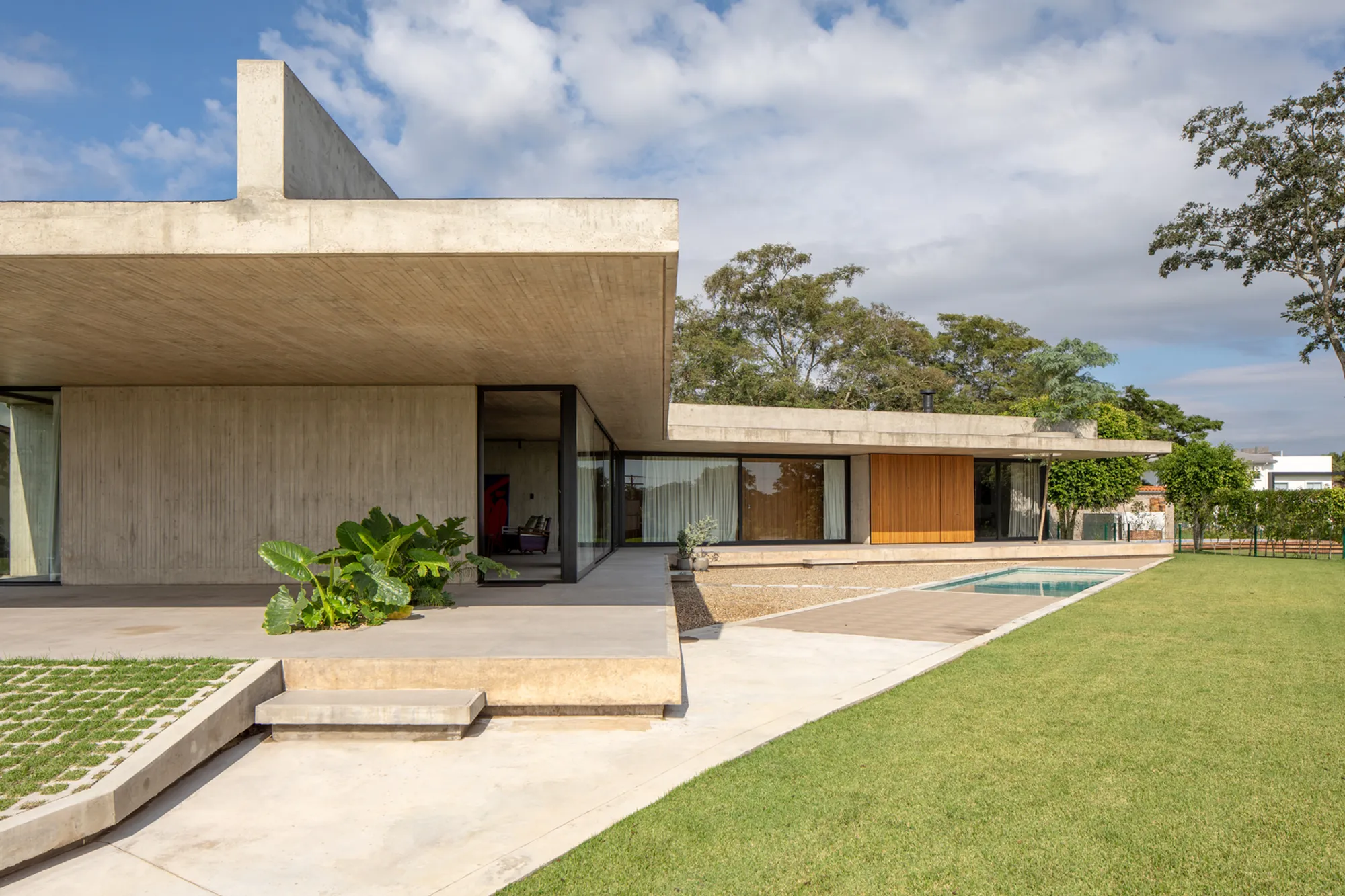
The Pages Residence by Sommet reads less like a house and more like a landscape operation. A single, uninterrupted concrete slab lifts itself off the ground and stretches outward, creating deep overhangs that shelter timber-clad volumes below. The composition is horizontal to a fault, deliberately echoing the flat terrain and the wide canopies of the mature trees that surround it. Every element, from the gridded grass pavers to the reflecting pools, reinforces the sense that this is a building designed to stay low and let the sky do the talking.
What makes the project genuinely compelling is its restraint. Sommet limits the material palette to three principal elements: board-formed concrete, vertical timber cladding, and full-height glass. That economy of means forces the architecture to work through proportion, shadow, and framing rather than through ornament or material novelty. The result is a house that feels both generous and precise, offering spacious covered terraces and open courts while maintaining a tight formal logic.
Concrete as Landscape Gesture
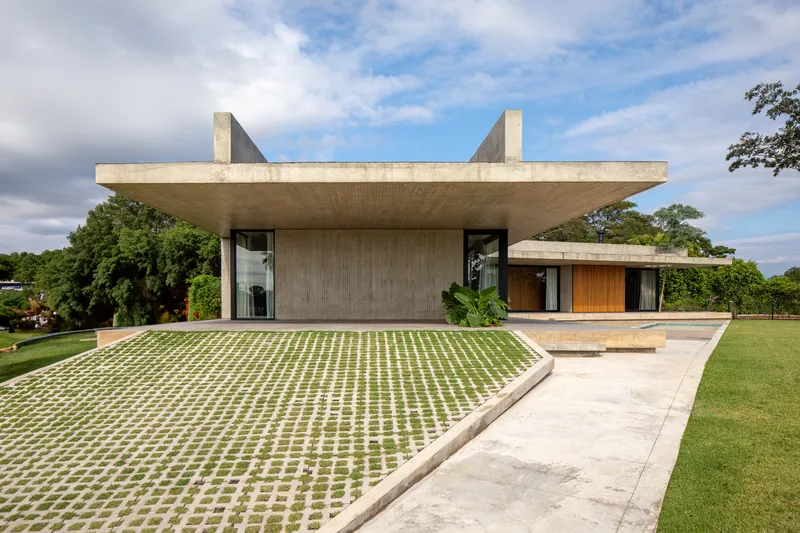
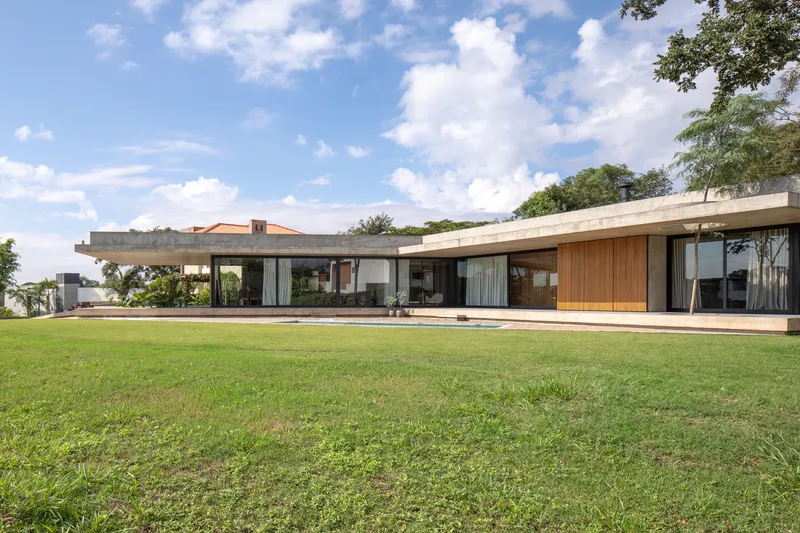
The dominant architectural move is the concrete roof plane. It extends well beyond the enclosed volumes beneath it, cantilevering over terraces, pools, and garden paths with an almost geological indifference. The slab is thick enough to register as a structural event but thin enough at its edges to feel light. Sommet treats the concrete not as a ceiling but as an artificial horizon, a datum line against which everything else, the timber volumes, the plantings, even the clouds, is measured.
The gridded grass pavers in the approach reinforce this horizontal reading. Rather than a conventional driveway or pathway, the ground surface becomes a softened extension of the landscape, blurring where the garden ends and the building begins. The reflecting pool at the base of the entry elevation doubles the concrete canopy, amplifying its visual weight and creating a sense of arrival that is calm rather than imposing.
Timber Cladding and the Warm Underbelly
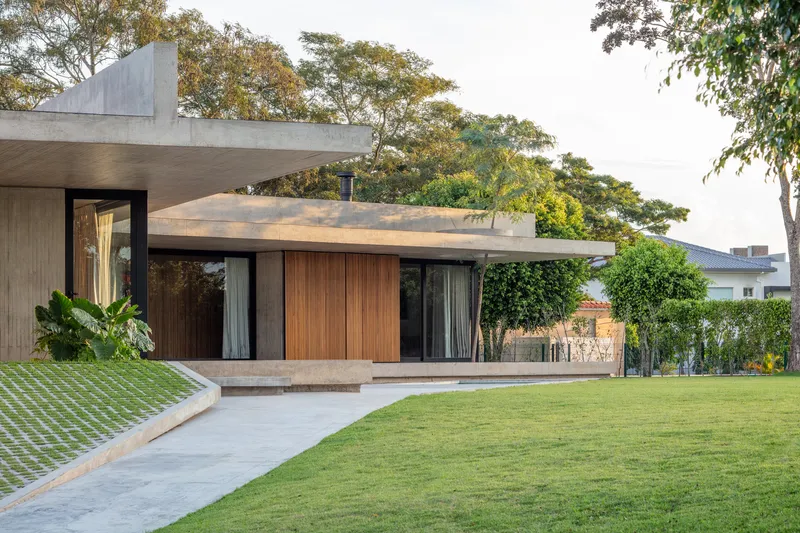
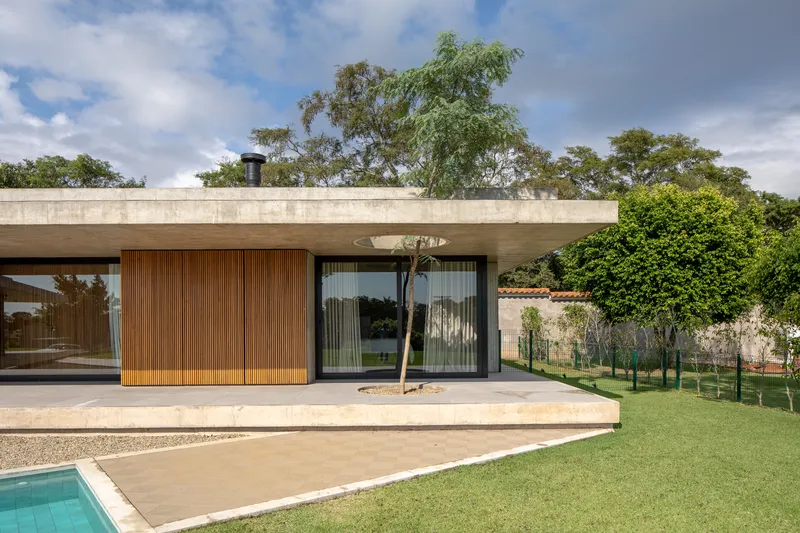
Beneath the concrete canopy, the enclosed living spaces are wrapped in vertical timber panels that shift the mood from monumental to intimate. The cladding runs floor to soffit in a consistent rhythm, interrupted only by full-height glazing that opens interiors directly to the surrounding lawn and trees. The timber reads as a warm lining tucked under the harder concrete shell, creating an almost nest-like sense of enclosure at the human scale.
The vertical grain of the timber works against the relentless horizontality of the concrete, providing just enough counterpoint to keep the elevations from feeling monotonous. Sommet appears to have been deliberate about the proportion of glass to solid: the glazed sections are wide enough to flood interiors with light and views but never so dominant that the timber volumes lose their identity as discrete objects under the floating roof.
Water, Gravel, and In-Between Spaces
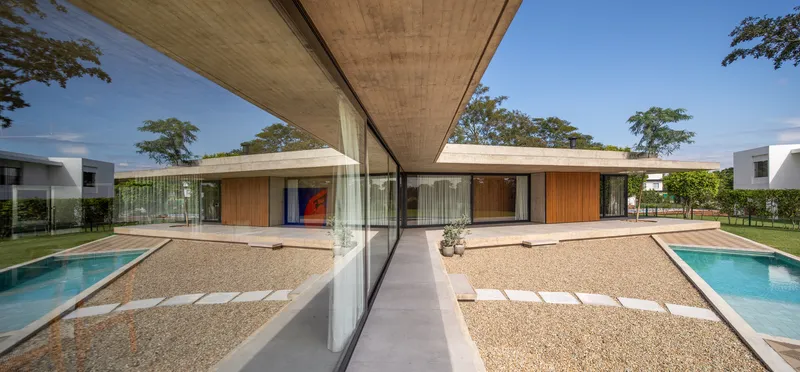
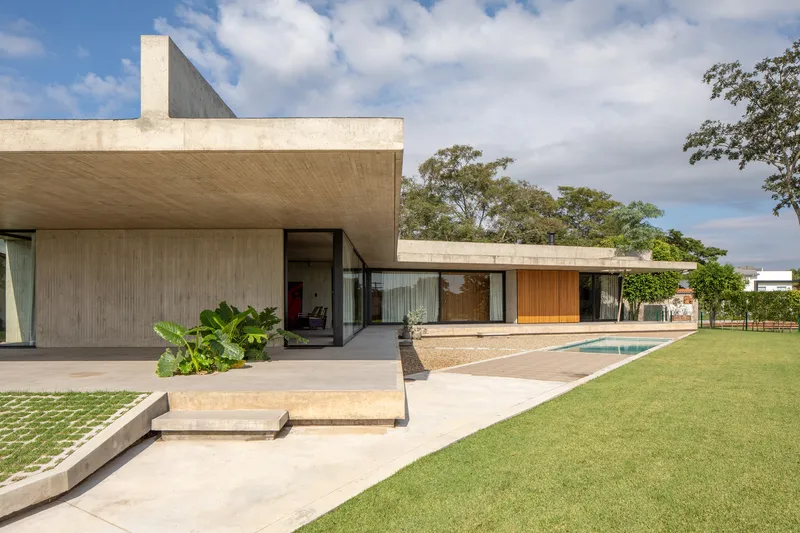
The most spatially rich moment in the house may be the glass-enclosed courtyard linking two reflecting pools beneath the cantilevered soffit. Here, the boundary between inside and outside collapses entirely. A gravel surface replaces flooring, the concrete plane overhead provides shelter without walls, and the water on either side creates a sense of floating that is genuinely disorienting in the best way. It is a space that belongs to neither the interior nor the garden, and the ambiguity is the whole point.
Tropical plantings along the pools soften the hard geometries and anchor the building in its climate. The palette of palms, broad-leafed shrubs, and ground cover is lush without being overgrown, suggesting careful curation rather than wild abandon. The partly cloudy skies captured in the reflecting pools remind you that in a house this open, weather is not something you observe from inside; it is a constant companion.
The Covered Terrace as Living Room
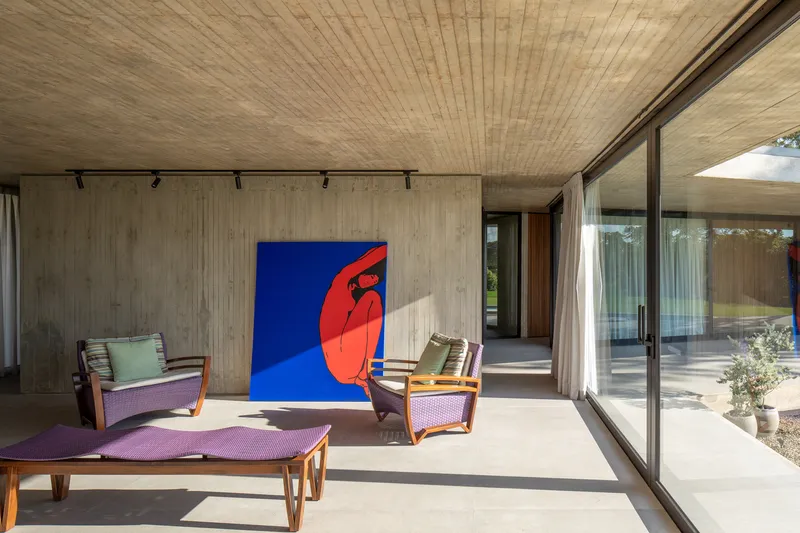
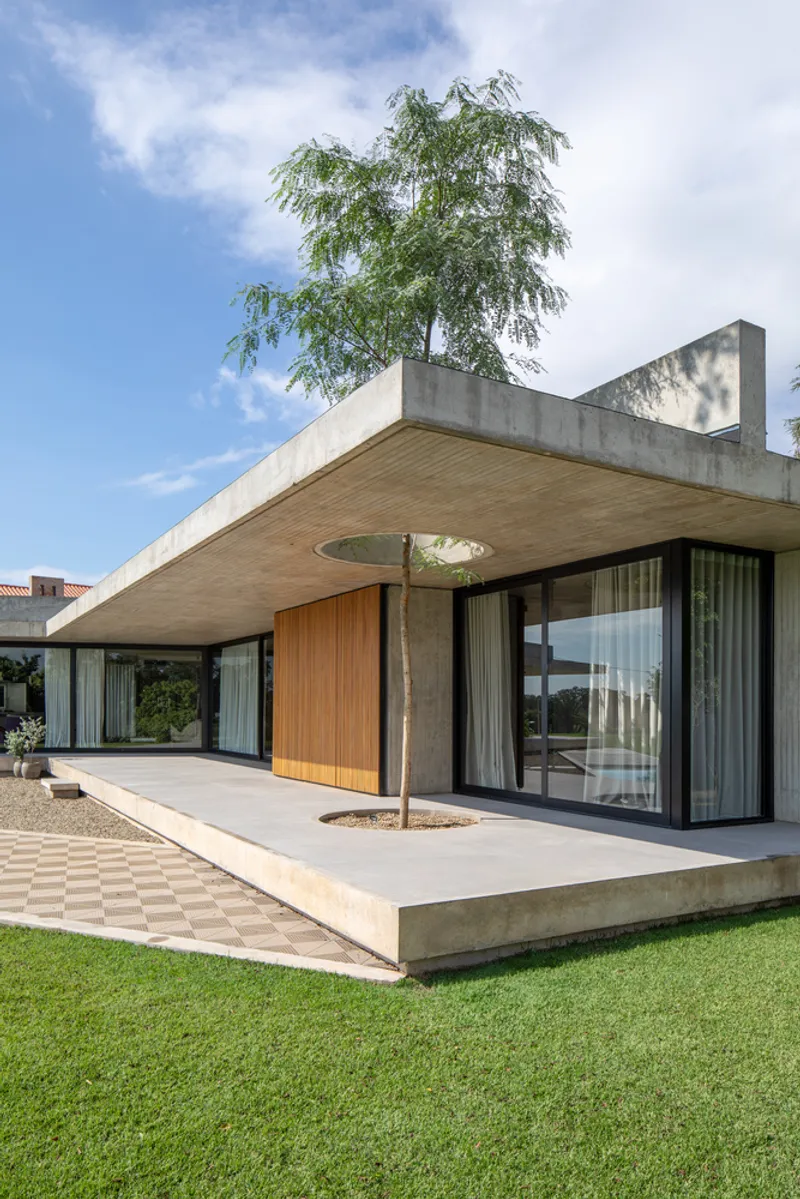
Under the deep board-formed concrete ceiling of the covered terrace, timber louvers filter light and frame a vibrant red and blue artwork that injects the only real burst of color into the project. The artwork does serious spatial work here: it stops the eye, anchors the long horizontal space, and provides a focal point that keeps the terrace from feeling like a mere corridor. The decision to place art in an outdoor room rather than a gallery-white interior signals that Sommet considers these covered outdoor spaces as primary living zones, not secondary appendages.
Equally striking is the elevated terrace where a mature tree pushes through a circular opening in the cantilevered wood soffit. The detail is surgical: the cutout is precisely sized, the tree's canopy rises above the roof plane, and the effect is of the architecture yielding to nature in a controlled, almost ceremonial way. It is a well-worn move in tropical modernism, but execution matters, and Sommet gets it right. The tree becomes a column, the opening becomes a skylight, and the terrace becomes a room with a living ceiling.
Why This Project Matters
The Pages Residence is not trying to reinvent the tropical house. Its lineage is clear: the cantilevered planes recall mid-century Brazilian modernism, the timber warmth nods to Southeast Asian pavilion traditions, and the reflecting pools are as old as courtyard architecture itself. What Sommet contributes is discipline. Every material junction, every proportion, and every threshold between inside and outside is handled with a consistency that elevates the project above the decorative minimalism that saturates residential design today.
More importantly, the house demonstrates that a restricted material palette does not have to produce sterile or cold environments. The interplay of concrete mass, timber warmth, water reflection, and lush planting creates a sensory richness that comes from spatial composition rather than surface treatment. For architects working in warm climates with generous sites, the Pages Residence is a useful reminder that the most powerful tool is not a new material or a parametric form; it is the roof plane, extended far enough to make living outdoors not just possible but preferable.
The Pages Residence by Sommet.
About the Studio
Share Your Own Work on uni.xyz
If projects like this are the kind of work you want to make, uni.xyz is a place to publish your own, find collaborators, and enter design competitions.



Popular Articles
Popular articles from the community


Hill & Cross Opera: Sculptural Opera House Architecture Shaped by Tallinn’s Landscape and Identity
Hill & Cross Opera reimagines opera house architecture in Tallinn through its sculptural hill, civic plaza, glass wave and a luminous cross.

Conexión: Biophilic Design Reimagines High-Rise Living in Hong Kong
Conexión reimagines high-rise living in Hong Kong through biophilic design, green facades, shared spaces, daylight, water and nature within.

The Ocean Hive: Sustainable Architecture for a Self-Sufficient Civilization at Sea
The Ocean Hive imagines sustainable architecture at sea, where modular habitats, algae, wave power and ocean waste sustain a growing colony.

Lunar Spiral: Space Architecture Shaped by the Mathematics of the Universe
Lunar Spiral reimagines space architecture through Fibonacci geometry, lunar regolith, levitating habitats, and self-sustaining Moon living.

Similar Reads
You might also enjoy these articles


Hodi-Mandai Geram
Project Function: Preservation and revitalization of the Intangible heritage and socio-spatial identity of the Hodi by Housing, Cultural Memory Center, Sacred Grove, landscape, local tourism economy


Olio Towers: A Mid-Rise for Performers That Fuses Housing, Rehearsal, and Stage
Located blocks from Houston's Theater District, this modular tower stacks living units around a central performance atrium.

Oasis: Modular Green Housing Carved into Dhaka's Urban Fabric
A shortlisted Plugin Housing entry reclaims unauthorized settlements in Dhaka with stepped concrete volumes, green roofs, and ventilation-driven design.

Black Hole: A Floating Megastructure for the Post-Physical Era
Emiliano Mazzarotto envisions a spherical, self-scaling arena where e-sports, digital hotels, and holographic stadiums replace traditional public space.


Explore Minimalism Competitions
Discover active competitions in this discipline



Challenge to reimagine the Iron Throne


Photograph architecture without architects


Illustrate the lost glory of Angkor Wat - Render Challenge


Design challenge to reuse E-waste
Comments (0)
Please login or sign up to add comments
No comments yet. Be the first to comment!