

The Park Collective: Deconstructing Connaught Place into Ecology, Culture, and Commerce
A modular reimagining of Central Park as a multifunctional urban landscape with geodesic domes, green corridors, and subterranean program layers.


What happens when you refuse to treat a park as a passive green rectangle? At the geographic and symbolic heart of New Delhi's Connaught Place, Central Park has long functioned as a transit hub, political gathering ground, and festival venue all at once. The Park Collective takes that multiplicity seriously, systematically breaking the park apart into distinct functional zones and then stitching them back together through green corridors, geodesic structures, and layered program spaces that extend both above and below grade.
Conceived by Amod Nargund, Danay Kamdar, and Pranay Khanchandani, this shortlisted entry for the Neo-Delhi competition envisions a park that is not static but adaptive, designed around modularity and flexibility so it can respond to the city's shifting needs over time. Rather than preserving the site as a green enclave surrounded by urban pressure, the designers propose a symbiotic framework where ecology, culture, and commerce coexist in tightly interwoven layers.
Geodesic Domes and Arched Pavilions Define a New Ground Plane
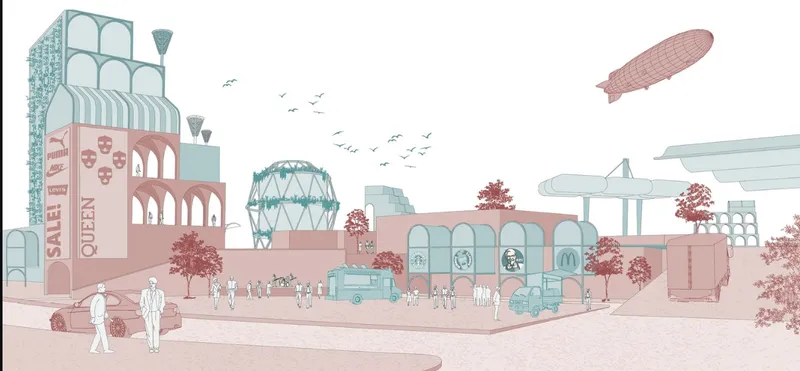

The perspective rendering immediately establishes the project's ambition: a mixed-use plaza anchored by a geodesic dome, flanked by arched pavilions, and populated with pedestrians moving through what feels more like a curated public living room than a conventional park. There is a playful surrealism here, a dirigible floating overhead as if to signal that the project belongs to a speculative future. The tiered public steps and canopy structures visible in the streetscape view reinforce the idea that this ground plane is not flat but actively sculpted to create moments of gathering, rest, and performance at multiple elevations.
Four Domes, One System: Reading the Aerial Plan
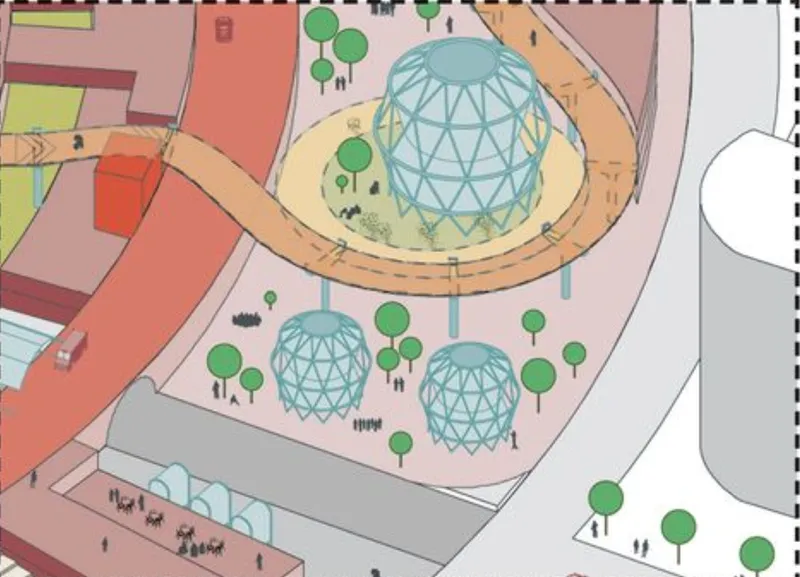

Seen from above, the organizational logic becomes clear. Four geodesic dome structures are arranged within the public plaza, surrounded by a matrix of trees that maintains the park's ecological footprint even as built form densifies the site. The paired axonometric drawings illustrate how the same site can accommodate two distinct configurations: open plazas for large gatherings and low pavilion clusters for more intimate cultural programming. This is the modularity the designers describe, a spatial system flexible enough to toggle between festival mode and everyday mode without requiring physical reconstruction.
Exploded Layers Reveal the Depth of Program

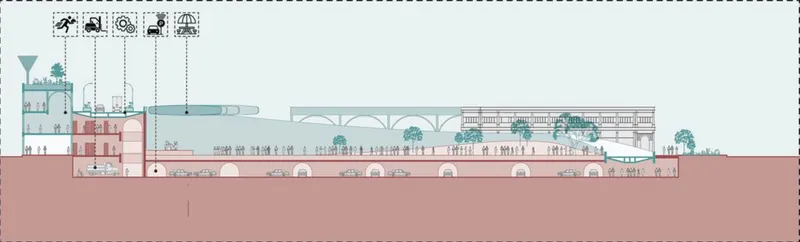
The exploded axonometric is the project's most revealing drawing. It peels apart the canopy, dome, and planted courtyard areas to show how program is stacked vertically rather than spread horizontally across the site. This vertical integration is what allows the park to remain green at grade while accommodating commerce and cultural infrastructure underneath and within the dome envelopes. The accompanying section drawing confirms this: arched subterranean spaces house program below the street-level plaza, while an elevated colonnade lined with trees creates a shaded promenade above. The section reveals a park with genuine architectural depth, not just landscape veneer laid over structure.
Bridges, Terraces, and Circulation Loops as Connective Tissue
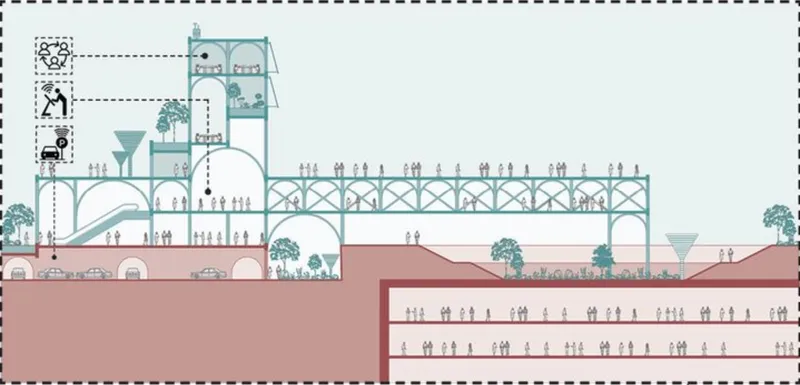
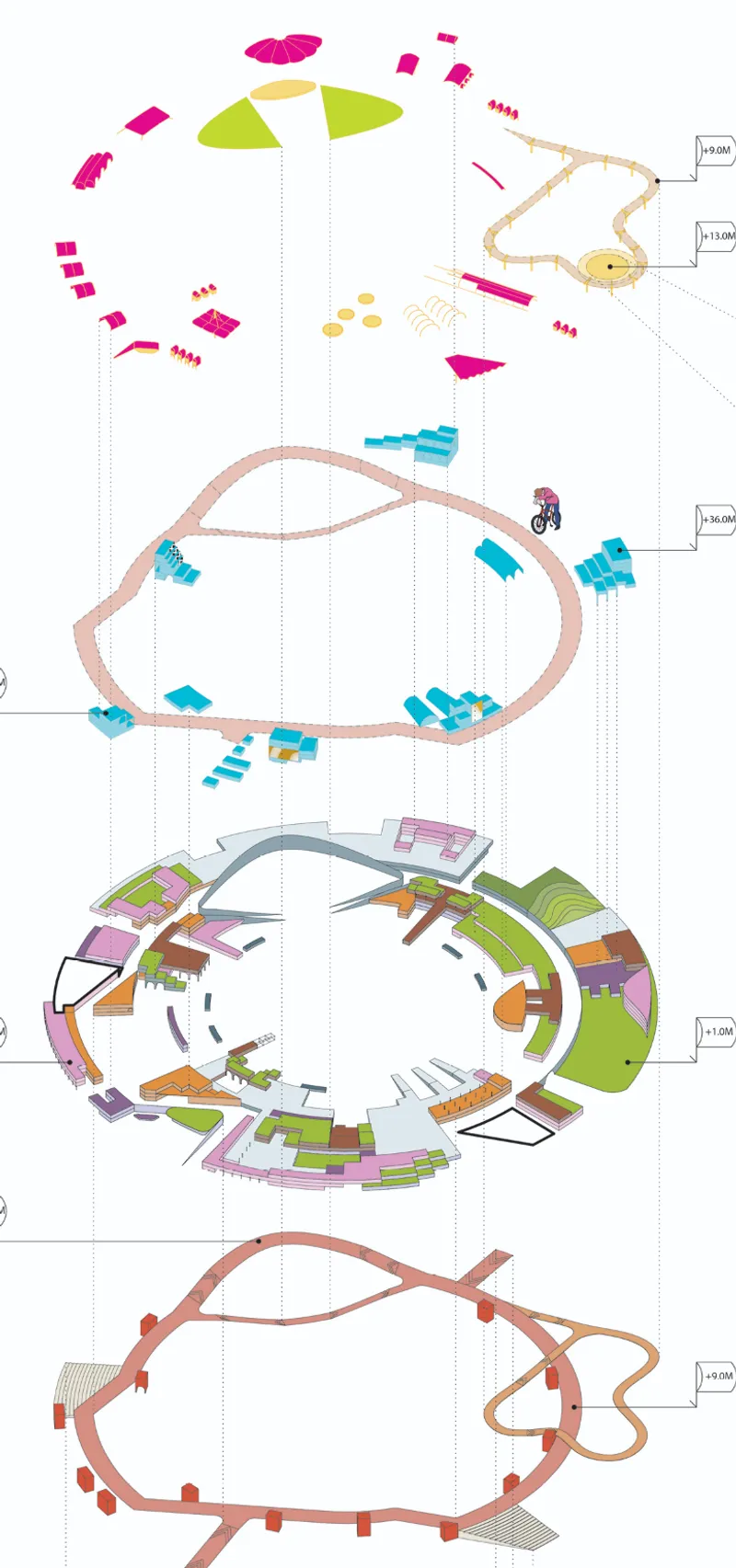
A second section drawing introduces an elevated pedestrian bridge that spans across different terraced levels, physically connecting zones that the plan keeps functionally distinct. It is this connective tissue that transforms a collection of pavilions and domes into a coherent public landscape. The stacked axonometric floor plans make the circulation strategy explicit: four different loops, each color-coded to a program zone, weave through the site at various levels. The result is a park where movement itself becomes the primary experience, where you are never simply crossing through but always choosing among routes that expose you to different activities and atmospheres.
Why This Project Matters
The Park Collective confronts a tension that most urban parks avoid acknowledging: the demand on centrally located open space to perform too many roles simultaneously. By deconstructing the park into layered, modular components, the designers demonstrate that density and greenery are not inherently opposed. Subterranean program, elevated walkways, and geodesic enclosures each claim specific roles, freeing the ground plane to remain genuinely public and genuinely planted.
For a site as symbolically loaded as Connaught Place's Central Park, this is a bold proposition. It asks Delhi to see its most central green space not as a heritage object to be preserved in amber, but as a living system capable of absorbing new functions as the city evolves. The shortlisted entry for Neo-Delhi succeeds because it treats flexibility not as vagueness but as a designed condition, with clear structural and circulatory logic supporting every future adaptation.
View the Full Project
About the Designers
Designers: Amod Nargund, Danay Kamdar, Pranay Khanchandani
Enter a Design Competition on uni.xyz
uni.xyz runs architecture and design competitions year-round that reward proposals with spatial conviction and real site intelligence.
Project credits: The Park Collective by Amod Nargund, Danay Kamdar, Pranay Khanchandani Neo-Delhi (uni.xyz).



Popular Articles
Popular articles from the community


Co-life: Sustainable Architecture for Age-Friendly Community Living
Co-life reimagines sustainable architecture for seniors through courtyards, rammed earth, shared gardens, and spaces designed for belonging.

The Musturak Paradise: Senior Living Architecture for a Connected Future in Temara, Morocco
The Musturak Paradise reimagines senior living architecture in Temara via private homes, social spaces, culture, community, and shared care.

Play: Fragments of Their World
Familiar architecture becomes modular playground design, creating safe spaces where displaced children can learn, connect, imagine and play.

Conexión: Biophilic Design Reimagines High-Rise Living in Hong Kong
Conexión reimagines high-rise living in Hong Kong through biophilic design, green facades, shared spaces, daylight, water and nature within.

Similar Reads
You might also enjoy these articles

Day and Night Park: A Time-Based Urban Newsstand in Beijing
A temporary urban newsstand in Beijing blending travel, light, and reading through poetic colors, compact form, and community-focused design.

Modernist Patio Renovation in El Masnou, Barcelona by Oliver Segura Arquitectura + Cebrià Arquitectura
Modernist patio renovation blending tradition and innovation with a movable pool, leveled floors, and Catalan materials in El Masnou.

Alto Residencial Coop: Cooperative Housing Development in Santiago de Compostela by Carbajo Barrios Arquitectos
A linear cooperative housing complex blending white volumes and perforated metal façades, enhancing community living, natural light, privacy, and urban integration.
Vil Genis School by BPA ARCHITECTURE – Massy, France
Vil Genis School in Massy, France, features sustainable design, south-facing classrooms, community integration, accessible spaces, and modern educational architecture.

Comments (0)
Please login or sign up to add comments
No comments yet. Be the first to comment!