

The Prometheus Mission
A Speculative Future

Q1 - WHAT WAS THE CONCEPT BEHIND THE PROJECT?
When we imagine the future of space settlement, usually it relates to those described in science fiction - high-tech futuristic environments inhabited by non-human entities, completed with robots and estranged beeps from the machine. However, this vision seldom reflects our collective memory, culture, and history. Inspired by Fleafolly’s visionary project - Modern Prometheus, this project envisions a timeless monument as our first settlement on the moon, one that both draws from the past and informs the future. Variates from the mythical figure - the Tower of Babel, and fabricated with advanced technology of the near future, the monument acts as a metaphor that reminds us to contemplate our relationship with technology.
Q2 - WHAT WAS THE INTENT BEHIND THE ORGANIZATION OF ELEMENTS ACROSS VARIOUS LEVELS (ARCHITECTURAL, SITE, URBAN)?
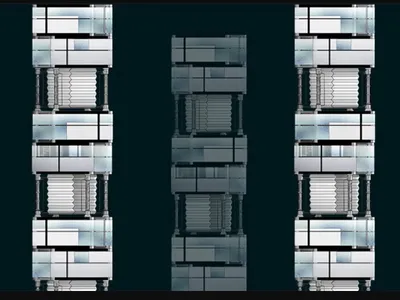
The tower gradually evolved with human colonization on the moon. Each layer of the ‘ring’ of the tower consists of multiple prefabricated modular sustained basic needs on the planet. The elements are replaceable and are growing with the expansion of population and rising demands of the settlement. New layers of the ‘ring’ will be attached to the main core of the tower to adapt to new use.
Q3 & Q4 - HOW MANY ITERATIONS WERE TRIED TO ARRIVE AT THE FINAL OUTCOME? WHICH METHODS OF DESIGN INVESTIGATION?
The design has been iterated three times. The original proposal featured a non-Euclidean space rooted in scientific imagination. However, after conducting further research, I opted for a more timeless approach. It was crucial for me to consider the information and messages conveyed by this project - do we need yet another high-tech megastructure that colonizes the moon, another sci-fi imagination, or something that has the power to reflect on our current condition that concerning the future? I chose to express a symbolic meaning and its cultural significance, which is not limited to Western culture but also aligns with common forms found in creation myths from various other cultures. This approach speculates and constructs a new type of metaphorical relationship between us and the re-imagined future.
Q5 & Q7 - HOW WAS THE PROGRAMME CONDENSED INTO FINAL? HOW WAS A SPECIFIC OBJECTIVE ATTEMPTED TO BE MET?
The Main Tower is a monumental structure situated at the center of the site. Located in the South Pole Craters, It was designed with layers of prefabricated ‘rings’ that allow continuous vertical and three-dimensional expansion.
Each ‘ring’ layer serves as a hub for essential collective human activities, which contains a communication center, a space-safe time capsule, a living area, hydroponic farms, and an integrated artificial lighting system to maintain human and agricultural activities. A quantum computation center is located at the bottom of the settlement and equipped with the most advanced computation power to support the ongoing research and archives for a time capsule that stores the human legacy of arts, culture, and collective memories.
Over time, the tower will evolve and transform through the phases of human settlement along the space colonization, ultimately becoming the first monument commemorating human presence on the moon.
Q6 - WHAT/HOW WERE THE MATERIALS CHOSEN?
To adapt to the environmental condition of the moon, the modules are prefabricated with high-resistance metal. In order to minimize material waste and facilitate rapid use and replacement, interior shells are constructed from the same material and modularity principle, partially incorporating soft fabric finishes. Hologram projections are deployed on the windows to simulate familiar environments, landscapes, and artificial lighting that cater to human needs.
Q8 & Q9 - WHAT IS THE EXPANSION PLAN OF THE PROJECT? HOW WILL THE PROJECT TRANSFORM WITH THE PASSING TIME?
The Main Tower of the project will progressively evolve into a monument symbolizing human settlement on the moon. The space will undergo a transformation, becoming an archive of history, technology, and culture, while also serving as a research base for future expansions. Surrounding this core, new settlements will emerge and gradually coalesce into a town or city, drawing inspiration from the city typology that gradually evolved around cathedrals or mosques. As technology continues to advance, achieving self-sufficiency within each settlement will become more attainable. In its evolving phases, the city will organically formalize without the need for planning or intervention, retaining a somewhat ‘formless’ yet highly adaptable character.

Popular Articles
Popular articles from the community


Opera on the Sea: Driftwood Logic Shapes a Timber Opera House on Estonia's Coast
Trevor Orgill's opera house translates the entangled drift of floating timber into a civic building where wood, water, and music converge.

Extended Shell: Retrofitting Kolkata's Balconies as Living Urban Thresholds
A modular retrofit system recovers the social and environmental intelligence of Kolkata's historic verandas for contemporary Park Street residents.

Faces of the Soviet Avant-Garde: Turning Moscow's Street Names into an Open-Air Museum
A network of sculptural installations across a Moscow residential district transforms forgotten architect names into spatial encounters with cultural memor
Tsunami Convergenics: Turning Catastrophic Ocean Forces into Underwater Housing Infrastructure
A speculative underwater settlement off the coast of Onagawa, Japan, treats tsunamis and typhoons as energy sources rather than threats.

Similar Reads
You might also enjoy these articles

Day and Night Park: A Time-Based Urban Newsstand in Beijing
A temporary urban newsstand in Beijing blending travel, light, and reading through poetic colors, compact form, and community-focused design.

Modernist Patio Renovation in El Masnou, Barcelona by Oliver Segura Arquitectura + Cebrià Arquitectura
Modernist patio renovation blending tradition and innovation with a movable pool, leveled floors, and Catalan materials in El Masnou.

Alto Residencial Coop: Cooperative Housing Development in Santiago de Compostela by Carbajo Barrios Arquitectos
A linear cooperative housing complex blending white volumes and perforated metal façades, enhancing community living, natural light, privacy, and urban integration.

Vil Genis School by BPA ARCHITECTURE – Massy, France
Vil Genis School in Massy, France, features sustainable design, south-facing classrooms, community integration, accessible spaces, and modern educational architecture.

Comments (0)
Please login or sign up to add comments
No comments yet. Be the first to comment!